

NCERT Solutions for Class 9 Social Science Part 2 Chapter 5 Managing Your Personal Finances are provided here with simple and easy-to-understand explanations. Based on the NCERT textbook Understanding Society: India and Beyond Part 2, this chapter introduces budgeting, saving, borrowing, and making thoughtful decisions about money. These NCERT Solutions for Class 9 help students understand important concepts, complete textbook activities, and revise the chapter for school examinations.
Managing Your Personal Finances Class 9 Questions and Answers
The Big Questions (Page No. 108)
Question 1: What is personal finance, and why is it important?
Answer: Personal finance refers to the planning and management of an individual’s money to meet their needs and wants. It involves decisions about earning, spending, saving, investing, and protecting money.
It is important because it helps people control unnecessary expenses, live within their means, prepare for emergencies, and achieve goals such as higher education or buying a house. Wise financial management builds financial security and independence.
Question 2: What are the pillars of personal finance?
Answer: The five pillars of personal finance are:
- Income: Money received through salary, business, rent, interest, or other sources.
- Budgeting: Planning how much money to spend and save.
- Saving: Setting aside part of one’s income for future needs and emergencies.
- Investing: Putting savings into assets to protect their value and earn returns.
- Protection and risk management: Safeguarding income, savings, and assets through insurance and responsible debt management.
Question 3: What are some common ways to save and invest money?
Answer: Some common ways to save and invest money are:
- Set aside part of one’s income regularly for future needs and emergencies.
- Deposit money in fixed deposits with banks or post offices to earn a fixed rate of interest.
- Use government-backed savings schemes such as PPF, NSC, and Sukanya Samriddhi Yojana.
- Buy bonds, which involve lending money to governments or companies in return for interest.
- Invest in shares to become a part-owner of a company and potentially earn dividends and gains from rising share prices.
- Invest in mutual funds, which pool investors’ money and spread it across different financial assets.
Question 4: How can we protect our savings and assets?
Answer: We can protect our savings and assets in the following ways:
- Buy suitable insurance to reduce financial losses caused by illness, accidents, death, or property damage.
- Keep savings for emergencies so that unexpected expenses do not exhaust money meant for other needs.
- Spread investments across different assets to reduce risk.
- Choose investments according to financial goals, risk tolerance, and when the money will be needed.
- Borrow only when necessary and repay loans on time to avoid an excessive debt burden.
Question 5: What is income tax?
Answer: Income tax is a direct tax paid to the government on the income earned by a person or organisation during a financial year. It helps fund public services such as schools, hospitals, roads, and defence. Individuals whose income falls below the prescribed exemption limit do not have to pay it.
Let’s Explore (Page No – 112)
Question: In Fig. 5.4 above, the curves are flatter in the beginning and tend to become steeper in the later years. Why do you think that happens?
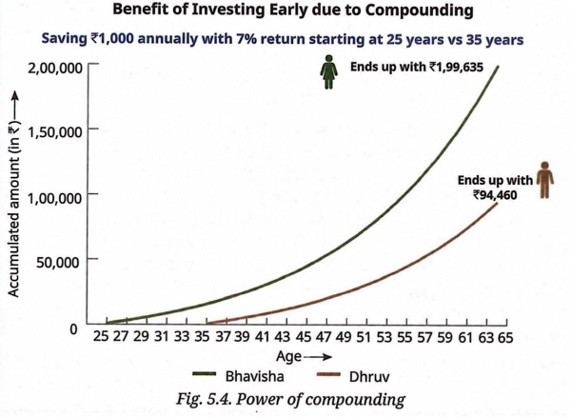
Answer: Initially, the accumulated balance is small, so earnings are modest. Later, new contributions and earlier earnings both earn further returns. At the same percentage rate, the larger balance produces a larger rupee return, so growth accelerates and the curves steepen. Starting at 25 also gives Bhavisha ten more years of contributions and compounding than Dhruv.
Stock Market Discussion (Page No. 114)
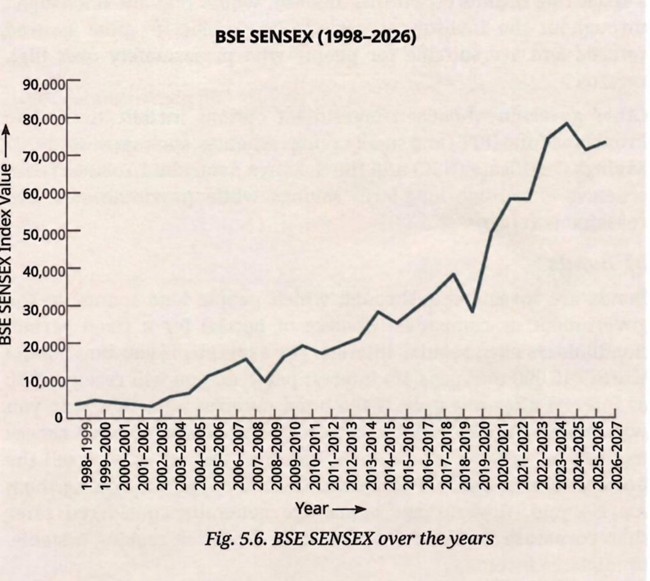
Question 1: Look at the graph that displays the performance of BSE SENSEX over the years. It fluctuates over short time periods; however, it can go up significantly in the long run. Why do you think these fluctuations happen? Discuss possible reasons with your classmates and find out more from newspapers, the internet, or by speaking to your family members.
Answer:
- Company profits, losses and announcements affect expectations about future earnings.
- Interest rates, inflation, government decisions and the wider economy influence investors’ decisions.
- Global developments, political uncertainty and unexpected events can affect confidence.
- Changes in buying and selling pressure cause prices to move.
Over long periods, growth in businesses and the economy may support higher values, but future gains are not guaranteed. The reproduced graph is the textbook’s illustration, including its original year labels; it should not be treated as a verified current market series. For a class discussion, choose a dated news report, identify the event and explain its possible effect rather than assuming every market movement has one cause.
Questions and Activities (Page No. 121)
Question 1: Why is managing money wisely important for all individuals irrespective of their income?
Answer: Managing money wisely is important for everyone because income is limited, while needs and wants can be many. It helps individuals prioritise essential expenses, avoid unnecessary spending, and live within their means. Regular saving prepares them for emergencies, while suitable investments help achieve future goals and protect against inflation. Responsible borrowing also prevents excessive debt. Thus, careful financial planning promotes security and independence, regardless of income.
Question 2: How can budgeting help people balance their present needs with their future financial goals? Give examples.
Answer: Budgeting helps people plan how to divide their income between present expenses and future savings. It prioritises essential needs, controls unnecessary spending, and sets clear savings targets. Tracking expenses and reviewing the budget help people live within their means while working towards their goals.
For example, a family can budget for food, rent, and school fees while saving for higher education and emergencies. Similarly, saving ₹500 each month for six months can help someone buy a bicycle costing ₹3,000.
Question 3: School Reopening Budget Activity: Your parents have given you ₹3,000 to prepare for the new school year. List necessary items, find their prices and prepare a budget using the given template. Check that total expenses stay within ₹3,000. If less, you may add one item; if more, decide what to postpone or avoid.
Answer: School Reopening Budget
Total amount available: ₹3,000
| Expenses | Amount (₹) |
| School bag | 500 |
| Books | 650 |
| Uniform and shoes | 1,000 |
| Notebooks | 350 |
| Pens | 80 |
| Pencils | 40 |
| Art supplies | 180 |
| Total expenses | 2,800 |
| Additional item: Geometry box | 150 |
| Final total expenses | 2,950 |
| Savings | 50 |
The expenses remain within ₹3,000. Since the initial total is ₹2,800, I can add a geometry box costing ₹150 and still save ₹50.
Question 4: Why is saving alone often not enough to build wealth in the long run? How do investments help increase the value of money over time?
Answer: Saving alone may not build wealth in the long run because money kept as cash does not grow, while inflation reduces its purchasing power. Thus, the same amount buys fewer goods and services over time.
Investments can generate returns through interest, dividends, or an increase in asset prices. Compounding allows returns to earn further returns, helping wealth grow over time. Suitable investments may also earn returns above inflation, protecting purchasing power. However, investments involve different levels of risk, and returns are not always guaranteed.
Question 5: Investment Planning Activity: You received ₹3,000 in birthday cash gifts and decided to save ₹1,500. With your teacher, calculate possible returns from investment combinations, including ₹500 in a fixed deposit, ₹800 in stocks and ₹200 in gold. Try other combinations, consult reliable sources and explain suitability.
Answer: I would invest the saved ₹1,500 across different options rather than put it all into one investment.
For this calculation, assume one-year returns of 6% on a fixed deposit, 10% on stocks, and 8% on gold. These are illustrative rates, not current quotations or guaranteed market returns. Taxes and charges are excluded.
Return = Amount invested × Rate ÷ 100
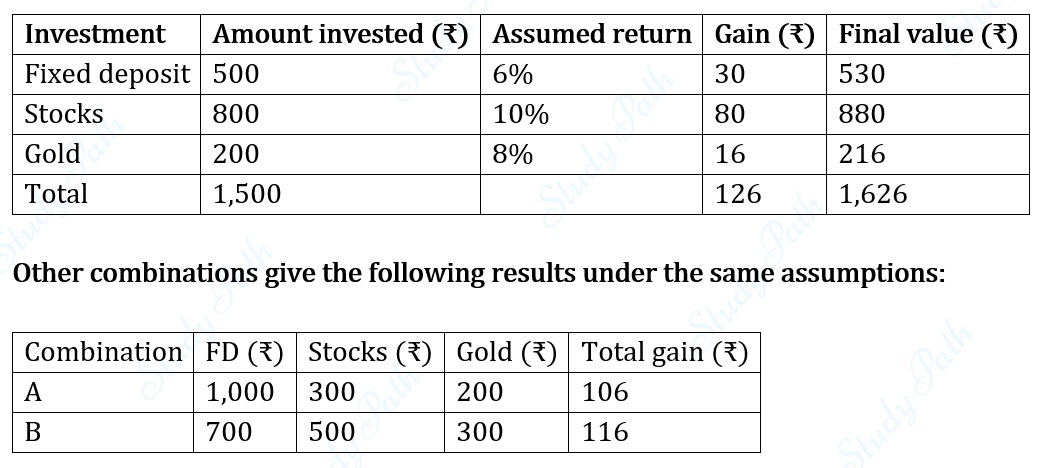
A fixed deposit provides predictable interest. Stocks offer growth potential but can lose value, making them unsuitable for money needed soon. Gold can diversify investments, although its price also fluctuates. Investment choices should match the investor’s goals, risk tolerance, and time horizon.
For a cautious classroom plan, I would choose Combination A because a larger portion earns fixed interest.
Question 6: How does inflation affect the value of money over time? Why should people consider inflation while making financial decisions?
Answer: Inflation is the rise in prices of goods and services over time. It reduces the purchasing power of money, meaning the same amount buys fewer things. For example, a school bag costing ₹1,000 today may cost ₹1,060 next year if inflation is 6%.
People should consider inflation when planning expenses, savings, and investments because future needs may cost more. Investments that earn returns above inflation can help protect purchasing power and achieve long-term financial goals.
Question 7: Different investment options involve different levels of risk and return. Do you think taking higher risks is always the best way to earn higher returns? How should a person decide which investment option is most suitable for them?
Answer: No, taking higher risks is not always the best way to earn higher returns. Higher-risk investments offer the possibility of greater returns, but they can also cause losses. Returns are not guaranteed.
A person should choose investments according to their financial goals, risk tolerance, time horizon, and liquidity needs. For example, fixed deposits may suit someone seeking safety and predictable returns, while shares may suit someone willing to accept greater risk and invest for the long term. Spreading investments across different assets can also help reduce risk.
Question 8: Why do people buy insurance policies even though they may never face a major loss? How does insurance provide financial security?
Answer: People buy insurance because unexpected events such as illness, accidents, death, or property damage can cause large financial losses. Even if such events never occur, insurance provides reassurance and protection against uncertainty.
Insurance works through risk sharing: many people pay premiums into a common pool, and the insurance company compensates those who suffer losses covered by their policies. This reduces the need to exhaust savings or borrow heavily, helping families recover from financial setbacks and maintain financial security.
Question 9: Imagine your family receives ₹1,00,000 from farming, a small business, livestock sales and savings. Help your family decide how to use it wisely by completing the budget, needs-versus-wants classification, compound-interest calculation, “Save First, Spend Later” exercise and reflections.
Answer: Do it yourself.
Class 9 Social Science Part 2 Chapter 5 NCERT Questions and Answers
The chapter Managing Your Personal Finances introduces ways of planning the use of income and meeting expenses. Students learn to distinguish needs from wants, set financial goals, and recognise the importance of saving for future requirements.
Students also explore financial services and the responsibilities associated with borrowing and managing risk. Everyday examples help them interpret financial choices and develop habits of careful planning, informed comparison, and responsible spending.