

NCERT Solutions for Class 9 Social Science Part 1 Chapter 9 The Price Puzzle: What Drives the Market are provided here with simple and easy-to-understand explanations. Based on the NCERT textbook Understanding Society: India and Beyond Part 1, this chapter introduces demand, supply, competition, and the forces that influence market prices. These NCERT Solutions for Class 9 help students understand important concepts, complete textbook activities, and revise the chapter for school examinations.
The Price Puzzle: What Drives the Market Class 9 Questions and Answers
The Big Questions (NCERT Textbook Page no. 162)
1: What are the factors that influence the demand and supply of goods and services in a market?
Answer: The demand for goods and services is influenced by factors such as price, income, tastes and preferences, prices of related goods, population, seasonality and future price expectations. Supply is influenced by price, prices of related goods, number of sellers, technology and future expectations. Changes in these factors affect the quantity buyers demand and sellers are willing to supply. These factors determine the quantity available and the price of goods in a market.
2: How are prices of goods and services determined through demand and supply interactions?
Answer: Prices of goods and services are determined by the interaction of demand and supply. When demand is greater than supply, there is excess demand and prices tend to rise. When supply is greater than demand, there is excess supply and prices tend to fall. The price at which quantity demanded equals quantity supplied is called the market equilibrium price.
3: What is market equilibrium, and does it exist in the real world?
Answer: Market equilibrium is the situation where the quantity demanded by consumers equals the quantity supplied by producers. At this point, there is neither excess demand (shortage) nor excess supply (surplus), so there is no immediate pressure for prices to change. In the real world, perfect equilibrium may not always exist due to changes in demand, supply, costs, and other factors. However, markets continuously adjust to reach near-equilibrium conditions.
However, in the real world, market equilibrium is not permanent or stable. Markets are dynamic, and conditions keep changing due to factors such as technology, wages, interest rates, wars, political events, pandemics, weather and natural disasters. As a result, markets are constantly adjusting towards a new equilibrium rather than remaining at one fixed point.
4: How and why does the government intervene in the market?
Answer: The government intervenes in the market to ensure fair competition, protect consumers, and maintain economic stability. It regulates prices of essential goods, controls unfair trade practices, provides subsidies, and collects taxes. The government also supports public services like healthcare, education, and infrastructure. Intervention is necessary because markets may sometimes fail to provide equal opportunities or protect weaker sections of society. Through these measures, the government promotes balanced economic growth and social welfare.
The Big Questions (NCERT Textbook Page no. 203)
Question: What happens to the supply of a product in case of a change in the cost of inputs for production, discovery or depletion of resources, weather, disaster, etc.? Discuss in class using examples of diverse goods and services.
Answer: A change in the cost or availability of inputs can change the supply of a product. If input costs rise, production becomes more expensive and supply may decrease. If resources become available or technology improves, supply can increase. Weather conditions and natural disasters can also reduce supply, especially of agricultural products.
Questions and activities (NCERT Textbook Page no. 210-213)
1: An increase in income always leads to a rise in demand for goods. Defend or refute, giving reasons for the same.
Answer: The statement is not always true. An increase in income generally increases the demand for several goods because consumers can afford to buy more or choose better-quality products. However, demand also depends on tastes, preferences, prices of related goods, seasonality and population. Therefore, higher income can increase demand, but it does not necessarily increase demand for every good.
2: If petrol prices double, what happens to-
(a) Demand for diesel cars
(b) Demand for electric cars
(c) Demand for car accessories
(d) Demand for public transport
Answer: If petrol prices double:
(a) Demand for diesel cars likely to increase, as some consumers may shift from petrol cars to diesel cars.
(b) Demand for electric cars likely to increase, as electric cars become relatively more attractive.
(c) Demand for car accessories may decrease, if fewer people buy or use conventional cars.
(d) The demand for public transport is likely to increase because a rise in petrol prices makes travelling by private petrol vehicles more expensive.
3: A farmer traditionally irrigates fields manually (labour-intensive). He installs drip irrigation (a technology upgrade) that reduces water use by 40%40% and increases yield by 30%30%. How does this affect-
(a) His cost of production
(b) His willingness to supply at different prices
(c) The overall market supply if many farmers adopt this technology
Answer: The use of drip irrigation is a technology improvement that affects the supply of agricultural products.
(a) Cost of production: It is likely to decrease because drip irrigation reduces water use and can make production more efficient.
(b) Willingness to supply: The farmer is likely to be willing to supply more at different prices, as improved technology reduces production costs and increases output.
(c) Market supply: If many farmers adopt it, overall market supply will increase because production rises.
4: During online festival sales, the prices of many products are very low. Use the concept of demand and supply to explain why the sellers sell at such a low price. What happens to the equilibrium when the price is lowered? Does this benefit only consumers or sellers as well? Explain.
Answer: During online festival sales, sellers may reduce prices to increase demand and attract more consumers. According to the law of demand, when the price of a product falls, its quantity demanded generally increases.
If the price is lowered below the existing equilibrium price, quantity demanded may become greater than quantity supplied, creating excess demand or a shortage. This creates pressure in the market for the price and quantity supplied to adjust towards a new equilibrium.
The lower prices benefit consumers because they can buy products at cheaper prices. Sellers can also benefit because higher sales may help them increase their total revenue and clear their stock. Thus, festival discounts can benefit both consumers and sellers.
5: Suppose the government sets a maximum sale price for an essential vaccine below the market-driven price. What is likely to happen? Choose from the options below and elucidate your point.
(a) Surplus
(b) Shortage
(c) No effect
(d) Fall in demand
Answer: (b) Shortage
Explanation: A maximum sale price below the market-driven price is called a price ceiling. When the government sets the price below the equilibrium price, consumers want to buy more because the vaccine is cheaper, while producers may be willing to supply less. Therefore, quantity demanded becomes greater than quantity supplied, creating a shortage.
6: The government levies higher taxes on products such as tobacco and alcohol to promote healthier choices among citizens. Can you find out other goods where price controls have been set in place? What are the reasons for the same?
Answer: Governments use price controls and taxes to protect public welfare and regulate markets. Besides tobacco and alcohol, price controls are often applied to essential goods like medicines, food grains, cooking gas, and electricity.
During the COVID-19 pandemic, demand for sanitisers increased sharply, leading to shortages and rising prices. The government declared sanitisers essential commodities and capped the maximum retail price at ₹100 for a 200 ml bottle to prevent hoarding and black-marketing.
7: Can excessive government regulation hurt markets? Explain with suitable examples.
Answer: Yes, excessive government regulation can hurt markets. While government intervention is important to protect consumers and ensure fairness, too much regulation may distort market outcomes and reduce the benefits of competition.
If the government fixes a price below the market price, producers may receive less than they would in a free market. This can reduce their motivation to produce, leading to lower production and shortages. For example, if wheat is priced at ₹20 per kg when the market price is ₹30, farmers may reduce production.
Too many licences, permits and compliance procedures can also increase costs and make it difficult for businesses, especially small enterprises, to operate. For example, a small restaurant may need several permissions related to food safety, fire safety, pollution control and local clearances.
Therefore, government regulation is important for fairness and consumer protection, but excessive regulation can reduce production incentives, increase costs and restrict businesses. The government should aim for a balanced approach that protects society while allowing markets to function efficiently.
8: In the table below, different prices of guava are given,
(a) Think and write how much guava you will buy at each price.
(b) Ask the same question to three of your friends and fill in the table.
(c) Also make a graph for each one of you and one final graph for the total quantity.
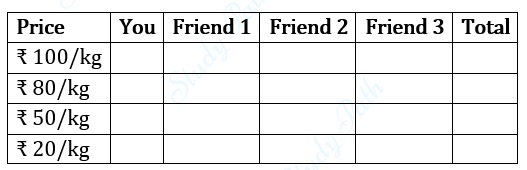
Answer: Do it yourself.
9: Visit the nearby vegetable market and try to find answers to the following questions.
(a) Who decides the prices of different vegetables in the vegetable market?
(b) Sometimes the prices of a few vegetables is too high, and sometimes too low. Why is this?
(c) The price of tomatoes is high in the morning and eventually gets lower by the evening. Have you ever noticed this? Comment.
Answer: (a) The prices are mainly determined through the interaction of demand and supply. Sellers consider their costs and the prices at which buyers are willing to purchase, while competition among sellers also influences the final price.
(b) Vegetable prices change when demand or supply changes. For example, poor weather or a natural disaster may reduce supply and increase prices. If supply is plentiful while demand is low, prices may fall.
(c) Yes, this can happen. As the day progresses, sellers may reduce prices to sell the remaining tomatoes before the market closes, especially if tomatoes are perishable. A lower price can attract more buyers and help sellers avoid wastage. This illustrates how prices can change as market conditions and supply-demand conditions change.
10: Categorise the following combination of goods into substitute goods and complementary goods.
(a) Movie ticket in the cinema hall and popcorn
(b) Eraser and pencil
(c) Laptop and computer
(d) Air Conditioner and cooler
(e) Notebook and pen
(f) Apple and banana
(g) Mobile and earphones
Answer: Substitute Goods: Goods that can replace each other and satisfy similar needs.
- Laptop and computer
- Air Conditioner and cooler
- Apple and banana
Complementary Goods: Goods that are used together and increase each other’s usefulness.
- Movie ticket in the cinema hall and popcorn
- Eraser and pencil
- Notebook and pen
- Mobile and earphones
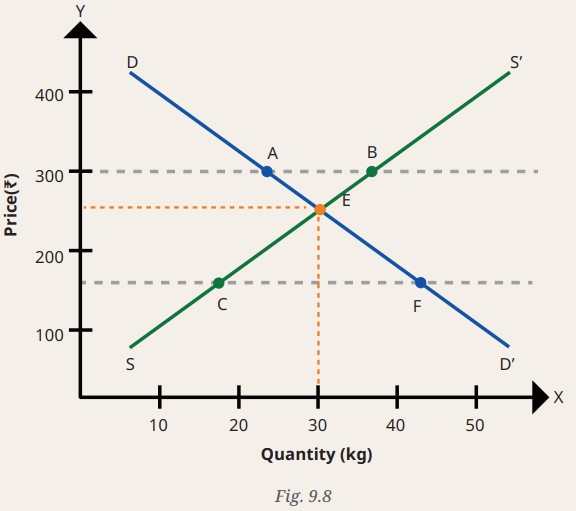
11: Figure shows the demand curve DD’ and Supply curve SS’. Based on the figure, answer the following questions:
(a) What does point E represent in this market?
(b) What is the equilibrium price and equilibrium quantity at point E?
(c) Point A lies on DD’. Point B lies on SS’. What do the points A and B indicate about demand and supply? What does the gap between A and B (both on the upper dashed price line) represent?
(d) Point F lies on DD’. Point C lies on SS’. What do the points F and C indicate about demand and supply? What does the gap between C and F (both on the lower dashed price line) represent?
(e) If the price stays at the lower dashed line, what could happen next in a free market?
Answer: (a) Point E represents the market equilibrium, where the quantity demanded is equal to the quantity supplied.
(b) The equilibrium price is ₹250, and the equilibrium quantity is 30 kg.
(c) At the upper dashed price line (₹300), Point A on the demand curve shows the quantity demanded (about 25 kg), while Point B on the supply curve shows the quantity supplied (about 37 kg). Since supply is greater than demand, the gap between A and B represents excess supply (surplus).
(d) At the lower dashed price line (about ₹170), Point F on the demand curve shows the quantity demanded (about 43 kg), while Point C on the supply curve shows the quantity supplied (about 18 kg). Since demand is greater than supply, the gap between C and F represents excess demand (shortage).
(e) If the price remains at the lower dashed line, there will be excess demand. As many buyers compete for the limited supply, sellers are likely to increase the price. The price will continue to rise until it reaches the equilibrium price of ₹250, where demand and supply become equal.
12. Draw a market equilibrium graph using the following demand schedule.
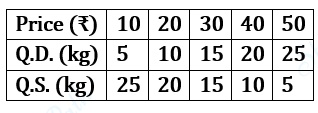
(a) Plot the demand and supply curve using the above data.
(b) Identify the equilibrium price and quantity.
(c) Observe the above data and analyse what happens if the price is set at ₹20 or ₹40.
Answer: (a) Plotting Price on the Y-axis and Quantity on the X-axis:
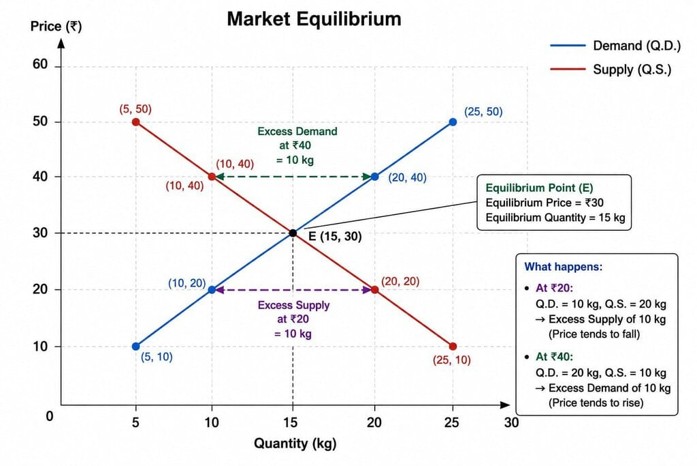
(b) Equilibrium Price and Quantity:
- Equilibrium occurs where quantity demanded equals quantity supplied.
- From the table, at ₹30, both Q.D. and Q.S. are 15 kg.
- Therefore, the equilibrium price is ₹30 and the equilibrium quantity is 15 kg.
(c) Analysis at ₹20 and ₹40:
At ₹20:
Quantity Demanded = 10 kg and Quantity Supplied = 20 kg. Since supply is greater than demand, there is excess supply (surplus) of 10 kg. Sellers may reduce the price to sell the excess stock and the market will move towards the equilibrium price of ₹30.
At ₹40:
Quantity Demanded = 20 kg and Quantity Supplied = 10 kg. Since demand is greater than supply, there is excess demand (shortage) of 10 kg. Buyers will compete to buy the product, causing the price to rise until it reaches the equilibrium price of ₹30.
Class 9 Social Science Part 1 Chapter 9 NCERT Questions and Answers
The chapter The Price Puzzle: What Drives the Market explores how buyers and sellers interact in markets. Students learn how changes in demand and supply can affect prices and the quantities of goods exchanged.
Students also examine incentives, competition, and the possible role of government in markets. Familiar examples help them interpret price changes and understand how individual decisions contribute to wider economic outcomes.