

NCERT Solutions for Class 9 Social Science Part 2 Chapter 2 Life on Earth are provided here with simple and easy-to-understand explanations. Based on the NCERT textbook Understanding Society: India and Beyond Part 2, this chapter introduces ecosystems, biomes, biodiversity, and the conditions that shape the distribution of life. These NCERT Solutions for Class 9 help students understand important concepts, complete textbook activities, and revise the chapter for school examinations.
Life on Earth Class 9 Questions and Answers
The Big Questions (Page No. 21)
Question 1: How do physiography and climate shape life on Earth?
Answer: Physiography refers to the physical features of the Earth, such as mountains, plains, and coastal regions. Physiography and climate shape life on Earth in the following ways:
- Determine biomes: Landforms, temperature, and rainfall influence the development of forests, grasslands, deserts, and tundra.
- Influence plants and animals: Different conditions support different life forms. Hot, wet regions support dense rainforests, while dry deserts have sparse vegetation and specially adapted animals.
- Shape human life: People adapt their livelihoods and lifestyles to local conditions. Grasslands support agriculture and livestock rearing, while forests provide food, fuel, and medicinal plants.
- Create biodiversity: Varied physical and climatic conditions provide different habitats, supporting a wide variety of life.
Question 2: How are humans and other life forms interconnected?
Answer: Humans and other life forms depend on one another for survival and ecological balance.
- Plants provide food, oxygen, fuel, shelter, and medicines for humans and animals.
- Animals help in pollination and seed dispersal, supporting plant growth and food production.
- Microorganisms recycle nutrients, helping maintain soil fertility and plant life.
- Forests and other ecosystems support human livelihoods through farming, fishing, forest products, and ecotourism.
- Human activities influence other life forms. Conservation protects their habitats, while deforestation and excessive resource use threaten biodiversity.
Thus, protecting other life forms is essential for human survival and the balance of nature.
Question 3: What is the importance of preserving various life forms, and how can we contribute to their conservation?
Answer: Preserving various life forms is essential for maintaining biodiversity and ecological balance. Plants, animals, and microorganisms support food chains, pollination, seed dispersal, and nutrient recycling. They also provide food, medicines, raw materials, and livelihoods. Their conservation protects valuable genetic resources for future generations.
We can contribute by:
- Protecting habitats such as forests, wetlands, and grasslands.
- Planting trees and preventing unnecessary tree cutting.
- Using natural resources sustainably and reducing pollution.
- Supporting protected areas and practising responsible ecotourism.
- Participating in community conservation, respecting traditional knowledge, and spreading awareness about biodiversity.
Let’s Map (Page 22)
Look at the world map in Fig. 2.2 and answer the following questions.
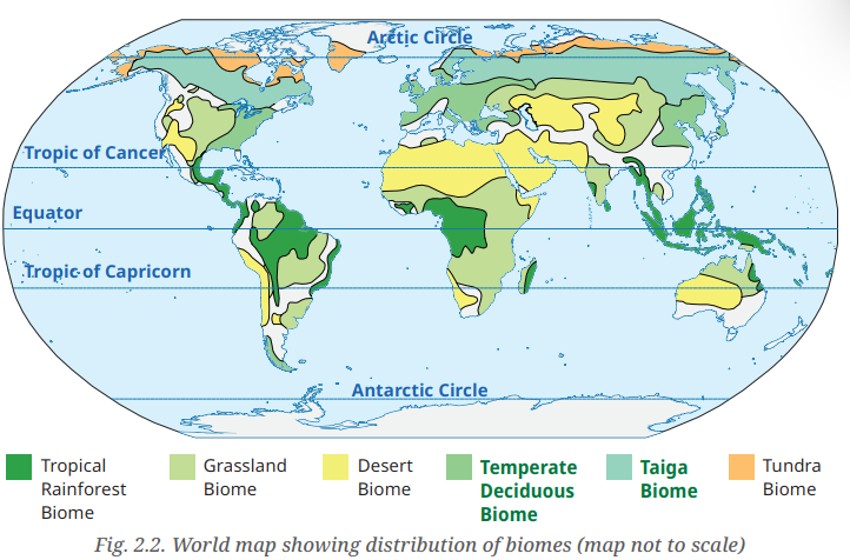
Question: Which type of biome is found in smaller, separate regions, and why?
Answer: Model map interpretation: Temperate deciduous forests are shown in separated regions, especially eastern North America, Europe and eastern Asia. Their distribution depends on moderate temperatures, seasonal changes and suitable moisture. These conditions occur in separated parts of continents rather than in a continuous worldwide belt.
Question: Which continent has the least number of biomes? What could be the reason for this?
Answer: Antarctica has the least variety represented on this map; most of it is left uncoloured. Extreme cold, extensive permanent ice and a short growing season limit terrestrial vegetation. This does not mean that Antarctica has no ecosystems: the figure is a simplified map of selected land biomes.
Question: Why are there areas that do not have any specific biomes?
Answer: Some areas are uncoloured because the map represents only selected broad terrestrial biomes. Permanent ice, high mountain conditions and transitions between vegetation types may not fit its categories clearly. Oceans are also not labelled as land biomes because they belong to aquatic biomes. An uncoloured area should not automatically be interpreted as lifeless.
Let’s Explore (Page 24)
Question: Look at the layers of vegetation in a rainforest. What do the yellow shapes in the figure indicate?
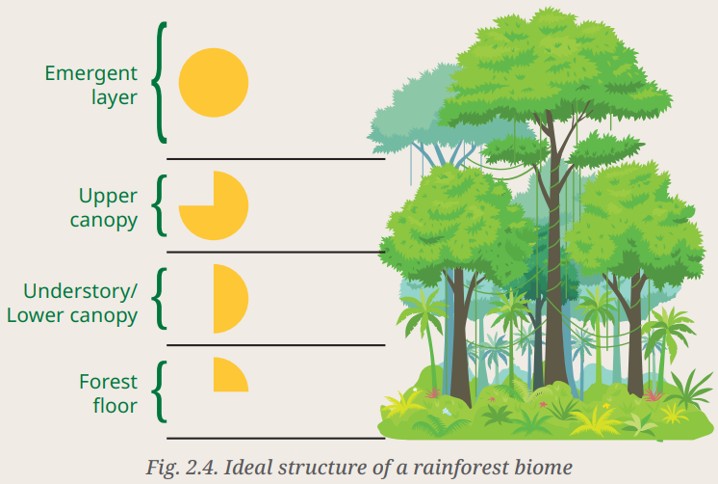
Answer: The yellow shapes indicate the relative amount of sunlight reaching each layer of the rainforest. The emergent layer receives the most sunlight, and the amount decreases through the upper canopy and understory. The forest floor receives the least sunlight because the dense vegetation above blocks much of it.
Let’s Explore (Page No – 25)
Question: Observe Fig. 2.5 and explore which of these animals you will find in the grasslands of India.
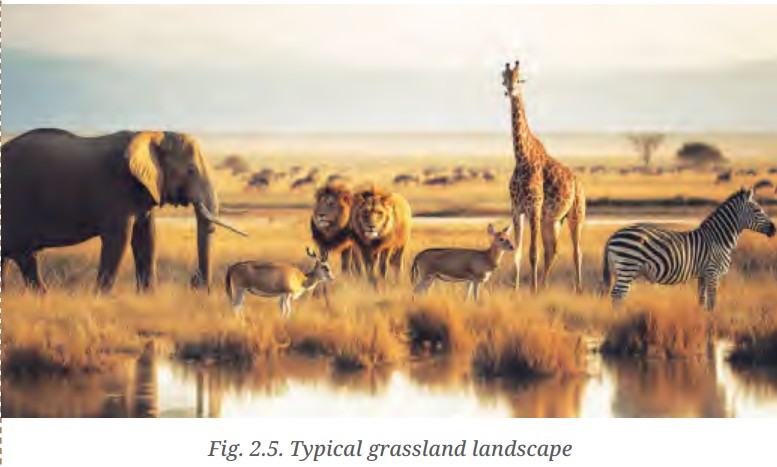
Answer: Among the animals shown, elephants and lions occur in India and use grassland habitats. Asiatic lions live in the Gir landscape of Gujarat. India also has antelopes such as blackbuck. Giraffes and zebras are not native to India.
Let’s Explore (Page No – 26)
Question: What types of activities do you think people in desert regions generally undertake to sustain their households and livelihood?
Answer: People may rear camels, goats or sheep, cultivate crops where irrigation or seasonal rainfall permits, and make handicrafts. Trading, transport, tourism and work associated with local minerals or salt can also provide income. Activities depend on the desert’s climate, water supply and available resources, so not every household follows the same occupation.
OR
People in desert regions undertake activities suited to the dry climate and limited water supply:
- Animal rearing: They rear camels, goats, and sheep for milk, wool, transport, and income.
- Farming: They grow drought-resistant crops such as bajra where water is available.
- Handicrafts: They make and sell textiles, pottery, carpets, and leather goods.
- Tourism: They earn through camel safaris, guiding, and providing accommodation.
- Mining and salt production: They work in mineral extraction, oil production, and salt-making where these resources occur.
Question: With the help of your teacher, explore how do people address issues related to the availability of water.
Answer: People collect and store rainwater in tanks and reservoirs, use wells where groundwater is available, maintain community water sources and use water carefully. Irrigation and water distribution systems can supply settlements and fields. With your teacher, investigate the systems used in one desert region and explain who maintains them, how they are shared and how water is conserved during dry periods.
OR
People in desert regions address water scarcity in the following ways:
- Rainwater harvesting: They collect and store rainwater in tanks and underground structures called tankas.
- Wells and stepwells: They obtain groundwater through wells, tube wells, and traditional stepwells.
- Water storage: They build ponds and small reservoirs to store water for dry periods.
- Canals and pipelines: They bring water from rivers and other distant sources.
- Careful water use: They use drip irrigation, grow drought-resistant crops, and avoid wasting water.
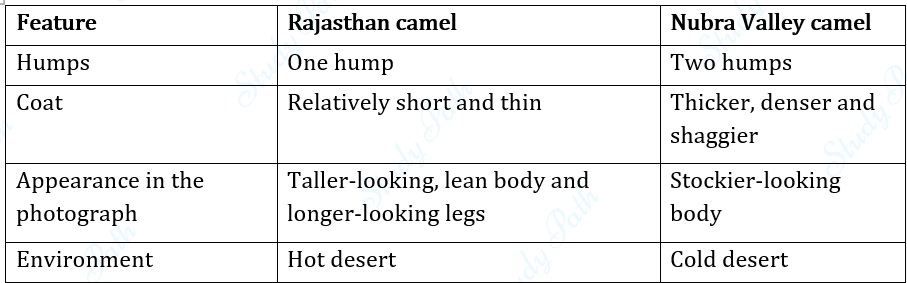
Question: Compare the physical features of the Rajasthan camel (Fig. 2.7a) and the Nubra Valley (Ladakh) camel (Fig. 2.7b).
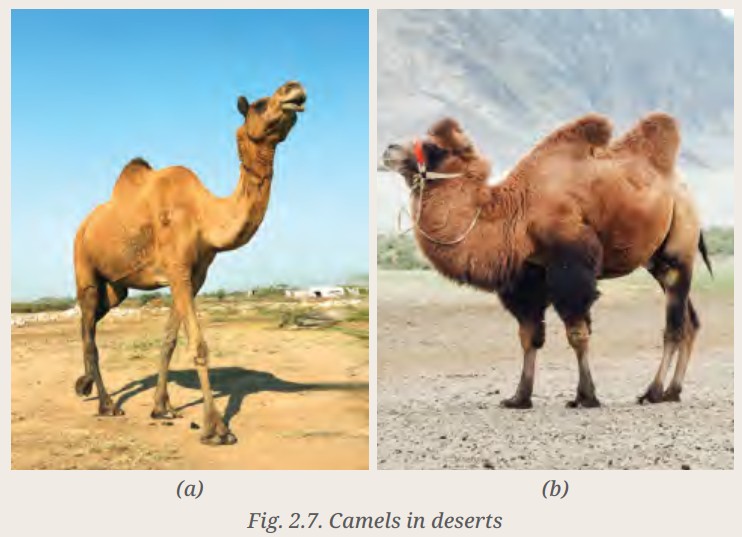
Answer: The visible differences are shown below.
Question: Considering the climatic conditions, why do you think the Nubra Valley camel might have a different fur density than the Rajasthan camel?
Answer: Nubra Valley has a cold desert climate, so dense fur helps retain body heat and protects the camel from low temperatures. Rajasthan is much hotter, where a relatively thinner coat suits the local conditions. The different coat densities illustrate adaptation to contrasting climates.
Think About It (Page No – 27)
Question: Tundra in polar regions has mosses, lichens, shrubs, etc., while the Himalaya, in the subtropics, is dominated by conifers. What could be the reason for this? What difference do you find in the animals found in these two regions? Which species are found only in the Himalaya? Discuss in class.
Answer: Polar tundra has extremely low temperatures, long winters, a short growing season, and permanently frozen subsoil called permafrost. These conditions prevent tree growth, so mosses, lichens, and small shrubs dominate. In the Himalaya, lower latitudes and suitable conditions at middle elevations allow coniferous forests to grow. Above the tree line, vegetation becomes similar to tundra.
Polar tundra supports animals such as reindeer, Arctic foxes, and polar bears, which are adapted to extreme cold. Himalayan animals include snow leopards, Himalayan tahr, musk deer, and Himalayan monal, many adapted to steep mountain terrain. Examples of species native only to the Himalayan region include the Himalayan tahr and Himalayan monal.
Let’s Explore (Page No – 28)
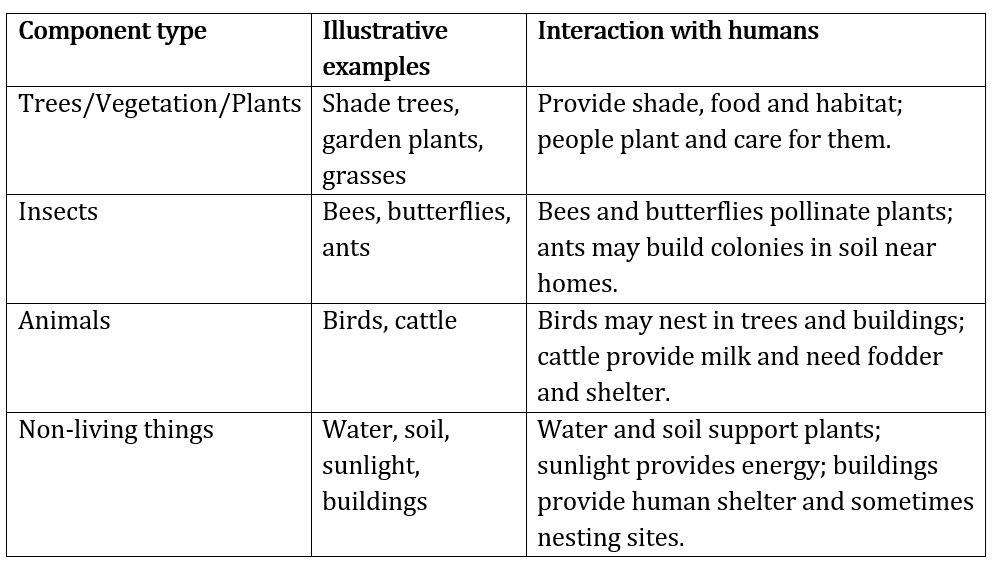
Question: Explore your local environment. This could be your village, city, town, or residential area. Observe how people, plants, and animals build structures and interact. Complete the table with your findings.
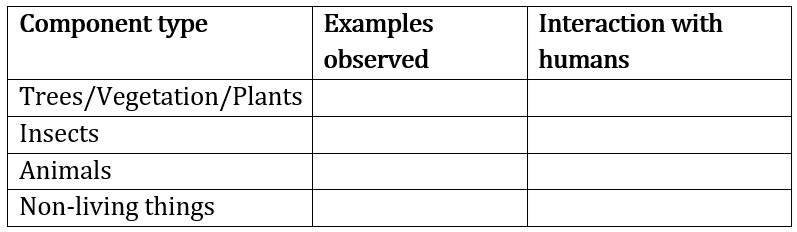
Answer: Observe a nearby garden, street or water body and record actual examples. Note structures such as nests, ant colonies, planted gardens, houses and drains, and explain their interactions. The following is an illustrative response, not a record of your locality.
Let’s Map (Page No – 29)
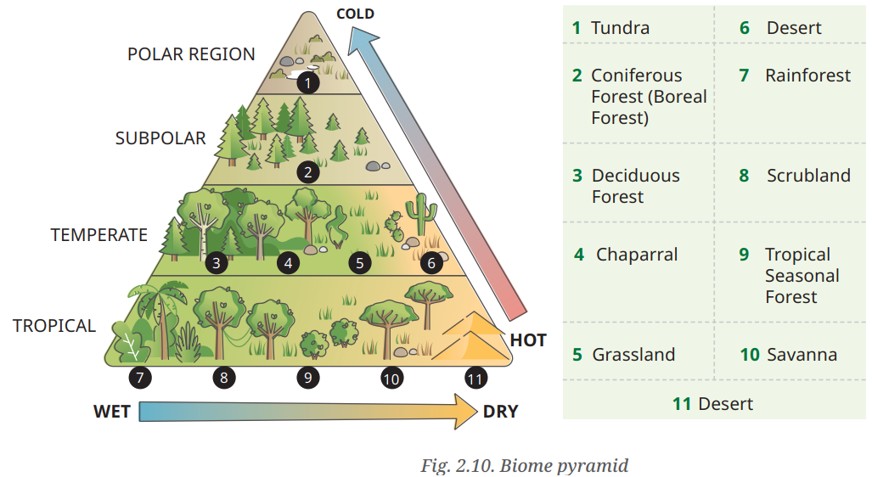
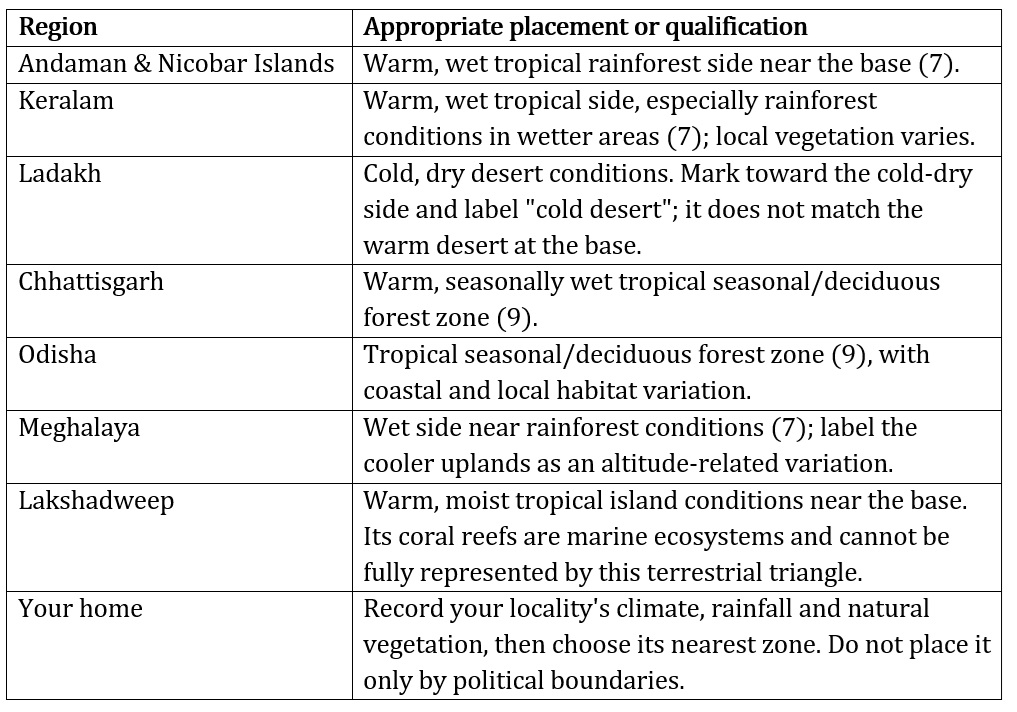
Question: Mark the following regions at appropriate levels on the Fig. 2.10: Andaman & Nicobar Islands, Keralam, Ladakh, Chhattisgarh, Odisha, Meghalaya, and Lakshadweep. Where will you place your home?
Answer: Use the temperature and moisture directions in the figure. Place labels near the most suitable climate-vegetation zone, with the qualifications below. These are broad placements because a state can contain several habitats.
Question: There is no arrow on the third side of the triangle. What would happen if we drew an arrow? Would it point upwards or downwards?
Answer: An arrow on the left side could represent increasing latitude, from the tropical region towards the polar region. With that label it would point upwards. In mountains, increasing altitude can also lead from warmer to colder conditions, but altitude and latitude are different. An arrow needs a stated meaning: one labelled “towards the tropics” would point downwards. This is a climate diagram, so the missing arrow is not an energy-flow arrow.
Let’s Explore (Page No – 39)
Question: You may have heard about the Pradhan Mantri Ujjwala Yojana (PMUY). How are the benefits of this scheme impacting the health of women?
Answer: The Pradhan Mantri Ujjwala Yojana (PMUY) provides LPG connections to women from poor households. Using LPG instead of firewood reduces exposure to harmful smoke and indoor air pollution. This helps reduce coughing, breathing difficulties, and eye irritation. It also reduces the physical strain of collecting firewood and makes cooking cleaner and more convenient.
Questions and Activities (Page No – 43)
Question 1: Why does India have diverse biomes? How does the local geography connect to the diversity?
Answer: India has diverse biomes because its regions differ greatly in landforms, altitude, temperature, rainfall, and water availability. These variations create suitable conditions for different plants and animals.
- Changes in altitude create different vegetation zones, including coniferous forests and alpine vegetation in the Himalaya.
- Warm, wet conditions support dense forests in the Northeast, Western Ghats, and Andaman and Nicobar Islands.
- Low rainfall supports desert vegetation in Rajasthan and Kutch.
- Moderate rainfall supports grasses and grazing animals.
- Rivers, lakes, wetlands, and seas support freshwater and marine biomes.
Question 2: Make a list of economically valuable native plants in your region and comment on their abundance.
Answer: Taking Tripura as an example, the following native plants are economically valuable:
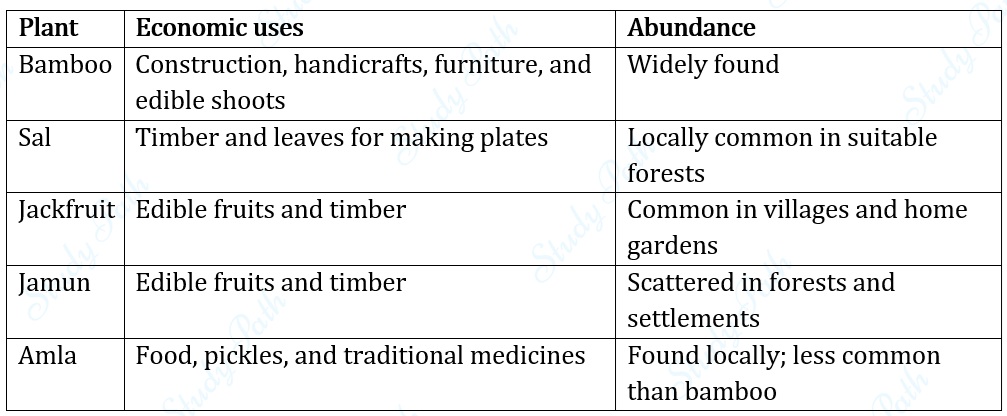
Their abundance varies from place to place, so the list should be checked through local observation.
Question 3: Prepare a map of your state or Union Territory showing national parks and sanctuaries.
Answer: Do it yourself.
Question 4: Study the impact of forest fires on people dependent on forests. Try to include the causes, losses, and preventive measures.
Answer: Forest fires seriously affect people who depend on forests for food, fuel, fodder, medicines, and income.
Causes: Prolonged dry weather, high temperatures, and climate change increase fire risk. Human activities, such as unattended fires, burning debris, and carelessly discarded burning materials, can also start fires.
Losses: Fires destroy forest produce, grazing areas, crops, and homes, reducing livelihoods. They kill wildlife, damage habitats, and may cause injuries or deaths. Smoke causes breathing difficulties, while affected families may be forced to leave their homes.
Preventive measures: Spread awareness, avoid lighting fires near dry vegetation, maintain firebreaks, and organise community monitoring. Early warnings, trained response teams, and timely evacuation can reduce damage.
Question 5: Why are forests often called the ‘lungs of the Earth’?
Answer: Forests are often called the ‘lungs of the Earth’ because trees absorb carbon dioxide and release oxygen during photosynthesis. This helps maintain the balance of gases in the atmosphere and supports life. Forests also help regulate the Earth’s climate.
Question 6: If large forest areas continue to be destroyed, what do you think would be its long-term effect on the global climate?
Answer: Continued destruction of large forest areas would have the following long-term effects on the global climate:
- Fewer trees would absorb carbon dioxide, while burning and decaying vegetation would release stored carbon into the atmosphere.
- Reduced release of water vapour from trees would disrupt the water cycle and affect rainfall.
- Loss of forest cover would reduce natural cooling and increase the risk of droughts and forest fires.
- These changes would damage ecosystems and threaten biodiversity, agriculture, and human livelihoods.
Question 7: Discuss some traditional forest conservation methods with your grandparents or an elderly person.
Answer: Some traditional forest conservation methods that can be discussed with elders are:
- Protecting sacred groves: Communities preserve forest patches such as Devrai, Devarakadu, Kavu, and Sarna because of religious and cultural beliefs.
- Respecting forest deities: Communities such as the Gonds and Bhils perform rituals before collecting forest resources, expressing respect for nature.
- Regulating resource collection: Community rules limit tree cutting and encourage careful use of forest produce.
- Passing on traditional knowledge: Elders teach younger generations how to use plants and herbs responsibly.
- Collectively protecting trees: Traditions such as those of the Bishnoi community encourage people to protect trees and wildlife.
Question 8: How do forest dwellers contribute to the protection and conservation of forests?
Answer: Forest dwellers contribute through their knowledge, daily practices and collective decisions.
- They pass on knowledge of plants, animals, medicines and suitable collection practices.
- They may regulate harvesting, tree cutting and grazing, allowing resources to regenerate.
- They protect sacred groves and uphold cultural practices that value nature.
- They can detect and report fires or illegal exploitation and take part in restoration and community management.
- Forest protection movements, including Bishnoi and Chipko, show community action against destructive cutting.
- Mendha Lekha illustrates collective Gram Sabha decisions, fire prevention and regulated bamboo harvesting, linking livelihoods with conservation.
Recognising community rights and supporting sustainable livelihoods can strengthen these contributions. The methods and level of participation vary between communities.
Question 9: What is a forest fire? Prepare a plan for prevention and mitigation of forest fires.
Answer: A forest fire is a fire that burns forest vegetation and can spread through grasses, leaf litter, shrubs or trees. It may damage biodiversity, homes and forest-based livelihoods. Prevention reduces the chance of ignition; mitigation reduces damage when a fire occurs.
Before a fire:
- Prepare a local risk map with forest staff, identifying dry vegetation, settlements, roads and water sources.
- Create awareness about safe behaviour: avoid unattended flames and careless disposal of burning materials.
- Have trained authorities maintain appropriate firebreaks and undertake approved vegetation management.
- Monitor dry periods, share warnings and establish ways to report smoke or fire promptly.
- Plan evacuation routes and safe assembly points, and identify households needing assistance.
During a fire:
- Inform the forest department or emergency authorities immediately and give the location.
- Follow evacuation instructions and move along designated safe routes away from the affected area.
- Keep children and untrained residents away from firefighting; trained personnel should handle suppression.
- Account for people at the assembly point and arrange assistance for affected households.
After a fire:
- Return only when authorities confirm it is safe.
- Assess damage to households, forest resources, water sources and livelihoods.
- Provide relief and restore habitat using suitable local vegetation.
- Review the cause, warning arrangements and response to improve the next season’s prevention plan.
Class 9 Social Science Part 2 Chapter 2 NCERT Questions and Answers
The chapter Life on Earth explores how living organisms interact with their physical surroundings. Students learn about major environments and the ways climate, water, soil, and vegetation influence plant and animal life.
Students also examine ecological relationships and the effects of human activities on habitats. The chapter helps them connect biodiversity with environmental balance and understand the importance of conserving the natural systems that support life.