

NCERT Solutions for Class 9 Social Science Part 2 Chapter 3 Resistance and Resilience (1000–1700 CE) are provided here with simple and easy-to-understand explanations. Based on the NCERT textbook Understanding Society: India and Beyond Part 2, this chapter introduces the responses of rulers and communities to political challenges and the ways society adapted between 1000 and 1700 CE. These NCERT Solutions for Class 9 help students understand important concepts, complete textbook activities, and revise the chapter for school examinations.
Resistance and Resilience (1000–1700 CE) Class 9 Questions and Answers
The Big Questions (Page No – 45)
Question 1: How did Indian rulers use resistance and alliances to safeguard their lands?
Answer: Rulers defended their territories through battles, forts, guerrilla tactics, and the use of local terrain. They also built alliances and confederacies, negotiated with stronger powers when useful, and drew on community support. Examples include the Rajput confederacy led by Rana Sanga, Mewar’s resistance, Ahom alliances and river strategy, and Maratha alliances and fort network.
OR
Indian rulers used military resistance, strategic alliances, and diplomacy to safeguard their lands and preserve their autonomy.
- Military resistance: Rulers fought invading armies. For example, Queen Naiki Devi defeated Muhammad Ghuri at Kasahrada in 1178.
- Confederacies: Rulers combined their forces against common threats. Rana Sanga led a Rajput confederacy against Babur in 1527.
- Guerrilla warfare: Maharana Pratap and the Marathas used difficult terrain, surprise attacks, and safe retreats to resist stronger armies.
- Local alliances: The Bhils supported Maharana Pratap with knowledge of the Aravalli terrain, archery, and logistical assistance.
- Diplomacy and treaties: Some Rajput rulers negotiated with the Mughals to protect their interests. Mewar’s sustained resistance eventually secured a treaty recognising its autonomy.
- Strategic forts: Forts provided defensive bases, protected supplies, and helped kingdoms withstand long sieges.
Question 2: What factors contributed to the resilience of different kingdoms and communities during this period?
Answer: Resilience grew from knowledge of local geography, community organisation, military adaptation, alliances, strong institutions, and economic resources. The Ahoms used river and forest terrain, the Marathas relied on forts and hill warfare, Sikh communities organised collectively, and Bhakti communities sustained shared practice through local languages and singing.
OR
The resilience of kingdoms and communities during 1000–1700 CE depended on several factors:
- Adaptable military strategies: Guerrilla warfare and knowledge of local hills, forests, and rivers helped rulers resist stronger armies.
- Forts and strong organisation: Forts, water supplies, and systems such as the Ahom Paik system supported prolonged resistance.
- Alliances and community support: Cooperation among rulers and local communities strengthened defence and helped preserve autonomy.
- Economic strength: Agriculture, irrigation, crafts, trade, and merchant networks provided resources to withstand political instability.
- Cultural and spiritual traditions: Bhakti songs, local languages, shared beliefs, and community gatherings strengthened solidarity.
- Adaptation and preservation: Communities restored temples and modified worship practices and architecture to preserve their traditions under changing conditions.
Question 3: How did the Bhakti tradition foster a sense of solidarity? (Page No – 45)
Answer: Bhakti saints composed in languages people used in daily life and encouraged shared devotional practices such as satsang, nam kirtan, and sankirtan. Community singing brought people together across social divisions and helped form shared cultural identities.
OR
The Bhakti tradition fostered solidarity by bringing people together through shared devotion.
- It welcomed people from diverse social backgrounds and encouraged women’s participation.
- Saints composed hymns in languages understood by ordinary people, making spiritual teachings widely accessible.
- Practices such as satsang, kirtan, and sankirtan created shared emotions and a sense of belonging.
- Saints such as Chaitanya Mahaprabhu and Guru Nanak used community singing to unite people.
- Devotional songs and regional versions of sacred texts strengthened cultural identity and helped communities remain united during difficult times.
Question 4: How did the expansion of agriculture, trade, and commerce keep the economy sound? (Page No – 45)
Answer: Cultivation and irrigation increased agricultural production, while inland routes and seaborne networks linked producers, towns, and overseas markets. Merchant communities organised and financed trade, and hundis enabled safer long-distance transfers. These activities sustained income, employment, and exchange even in periods of political change.
OR
- The expansion of cultivation and irrigation increased agricultural production, providing food, raw materials, and land revenue, the main source of state income.
- Growing craft production, especially cotton textiles, provided employment to weavers, dyers, and other artisans.
- Inland trade connected villages with towns and distant markets. Traders such as the banjaras helped transport goods between rural and urban areas.
- Maritime trade linked India with the Persian Gulf, Southeast Asia, and other regions, strengthening its position in the Indian Ocean trading network.
- Merchant communities financed production and trade, managed supply chains, and provided financial support to states.
- Financial instruments such as hundis enabled safer payments and long-distance transfers without carrying large amounts of money.
These activities provided the resources needed to sustain kingdoms and communities despite wars and political instability.
Question: Identify any two specific actions mentioned in the text which show that Maharana Pratap maintained his independence from the Mughal court. (Page No. 54)
Answer: Two actions showing Maharana Pratap’s independence from the Mughal court were:
- He never participated in the Nauroz festival at the Mughal court.
- He never mounted guard for the emperor during Jharokha Darshan.
Let’s Explore (Page No – 64)
Question: Explore the contributions of the Nayanar saints (devotees of Shiva) like Karaikal Ammaiyar and the Alvar saints (devotees of Vishnu) like Andal to the spread of the Bhakti tradition in peninsular India. Discuss their teachings and devotional practices and the ways in which they connected with people through their hymns.
Answer:
- The Nayanars, devoted to Shiva, and the Alvars, devoted to Vishnu, spread the Bhakti tradition across peninsular India through heartfelt devotion and hymns in Tamil.
- Karaikal Ammaiyar, a woman Nayanar saint, renounced worldly comforts and composed hymns expressing her deep devotion to Shiva, especially his divine dance.
- Andal, a woman Alvar saint, expressed her love for Vishnu through works such as the Tiruppavai. Her hymns encouraged devotion, prayer, and collective worship.
- Their teachings emphasised sincere love and surrender to God, making spiritual life accessible to ordinary people.
- Singing hymns in local languages and participating in temple worship brought communities together. Their example also strengthened women’s participation in religious life.
Think About It (Page No – 67)
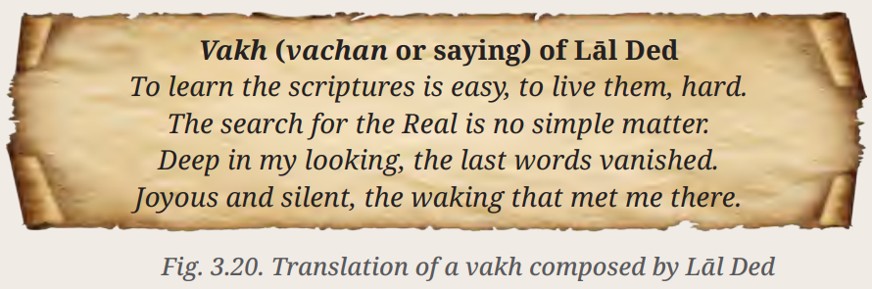
Question: Lal Ded says that it is ‘easy’ to learn scriptures but ‘hard’ to live them. What is the difference between knowing a rule and actually following it? Can you give an example from your daily life?
Answer: Knowing a rule means understanding or remembering it, while following it means putting it into practice through our actions, even when it is difficult. Lal Ded emphasises that true learning lies in living according to teachings.
For example, I know that honesty is important, but practising it means admitting my mistake even when I fear being punished. This requires courage and self-discipline.
Think About It (Page No – 74)
Question: What do you think made hundis a safer and more convenient choice than physically transporting money across long distances?
Answer: Hundis allowed merchants to make payments and transfer money over long distances without carrying large amounts of currency. This reduced the risk of theft and the burden of transporting coins. Trusted networks of sarrafs (money-changers) and their agents enabled payments at distant places, making trade safer and more convenient.
Think About It (Page No – 76)
Question: Identify some cultural and economic pillars that exist in any community (places of faith, traditions, business, and trade, etc.). How do you think these contribute to resilience within a society facing invasions/external pressures?
Answer: Cultural pillars include places of worship, shared traditions, local-language songs, and community gatherings. They preserve identity, sustain confidence, and bring people together. Economic pillars include agriculture, irrigation, craft production, markets, trade, and financial networks. They provide food, employment, revenue, and resources. Together these support adaptation and help communities endure external pressure.
OR
Cultural and economic pillars help communities withstand external pressures and recover from difficulties.
- Places of faith bring people together, provide spiritual support, and preserve religious and cultural practices.
- Shared traditions, festivals, and languages strengthen identity, unity, and a sense of belonging.
- Community networks encourage cooperation and mutual assistance during crises.
- Agriculture and irrigation provide food, livelihoods, and revenue to sustain society.
- Businesses, crafts, and trade generate employment and wealth, while merchant networks and financial instruments such as hundis help commerce continue.
Together, these pillars provide emotional strength, material resources, and the ability to adapt while preserving a community’s way of life.
Questions and Activities (Page No -77)
Choose the most appropriate answer
Question: Resistance and resilience are closely connected because:
(a) Resistance always involves warfare.
(b) Resilience enables communities to endure difficulties and sustain resistance.
(c) Resistance is possible only when a kingdom has a large army.
(d) Resilient societies avoid all forms of conflict.
Answer: (b) Resilience enables communities to endure difficulties and sustain resistance.
Explanation: Resilience provides the strength to withstand hardships and continue opposing threats. Resistance may involve warfare, alliances, diplomacy, or negotiation.
Question 2: Why and how did groups such as the Sikhs, Marathas, and Rajputs assert their political power and identity during periods of changing political authority?
Answer: The Sikhs, Marathas, and Rajputs asserted their political power to protect their lands, preserve their cultural and religious identities, and resist external control.
- The Sikhs responded to persecution and Mughal interference through collective organisation and armed resistance. Guru Hargobind established the Akal Takht, while Guru Gobind Singh founded the Khalsa in 1699, strengthening their spiritual and political identity.
- The Marathas, under Chhatrapati Shivaji, pursued swarajya, or self-rule. They used guerrilla warfare, strategic forts, knowledge of local terrain, and alliances to establish and defend an independent state.
- The Rajputs defended their sovereignty through warfare, confederacies, and diplomacy. Mewar maintained prolonged resistance, while some rulers, such as those of Amber, negotiated alliances with the Mughals to safeguard their interests.
Question 3: Why did some Rajput rulers decide to negotiate alliances with the Mughal power? (Page No -78)
Answer: Some Rajput rulers negotiated alliances with the Mughals to safeguard their kingdoms and political interests as Mughal power expanded. Cooperation offered a way to avoid prolonged warfare and retain a degree of autonomy. The Mughals granted them mansabs, giving them positions in imperial military and administration. In return, the Mughals gained the Rajputs’ military strength, loyalty, and administrative skills. Thus, these alliances served the strategic interests of both sides.
Question 4: Imagine a market in a port town of India such as Surat, Masulipatnam, or Puducherry. You are a foreign trader from Italy or France and want to make a deal of cotton textiles. How would you secure the product in the local market? Whose help would you seek and what kind of challenges would you face in terms of language, quality of product, prices of commodities, etc.? (Page No -78)
Answer: As a French trader visiting Surat, I would contact a local merchant or broker to arrange a supply of cotton textiles from weavers. I would seek the help of a dubhashi (interpreter) to communicate with sellers and negotiate terms. Before purchasing, I would examine samples, compare prices, and agree on the quantity, quality, delivery date, and payment. A sarraf (money-changer) could help exchange currency or arrange payment through a hundi.
I might face difficulties because of unfamiliar languages, different currencies and measures, variations in cloth quality, and changing prices. Reliable local contacts would help me secure suitable goods and arrange their transport to the port.
Question 5: Watch any video at the given link (https://www.indianculture.gov.in/forts-of-india/tales-of-forts) and analyse the various functions of forts and fortresses. How did rulers perceive the importance of forts in terms of strategic concerns.
Answer: Forts protected people, rulers, supplies, and weapons; controlled routes and territory; served as military bases and places of retreat; and could act as administrative centres or capitals. Rulers valued a fort’s location, access to water and supplies, defensibility, and ability to support movement of troops. The chapter’s examples show that forts could enable resistance, help launch attacks, and withstand long sieges. The video-based part should be completed after viewing the specified resource; these points provide a chapter-based guide for analysis.
Question 6: What architectural changes occurred in temple construction during the period under study? How do these changes reflect upon the resilient nature of Indian civilisation? (Page No -78)
Answer: From the 16th century onwards, some temples were built in less visible locations, along narrow lanes, with entrances away from main streets. Elaborate exteriors became less common, and tall shikharas were often avoided. Many temples resembled ordinary houses or havelis, giving rise to the term ‘haveli temples’.
These changes helped communities protect sacred sites from destruction while continuing worship. Rulers, merchants, and religious communities also maintained and restored damaged temples. Such adaptations reflect the resilience of Indian civilisation—its ability to adjust to difficult circumstances while preserving religious practices and cultural traditions.
Question 7: A kingdom has limited military resources but possesses fertile agricultural land, strong local support, and detailed knowledge of its terrain. Explain two ways in which these resources could contribute to the kingdom’s resilience when faced with a threat. (Page No -78)
Answer: Fertile agricultural land could provide food for the people and soldiers, while land revenue could finance defence. Strong local support could help maintain supplies and sustain the kingdom during prolonged conflict.
Detailed knowledge of the terrain could help a smaller army use hills, forests, and rivers for defence, surprise attacks, and safe retreats. Local communities could provide guides and information, helping the kingdom resist a stronger enemy.
Question 8: Consider the following statement:
“A tradition becomes more resilient when people can carry it with them.”
Do you agree? Explain using examples from the Bhakti tradition.
Answer: Yes, I agree. A tradition becomes more resilient when people can preserve and practise it wherever they go, without depending entirely on physical structures.
The Bhakti tradition spread through devotional hymns, naam kirtan, and satsang in local languages. Even when temples were destroyed or their construction restricted, devotees could continue worship through singing and reciting the divine name. Saints such as Chaitanya Mahaprabhu and Guru Nanak brought people together through community singing. Tulsidas’s Ramcharitmanas, composed in Awadhi, carried spiritual teachings into ordinary households.
Thus, people could carry Bhakti teachings in their memory and everyday practices, preserving faith and community bonds despite difficult circumstances.
Question 10: Choose any two of the following and write a short first-person account explaining what resilience means from that person’s perspective:
- A Bhakti saint
- A Rajput soldier
- An Ahom commander
- A Maratha administrator
- A merchant
- A Jat leader
Answer:
A Bhakti saint:
“To me, resilience means keeping devotion alive despite hardship. I sing hymns in the language of ordinary people and welcome everyone into our gatherings. Even if a temple is destroyed, our faith survives through songs, prayer, and shared devotion.”
A Rajput soldier:
“To me, resilience means continuing to defend our land despite setbacks. We use our knowledge of the hills, support from local communities, and the protection of forts to resist stronger armies. Defeat in one battle does not end our determination.”
An Ahom commander:
“To me, resilience means adapting our strategy to protect our kingdom. Our forests, rivers, and monsoons help us challenge invading forces. With organised soldiers and swift boats, we defend our homeland and recover lost territory.”
A Maratha administrator:
“To me, resilience means ensuring that swarajya survives prolonged conflict. I help maintain forts, water supplies, and administrative arrangements so that our people and soldiers can endure sieges. Strong organisation supports our struggle for self-rule.”
A merchant:
“To me, resilience means keeping trade alive during political unrest. I depend on trusted trading contacts, adapt to changing conditions, and use hundis to transfer money safely. Our commercial networks sustain livelihoods and help communities recover.”
A Jat leader:
“To me, resilience means standing together against heavy taxation and exploitation. Though powerful armies may suppress an uprising, our determination survives. Through collective organisation and continued resistance, we defend our livelihoods and assert our political identity.”
Question 10: You are a military architect advising a ruler. Draw a simple, labelled plan of a fort that includes the following:
- Residential complex
- Defensive walls
- Water source
- Food storage
- Escape route
- Watchtower
- Administrative area
Now, write a few sentences explaining how your design would help the kingdom withstand a long siege.
Answer: A suitable plan should place the residential and administrative areas inside strong defensive walls, with a watchtower overlooking the approaches. The water source and food store should be protected within the fort and kept accessible during a siege. An escape route should be discreet and lead beyond the most exposed side. These features would help residents remain supplied, organise defence, observe approaching forces, and avoid being trapped if the fort could no longer be held. The model plan above includes all seven features required by the question. Students may adapt the layout while retaining them.
Class 9 Social Science Part 2 Chapter 3 NCERT Questions and Answers
The chapter Resistance and Resilience (1000–1700 CE) explores how kingdoms and communities defended their interests through resistance, alliances, and cooperation. Students learn about leadership, regional responses, and the strategies used during changing political conditions.
Students also examine how cultural traditions, agriculture, trade, and social networks helped communities endure and adapt. The chapter connects political events with economic and cultural life and encourages attention to both conflict and cooperation in historical evidence.