

NCERT Solutions for Class 9 Social Science Part 1 Chapter 7 Elections are provided here with simple and easy-to-understand explanations. Based on the NCERT textbook Understanding Society: India and Beyond Part 1, this chapter introduces representation, electoral participation, and the procedures used to choose public representatives. These NCERT Solutions for Class 9 help students understand important concepts, complete textbook activities, and revise the chapter for school examinations.
Elections Class 9 Social Science Questions and Answers
The Big Questions (NCERT Textbook Page no. 162)
1: Why are elections essential to a democratic system?
Answer: Elections are essential to a democratic system because they allow citizens to choose their representatives and hold them accountable. Regular and periodic elections ensure that elected representatives continue to have the people’s mandate. Through voting, citizens exercise their democratic right to participate in choosing those who make decisions on their behalf. Thus, elections ensure representation, accountability and people’s participation.
2: How do electoral systems and rules shape political representation and fairness?
Answer: Electoral systems decide how votes are converted into seats in the legislature. Different systems can produce different forms of representation. For example, India uses the First-Past-The-Post (FPTP) system for Lok Sabha and Vidhan Sabha elections, while proportional representation is used for elections to the Rajya Sabha, President and Vice President.
Electoral rules also promote fairness. The Representation of the People Acts, 1950 and 1951 provide rules regarding electoral rolls, voting, candidate nominations, campaigns and election disputes. They also ensure that citizens above 18 years have the right to vote without discrimination. Together, these systems and rules help make elections representative, transparent and accountable.
3: What role do institutions and laws play in ensuring free and fair elections?
Answer: Institutions and laws help ensure that elections are free, fair and transparent. The Election Commission of India (ECI) supervises and controls the entire electoral process, including electoral rolls, election schedules, campaigns, voting, counting and dispute resolution. The Representation of the People Acts, 1950 and 1951 provide rules for voting, nominations, campaigns and electoral offences. Together, they promote integrity, transparency and accountability.
4: What challenges do elections face in practice, and how can these challenges affect democracy?
Answer: Elections in India face challenges such as misinformation, fake news, intimidation and difficulties in ensuring accessibility. Electoral misconduct, such as offering gifts to influence voters or appealing for votes on the basis of religion, caste or language, can also affect fairness. If such problems are not controlled, they can reduce the democratic value of elections and weaken public confidence in electoral institutions. The ECI tries to overcome these challenges through laws, the Model Code of Conduct, EVMs, VVPAT, voter-awareness campaigns and constant vigilance.
Questions and activities (NCERT Textbook Page no. 179-182)
1: What reforms have been introduced by the ECI to make voting more inclusive for the following groups?
a. People with Disabilities
b. Service Voters
c. Senior Citizens (60 years and above; and 80 years and above)
d. Prisoners
e. Persons in preventive detention
Answer: The Election Commission of India (ECI) has introduced several measures to make voting more accessible for various groups:
(a) People with Disabilities (PwDs): The ECI has made polling stations accessible by providing ramps, wheelchairs, and Braille-enabled Electronic Voting Machines (EVMs). The Saksham App assists PwDs with voter registration and locating polling stations. Voting from home is also available for PwDs with a benchmark disability of 40% or more.
(b) Service Voters: The ECI introduced the Electronically Transmitted Postal Ballot System (ETPBS). It allows service voters to receive and cast their postal ballot electronically from a location outside their original constituency.
(c) Senior Citizens: The ECI has introduced home voting facilities for senior citizens. The chapter specifically states that during the 2024 General Elections, home voting was extended to senior citizens above 85 years of age.
(d) Prisoners: Prisoners are not permitted to vote in India, except for those held under preventive detention.
(e) Persons in Preventive Detention: These individuals are allowed to vote via postal ballots, preserving their right to participate in elections.
2: What are the various functions of the Election Commission of India? Which of these functions is most important for the conduct of free and fair elections? Explain.
Answer: The Election Commission of India (ECI) is responsible for the superintendence, direction and control of the entire electoral process. Its major functions include:
- Preparing and revising electoral rolls.
- Deciding the election schedule and dates.
- Registering political parties and allocating election symbols.
- Regulating election campaigns.
- Conducting voting and counting votes.
- Declaring election results.
- Resolving election-related disputes.
- Coordinating security arrangements and law enforcement during elections.
Among these, the most important is ensuring that elections are conducted freely, fairly and impartially. If elections are not fair, the democratic value of elections is reduced. Fair and transparent elections are therefore essential for maintaining public confidence and trust in electoral institutions.
3: Elections are the soul of a democracy. Do you agree? Why or why not?
Answer: Yes, I agree. Elections are called the soul of democracy because they give every citizen an equal voice in the formation of the government. Through regular and periodic elections, people can choose their representatives and hold them accountable. Elections also give citizens the opportunity to change non-performing representatives. Therefore, elections are essential for ensuring representation, accountability and equality in a democracy.
4: Explain at least three differences between the national and state/regional political parties.
Answer: National parties and State (Regional) parties differ in the following ways:
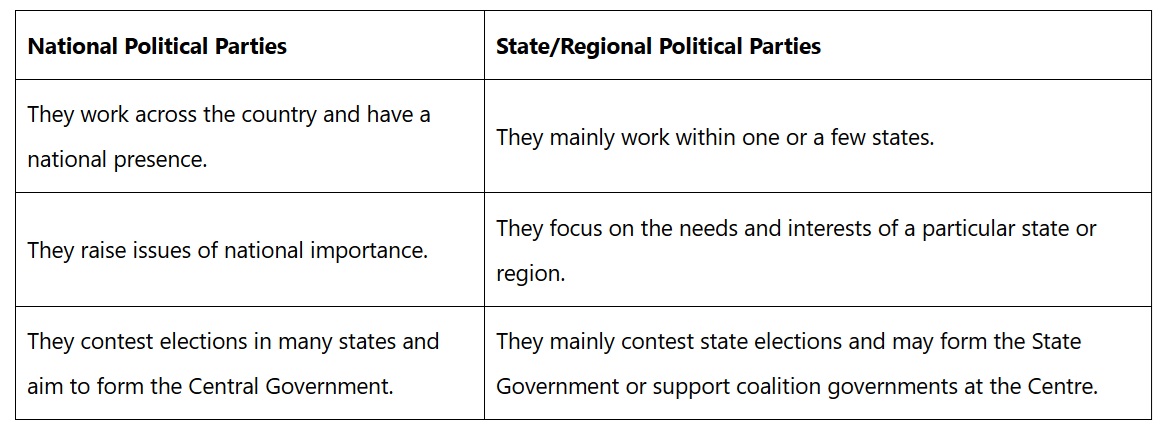
5: Why should you vote? Arrange the following in the descending order of your choice. Discuss the reasons for your choice.
a. Opportunity to choose my representative
b. Makes me a responsible person
c. Opportunity to change the non-performing representative
d. Strengthens democracy
Answer: Descending order of choice:
d. Strengthens democracy
a. Opportunity to choose my representative
c. Opportunity to change the non-performing representative
b. Makes me a responsible person
Voting is important because it strengthens democracy by giving people the power to decide who governs them. It allows citizens to choose honest and capable representatives who can work for public welfare. Elections also provide an opportunity to replace leaders who fail to perform or meet public expectations. Finally, voting encourages responsible citizenship by making people actively participate in the democratic process. Thus, every vote helps build an accountable, representative, and effective government.
6: What is the Special Intensive Revision (SIR) initiative of the ECI? Explain the objectives and the necessity of conducting SIR.
Answer: Special Intensive Revision (SIR) is an initiative of the Election Commission of India (ECI) to update, verify and correct the electoral rolls.
Objectives of SIR:
- To ensure that no eligible citizen is left out of the electoral roll.
- To ensure that no ineligible person is included in the electoral roll.
- To add eligible voters, especially young people who have recently turned 18.
- To remove names due to death, change of residence or duplicate enrolment.
SIR is necessary to keep the electoral rolls accurate and up to date. It ensures that only eligible citizens are able to vote and helps make elections free, fair and transparent. The ECI also gives people an opportunity to raise claims and objections before the final electoral roll is published.
7: Match the political party name with its symbol.
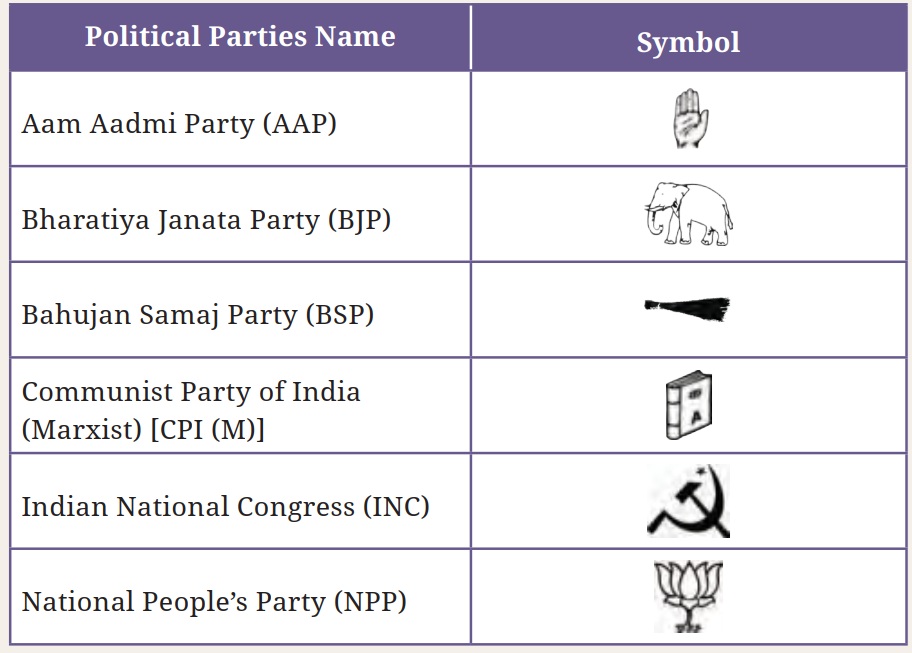
Answer: (a) – (iii), (b) – (vi), (c) – (ii), (d) – (v), (e) – (i), (f) – (iv)
8: Read the case study below and answer the following questions.
Ishani and her mother were in the local market, day before the state assembly elections. She noticed wall writing and campaign posters pasted everywhere. Large groups of campaigners were distributing pamphlets and raising slogans in support of the respective candidates. Ishani has turned 18 and will be voting for the first time. She had registered to vote through the ECI’s online portal. The next morning, she, along with her mother and her disabled elder brother, went to the polling station, which was well guarded by the police personnel. A wheelchair was made available to them, and volunteers guided them to the polling booth. Inside the polling booth, there were only three people who were performing all duties. Ishani had forgotten her voter ID card and Aadhaar card, but she was surprised as no one asked for them. After casting her vote, she was also able to see the VVPAT slip. While leaving, she wondered how the police personnel vote, as they must be on duty from early morning till late evening. When she went home, she narrated her entire experience to her 89-year-old grandmother, who cast her vote from home.
- What initiatives were taken by the ECI to enable the voters to cast their vote?
- If Ishani was allowed to vote even without carrying her Voter ID card or Aadhaar card, which other document might she be carrying that is valid for voting?
- Cite the examples of violations of the Model Code of Conduct.
- Give a suitable title to the passage.
- Find out how the police and army personnel cast their votes.
Answer:
- The ECI enabled voting through online voter registration, wheelchair facilities, volunteers for persons with disabilities, secure polling stations, VVPAT, and home voting for eligible senior citizens.
- Ishani could have carried another approved identity document, such as a passport, driving licence, PAN card, or MGNREGA job card.
- Wall writing, campaign posters in public places, and loud slogan shouting during the restricted campaign period are examples of Model Code of Conduct violations.
- Suitable title: A First-Time Voter’s Election Experience
- Police personnel on election duty and army personnel, known as service voters, usually vote through postal ballots or the Electronically Transmitted Postal Ballot System (ETPBS).
9: A comparative chart of three countries is given below. Based on the information given in the chart, answer the questions.
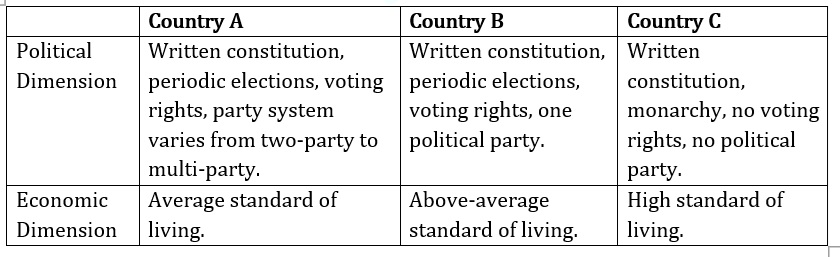
(a) What is the difference between having a voting right in a country with a multi-party system and another with a single-party system?
(b) In which of the above countries would you like to stay and why?
Answer: (a) In a multi-party system, citizens have the freedom to choose from different political parties and candidates. They can compare policies and elect the representative they prefer. In a single-party system, voters may have only one political option, which limits their choice and political competition.
(b) I would prefer to stay in Country A because it has written constitutional rights, periodic elections, voting rights, and a multi-party system. These features allow citizens to participate in government, choose their leaders, and hold them accountable. Although Country C has a high standard of living, the absence of voting rights and political parties reduces people’s participation in decision-making. Country A provides a better balance between democracy and citizens’ freedom.
10: What are the challenges to conducting free and fair elections?
Answer: The main challenges to conducting free and fair elections are misinformation, fake news and intimidation. These challenges can mislead voters, influence their choices and create fear during the electoral process. Conducting elections in a large and diverse country like India is also difficult because of the huge number of voters, polling stations and political parties. The ECI addresses such challenges through measures such as the Representation of the People Acts, Model Code of Conduct, EVMs, Voter Verifiable Paper Audit Trail (VVPAT), voter-awareness campaigns and other measures.
11: On the Stage.
Elections are to be held in your school for the posts of Head Girl, Head Boy, and Sports Captain. Assume the roles of an Election Commissioner, Returning Officer, Polling Agent, Candidate, Campaigner, Polling Officer, Police Personnel, and a Journalist, and perform their roles while ensuring free, fair, and transparent elections.
Answer: Do it yourself.
12: Try and make videos or audios on topics like: My Vote My Nation; No Voter to be Left Behind; How to Eliminate the Ill of Money Power, etc.
Answer:
My Vote, My Nation
My vote is my voice, and my vote helps shape my nation. Elections give every citizen an equal opportunity to choose their representatives. By voting, we participate in democracy and help hold elected representatives accountable. Every vote matters because elections give citizens an equal voice in the formation of government. Therefore, I will vote responsibly and encourage others to vote too. My Vote, My Nation!”
13: Select one national or state political party. Using authentic and reliable sources such as the Election Commission of India (ECI) website, the official website of the selected political party, and newspapers. Prepare a comparative chart of the last two State Legislative Assembly elections. The chart should include the following details for the chosen party:
a. Some promises made in the Election manifesto
b. Percentage of votes poled
c. Number of seats won
d. Number of women who contested
e. Number of women candidates elected
Present the data for both elections in a clear and comparative format, citing all sources used.
Answer: For this activity, I have selected Bharatiya Janata Party – Gujarat Legislative Assembly Elections 2017 and 2022.
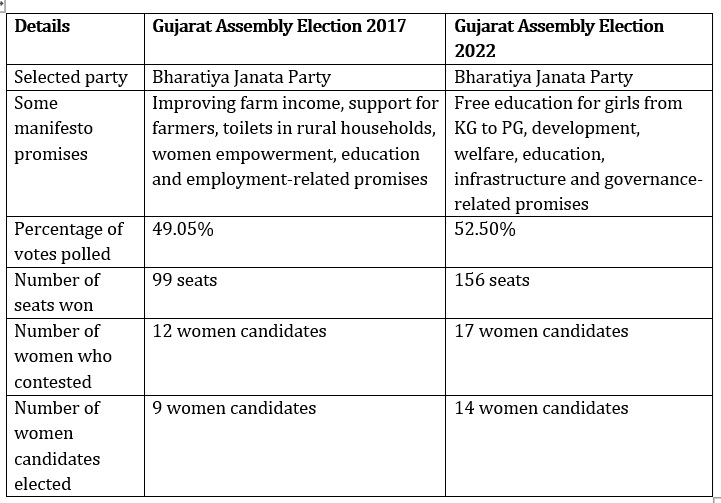
The 2017 result data shows that BJP won 99 seats with 49.05%49.05% vote share, while the 2022 result data shows that BJP won 156 seats with 52.5052.50% vote share. The women-candidate data shows that in 2017 BJP fielded 12 women candidates, out of whom 9 won; in 2022 BJP fielded 17 women candidates, out of whom 14 won.
Conclusion: The BJP performed better in the 2022 Gujarat Assembly election than in 2017 because its vote share and seats both increased. The number of women candidates elected from the party also increased.
14: Do you think ‘One Nation, One Election’ can improve the efficiency of the electoral process? Divide the class and discuss into two groups-one to examine its potential advantages and the other to analyse its limitations.
Answer: Yes, ‘One Nation, One Election’ may improve the efficiency of the electoral process, but it also has some limitations.
Group 1: Potential Advantages
- Elections held together may reduce the time and resources spent on conducting repeated elections.
- It may reduce the repeated election-related arrangements and administrative work.
- It could allow governments to focus more continuously on governance and development instead of frequent election preparations.
Group 2: Limitations
- It may be difficult to coordinate elections for the Lok Sabha and all State Legislative Assemblies.
- Different State Assemblies may have different terms, making simultaneous elections difficult to maintain.
- Frequent elections allow people to choose or change their representatives at different levels according to their needs.
Conclusion: ‘One Nation, One Election’ could make the electoral process more efficient by reducing repeated election-related work, but its practical and democratic challenges must also be carefully considered. The NCERT chapter presents this as a discussion topic, asking students to examine both its potential advantages and limitations.
Class 9 Social Science Part 1 Chapter 7 NCERT Questions and Answers
The chapter Elections explains how elections connect citizens with representative institutions. Students learn about constituencies, candidates, political parties, campaigning, and voting and consider why regular elections matter in a democracy.
Students also explore the importance of free and fair procedures and the role of electoral institutions. The chapter encourages informed participation and helps students understand how choices made by voters influence public decision-making.