

NCERT Solutions for Class 9 Social Science Part 1 Chapter 6 Democracy are provided here with simple and easy-to-understand explanations. Based on the NCERT textbook Understanding Society: India and Beyond Part 1, this chapter introduces popular participation, representative government, equality, and the principles that support democracy. These NCERT Solutions for Class 9 help students understand important concepts, complete textbook activities, and revise the chapter for school examinations.
Democracy Class 9 Social Science Questions and Answers
The Big Questions (NCERT Textbook Page no. 138)
1: How has the idea of democracy evolved over time and shaped our understanding of it today?
Answer: Democracy began with small-group and collective decision-making in early societies. Over time, it developed into more organised forms of government, including representative democracy. Democratic ideas gradually expanded to include greater participation and rights for citizens. Today, democracy is based on popular sovereignty, free and fair elections, equality, justice, rights and duties, with laws and institutions helping to ensure that governments remain accountable.
OR
The idea of democracy in India has evolved through a long historical process. In the Vedic period, the Sabha, Samiti and Vidhata involved collective decision-making, while the gaṇas or saṁghas represented early republican forms of government. The king worked in consultation with assemblies, ministers and officers rather than ruling completely independently.
The Bauddha Saṁghas also reflected democratic traditions through debate, discussion, election of leaders and voting. Later, British colonial rule limited people’s participation in governance, but the freedom struggle revived and strengthened democratic ideas.
In 1946, the Constituent Assembly was formed to draft the Constitution. The Constitution, adopted in 1949 and coming into force in 1950, established democratic institutions and protected liberty, equality, justice, fraternity and Fundamental Rights.
Today, democracy means that the ultimate source of power lies with the people. Citizens participate through free and fair elections and enjoy rights to express their opinions and participate in decision-making.
2: What are the different forms of democracy, and how are they practised in India and other parts of the world?
Answer: Democracy does not have a single model. Different countries practise democracy in different ways depending on how citizens participate in decision-making and how political power is organised. The two broad forms are direct democracy and representative democracy.
- Direct Democracy: Citizens directly participate in making important decisions. Switzerland is an example of direct democracy.
- Representative Democracy: Citizens elect representatives who make decisions and govern on their behalf. India follows a representative parliamentary democracy, where the Council of Ministers headed by the Prime Minister exercises executive power. Canada and the United Kingdom also follow representative parliamentary systems, while the United States follows a representative presidential democracy.
3: What are the essential features of a democracy and how do they extend beyond government institutions?
Answer: The essential features of democracy include freedom, equality, participation, rule of law, rights and duties. Democracy ensures that citizens have opportunities to express their opinions, participate in decision-making and contribute to governance. Participation is not limited to voting in elections; it can also take place through local councils, public consultations and community-driven initiatives.
These principles extend beyond formal government institutions into everyday social life. Civil society organisations, community institutions, cooperatives and trade unions may use democratic methods of decision-making. Citizens also strengthen democracy through civic awareness, responsible participation, respect for rights and duties, and responsible use of media.
4: What are the challenges faced by Indian democracy?
Answer: Indian democracy faces several challenges, including illiteracy, misinformation and fake news, inequality, poverty, regionalism, gender inequality and social discrimination. Gaps in the effective implementation of laws and policies can also reduce public trust in democratic institutions. These challenges can create barriers to equal participation and weaken democratic values.
Think About It (NCERT Textbook Page no. 140)
Q: Why is it important that the ultimate source of power rests with the people in a democracy?
Answer: It is important that the ultimate source of power rests with the people because democracy is based on popular sovereignty. This means that the government gets its authority from the people. Citizens use their right to vote to elect their representatives and choose their government through free and fair elections.
When power rests with the people, citizens can participate in decision-making and hold their elected representatives accountable. It also ensures that the government works according to the wishes and interests of the people rather than the personal interests of those in power.
Q: How does people’s participation through voting strengthen popular sovereignty?
Answer: People’s participation through voting strengthens popular sovereignty because it allows citizens to directly choose their representatives and government. Since the ultimate source of power in a democracy lies with the people, voting ensures that the government derives its authority from citizens. Regular and free elections also allow people to express their choices and participate in shaping governance. It also helps ensure that governments remain accountable to the people, as citizens can choose to support or replace their representatives through elections.
Let’s Explore (NCERT Textbook Page no. 141)
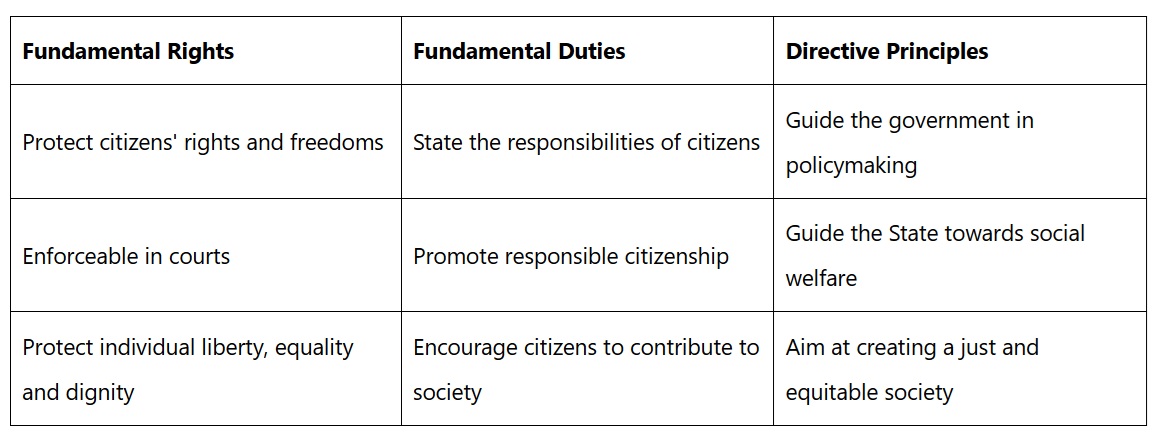
Q: The Constitution not only guarantees Fundamental Rights to citizens but also outlines their Fundamental Duties and the Directive Principles of State Policy. Discuss their significance and identify the differences among them.
Answer: The Fundamental Rights, Fundamental Duties and Directive Principles of State Policy are important parts of the Constitution, but they have different purposes.
- Fundamental Rights protect the freedom, equality and dignity of citizens. They are enforceable in courts, so citizens can seek legal remedies if these rights are violated.
- Fundamental Duties remind citizens of their responsibilities towards the country and society. They encourage responsible citizenship, respect for others’ rights, following laws and rules, and participation in activities that strengthen unity.
- Directive Principles of State Policy (DPSPs) provide guidance to the government in making policies and working towards the welfare of society. The chapter mentions, for example, the government’s duty to protect vulnerable groups and promote their educational and economic interests.
Main difference:
Q: The Right to Education (Article 21A) was added in 2009, ensuring free and compulsory education for children aged 6 to 14. Discuss its significance.
Answer: The Right to Education (Article 21A) was added to the Constitution in 2009. It ensures free and compulsory education for children between 6 and 14 years of age.
Its significance is that it helps ensure that every child has access to education, regardless of their social or economic background. Education enables children to develop knowledge and skills, increases their awareness of their rights and duties, and helps them participate more effectively in democratic society. It also supports the democratic principle of equality of opportunity.
Think About It (NCERT Textbook Page no. 142)
Q: What do you think would happen if the same organ of the government made laws, implemented them, and enforced them? Share your opinion with your classmates.
Answer: If the same organ of government made laws, implemented them and enforced them, there would be a concentration of power in one place. This could lead to misuse of power and arbitrary decisions, as there would be no independent body to check its actions.
Questions and activities (NCERT Textbook Page no. 158-159)
Q: Read the passage and answer the questions that follow:
A school cabinet was responsible for planning a Republic Day celebration, and members had different opinions on which activities to include. After a discussion, they decided to vote, and the activities supported by the majority were selected.
- Which democratic values are reflected in this situation?
- How does voting help resolve differences of opinion?
- Why is the majority decision important in a democracy?
- Mention responsibilities of elected representatives after a decision is made.
Answer: (a) The situation reflects participation, equality, discussion, respect for different opinions and majority rule. All members were given an opportunity to express their views before the decision was taken.
(b) Voting provides a fair and peaceful way to make a decision when people have different opinions. Each member gets a chance to vote, and the option receiving the majority of votes is selected.
(c) The majority decision is important because it allows a group to reach a common decision while respecting the choices of its members. It prevents one person or a small group from imposing its decision on everyone.
(d) After a decision is made, elected representatives should implement the decision responsibly, respect the views of others, remain accountable to the people they represent, and work for the common interest. Democracy requires representatives to remain accountable to the people
2: How would democracy be affected if citizens stopped following laws and civic responsibilities? Explain with an example.
Answer: Democracy depends not only on government institutions but also on responsible citizens. If citizens stopped following laws and fulfilling their civic responsibilities, it could lead to disorder, violation of others’ rights and weakening of democratic values. For example, if people ignored traffic rules, it could endanger others and create disorder.
3: Which situation best reflects the idea of popular sovereignty and why?
(a) A law is passed without public discussion
(b) Citizens vote to choose their representatives
(c) A court gives a final judgment
(d) A minister takes an independent decision
Answer: (b) Citizens vote to choose their representatives.
Explanation: This best reflects popular sovereignty because popular sovereignty means that the ultimate power lies with the people. In a democracy, citizens use their voting right to choose their representatives and form the government. This shows that the government gets its authority from the people.
4: The Rule of Law is violated when:
(a) Laws are applied equally to all
(b) Courts review government actions
(c) Powerful individuals are treated above the law
(d) Citizens challenge laws through legal means
Answer: (c) Powerful individuals are treated above the law
Explanation: The Rule of Law means that everyone is equal before the law and no one is above the law. If powerful individuals are given special treatment or are not punished for breaking laws, then the Rule of Law is violated.
5: Why is the Rule of Law essential for protecting democracy?
Answer: The Rule of Law is essential for protecting democracy because it ensures that everyone is equal before the law and no one is above the law. It prevents misuse of power by powerful people or government authorities. It also protects citizens’ rights by ensuring that disputes are solved through proper legal procedures, not by force or personal influence. Thus, the Rule of Law promotes justice, equality, accountability, and trust in a democratic system.
6: Is voting alone enough to make a country democratic? Support your answer with examples from the chapter.
Answer: No, voting alone is not enough to make a country democratic. Elections are an important part of democracy because they allow citizens to choose their representatives, but a healthy democracy requires several other principles and institutions. These include freedom, equality, participation, Rule of Law, Fundamental Rights, accountability and transparency. In India citizens participate in democracy through Gram Sabhas, Panchayati Raj institutions, local councils, public consultations and community driven initiatives.
Democracy also requires institutions such as the judiciary to protect citizens’ rights and maintain checks and balances, while mechanisms such as the RTI Act strengthen transparency and accountability. Therefore, democracy is not limited to elections; it is a continuous process of participation, responsibility, and respect for democratic values.
7: Social media allows people to express opinions freely.
(a) How can this strengthen democracy?
(b) How can it weaken democracy if used irresponsibly?
Answer: (a) Social media can strengthen democracy by giving people a platform to express their opinions, discuss public issues and raise concerns. It helps citizens stay informed, participate in public discussions and make their voices heard.
(b) If used irresponsibly, social media can spread misinformation and fake news. False information may influence public opinion, create confusion and sometimes lead to conflict. Therefore, citizens should use social media responsibly, verify information and avoid spreading false or harmful content.
8: Write a paragraph on what democracy means to you as a young citizen.
Answer: As a young citizen, democracy means having the freedom to express my views, respect others’ opinions, follow rules, and participate responsibly in society. Democracy gives people equal rights and opportunities and allows citizens to choose their representatives through voting. It also teaches us duties such as respecting public property, using media responsibly, helping others, and following the Constitution. For me, democracy is not only about elections; it is about active participation, responsibility, equality, and working together for a better society.
9: Conduct a model parliament session or Gram Sabha in class on local issues-cleanliness, responsibilities towards public property, or school safety.
Answer: Do it yourself.
10: Choose any one democratic institution in India (such as Parliament, Election Commission, Judiciary, or Panchayat).
Prepare a short note explaining:
a. Its role in democracy
b. How it ensures accountability and participation.
Answer:
Democratic Institution: Parliament
The Parliament is an important democratic institution that represents citizens and participates in the process of law-making and governance. It provides a forum where public issues can be discussed and different viewpoints can be expressed.
Parliament ensures accountability through procedures such as Question Hour, during which members ask questions to the government and examine its work. The auditing of government accounts also helps ensure accountability, while citizens can use mechanisms such as the Right to Information to promote transparency. In this way, Parliament helps ensure that the government remains answerable to the people.
11: What role does the Constitution play in strengthening democracy in India?
Answer: The Constitution plays a very important role in strengthening democracy in India. It provides the basic rules and principles for running the country. It guarantees Fundamental Rights, ensures equality before law, protects citizens from discrimination, and provides the right to vote through Universal Adult Franchise.
The Constitution also separates powers among the legislature, executive, and judiciary, which prevents concentration of power. It supports federalism, local self-government, and protection of vulnerable groups. Thus, the Constitution acts as the foundation of Indian democracy.
12: What challenges do you think democracy in India faces today?
Answer: Democracy in India faces several challenges today. Some major challenges are illiteracy, poverty, inequality, misinformation, fake news, regionalism, gender inequality, social discrimination, and weak implementation of laws.
Fake news on social media can mislead people and create confusion. Poverty and inequality may prevent some citizens from participating equally. Social discrimination and gender inequality can reduce representation of weaker sections. Therefore, democracy needs aware citizens, strong institutions, responsible media, and proper implementation of laws to remain healthy and effective.
About the Chapter: Democracy
The chapter Democracy explores how people take part in governing their society. Students learn about the importance of accountability, rights, constitutional government, and the rule of law in democratic life.
Students also examine the responsibilities of citizens and the challenges democracies face. Examples encourage them to distinguish democratic principles from their practice and consider how informed participation can strengthen public institutions.