

NCERT Solutions for Class 9 English Kaveri Poem 6 A Friend Found in Music are provided here with simple and easy-to-understand explanations. This poem is included in Unit 6 of the NCERT textbook Kaveri. It explores music as a source of comfort, companionship, and emotional strength. These NCERT Solutions for Class 9 help students understand the main ideas, complete textbook activities, improve their language skills, and prepare for school examinations.
A Friend Found in Music Class 9 English Questions and Answers
Reflect and Respond (NCERT Textbook Page No. 194)
I. Read the questions given below and share your answers with your classmates and teacher.
1. What kind of music do you prefer to listen to – vocal or instrumental?
Answer: I prefer instrumental music because it helps me relax and concentrate. I especially enjoy instruments like the violin, flute, and piano.
2. Name your favourite musician(s).
Answer: My favourite musicians are A. R. Rahman and Shreya Ghoshal. I admire A. R. Rahman for his creative compositions and unique blend of Indian and modern music, while Shreya Ghoshal is one of my favourites because of her melodious voice and expressive singing.
3. Give reasons for your choice.
Answer: I chose A. R. Rahman and Shreya Ghoshal because both of them create music that is melodious, emotional, and memorable. A. R. Rahman is known for his creative compositions and his ability to blend Indian and modern styles, while Shreya Ghoshal impresses me with her clear, expressive, and soothing voice
Check Your Understanding (NCERT Textbook Page No. 195)
I. Read the poem again to complete the poet’s diary about her feelings on music. Fill in the blanks with words from the poem.
Today, I’ve been thinking about how essential music is to me. It is like an ocean that calls me to its 1. ________ Music is the 2. ________ that harmonises with my 3. ________ , moving me in ways I can’t explain. When I feel sad or upset about things, music is the 4. ________ that eases the ache. It is amazing how music has the power to lift my 5. ________ , and give me strength to pull through difficult times. I know that it is the effect of music whenever I feel 6. ________ . Music is the much 7. ________ , dependable friend when there is no one to 8. ________ : Thank you, my dear music, for being my all-time comfort.
Answer:
- shore
- rhythm
- core
- therapy
- spirit
- cheerful
- needed
- care
II. Let us appreciate the poem.
1. The phrase ‘moves me’ in the line ‘That moves me to the core,’ is an example of __________.
Answer: The phrase “moves me” is an example of an idiom.
2. The poet uses metaphors for music. List these metaphors and rewrite them as similes.
Answer: The poet uses the following metaphors for music:
- Music is the ocean → Music is as vast and powerful as an ocean.
- Music is the rhythm → Music is like a rhythm that moves the poet deeply.
- Music is the therapy → Music is like a therapy that comforts and heals the poet.
- Music is the needed friend → Music is like a dependable friend who stays with the poet when no one else does.
3. What is the rhyme scheme of the poem? What impact does it have?
Answer: The rhyme scheme is ABCB, where the second and fourth lines of each stanza rhyme (e.g., shore/core, blue/through, there/care). This gives the poem a gentle, flowing musicality that mirrors its subject. The alternating rhyme creates a pleasing rhythm without feeling rigid – like a melody with a recurring but unhurried pattern – making the poem feel like a song itself.
4. What is the poet’s purpose in using the word ‘music’ repetitively?
Answer: The poet repeats the word “music” to emphasize how important and powerful music is in her life. It keeps the reader’s attention focused on the central idea of the poem and shows that music is a constant source of comfort, happiness, strength, and companionship for the poet. The repetition also gives the poem a rhythmic and musical quality.
5. What is the message the poet wishes to convey through the poem?
Answer: The poet wishes to convey that music is a powerful source of comfort, joy, strength, and companionship. It supports us when we feel sad, lifts our spirits, and stays with us even when no one else seems to care. Through the poem, the poet shows that music can deeply influence our emotions and become like a dependable friend in life.
6. Identify the mood of the poem from the options given below.
(i) nostalgic (ii) thoughtful (iii) amused (iv) playful
Answer: (ii) Thoughtful.
7. Give evidence from the poem to support that the speaker is the poet herself.
Answer: The use of first-person expressions such as “I need when I feel blue,” “I’m most cheerful,” and “when no one seems to care” shows that the speaker is expressing her own personal feelings and experiences with music. This suggests that the speaker is the poet herself, describing how music comforts and supports her in different moods.
Critical Reflection (NCERT Textbook Page No. 196)
I. Read the extract given below and answer the questions that follow.
1. Music is the therapy
I need when I feel blue.
Music lifts my spirits
To make sure I pull through.
(i) Complete the following sentence suitably.
The phrase ‘feel blue’ indicates __________.
Answer: The phrase “feel blue” indicates feeling sad, unhappy, or low in spirits.
(ii) Identify the line which shows music makes the poet happy.
Answer: The line is: “Music lifts my spirits”
(iii) What does the last line of the extract signify?
Answer: The last line, “To make sure I pull through,” signifies that music gives the poet strength and courage to overcome difficult times. It acts as a source of emotional support and helps her face challenges.
(iv) State whether the following sentence is true or false.
Music plays a vital role in the poet’s life.
Answer: True.
(v) Select the central idea of the extract from the following options.
A. Music brings comfort during sadness.
B. Music is a necessity in times of happiness.
C. Music improves our ability to pull heavy loads.
D. Music is a source of knowledge and excitement.
Answer: A. Music brings comfort during sadness.
II. Answer the following questions.
1. How is music able to move the poet ‘to the core’?
Answer: Music is able to move the poet “to the core” because it deeply affects her emotions. It can make her feel comforted, cheerful, and strong, especially when she is sad or troubled. Thus, music touches her heart and has a powerful emotional influence on her.
2. Why does the poet compare music to a ‘needed friend’?
Answer: The poet compares music to a “needed friend” because music gives her comfort, support, and companionship, especially when she feels lonely or sad. Just like a true friend, music stays with her and helps her feel better when no one else seems to care.
3. Explain the poet’s attitude towards music.
Answer: The poet has a deep love and strong emotional connection with music. She considers music a source of comfort, strength, and happiness that helps her overcome sadness and difficult times. She also sees music as a “needed friend” that stays with her when no one else seems to care.
4. Support the opinion that this poem has a universal appeal.
Answer: The poem has universal appeal because music is enjoyed and valued by people of all ages and backgrounds. Feelings such as sadness, loneliness, happiness, and the need for comfort are common to all people. Music can comfort us when we are sad, lift our spirits, and give us strength during difficult times. The poet also presents music as a dependable friend when no one else seems to care.
5. Compare your experience of music with the feelings expressed in the poem.
Answer: My experience of music is similar to the poet’s feelings because music makes me feel happy, relaxed, and positive. I often listen to music when I am sad or stressed, and it helps me feel better and gives me strength. Like the poet, I also feel that music can be a comforting friend during difficult times.
Vocabulary in Context (NCERT Textbook Page No. 197-198)
I. Read the following phrases from the poem denoting happiness and sadness.
Classify the words given in the box as positive emotions and negative emotions.

Positive emotions (happiness): ________.
Negative emotions (sadness): ________.
Answer: Positive emotions (happiness): lifts my spirits, most cheerful
Negative emotions (sadness): feel blue
Now, fill in the blanks by choosing the correct word from those given in the brackets.
1. The familiar tune stimulated a rush of ________ , transporting listeners back to cherished moments from their past. (nostalgia/ elation)
Answer: nostalgia
2. The soulful ballad expressed the singer’s ________ , leaving the audience moved by the intensity of their emotions. (despondence/ anguish)
Answer: anguish
3. The pianist played a soulful melody on the stage, creating an ambience of ________ . (melancholy/despair)
Answer: melancholy
4. The festive symphony filled the air with ________ tones, lifting the spirits of everyone present on the joyous occasion. (jubilant/ euphoric)
Answer: euphoric
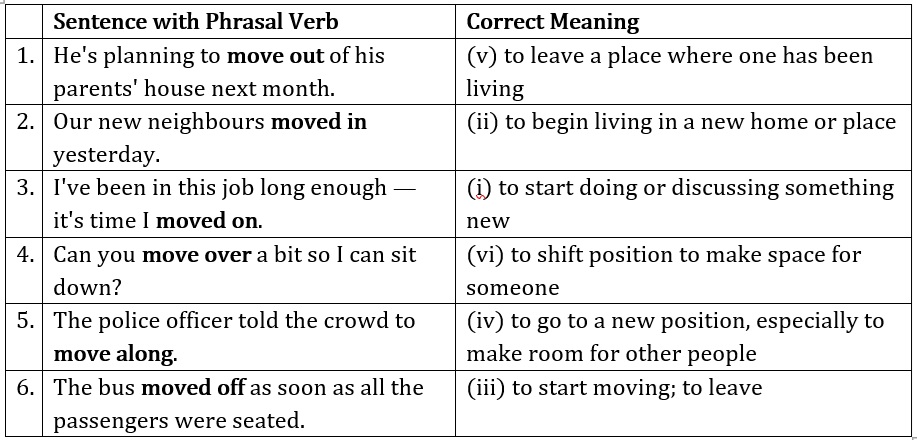
III. Choose the correct meaning from the box for the underlined phrasal verbs in the following sentences.
1. He’s planning to move out of his parents’ house next month.
2. Our new neighbours moved in yesterday.
3. I’ve been in this job long enough-it’s time I moved on.
4. Can you move over a bit so I can sit down?
5. The police officer told the crowd to move along.
6. The bus moved off as soon as all the passengers were seated.
(i) to start doing or discussing something new
(ii) to begin living in a new home or place
(iii) to start moving, to leave
(iv) to go to a new position, especially in order to make room for other people
(v) to leave a place where one has been living
(vi) to shift position to make space for someone or something
Answer:
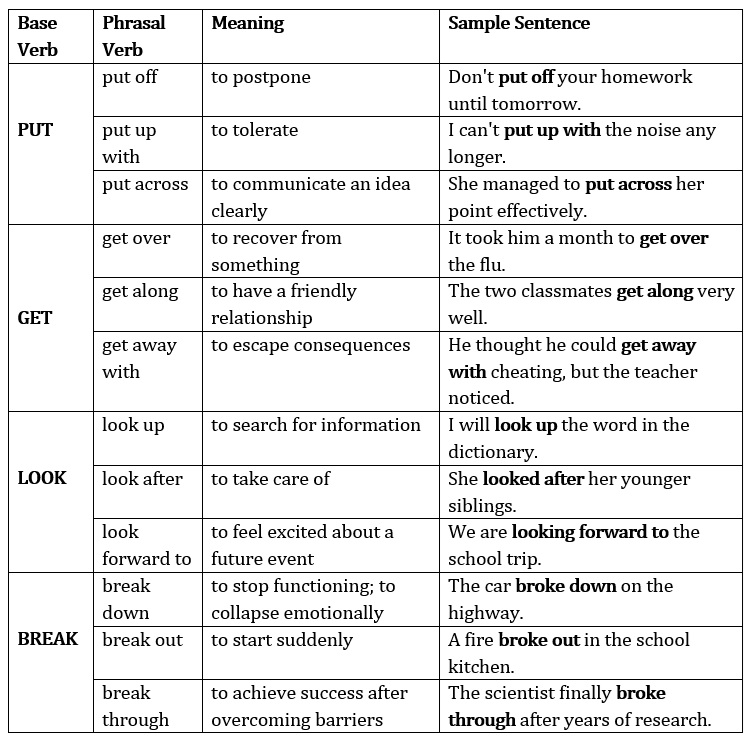
IV. Create phrasal verbs from the verbs ‘put’, ‘get’, ‘look’, ‘break’. Find the meanings of the phrasal verbs you create. Make sentences with the phrasal verbs. Discuss them with your classmates and teacher.
Answer:
Listen and Respond (NCERT Textbook Page No. 199)
I. Before you listen, read the questions and guess the responses to the given questions.
1: How are the two speakers connected?
(i) parent-child
(ii) teacher-student
(iii) brother-sister
Answer: (i) parent-child
2: Where is the conversation taking place?
(i) music centre
(ii) park
(iii) school reception area
Answer: (i) music centre
3: Which musical instrument is the reason for the problem?
(i) sitar
(ii) santoor
(iii) sarod
Answer: (ii) santoor
4: What is the problem being discussed?
(i) inability to play the musical instrument
(ii) irregularity of the music class
(iii) lack of choice of the musical instrument
Answer: (i) inability to play the musical instrument
5: What has been the unsuccessful solution?
(i) practising for longer hours
(ii) singing while playing the instrument
(iii) watching videos about playing the instrument
Answer: (iii) watching videos about playing the instrument
6: What is the final decision taken?
(i) change classes
(ii) pick a simpler instrument
(iii) purchase the musical instrument
Answer: (iii) purchase the musical instrument
II. Now, listen to the conversation between the two people. As you listen, check your answers and rectify them wherever needed. Once done, discuss your responses with your classmates and teacher. (Transcript for teacher on page 270)
Answer: I checked the answers, all of the them are correct.
Writing Task (NCERT Textbook Page No. 200-201)
I. Your school is organising a musical evening on 21 June, World Music Day. You are presenting a Sitar recital at the event. Draft an invitation letter requesting your grandparents to attend the event.
Answer:
24, Sector 8,
Delhi – 100 001
16 June 20XX
Dear Grandma and Grandpa,
I hope you are both in the best of health and enjoying the summer. I have been thinking of you a lot, and I have a very special reason for writing to you today.
Our school, Paul Public School, is organising a grand musical evening on 21 June 20XX to celebrate World Music Day. The event will be held in the School Auditorium, Sector 12, Delhi, and will begin at 5:30 p.m. There will be several wonderful vocal and instrumental performances by the students.
The most exciting news is that I will be presenting a Sitar recital at the event! It will be my first performance before a large audience, and I have been practising very hard for the past two months. I would be extremely happy if both of you could be there to watch and encourage me.
Please do try to come for the occasion. Your presence would mean a lot to me and would make the evening even more special. You are also most welcome to stay with us for a few days afterwards.
I eagerly await your response. Please write back or call soon.
Yours affectionately,
Karan
About the Poem: A Friend Found in Music
The poem A Friend Found in Music presents music as a dependable presence during both happy and difficult moments. Through comparisons with familiar sources of strength and relief, the speaker expresses a deep emotional bond with music.
Students also explore metaphor, repetition, and the poem’s personal tone. The activities help them understand how poetic images communicate feelings and reflect on the role of art in offering comfort and connection.