

NCERT Solutions for Class 9 English Kaveri Poem 4 I Cannot Remember My Mother are provided here with simple and easy-to-understand explanations. This poem is included in Unit 4 of the NCERT textbook Kaveri. It explores childhood memory, a mother’s lasting presence, and the emotions awakened by familiar sensations. These NCERT Solutions for Class 9 help students understand the main ideas, complete textbook activities, improve their language skills, and prepare for school examinations.
I Cannot Remember My Mother Class 9 English Questions and Answers
Reflect and Respond (NCERT Textbook Page No. 126)
I. Work in pairs. Discuss the memories from your childhood that you remember. List them and share with your classmates and teacher.
Answer: Some childhood memories that I remember are:
- Playing with my friends in the evening.
- Celebrating birthdays with my family.
- Going on picnics and family trips.
- Listening to stories told by my grandparents.
- Taking part in school functions and competitions.
- Enjoying festivals with my family.
- Playing games during the summer holidays.
- Receiving gifts and spending time with my relatives.
These memories are special to me because they remind me of the happy, carefree days of my childhood.
II. Discuss how children’s relationship with their mother can influence their emotions and memories.
Answer: A child’s relationship with their mother can have a deep influence on their emotions and memories. A loving and caring mother leaves behind memories that may remain even when specific details are forgotten. In the poem, the poet cannot clearly remember his mother, but her presence returns through the tune she used to hum while rocking his cradle, the fragrance of shiuli flowers associated with the morning service, and the stillness of her gaze reflected in the sky. These memories show how a mother’s love can remain deeply connected with a child’s emotions and experiences even after many years.
III. Match the words given in Column 1 with their meanings in Column 2.
| Column 1 | Column 2 |
| 1. hover | (i) sing a tune with your lips closed |
| 2. hum | (ii) a type of flower (coral jasmine) |
| 3. cradle | (iii) look steadily for a long time |
| 4. shiuli | (iv) rituals conducted in a temple |
| 5. morning service | (v) linger or remain near a place |
| 6. gaze | (vi) a small bed for a baby |
Answer:
| Column 1 | Column 2 (Correct Match) |
| 1. hover | (v) linger or remain near a place |
| 2. hum | (i) sing a tune with your lips closed |
| 3. cradle | (vi) a small bed for a baby |
| 4. shiuli | (ii) a type of flower (coral jasmine) |
| 5. morning service | (iv) rituals conducted in a temple |
| 6. gaze | (iii) look steadily for a long time |
Check Your Understanding (NCERT Textbook Page No. 127-129)
I. Fill in the blanks with appropriate words.
Stanza 1
1. The poet remembers his mother while he __________.
2. The poet remembers the __________ but not the __________.
Setting: __________ (outdoor/indoor)
Answer: 1. The poet remembers his mother while he is playing.
2. The poet remembers the tune but not the words of the song.
Setting: Indoor
Stanza 2
1. The poet remembers his mother in the __________ season.
2. The poet remembers his mother by the smell of __________.
Setting: __________ (outdoor/indoor)
Answer: 1. The poet remembers his mother in the early autumn season.
2. The poet remembers his mother by the smell of shiuli flowers.
Setting: outdoor
Stanza 3
1. The poet feels that his mother __________ at him from the __________.
Setting: __________ (outdoor/indoor)
Answer:
1. The poet feels that his mother gazes at him from the distant blue sky.
Setting: Indoor
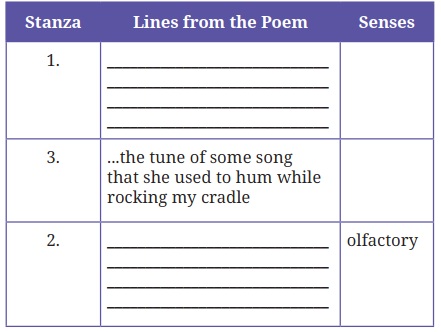
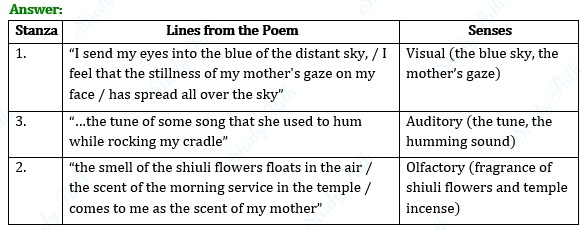
II. The senses of olfactory (smell), auditory (hearing), and visual (sight) are three of the five basic senses in humans. Give examples of references to senses from the poem. Complete the table.
III. Read the poem silently once again and complete the following.
1. Two examples of alliteration from the poem are (i) __________ and (ii) __________.
Answer: Two examples of alliteration from the poem are:
(i) “smell of the shiuli flowers”
(ii) “scent of the morning service”
Both use the repetition of the ‘s’ sound.
2. An example of onomatopoeia is __________.
Answer: An example of onomatopoeia is “hum.”
3. The poem uses imagery extensively. Explain.
Answer: The poem uses visual, auditory, and olfactory imagery to bring the poet’s memories of his mother to life. The tune she used to hum appeals to the sense of hearing, the scent of shiuli flowers appeals to the sense of smell, and the blue distant sky and his mother’s gaze appeal to the sense of sight. These sensory images make his memories vivid and emotional.
4. Although the poem does not have a rhyme scheme, it is enjoyable because __________.
Answer: Although the poem does not have a rhyme scheme, it is enjoyable because its musical language, repetition, vivid imagery, and gentle flow create a lyrical and emotional effect.
5. What is the tone of the poet? Why do you say so?
Answer: The tone of the poet is nostalgic and emotional because he remembers his mother through the tune she used to hum, the fragrance of shiuli flowers and the stillness of her gaze. These memories create a sense of love, longing and sadness for his mother, whom he cannot clearly remember.
6. What impact does the title of the poem have on the overall mood of the poem?
Answer: The title “I Cannot Remember My Mother” creates a sad, nostalgic and emotional mood throughout the poem. It highlights the poet’s inability to remember his mother clearly, while the memories of her still return through her humming tune, the fragrance of shiuli flowers and her loving gaze. This makes the poem deeply touching and full of love and longing.
7. The poet uses “I cannot remember my mother” as a refrain because __________.
Answer: The poet uses “I cannot remember my mother” as a refrain because it emphasises his inability to remember his mother clearly, while showing that her presence still lives on through his childhood memories and the sights, sounds, and scents around him.
8. The poet uses symbolism to indicate the memory of his mother’s presence. Identify the symbols used in the poem.
Answer: The symbols used in the poem to indicate the memory of the mother’s presence are the humming tune, the shiuli flowers and their fragrance, and the blue distant sky. The humming tune reminds the poet of his mother rocking his cradle, the scent of shiuli flowers reminds him of her presence through the morning temple service, and the blue sky symbolises the stillness of his mother’s loving gaze.
Critical Reflection (NCERT Textbook Page No. 126)
I. Read the extracts given below and answer the questions that follow.
Extract 1:
I cannot remember my mother
only sometimes in the midst of my play
a tune seems to hover over my playthings,
(i) Complete the following sentence appropriately:
The poet is reminded of his mother during his ___________.
Answer: The poet is reminded of his mother during his playtime.
(ii) What is the primary emotion conveyed by the line ‘a tune seems to hover over my playthings’?
A. It enhances the joy of play.
B. It disrupts the playtime atmosphere.
C. It activates memories of the mother.
D. It symbolises the carefree nature of childhood.
Answer: C. It activates memories of the mother.
Reason: The tune that seems to hover over the poet’s playthings reminds him of the song his mother used to hum while rocking his cradle. Thus, the tune brings back memories of his mother during his playtime.
(iii) In the context of the poem, what role does the hovering tune play during the speaker’s playtime?
Answer: The hovering tune reminds the speaker of his mother during his playtime. It is the song she used to hum while rocking his cradle, so the tune brings back a sense of her love and presence, even though he cannot clearly remember her.
(iv) State whether the following sentence is true or false:
The poet experiences the tune lingering over playthings only occasionally during playtime.
Answer: True.
Reason: The poet says that “only sometimes in the midst of my play” a tune seems to hover over his playthings. This shows that the tune comes to him occasionally during playtime and reminds him of his mother.
(v) How could the poet feel his mother’s presence, even though she isn’t there?
Answer: The poet could feel his mother’s presence through the familiar tune she used to hum, the fragrance of shiuli flowers and the scent of the morning temple service. He also feels that the stillness of his mother’s gaze has spread across the blue sky. These memories connect him with his mother and make her presence feel close, even though she is not physically there.
Extract 2:
I feel that the stillness of
my mother’s gaze on my face
has spread all over the sky.
(i) What does the poet suggest about the stillness of his mother’s gaze spreading over the sky?
A. The mother’s gaze is physically present in the sky.
B. The sky is a symbolic extension of the mother’s presence.
C. The sky mirrors the mother’s emotions.
D. The stillness is fleeting and unrelated to the mother.
Answer: B. The sky is a symbolic extension of the mother’s presence.
Reason: The poet suggests that his mother’s gaze and presence seem to spread across the sky. The sky therefore becomes a symbol of his mother’s continuing presence and the emotional connection he still feels with her.
(ii) What emotion does the poet associate with the ‘stillness’ of his mother’s gaze?
A. a sense of grief
B. a sense of anticipation
C. a sense of nostalgia
D. a sense of serenity
Answer: D. a sense of serenity.
Reason: The word “stillness” suggests a feeling of peace and calmness. The poet imagines his mother’s gentle, loving gaze spreading across the quiet blue sky, creating a sense of serenity and comfort.
(iii) State whether the following sentence is true or false:
The poet suggests that the mother’s gaze has a tangible and visual effect on the sky.
Answer: False.
Reason: The effect is not tangible or physically visible. It is emotional and metaphorical. The poet uses the sky as a symbolic extension of his mother’s presence, imagining that the stillness of her gaze has “spread all over the sky.” It represents how deeply her memory is felt by him rather than suggesting that her gaze has a literal, visible effect on the sky.
(iv) What is the purpose of likening the mother’s gaze to the sky?
Answer: The purpose of likening the mother’s gaze to the sky is to show how deeply her presence is felt by the poet even though she is absent. The vast blue sky becomes a symbolic extension of her gentle and watchful gaze, suggesting that her loving presence seems to surround the poet everywhere.
(v) Complete the sentence appropriately: The tone of the poet in the given extract is _____________ because _____________.
Answer: The tone of the poet in the given extract is nostalgic and serene because he lovingly recalls his mother’s gentle, still gaze and imagines its presence spreading across the vast blue sky.
II. Answer the following questions.
1. What is the emotional impact of the refrain, ‘I cannot remember my mother’?
Answer: The refrain “I cannot remember my mother” creates a deep sense of nostalgia, longing, and emotional loss. Although the poet cannot clearly remember his mother, the repeated line is followed by memories of her humming tune, the fragrance of shiuli flowers, and her gentle gaze, showing that her presence still lives in his mind. The repetition makes the poem more touching and shows the deep bond between the poet and his mother.
2. Interpret the connection between the poet’s mother and the following: (i) shiuli flowers (ii) humming tune
Answer: (i) Shiuli flowers: The scent of the shiuli flowers reminds the poet of his mother. It brings back the memory of the morning temple service, whose fragrance he associates with her presence.
(ii) Humming tune: The tune reminds the poet of the songs his mother used to hum while rocking his cradle. Even though he cannot clearly remember her, the familiar tune makes him feel her loving presence.
3. What role does nature play in the poet’s description of the memory of his mother?
Answer: Nature acts as a bridge between the poet and his memories of his mother. The fragrance of shiuli flowers in the autumn morning reminds him of his mother’s scent, while the blue distant sky makes him feel the calm and loving gaze of his mother. Thus, natural sights and smells bring back his mother’s presence and make his memories of her more vivid and emotional.
4. What can be inferred about the poet’s perception of the mother-child relationship?
Answer: The poet perceives the mother-child relationship as deep, loving, and lasting. Although he cannot clearly remember his mother, her presence continues to be felt through the humming tune of her song, the scent of shiuli flowers, and the stillness of her gaze. This suggests that a mother’s love becomes a lasting part of a child’s emotional memory and remains with the child even when she is no longer physically present.
Vocabulary in Context (NCERT Textbook Page No. 131-133)
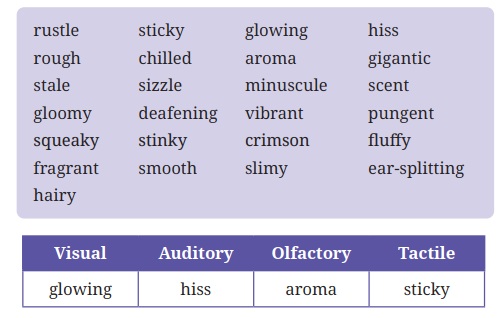
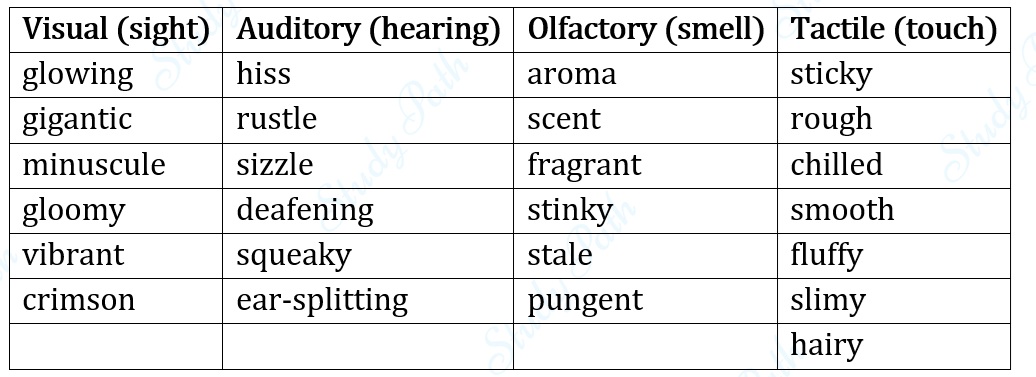
I. Work in pairs to classify the sensory words given in the box. One example has been done for you.
Answer:
II. Fill in the blanks with sensory words from the box for the passage written by Sarojini Naidu. There are two extra words.

Come and share my exquisite March morning with me: this sumptuous blaze of gold and sapphire sky; these 1 . _______ lilies that adorn the sunshine; the voluptuous 2. _______ of neem and champak and serisha that beat upon the languid air with their implacable 3. _______ ; the thousand little gold and blue and silver breasted birds bursting with the 4. _______ ecstasy of life in nesting time. And, do you know that the scarlet lilies are woven petal by petal from my heart’s blood, these little quivering birds are my soul made incarnate music, these heavy 5. _______ are my emotions dissolved into aerial 6. _______ , this 7. _______ blue and gold sky is the ‘very me’…
Answer: Come and share my exquisite March morning with me: this sumptuous blaze of gold and sapphire sky; these 1. scarlet lilies that adorn the sunshine; the voluptuous 2. perfumes of neem and champak and serisha that beat upon the languid air with their implacable 3. scents; the thousand little gold and blue and silver breasted birds bursting with the 4. sweetness ecstasy of life in nesting time. And, do you know that the scarlet lilies are woven petal by petal from my heart’s blood, these little quivering birds are my soul made incarnate music, these heavy 5. flaming are my emotions dissolved into aerial 6. essence, this 7. shrill blue and gold sky is the ‘very me’…
Extra words (not used): sizzle, smooth
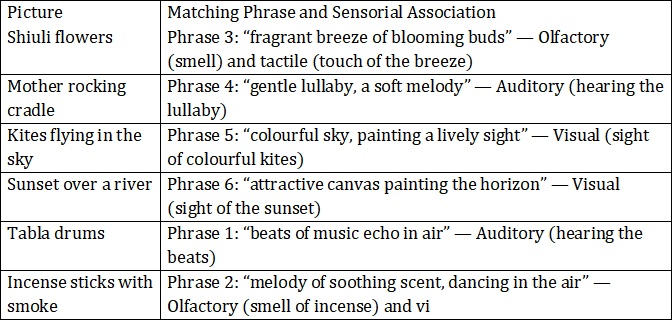
III. Write numbers against each picture with the phrases that describe them with their sensorial associations.
- beats of music echo in air
- melody of soothing scent, dancing in the air
- fragrant breeze of blooming buds
- gentle lullaby, a soft melody
- colourful sky, painting a lively sight
- attractive canvas painting the horizon

Answer:

Writing Task (NCERT Textbook Page No. 135)
I. Imagine you had been on a school trip to a scenic place which appealed to all your senses. Write a diary entry describing the place and why it was a memorable experience.
Answer:
15 August 2026, Saturday
9:30 p.m.
Dear Diary,
Today was one of the most memorable days of my life. Our school took us on a trip to a beautiful hill station surrounded by green mountains, tall trees, and colourful flowers.
The cool breeze touched my face, while the sweet fragrance of flowers filled the air. I could hear birds chirping, leaves rustling, and water flowing in a nearby stream. The clear blue sky and the beautiful hills looked wonderful in the sunlight. We also enjoyed some warm snacks, which tasted even better in the cool weather.
What made the trip special was the peaceful beauty of the place and the time I spent with my friends and teachers. Every sight, sound, smell, touch, and taste made the experience unforgettable. I will always remember this wonderful trip.
Good night!
About the Poem: I Cannot Remember My Mother
The poem I Cannot Remember My Mother explores how memories of a mother can remain through sounds, scents, and impressions even when her face is difficult to recall. The speaker’s experiences connect the natural world with feelings of love and loss.
Students also explore sensory imagery, tenderness, and the poem’s reflective mood. The activities help them understand how ordinary experiences evoke powerful emotions and how poetic language expresses memories that are difficult to describe directly