

NCERT Solutions for Class 9 English Kaveri Poem 8 Believe in Yourself are provided here with simple and easy-to-understand explanations. This poem is included in Unit 8 of the NCERT textbook Kaveri. It explores self-confidence, courage, and the importance of taking the first step towards a goal. These solutions help students understand the text and complete textbook activities with confidence.
These NCERT Solutions for Class 9 help students understand the main ideas, complete textbook activities, improve their language skills, and prepare for school examinations.
Believe in Yourself Class 9 Questions and Answers
Reflect and Respond (NCERT Textbook Page No. 245)
I. Imagine that you are the person in the image (standing at the base of a difficult task).
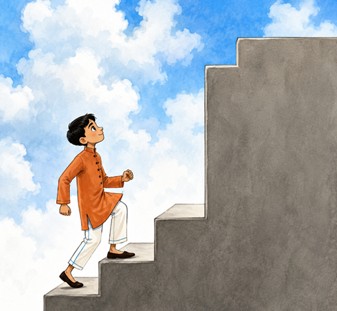
1. What emotions do you feel standing at the base of a difficult task?
Answer: Standing at the base of a difficult task, I feel nervous, uncertain, and a little afraid, but also excited and determined to face the challenge. These mixed emotions come from not knowing how difficult the journey will be, while still wanting to move forward and succeed.
2. What might make you take the first step?
Answer: My determination to achieve my goal, along with encouragement from my parents, teachers, or friends, might make me take the first step. Believing that every difficult journey begins with a small action can give me the courage to move forward despite fear or uncertainty.
II. Think about a time when you had to face a challenge.
1. What was it, and how did you feel at the start of the journey?
Answer: One challenge I faced was preparing for an important examination while managing several subjects at the same time. At the start of the journey, I felt nervous, overwhelmed, and unsure whether I would be able to complete everything on time. However, I was also determined to work hard and improve step by step.
2. How did you feel once you made the decision to move forward?
Answer: Once I decided to move forward, I felt more confident, focused, and hopeful. Taking the first step reduced my fear and made the challenge seem more manageable. I also felt motivated because I knew I had started working towards my goal.
III. What does the phrase ‘believe in yourself’ mean to you? Write some words or phrases you associate with believing in yourself.
Answer: To me, “believe in yourself” means having confidence in my abilities and trusting that I can face difficulties and achieve my goals through effort and perseverance.
Some words and phrases I associate with believing in myself are self-confidence, courage, determination, positive thinking, perseverance, hope, resilience, taking initiative, facing challenges, and never giving up. The poem also emphasizes that believing in oneself helps us take the difficult first step and keep our future on track.
IV. Select the correct meaning of ‘status quo’ based on the given sentence.
“Even though some kids wanted to try new activities, most of them were happy with the status quo and didn’t want any changes.”
1. A plan to make things more exciting.
2. A situation to keep things the same.
3. A decision where everything is completely different.
4. A choice to change things quickly without thinking.
Answer: 2. A situation to keep things the same.
‘Status quo’ is a Latin phrase meaning ‘the existing state of affairs’ – the children were comfortable with how things were and did not want anything to change.
Check Your Understanding (NCERT Textbook Page No. 245)
I. Based on your understanding of the poem, select the correct central idea for each stanza.
Stanza 1 – “Step up to the challenge / There is no crowd to see…”
(i) Facing challenges requires personal responsibility and a clear focus on one’s future.
(ii) Facing challenges is a journey best taken with support and guidance from others.
Answer: (i) Facing challenges requires personal responsibility and a clear focus on one’s future.
Stanza 2 – “Will it pull you forward / Or push you back in fear?…”
(i) Fear and uncertainty make it difficult to make choices as the future approaches.
(ii) Facing the future with confidence makes choices easier and more straightforward.
Answer: (i) Fear and uncertainty make it difficult to make choices as the future approaches.
Stanza 3 – “There is such ease in comfort / To maintain the status quo…”
(i) Personal growth involves finding balance between comfort and change.
(ii) Personal growth requires leaving behind comfort and embracing change.
Answer: (ii) Personal growth requires leaving behind comfort and embracing change.
Stanza 4 – “The first step is the hardest / There is no turning back…”
(i) The first step towards change may feel easy if you place your trust in others to guide you.
(ii) The first step towards change is difficult, but having self-belief and confidence helps you stay on track.
Answer: (ii) The first step towards change is difficult, but having self-belief and confidence helps you stay on track.
II. Rhyme Scheme – Fill in the blank to complete the following sentence.
The poem follows a simple, yet effective rhyme scheme __________ that flows steadily through each stanza.
Answer: ABCB
III. Tone
State whether the following statements are true or false.
1. The overall tone of the poem is motivational and encouraging.
Answer: True
Reason: The poem inspires us to face challenges bravely and believe in ourselves. It encourages us to take the first step toward our future.
2. The tone shifts from thoughtful in the beginning to one of determination by the end of the poem.
Answer: True
Reason: At first, the poem makes us think deeply about the difficult choices ahead. By the end, it motivates us to act with confidence and determination.
IV. Speaker
Fill in the blanks with the correct options.
The speaker in this poem is not distant; rather, he/ she comes across as a ________ (stranger/guide) who understands the struggle and is encouraging the reader to take ________ (interest in/control of) his/her own future.
The use of direct address ‘You’ creates a close connection, as though the speaker is ________ (talking directly to the reader/addressing the reader from a distance).
Answer: The speaker comes across as a guide who is encouraging the reader to take control of his/her own future. The use of ‘You’ creates a close connection, as though the speaker is talking directly to the reader.
V. Imagery
Match the phrases from the poem in Column 1 with the imagery they represent in Column 2. An extra representation is given.
| Column 1 | Column 2 |
| 1. There is no crowd to see… | (i) Represents the difficulty of beginning a new challenge or change. |
| 2. push you back in fear? | (ii) Suggests a solitary journey, stressing individual effort. |
| (iii) Evokes the mental barrier that prevents growth. |
Answer:
| Column 1 | Column 2 |
| 1. There is no crowd to see… | (ii) Suggests a solitary journey stressing individual effort. |
| 2. push you back in fear? | (iii) Evokes the mental barrier that prevents growth. |
VI. Symbolism
Select the words/phrases from the box to complete the given sentences.

1. Comfort and the status quo represent ________ and fear of change, symbolising the comfort zone that holds one back.
Answer: stagnation
2. The future symbolises the ________ , the potential for change and success that lies ahead but requires ________ to step into.
Answer: unknown, leap of faith
3. The first step symbolises the initial ________ required to begin the journey of ________ or personal development.
Answer: courage, self-improvement
VII. Metaphor
The poet uses a metaphor in the line, ‘The first step is the hardest’. Explain why this is metaphorical.
Answer: The line “The first step is the hardest” is metaphorical because the “first step” does not mean an actual physical step. It represents the first action or decision taken towards facing a challenge or pursuing a goal.
The poet suggests that beginning is often the most difficult part because fear, doubt, and uncertainty can hold us back. Once we decide to move forward and believe in ourselves, the journey becomes easier to continue.
VIII. Antithesis
The poem uses antithesis in a couple of lines
Identify the lines from the poem that show antithesis and explain why it is so.
Answer: The lines that show antithesis are:
“Will it pull you forward
Or push you back in fear?”
The words “pull you forward” and “push you back” express opposite ideas. This contrast highlights the two possible reactions to a challenge: we may either move ahead with courage or retreat because of fear. The antithesis makes the choice between progress and hesitation more striking.
Example 1: “Will it pull you forward / Or push you back in fear?”
Two directly opposite forces – “pull forward” and “push back” – are placed in parallel structure. “Forward” and “back” are directional opposites, capturing the internal conflict between courage and fear, progress and retreat.
Example 2: “There is such ease in comfort / … But this isn’t what we are made for / This isn’t how we grow.”
“Ease in comfort” (passive stagnation) is contrasted with “how we grow” (active transformation). The antithesis highlights that what feels safe is not what makes us better, and what makes us grow is not what feels safe – driving home the poem’s central message.
Critical Reflection (NCERT Textbook Page No. 250-251)
I. Read the extract given below and answer the questions that follow.
1. Step up to the challenge
There is no crowd to see,
It’s just you and the future
And where you want to be.
(i) What does the line, ‘There is no crowd to see’ suggest about facing challenges?
Answer: The line “There is no crowd to see” suggests that facing a challenge is often a personal struggle. There may be no audience to watch, praise, or encourage us, so we must rely on our own courage, determination, and self-belief to move forward.
(ii) Complete the following suitably.
The line ‘It’s just you and the future’ suggests that _________.
Answer: The line “It’s just you and the future” suggests that your future depends largely on the choices you make and the courage you show when facing challenges. It emphasizes personal responsibility and the need to move forward with self-belief.
(iii) Fill in the blank with the appropriate word/phrase from the extract.
Latha will ________ her efforts to improve her vocal performance by practising harder each day.
Answer: Latha will step up her efforts – from the opening line “Step up to the challenge,” meaning to increase effort or rise to meet a demand.
(iv) Select the most suitable title for the extract.
A. The Struggles of Change
B. Facing the Future Alone |
C. A Journey of Growth
D. The Power of Fear
Answer: C. A Journey of Growth.
(v) Complete the analogy by using a word from the extract.
achieve : goal :: face : _________
Answer: achieve : goal :: face : challenge
II. Answer the following questions.
1. What is the significance of the metaphor, ‘The first step is the hardest’ in the context of personal growth?
Answer: The metaphor “The first step is the hardest” means that beginning a difficult task or making the decision to change is often the most challenging part. In the context of personal growth, it suggests that fear, doubt, and uncertainty can hold us back at first, but once we take that initial step, we begin to gain confidence and move forward. The poem therefore shows that growth starts when we overcome hesitation, believe in ourselves, and take action.
2. What message does the antithesis in the poem convey about the nature of personal development?
Answer: The antithesis in the poem conveys that personal development involves a choice between moving forward with courage and being held back by fear. The contrast between “pull you forward” and “push you back” shows that growth happens when a person leaves the comfort of the status quo, faces challenges, and chooses progress over hesitation.
3. Do you think the poet’s message is realistic in the context of real-world struggles? (Evaluate whether simply ‘believing in yourself’ is enough to overcome obstacles or other factors are also necessary.)
Answer: The poet’s message is realistic to an extent. Believing in yourself is important because it gives you the courage to take the first step and continue despite fear or uncertainty. The poem stresses that self-belief helps a person move forward and keep the future “on track.”
However, in real life, self-belief alone may not be enough. Personal growth also requires effort, planning, perseverance, support from others, and the ability to deal with practical difficulties. So, the poem gives an important starting message, but real-world success usually depends on both confidence and sustained action.
4. Consider a situation where you or someone you know had to take a difficult first step towards a goal. How does the poem’s message about the importance of self-belief apply to this situation?
Answer: My classmate Aman was afraid of giving speeches in the school assembly. He never volunteered to share the “Thought of the Day”, even when we encouraged him. However, one day he decided to participate in a debate competition. For him, the most difficult first step was enrolling in the competition, because it meant stepping out of his comfort zone and facing an audience.
The poem’s message applies well to Aman’s situation. It suggests that the first step is often the hardest, but self-belief gives us the courage to overcome fear and move forward. In Aman’s case, believing in himself helped him face the crowd instead of turning back. Thus, self-belief acted like a driving force that kept him on track towards his goal.
Vocabulary in Context (NCERT Textbook Page No. 251-253)
I. The phrase ‘status quo’ is a Latin expression that translates to ‘the state in which’ or ‘the existing state of affairs.’ Over time, it has become a popular term used in English to refer to the current situation or condition, especially when things remain unchanged.
There are other Latin terms commonly used in English.
Read a few given below along with their meanings.
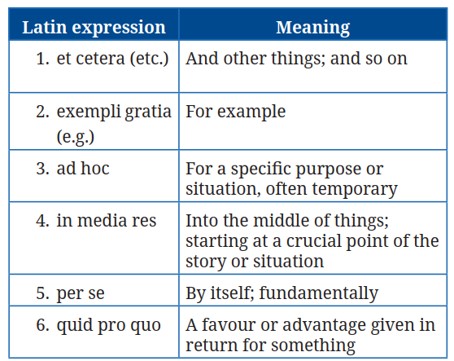
Now, fill in the blanks in the given sentences with the Latin expressions used in English from the table.
(i) I enjoy reading fantasy books, ________ Harry Potter and Magical Paint Brush.
Answer: e.g. Harry Potter
(ii) After helping Tanya with the homework, Ritu asked for a ________ to borrow her notes next time.
Answer: quid pro quo (a favour given in return of something)
(iii) I love all kinds of outdoor activities, such as trekking, hiking, biking, ________ .
Answer: etc. (et cetera)
(iv) The park is not very special ________ ; it becomes more fun when you visit with friends.
Answer: per se (by itself, fundamentally)
(v) We created an ________ team to organise the school festival.
Answer: ad hoc (for specific purpose often temporary)
(vi) The movie started ________ , with the hero already fighting the villain in a huge battle.
Answer: in media res (into the middle of something)
II. The line, ‘Will it pull you forward/or push you back in fear?’ is a rhetorical question.
A rhetorical question is a question that doesn’t require an answer because it is used to make the reader think or reflect on a particular idea.
1. Read the following rhetorical questions and state what they intend to achieve.
(i) Isn’t it obvious that we must act now? Don’t we all have a responsibility to make a change?
(ii) Will we let fear control us, or will we rise above it?
Answer:
(i) These questions are meant to urge the listener to take immediate action and make them feel a sense of shared responsibility. They encourage people to reflect on their duty instead of remaining passive.
(ii) This question is meant to make the listener choose courage over fear. It encourages self-reflection and motivates people to overcome hesitation and face challenges bravely.
2. Match the situations in Column 1 to the rhetorical questions in Column 2.
| Column 1 | Column 2 |
| (i) Deciding whether to stand up for what is right | A. How can we ever grow if we never try anything new? |
| (ii) Owning up to a mistake made in a group project | B. Isn’t it better to admit our mistakes than to let them define us? |
| (iii) Deciding whether to try something challenging, like public speaking | C. If I don’t take responsibility now, when will I? |
| (iv) Choosing between two career paths | D. Can I really move forward without knowing which path to take? |
Answer:
| Column 1 | Column 2 |
| (i) Deciding whether to stand up for what is right | F. How can we stay silent when we know what is right? |
| (ii) Owning up to a mistake made in a group project | C. If I don’t take responsibility now, when will I? |
| (iii) Deciding whether to try something challenging, like public speaking | A. How can we ever grow if we never try anything new? |
| (iv) Choosing between two career paths | D. Can I really move forward without knowing which path to take? |
| (v) Deciding whether to apologise for a mistake | B. Isn’t it better to admit our mistakes than to let them define us? |
| (vi) Trying something new and stepping out of your comfort zone | E. What’s the point of playing it safe if it means staying stuck? |
Listen and Respond (NCERT Textbook Page No. 253)
I. You will listen to a conversation between two friends. As you listen, answer the following questions in one to three exact words that you hear.
1: How did the boy feel before the play?
Answer: Nervous
2: According to the girl, where does confidence come from?
Answer: Self-belief.
3: What was the girl finally sure about regarding the boy?
Answer: Believe in yourself.
II. You will once again listen to the conversation. As you listen, select the four true statements from 1-7 given below.
1. The boy feels confident but is worried about freezing on stage.
Answer: False
Reason: The boy is nervous and also worried about forgetting his lines on the stage.
2. The girl encourages the boy to push through his doubts by trusting in his preparation.
Answer: True
Reason: The girl suggests the boy to believe in himself and to trust his preparation because it will help him overcome his fear.
3. The boy thinks that the audience will be supportive regardless of his performance.
Answer: False
Reason: The boy thinks that if he forgets his lines on stage, the audience will be watching him and might make fun of him.
4. The girl believes that self-doubt is a normal part of preparing for a big performance.
Answer: True
Reason: The girl believes that everyone feels nervous before a big moment, even when we are prepared for it. In such situations, we should believe in ourselves and take action.
5. The boy feels that his preparation is not enough and doubts his abilities, even though he has practiced.
Answer: True
Reason: The boy is nervous and feels that he is not prepared for his performance yet.
6. The girl suggests that the boy should avoid feeling nervous and perform perfectly.
Answer: False
Reason: The girl comforts him, saying he shouldn’t doubt his preparation and should give it his best shot.
7. The girl believes that pushing through nervousness will help the boy grow and build confidence.
Answer: True
Reason: The girl tells the boy that it is okay to feel nervous before the big moments in our life but we should not let our nervousness or fear stop us from working towards our goal.
Writing Task (NCERT Textbook Page No. 253)
Speech Writing is the art of preparing a structured, impactful piece of spoken communication for an audience. Unlike essays or letters, a speech is meant to be heard, not just read, so it must be clear, engaging, and easy to follow.
Key Features of a Good Speech
- Clear structure: Introduction, Body, Conclusion.
- Audience awareness: Language and tone suited to listeners.
- Purpose-driven: Informative, persuasive, or entertaining.
- Simple language: Easy to understand when spoken aloud.
- Engagement: Rhetorical questions, anecdotes, or quotes.
- Memorable ending: Leaves a lasting impression.
I. Your class is conducting the morning assembly. You have been asked to deliver a speech on the topic, ‘Turning Challenges into Opportunities’. Draft this speech by following the guidelines given below.
- Opening paragraph: Greet the audience and introduce yourself. Begin with a quotation, a question or a surprising fact. State the purpose of your speech and provide an overview of what you will be talking about.
- Paragraphs 2 and 3-Body of the speech: Divide the body of your speech into two paragraphs, each focusing on a different main point or idea. Use transition words, anecdotes, statistics, and other supporting evidence to strengthen your points.
- Concluding paragraph: Summarise the main points of your speech. End with a statement that leaves a lasting impression on the audience and convey your thanks.
- Use formal language to present ideas clearly.
- Use persuasive tone-don’t you agree…/…, isn’t it?
Refer to the guidelines given below.
- Consider how challenges can lead to new learning experiences, growth or unexpected benefits.
- Why do you think people often feel scared or anxious when faced with change?
- How can change open doors to new opportunities?
Can you think of an example from your own life or someone you know? - What are some strategies or attitudes you can adopt to approach change with a positive mindset?
- Think about how facing challenges builds skills, determination, and confidence, all of which are essential for success.
Answer:
Speech: Turning Challenges into Opportunities
Good morning respected Principal, teachers, and my dear friends. I am Atul from Class IX. I would like to begin with a question: Do challenges stop us, or do they prepare us for something better? Today, I am going to speak on the topic “Turning Challenges into Opportunities.” Challenges are a part of life, but the way we respond to them can decide whether we grow or give up.
At first, change and difficulty often make us feel nervous because they take us out of our comfort zone. We may fear failure, criticism, or uncertainty. However, every challenge can also become a learning experience. For example, a student who is afraid of public speaking may feel anxious before participating in a debate. But by accepting the challenge, the student gradually develops confidence, communication skills, and courage. Isn’t it true that we often discover our strengths only when we are tested?
Moreover, challenges can open doors to new opportunities. They teach us to think differently, work harder, and become more determined. A positive attitude, careful planning, perseverance, and belief in ourselves can help us deal with difficult situations. We should not see failure as the end; instead, we should treat it as feedback and learn from it. By facing challenges, we develop skills and confidence that are essential for future success.
To conclude, challenges may appear like obstacles at first, but they can become stepping stones towards growth and success. If we face change with courage and an open mind, every difficulty can teach us something valuable. So, the next time life presents a challenge, let us not ask, “Why is this happening to me?” Instead, let us ask, “What can I learn from this?”
Thank you, and have a wonderful day.
About the Poem: Believe in Yourself
The poem Believe in Yourself encourages readers to face challenges instead of remaining within familiar comforts. It recognises the difficulty of beginning and presents confidence in oneself as an important source of motivation.
Students also explore direct address, the speaker’s encouraging tone, and the contrast between fear and action. The activities help them interpret the poem’s advice and reflect on the relationship between self-belief, effort, and personal growth.