

NCERT Solutions for Class 9 English Kaveri Chapter 7 Carrier of Words are provided here with simple and easy-to-understand explanations. This feature article is included in Unit 7 of the NCERT textbook Kaveri. It explores a rural postman’s dedication and the human connections maintained through communication. These NCERT Solutions for Class 9 help students understand the main ideas, complete textbook activities, improve their language skills, and prepare for school examinations.
Carrier of Words Class 9 English Questions and Answers
Reflect and Respond (NCERT Textbook Page No. 203-204)
I. Look at the pictures given below of persons engaged in the same profession. Discuss in pairs and share your answers with your classmates and teacher.
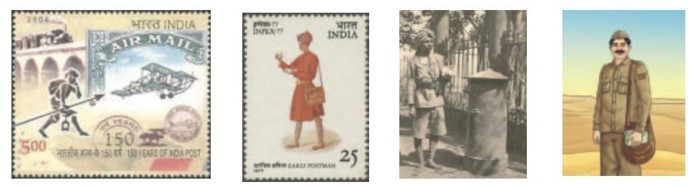
1. Which profession do they belong to?
Answer: They belong to the postal profession – postmen / Gramin Dak Sewaks who deliver letters and parcels.
2. Do they face any difficulties while doing their duty?
Answer: Yes, postmen generally face difficulties such as extreme weather conditions, long distances to cover on foot, carrying heavy mailbags, and reaching remote or inaccessible areas.
3. How does their profession affect the people they meet?
Answer: They help people stay connected with their families by delivering letters, money orders and news. They also read letters and write replies for villagers who need their help.
II. Discuss in groups.
1. How can ‘words’ be ‘carried’?
Answer: Words can be carried through letters, postcards, telegrams, books, newspapers, and digitally through emails, SMS, and social media. Physically, a postman carries written words from one place to another.
2. Who could be a carrier of words?
Answer: A carrier of words could be a postman / GDS who delivers letters; a courier agent; a journalist; a teacher; or in earlier times, a messenger or herald. Today, the internet and mobile phones carry words digitally.
3. What are the means for people to stay connected?
Answer: People stay connected through letters and postcards, telephone calls, emails, messaging apps (WhatsApp, Telegram), video calls (Zoom, Google Meet), and social media. In remote areas, the postal service (GDS) remains the primary means of connection.
III. Read the words given in the box below and place them in their appropriate context in the following passage.

We stepped out of the vehicle at the end of the road. Immediately, our body sent 1. _______ that our decision to visit the sand 2. _______ in the afternoon was insane. We had passed a few 3. _______ on our way to the desert. We could not find even a single soul outdoors, 4. _______ the blazing sun. Even the camels were 5 . _______ in the little shade offered by the khejri trees. In this remote place people relied on Bharat Sanchar Nigam Limited (BSNL) to connect to the world as the area was 6. _______ of any other network service.
Answer:
1. signals
2. dunes
3. hamlets
4. defying
5. slumped
6. devoid
Check Your Understanding – Part I (NCERT Textbook Page No. 207)
I. Khetaram needs to submit information about himself for getting an identity card. While reading the text, fill up the following information sheet for Khetaram.
| Name | Khetaram |
| Position | |
| Employer | |
| Official address | |
| Mode of transport used | |
| Key responsibilities | • ___________________________ • ___________________________ • ___________________________ • ___________________________ |
Answer:
| Information | Details |
| Name | Khetaram |
| Position | Gramin Dak Sewak (GDS) |
| Employer | India Post |
| Official address | Somarad Branch Post Office, Rajasthan |
| Mode of transport used | On foot |
| Key responsibilities | • Delivering letters and mail to remote villages • Carrying money orders • Reading out letters for villagers • Writing/drafting replies for them |
II. Discuss with your teacher.
1. Why do you think Khetaram has taken up this challenging job?
Answer: Khetaram has taken up this challenging job because it gives him a steady source of income. He lives in a region where farming is unreliable due to frequent famine. He explains that even in a good year, one crop of bajra is not enough to feed his family of five, and without this job they would struggle to survive. Thus, the job is difficult, but it provides security for his family and also allows him to serve the people of remote villages.
2. How do you think Khetaram would feel about taking up this challenging task every day?
Answer: Khetaram would probably feel tired but proud and satisfied while taking up this challenging task every day. The extreme heat, long distances, and heavy mailbag make his work physically exhausting, yet he continues because the villagers depend on him for letters, money orders, and communication with their families. His willingness to keep serving even after the age of sixty shows that he values his duty and feels a strong sense of responsibility towards the people.
Check Your Understanding – Part II (NCERT Textbook Page No. 210)
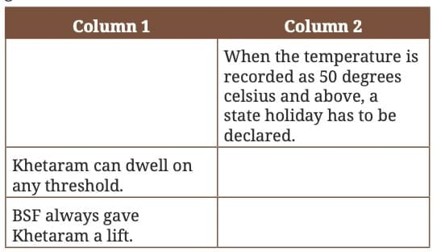
I. Complete the table given below with the situations given in Column 1 and the reasons in Column 2.
Answer:
| Column 1 | Column 2 |
| Mail is delivered in the evenings. | When the temperature is recorded as 50 degrees celsius and above a state holiday has to be declared. |
| Khetaram can dwell on any threshold. | He is trusted by everyone in the villages. |
| BSF always gave Khetaram lift. | The jawans are kind and helpful. |
II. Why was a piece of jaggery offered in the village when he brought news of a birth or weddings?
Answer: In India, villagers believe that good news should be welcomed with sweetness. The villagers are very poor and jaggery is the most basic sweet available to them. So, offering a piece of jaggery to the postman was a simple way of sharing their joy and thanking him for delivering such happy news.
III. How would phone lines help Khetaram in his job?
Answer: Phone lines would help Khetaram by allowing him to carry a cell phone along with the post from home to home. He could then become a Gramin Sanchar Sewak and
help people in remote villages stay connected while delivering their mail.
Critical Reflection (NCERT Textbook Page No. 210-212)
I. Read the extracts given below and answer the questions.
1: Akaal or famine is a way of life here. In a good year, I get one crop of bajra. That cannot feed my family of five. We would starve without this job,” he says.
And for each family which resides in this arid land, survival is partly dependent on money orders remitted by a relative.
(i) Complete the sentence given below with an appropriate reason.
One crop of bajra makes a little difference for people like Khetaram because __________.
Answer: One crop of bajra makes a little difference for people like Khetaram because it is not enough to feed his family of five for the whole year.
(ii) Why did Khetaram term famine as ‘a way of life’?
Answer: Khetaram called famine “a way of life” because the region regularly suffers from drought and poor harvests. Even in a good year, he gets only one crop of bajra, which is not enough to support his family. Thus, scarcity and the struggle for food are a normal part of life there.
(iii) Give one reason why Khetaram had to take up a job to help his family to survive.
Answer: Khetaram had to take up a job because the single crop of bajra he received even in a good year was not enough to feed his family of five. Without the income from his GDS job, his family would struggle to survive.
(iv) Complete the analogy given below with a word from the extract.
Other families: Money orders :: Khetaram: __________
Answer: Other families: Money orders :: Khetaram: Job (GDS salary)
(v) What would ‘a good year’ signify?
Answer: ‘A good year’ signifies a year with adequate rainfall in which Khetaram can successfully grow and harvest one crop of bajra.
2: There is one letter delivery he dreads. The envelope with the right corner torn off, which signifies that the missive bears news of death. “Ashubh Samachar cannot be carried into the house,” says Khetaram. So, he stands outside, reads out the letter twice, then tears it to bits. “Bad news must be destroyed,” he mutters philosophically.
(i) Choose the correct option for the following question.
Who could have torn the right corner of the envelope?
A. Khetaram
B. Sender of the letter
C. Receiver of the letter
D. The postmaster
Answer: B. Sender of the letter.
(ii) Complete the sentence with an appropriate reason.
The most likely reason for Khetaram reading the letter twice is because __________.
Answer: The most likely reason for Khetaram reading the letter twice is because he wanted to make sure that the sad news of death was clearly understood by the family before he destroyed the letter.
(iii) What was Khetaram’s philosophy regarding bad news, and how did he act upon it?
Answer: Khetaram’s philosophy was that bad news should not be carried into the house and should be destroyed. Therefore, when he delivered a letter containing news of death, he stood outside, read the letter twice, and then tore it into pieces.
(iv) State whether the following sentence is true or false.
Khetaram’s action of tearing the letter differed from his beliefs.
Answer: False.
Reason: Khetaram’s action of tearing the letter matched his belief that bad news should be destroyed. He read the letter twice and then tore it into pieces.
(v) Mention any one aspect of Khetaram’s temperament which is revealed through this extract.
Answer: One aspect of Khetaram’s temperament revealed in the extract is that he is sensitive and compassionate. He understands the pain caused by news of death and handles such letters with care and respect.
II. Answer the following questions.
1. Justify the statement made by the Postmaster-General, Rajasthan Western Region, stating that the role of GDS is ‘invaluable’.
Answer: The Postmaster-General calls the role of Gramin Dak Sewaks “invaluable” because they provide postal services in remote and difficult areas where other means of transport may not be available. They often travel on foot through harsh conditions to deliver letters and money orders, helping people stay connected with their families. In places like Khetaram’s desert region, the GDS becomes an important and trusted link between isolated villages and the outside world.
2. How was the purpose of India Post different from that of the British postal system?
Answer: The British postal system in India was mainly established to carry official company mail between administrative centres. In contrast, after Independence, India Post aimed to bring the entire population within the postal network, including people living in remote and rural areas. This is why the number of post offices expanded greatly and services were extended through Gramin Dak Sewaks.
3. People trusted Gramin Dak Sewaks. Support this statement with any two instances from the text.
Answer: People trusted the Gramin Dak Sewaks in many ways. For example, villagers felt comfortable asking Khetaram to read their letters aloud and write replies for them, showing their confidence in him.
Another instance is that people depended on the post office and GDS workers for money orders sent by relatives, which were often essential for their survival. This shows the strong trust they placed in the postal system and its workers.
4. Infer the most likely reason that Khetaram was grateful to continue as GDS, even after the age of 60.
Answer: Khetaram was grateful to continue as a GDS even after the age of 60 because the job gave him a steady income and a sense of purpose. Farming in his region was uncertain, and he had said that his family could not survive on the single crop of bajra alone. Continuing as a GDS therefore helped him support his family while also allowing him to keep serving the people of the remote villages.
5. Explain why the author pays tribute to people like Khetaram.
Answer: The author pays tribute to people like Khetaram because they perform a difficult yet essential service for people living in remote areas. Despite extreme heat, long distances, and physical hardship, Khetaram continues to deliver letters, money orders, and important news to isolated villages. He also goes beyond ordinary postal duties by reading letters aloud, writing replies, and helping villagers stay connected with their families.
He is the lone human link between isolated communities and the outside world, yet receives little recognition. The author rightly calls such people “part and parcel of our social fabric” – silently holding communities together without glory.
Vocabulary and Structures in Context (NCERT Textbook Page No. 210-212)
I. Study the phrases given in Column 1 and match them with their meanings in Column
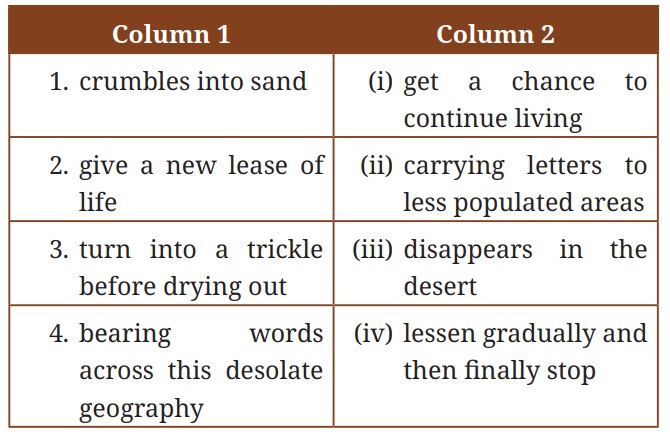
Answer:
| Column 1 | Column 2 |
| 1. crumbles into sand | (iii) disappears in the desert |
| 2. give a new lease of life | (i) get a chance to continue living |
| 3. turn into a trickle before drying out | (iv) lessen gradually and then finally stop |
| 4. bearing words across this desolate geography | (ii) carrying letters to less populated areas |
Now, use the phrases from Column 1 in sentences of your own.
Answer: Sentences of phrases from Column 1.
- crumbles into sand: The ancient fort’s outer wall had slowly crumbled into sand over the centuries.
- give a new lease of life: The successful surgery gave the elderly patient a new lease of life.
- turn into a trickle before drying out: Due to the summer drought, the once-mighty stream turned into a trickle before drying out completely.
- bearing words across this desolate geography: Khetaram spent decades bearing words across this desolate geography, connecting isolated families to their loved ones.
II. Identify examples of alliteration and metaphor in the extract given below.
“Khetaram’s khaki turban and uniform are his only protection against the desert’s furies, the scorching summer winds and swirling sandstorms which turn him into a walking sandman.”
Answer: Alliteration: “Khetaram’s khaki” – repetition of the ‘k’ sound.
“Scorching summer winds and swirling sandstorms” – repetition of the ‘s’ sound.
Metaphor: “The desert’s furies” – the desert is compared to an angry, furious entity. “Turn him into a walking sandman” – Khetaram is compared to a sandman, so covered in sand he appears to be made of it.
III. Match the words in Column 1 to what they suggest in Column 2 in the context of the chapter.
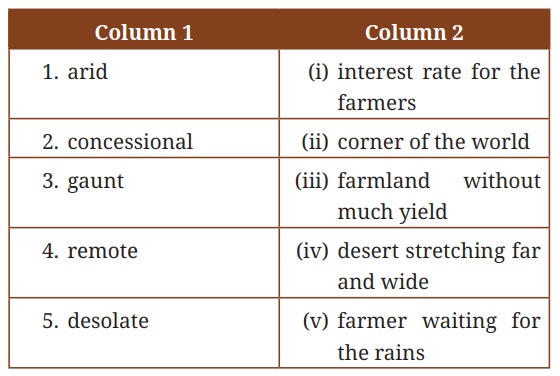
Answer:
| Column 1 | Column 2 |
| 1. arid | (iii) farmland without much yield |
| 2. concessional | (i) interest rate for the farmers |
| 3. gaunt | (v) farmer waiting for the rains |
| 4. remote | (ii) corner of the world |
| 5. desolate | (iv) desert stretching far and wide |
Now, use the words from Column 1 in sentences of your own.
Answer:
Sentences of phrases from Column 1.
- arid: The arid landscape of the Thar Desert stretches for hundreds of kilometres, with little vegetation in sight.
- concessional: The government announced concessional loans for farmers affected by the flood.
- gaunt: After months of drought and famine, the gaunt farmers prayed desperately for rain.
- remote: The GDS system was designed specifically to serve even the most remote corners of India.
- desolate: Walking through the desolate sands of the Thar at noon, Khetaram was truly alone in the world.
IV. Study the sentences and their functions. Then fill in the blanks using the present perfect form of the verbs given in brackets.
| Column 1 | Column 2 |
| 1. She has found her book. | (i) finished actions (past event—present result) |
| 2. I have just eaten a mango. | (ii) recently completed action |
| 3. Have you ever seen a play before? | (iii) life experiences |
| 4. I have finished my project. | (iv) accomplishment |
| 5. Ajay has become a good bowler in five years. | (v) changes over time |
| 6. I have seen this book in the library many times. | (vi) multiple actions at different times |
| 7. I have studied in this school for six years. | (vii) action completed in the past but has its impact in present |
All the verbs in the sentences in Column 1 are in present perfect tense.
The structure is: has/have + past participle (third form of the verb).
Now, fill in the blanks by using the present perfect form of the verbs given in the brackets to complete the following paragraph.
1. I _______ (has/have) just _______ (get) a collection of postage stamps from my grandfather. He 2. _______ (collect) these stamps over a period of 20 years. I 3. _______ (study) most of the stamps in his collection and loved all of them. I 4. _______ (begin) my own collection of postage stamps. Grandfather 5. _______ truly _______ (inspire) me.
Answer: 1. I have just got a collection of postage stamps from my grandfather. He 2. has collected these stamps over a period of 20 years. I 3. have studied most of the stamps in his collection and loved all of them. I 4. have begun my own collection of postage stamps. Grandfather 5. has truly inspired me.
V. Study the sentences given below.
1. GDS delivers the mail at the border.
When the subject does the action, the sentence is in active voice.
2. The mail is delivered by the GDS at the border.
This implies that the ‘mail’ receives the action ‘deliver’.
This sentence is in passive voice because the subject is receiving the action.
3. Khetaram’s nephew wants to join the GDS. He asks Khetaram how to prepare for it. Khetaram gives him the following advice.
(i) You will need a lot of stamina for this job.
(ii) Practise reading clearly as some of the villagers will expect you to read out the letters.
(iii) Write words neatly as some villagers will ask you to draft replies.
(iv) Wear full-sleeved shirts and trousers to protect yourself from the heat.
Now, complete the following paragraph about the advice given by Khetaram. One example has been done for you.
To begin with, a lot of stamina will be needed for this job. Next, reading clearly A. _______ , as you B. _______ to read out the letters by some of the villagers. Words C. _______ neatly as you D. _______ to draft replies by some villagers. Full sleeved-shirts and trousers E. _______ to protect yourself from the heat.
Answer: To begin with, a lot of stamina will be needed for this job. Next, reading clearly A. will need to be practised, as you B. may be expected to read out the letters by some of the villagers. Words C. must be written neatly as you D. may be asked to draft replies by some villagers. Full-sleeved shirts and trousers E. should be worn to protect yourself from the heat.
Listen and Respond (NCERT Textbook Page No. 215-216)
I. You will listen to a girl talking about an event. As you listen, fill in the blank with the suitable word from the brackets. (Transcript for teacher on page 272)
The speaker concluded her talk with a _______ . (suggestion/request/advice)
Answer: request
II. You will listen to the girl talking about the event again. As you listen, choose the correct option for the following questions.
1: What was the occasion that the speaker was talking about?
(i) Letter writing carnival
(ii) Philately day
(iii) Indian Postal Day
Answer: (iii) Indian Postal Day
2: India Post is famous for having the most extensive network _______ .
(i) in India
(ii) in the world
(iii) among design institutes
Answer: (ii) in the world
3: Letter writing is being revived as this art form has been _______ .
(i) celebrated
(ii) appreciated
(iii) forgotten
Answer: (iii) forgotten
4: Which of the following will be a part of the letter writing carnival?
(i) calligraphy and graphology
(ii) origami and designing
(iii) letter posting and philately
Answer: (i) calligraphy and graphology
5: What will the postal department add to the event?
(i) interactive demonstrations
(ii) theatre and dance
(iii) workshop for letter writing
Answer: (i) interactive demonstrations
Writing Task (NCERT Textbook Page No. 217-218)
A condolence message communicates your feelings to someone whose relative or a person close to them has just passed away. It mentions how sorry you feel for the loss and your prayers for strength to the family members.
I. Khetaram saw a letter with a torn corner. It had news about Bhawar Singh’s uncle passing away. Read the condolence message that Sawant Singh sent to his cousin as a reply to the letter.
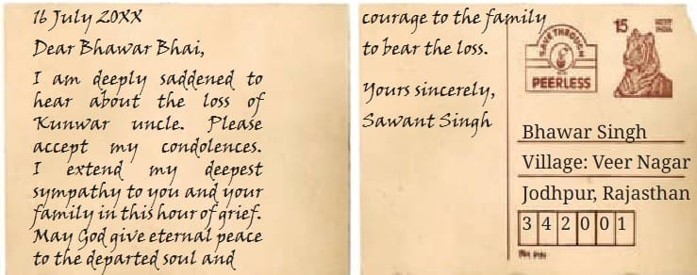
Answer: Sample Condolence Message
18 March 2026
Dear Aunty,
We were deeply saddened to learn of the passing of your dear father, our Nana ji. Words fall short at a time like this, but we want you to know that our hearts are with you and your family.
He was a man of great strength and warmth, and the memories he leaves behind will forever be a source of comfort and inspiration for all of us. We are grateful for the love and wisdom he shared with each one of us over the years.
Please accept our heartfelt condolences. May God grant eternal peace to his soul, and may He give your family the courage and strength to bear this irreplaceable loss. We are here for you – please do not hesitate to reach out whenever you need us.
Yours lovingly,
Ajay
About the Chapter: Carrier of Words
The feature Carrier of Words introduces Khetaram, a postal worker serving communities in Rajasthan’s Thar desert. His demanding journeys show how letters and postal services connect people across distance and difficult terrain.
Students also explore responsibility, trust, and the value of public service. The chapter encourages appreciation for often overlooked workers while helping students identify important information and understand the personal significance of everyday communication.