

NCERT Solutions for Class 9 English Kaveri Chapter 4 Vitamin-M are provided here with simple and easy-to-understand explanations. This humorous story is included in Unit 4 of the NCERT textbook Kaveri. It explores family relationships, memory, and the importance of respecting older people’s independence. These NCERT Solutions for Class 9 help students understand the main ideas, complete textbook activities, improve their language skills, and prepare for school examinations.
Vitamin-M Class 9 English Questions and Answers
Reflect and Respond (NCERT Textbook Page No. 97-98)
I. From your experience with an elderly person at home or in your neighbourhood, complete the following graphic organiser.
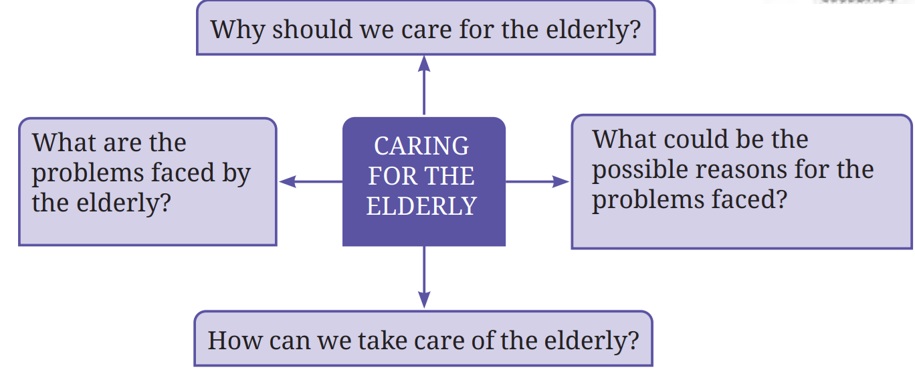
Now, discuss the points written in the organiser with your classmates and teacher.
Question: Why should we care for the elderly?
Answer: They have spent their lives caring for us. They carry wisdom, experience and love. It is our moral and social responsibility to return their care and ensure their dignity in old age.
Question: What are the problems faced by the elderly?
Answer:
- Failing memory, weak eyesight and hearing
- Physical weakness and risk of falls
- Loneliness and feeling of being a burden
- Dependence on others for daily needs
- Health issues requiring regular medicines
Question: What could be the possible reasons for the problems faced?
Answer:
- Old age causing natural physical and mental decline
- Nuclear family system leaving elders alone
- Children being busy with work and their own lives
- Shift from hometown to city, causing displacement and stress
Question: How can we take care of the elderly?
Answer:
- Spend quality time with them
- Help with medicines and doctor visits
- Listen to their stories and experiences
- Make them feel loved, respected and included.
II. Fill in the table given below. You may check your answers with the help of a dictionary.
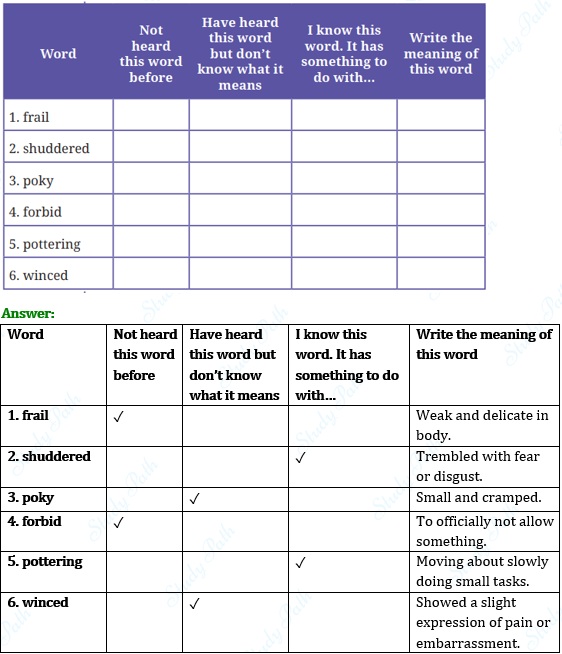
III. Think of a tradition, story, or recipe passed down by grandparents or an elderly relative in your family. What does it mean to you? How does it connect you to your growing-up years? Share with your classmates and teacher.
Answer: A tradition passed down by my grandmother is preparing a special dish during festivals. She taught me the recipe and explained the importance of making it with love and sharing it with family members. This tradition connects me to my childhood because I remember helping her in the kitchen and listening to her stories. It makes me value my family’s traditions and memories.
Check Your Understanding (NCERT Textbook Page No.102)
I: Why did Grandpa dislike living in the city with his daughter? In the chapter “Vitamin-M”.
Answer: Grandpa disliked living in the city because he found it noisy, crowded, and uncomfortable. He missed his quiet brick house in the town, where there was a big mango tree in the garden and peaceful surroundings. In the city flat, he felt restricted and unhappy, as he preferred the calm and independence he had in his own home.
II: Why did Vidya not want her father to go out alone?
Answer: Vidya did not want her father to go out alone because she feared for his safety. Grandpa’s memory and physical abilities had started to decline, and he had recently taken a double dose of his medicines and got lost while returning from a walk. He had also slipped and fallen in his garden and spent the whole night outside because no one was there to help him.
III: Was Ravi in favour of his mother treating Grandpa like a child? How can you say so?
Answer: No, Ravi was not in favour of his mother treating Grandpa like a child. He felt uncomfortable when his mother spoke to Grandpa in an overly loud voice and instructed him not to go out alone. Ravi respected his grandfather and felt that he should be treated normally. This shows that Ravi believed Grandpa deserved respect and independence instead of being treated like a helpless child.
IV: Would Ravi be able to keep up his promise to his mother?
Answer: No, Ravi would not be able to keep his promise completely. Although he promised his mother that he would stay at home and look after Grandpa, he became worried when Grandpa went out to get the newspaper. Ravi secretly followed him to make sure that he came to no harm. This shows that he tried to protect Grandpa, but could not stay at home as promised.
Check Your Understanding (NCERT Textbook Page No. 106-107)
I. Complete the flow chart by describing Grandpa’s day out.
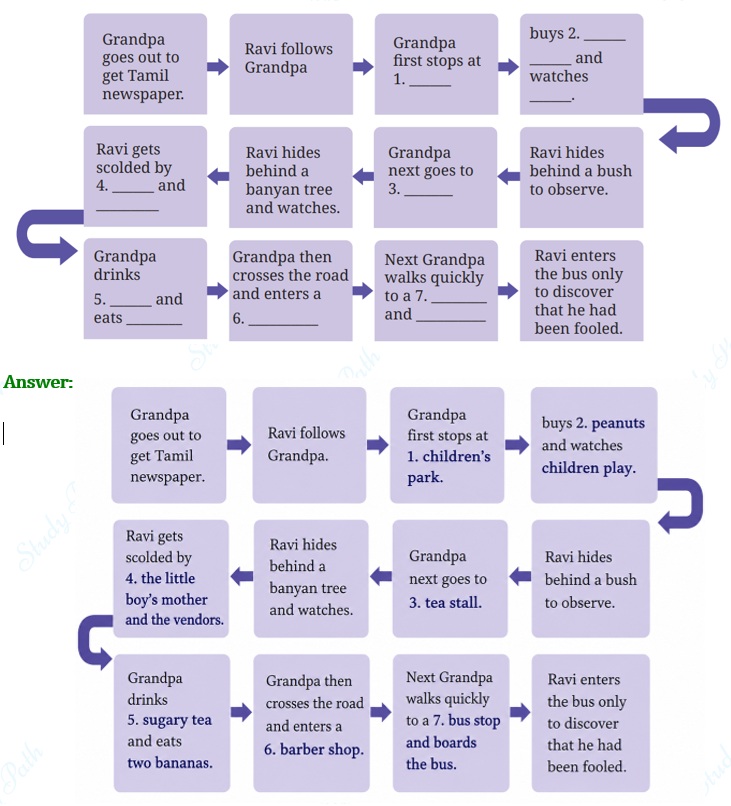
II: Was Grandpa lost as feared by Ravi’s mother?
Answer: No, Grandpa was not lost as Ravi’s mother feared. Although Ravi became worried when he could not find him at the barber shop or park, Grandpa had already returned home safely. Ravi was relieved to hear Grandpa snoring gently in his bedroom, showing that he had found his way back without any trouble.
III: How would Ravi feel after seeing Grandpa?
Answer: Ravi would feel greatly relieved and happy after seeing Grandpa safe at home. He had been frightened and worried that Grandpa might have got lost or come to some harm. Seeing his grandfather sleeping peacefully filled him with affection and respect for him.
IV: Do you think Ravi’s mother will get to know about what had happened?
Answer: No, Ravi’s mother would probably not get to know what had happened. Ravi decided not to tell Grandpa that he had followed him because doing so would reveal that he had disobeyed his mother. Grandpa also cleverly told Vidya that he had had a quiet morning, so the truth remained hidden.
Check Your Understanding (NCERT Textbook Page No. 109)
I: Describe how Ravi’s emotional reaction upon finding Grandpa safe at home reveals his feelings towards his grandfather.
Answer: Ravi’s emotional reaction when he finds Grandpa safe at home shows his deep love, concern, and affection for him. After worrying that Grandpa might be lost or in danger, Ravi feels greatly relieved when he finds him sleeping peacefully. He kneels beside him, touches his face, and gives him a warm hug. This shows that Ravi truly cares about Grandpa’s safety and well-being. His worry, relief, and affection reveal the strong bond they share and how important Grandpa is to him.
II: What might be the significance of Grandpa’s habit of giving gifts to everyone on his birthday rather than receiving them? In the chapter “Vitamin-M”.
Answer: Grandpa’s habit of giving gifts to everyone on his birthday shows that he is generous, loving and thoughtful. Even though it is his birthday, instead of expecting others to celebrate him, he enjoys making his family happy by giving them gifts.
He still considers Ravi, his mother, and his father his “babies”, showing his deep affection for them. This habit also suggests that Grandpa values giving and sharing love more than receiving gifts.
III: Why do you think Grandpa gave Ravi a detective story book as a gift? What might this suggest about Grandpa’s awareness of Ravi’s actions earlier in the day?
Answer: Grandpa gave Ravi a detective story book because he had probably realised that Ravi had been following him throughout the day. The book contained tips on how to avoid being fooled while trailing a suspect, which was a clever hint about Ravi’s actions. Grandpa’s twinkle in his eye also suggests that he knew what Ravi had done and was playfully teasing him.
Critical Reflection (NCERT Textbook Page No. 109-111)
I. Read the extract given below and answer the questions that follow.
1. Grandpa hated the noise and bustle of city life and when they were on their own, he often spoke longingly of his small brick house in town, “Such a wonderful place…! With that big mango tree in the garden! It is so quiet that at dusk you can even hear a leaf fall!” But then Grandpa had slipped and fallen in the garden late one evening while he was pottering around and lain outside all night because there was no one at home to help him up.
(i) Choose the emotion displayed by the Grandfather.
A. regretful
B. apologetic
C. nostalgic
D. wistful
Answer: C. nostalgic
Reason: Grandpa feels nostalgic because he fondly remembers his quiet brick house, the big mango tree and the peaceful surroundings of his old home.
(ii) Complete the following sentence with a reason.
Grandpa hated the busy and noisy city life because __________.
Answer: Grandpa hated the busy and noisy city life because he preferred the peace and quiet of his small brick house in town, where he could enjoy his garden and the big mango tree.
(iii) Why did Grandpa come to the city despite his dislike for city life?
Answer: Grandpa came to the city despite his dislike for city life because he had become too old to live on his own safely. After he accidentally took a double dose of his medicines, got lost while out for a walk, and later slipped and fell in his garden, Vidya decided to bring him to live with the family.
(iv) Choose an expression similar in meaning to, ‘you can even hear a leaf fall’.
A. end of one’s life
B. arrival of autumn
C. sign of good luck
D. pin drop silence
Answer: D. Pin drop silence.
(v) State one advantage and one disadvantage of the Grandfather living in the house in town.
Answer: One advantage of Grandpa living in his house in town was that he enjoyed peace, quiet and independence, especially with the big mango tree in his garden.
One disadvantage was that he could be alone in an emergency, as shown when he slipped and fell in the garden and had to lie outside all night without anyone to help him.
2. “I had a quiet morning, but I don’t know about Ravi. He just disappeared instead of staying at home to look after me like you told him to,” answered Grandpa coolly, while Ravi just looked confused and embarrassed.
Grandpa had another surprise for Ravi. A giftwrapped parcel!
“But, Papa, Ravi’s birthday was three months ago. Have you forgotten?” exclaimed Ravi’s mother, impatiently.
(i) Choose the option that displays the tone of the Grandfather’s response.
A. apologetic
B. hurtful
C. calm
D. puzzled
Answer: C. calm
Reason: Grandpa’s response has a calm and composed tone because he answers Ravi’s mother casually, saying that he had a quiet morning. He does not show anger or confusion, even though he knows that Ravi had disappeared while secretly following him.
(ii) Why was Ravi confused and embarrassed?
Answer: Ravi was confused and embarrassed because he had secretly followed Grandpa instead of staying at home to look after him as his mother had instructed. When Grandpa told Vidya that Ravi had “disappeared” instead of looking after him, Ravi became confused and embarrassed because he realised that Grandpa knew about his absence.
(iii) Complete the sentence with a suitable reason.
Ravi’s mother was impatient because _________ .
Answer: Ravi’s mother was impatient because Grandpa gave Ravi a gift-wrapped parcel even though his birthday had already passed three months ago.
(iv) State whether the following sentence is true or false.
Grandfather forgot that Ravi’s birthday was three months ago.
Answer: False.
Reason: Grandfather did not forget that Ravi’s birthday was three months ago. He deliberately gave Ravi a gift because he had a habit of giving a gift to every child in the house on his own birthday, showing that he remembered the occasion.
(v) Why did Grandpa say he didn’t know what kind of morning Ravi might have had?
Answer: Grandpa said he didn’t know what kind of morning Ravi might have had because Ravi had disappeared instead of staying at home to look after him as his mother had instructed. Grandpa was playfully teasing Ravi, suggesting that he was aware that Ravi had secretly followed him during his outing.
II. Answer the following questions
1: Grandpa is portrayed as a person with failing memory in the beginning of the story. Give two evidences to disprove the statement. In the chapter “Vitamin-M”
Answer: Although Grandpa is initially described as forgetful, several incidents prove that his memory and awareness are still strong. First, he remembers thousands of chess games, including the opening moves and mistakes made by famous players like Karpov and Bobby Fischer. Second, he remembers his birthday tradition of giving gifts to every child in the house, and he even remembers that Ravi’s birthday had already passed three months earlier. These examples show that Grandpa’s memory is selective rather than completely failing.
2: Give two characteristic traits of each of the following characters.
(i) Grandfather
(ii) Ravi
(iii) Ravi’s mother
Answer: (i) Grandfather is generous and witty. He is generous because he gives gifts to everyone in the house on his birthday and is always thoughtful towards his family. He is also witty and clever, as shown when he cleverly teases Ravi about secretly following him.
(ii) Ravi is caring and responsible. He is caring because he worries about Grandpa’s safety and secretly follows him to make sure he does not come to any harm. He is also responsible, as he tries to keep the promise he made to his mother to look after Grandpa.
(iii) Ravi’s mother is Caring and protective. She is caring because she is concerned about her father’s health and safety. She is also protective, as she brings Grandpa to live with the family and does not want him to go out alone after his earlier accidents.
3: Why was Ravi worried about what Grandfather had at the tea stall?
Answer: Ravi was worried because Grandpa drank sugary tea, ate two bananas, and had an ice cream at the tea stall. Ravi knew that his mother had forbidden Grandpa from eating such items because they might affect his health. Thinking about how upset his mother would be if she found out made Ravi feel anxious and uncomfortable.
4: Do you think it was easy for Ravi to follow his Grandfather? If yes, why? If no, why not?
Answer: No, it was not easy for Ravi to follow his grandfather. Grandpa moved around the city quickly, going to the children’s park, tea stall, barber shop, and finally a bus stop. Ravi had to hide behind bushes, trees, and a car, crawl and duck to avoid being noticed, and even sprint to catch the bus. Despite these difficulties and embarrassing moments, Ravi continued following Grandpa because he was worried about his safety.
5: ‘Ravi is a good detective’. Give one argument in favour of and against the given statement.
Answer: Ravi can be considered a good detective because he carefully followed Grandpa, kept a safe distance, and observed his movements without being noticed for much of the time. However, he was not a completely successful detective because he failed to realise that the man on the bus was a stranger wearing a similar yellow cap, and Grandpa had already disappeared.
6: Was Grandfather aware that Ravi was following him? How do you know?
Answer: Yes, it can be understood that Ravi’s movements were noticed by Grandpa. This is suggested by the detective story book that was later given to Ravi and by Grandpa’s remark about avoiding being fooled while trailing a suspect. His mischievous smile at the end further suggests that Ravi’s secret following had been noticed and was being playfully teased.
7: In your opinion, who needs Vitamin-M? And why?
Answer: In my opinion, Ravi’s mother is the one who needs Vitamin-M. At the beginning of the story, she assumes that Grandpa’s memory has weakened with age and remains constantly worried about him. She even speaks to him loudly, as though he cannot hear or understand her properly.
However, several incidents prove that Grandpa’s memory is still quite sharp. He remembers famous chess games and players while playing with Ravi, and he also remembers the family tradition of giving gifts to everyone on his birthday.
In fact, Ravi’s mother is the one who forgets this tradition and mistakenly believes that Grandpa has forgotten Ravi’s birthday. By the end of the story, Grandpa humorously suggests that his daughter needs Vitamin-M for her memory. Therefore, the story cleverly shows that Ravi’s mother might need the memory vitamin more than Grandpa.
8: Some people believe society shows bias based on age (being young or old). Give an example where you might have experienced or observed such discrimination, when opinions were disregarded because of age.
Answer: Age-based bias occurs when people ignore someone’s opinions because they think the person is too young or too old. For example, children’s ideas may sometimes be ignored simply because of their age, even when they have useful suggestions. Similarly, elderly people may be treated as incapable of making decisions despite their experience. In the story, Ravi’s mother assumes that Grandpa cannot remember things properly or take care of himself. However, Grandpa proves that he is still intelligent, observant, and capable. This shows that people of all ages should be respected, heard, and valued for their abilities.
Vocabulary and Structures in Context (NCERT Textbook Page No. 111-116)
I. Classify the words given in the box into movement words (Column 1) and sound words (Column 2).
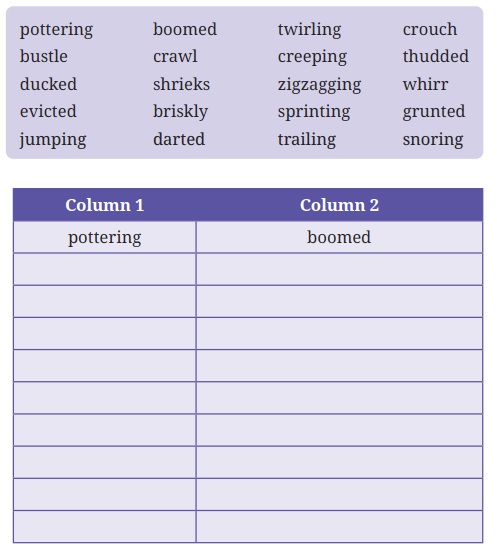
Answer:
| Column 1 Movement Words | Column 2 Sound Words |
| pottering | boomed |
| ducked | shrieks |
| jumping | thudded |
| crawl | whirr |
| briskly | grunted |
| darted | snoring |
| twirling | |
| creeping | |
| zigzagging | |
| sprinting | |
| trailing | |
| crouch | |
| bustle |
Now, fill in the blanks with appropriate words from Column 1 or Column 2.
Detective Shankar, 1. _________ the mysterious suspect through the dimly lit side lanes, away from the 2. _________ of the city, quickened his pace 3. _________ . The suspect’s heavy footsteps 4. _________ across the street, unaware of the pursuit. Shankar 5. _________ his magnifying glass had to 6. _________ behind the market stalls, 7. _________ through the lanes to avoid being seen. Shankar 8. _________ when he hit himself against a pole. This alarmed the suspect and he 9 . _________ into the night leaving only the distant 10. _________ of the sleeping city behind.
Answer: Detective Shankar 1. trailing the mysterious suspect through the dimly lit side lanes, away from the 2. bustle of the city, and quickened his pace 3. briskly. The suspect’s heavy footsteps 4. thudded across the street, unaware of the pursuit. Shankar 5. twirling his magnifying glass had to 6. crouch behind the market stalls, 7. zigzagging through the lanes to avoid being seen. Shankar 8. grunted when he hit himself against a pole. This alarmed the suspect and he 9. darted into the night, leaving only the distant 10. whirr of the sleeping city behind.
II. Study the highlighted word “dilemma” in the sentence and fill in the boxes with synonymous words.
Off he went, twirling his walking stick jauntily, leaving Ravi in a dilemma.
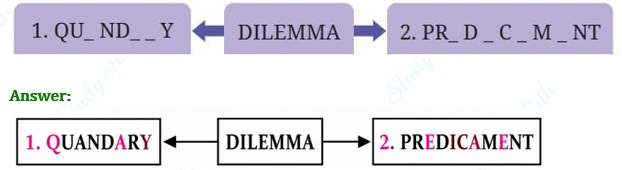
Both “quandary” and “predicament” are synonyms for “dilemma” – a situation in which a person faces a difficult choice between options, each with its own disadvantages.
III. Fill in the table with meaning, part of speech, synonym, and antonym of the given words.
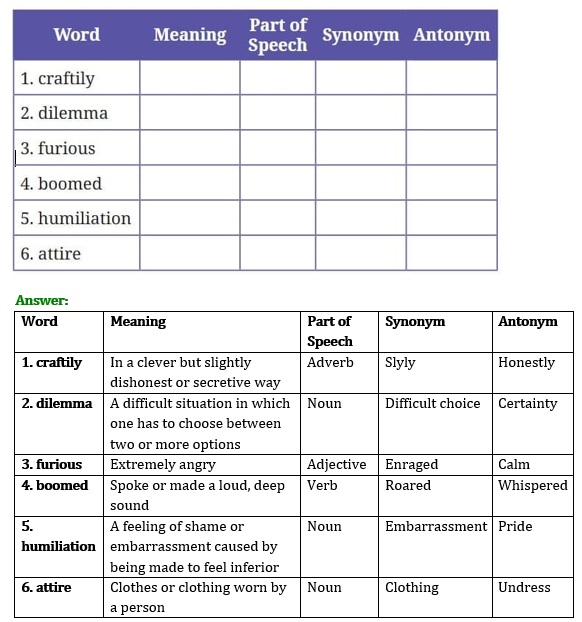
IV. Match the emotions/expressions in Column 1 with their meanings in Column 2. (One meaning is extra.)
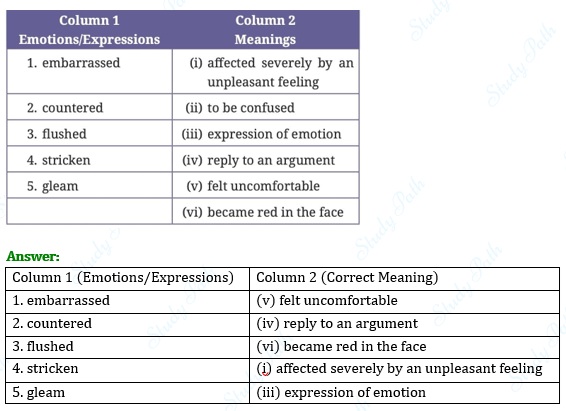
Extra meaning (not used): (ii) to be confused
V. Read the highlighted words in the following phrases from the story. Now, revisit the story and underline the prepositions.
- I’ll just walk across to the corner shop…
- …he felt a shadow fall over him…
- …the vendors sitting under the tree…
- Ravi took position behind a big banyan…
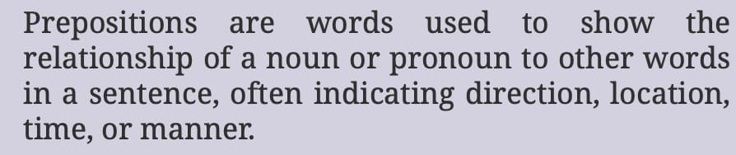
Now, fill in the blanks with appropriate prepositions.
I walked (i) ____________ (through, between, against) the village, crossed a bridge (ii) ____________ (over, under, beside) a brook, and found a quiet garden (iii) ____________ (among, near, across) a cottage. Sitting on a bench (iv) ____________ (on, at, in) the garden, I enjoyed the peaceful surroundings. Later, I strolled (v) ____________ (beside, through, along) a riverbank, exploring the forest and heading (vi) ____________ (into, towards, beyond) the unknown.
Answer: I walked (i) through the village, crossed a bridge (ii) over a brook, and found a quiet garden (iii) near a cottage. Sitting on a bench (iv) in the garden, I enjoyed the peaceful surroundings. Later, I strolled (v) along a riverbank, exploring the forest and heading (vi) towards the unknown.
VI. Read the dialogues and choose the correct answers.
- “Shall we play chess or watch the cricket match on TV, Grandpa?” asked Ravi.
- “Who are you?” said the little boy’s mother.
- “What did you both do today?” asked Ravi’s mother.
- “Have you forgotten?” countered Grandpa.
- A small child came up to him and asked, “Are you playing hide and seek?”
Now, choose the correct answer.
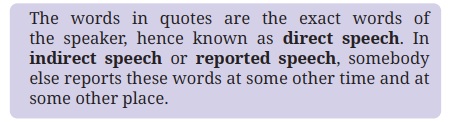
A. The words in the quotes are (i) __________ (exclamatory/interrogative) sentences.
B. Sentences 1, 4, and 5 are (ii) __________ (Wh-/Yes, No type) interrogative sentences.
C. Sentences 2 and 3 are (iii) __________ (Wh-/Yes, No type) interrogative sentences.
So, there are (iv) __________ (two/three) types of interrogative sentences.
Answer:
A. The words in the quotes are (i) interrogative sentences.
B. Sentences 1, 4, and 5 are (ii) Yes/No type interrogative sentences.
C. Sentences 2 and 3 are (iii) Wh- type interrogative sentences.
So, there are (iv) two types of interrogative sentences.
VII. Complete the following sentences in reported speech based on the conversation between Arvind and Priya.
ARVIND: Do you help in taking care of your grandparents at home?
PRIYA: Yes, I do. We take turns making sure they’re alright. Do you have grandparents living with you?
ARVIND: No. My parents and I visit my grandpa every weekend. How do you manage your grandparents’ medical needs?
PRIYA: We have a schedule for giving medications and visits to the doctor.
Answer: Arvind asked Priya if she 1. helped in taking care of her grandparents at home, for which Priya replied in the affirmative and said that they 2. took turns making sure they were alright. Priya further asked Arvind 3. whether he had grandparents living with him. Arvind replied in the negative and said that 4. his parents and he visited his grandpa every weekend. He further enquired 5. how she managed her grandparents’ medical needs. Priya responded by saying that they 6. had a schedule for giving medications and visits to the doctor
Writing Task (NCERT Textbook Page No. 119)
I. Write an article for your school magazine on the topic ‘Our Inspiring Elderly’.
Answer:
Our Inspiring Elderly
Elderly people are an important part of our families and society. They have a lifetime of experience, knowledge and wisdom to share with younger generations. Their stories, advice and traditions help us understand our roots and learn valuable lessons.
Grandparents, in particular, can be a great source of love and inspiration. They teach us to be patient, kind, responsible and respectful. Their experiences show us how to face difficulties with courage and confidence. However, elderly people should not be treated as helpless simply because they are old. They can still think clearly, make decisions and contribute to the family and society.
We should spend time with our elderly, listen to their experiences and respect their opinions. Small acts of kindness and care can make them feel valued and loved. Our elderly are not just a link to the past; they are a source of wisdom that can guide our future.
About the Chapter: Vitamin-M
The story Vitamin-M follows Ravi as he secretly trails his grandfather through the city, believing he must keep the older man safe. Unexpected events challenge the family’s assumptions about Grandpa’s memory and alertness, creating humour and a surprising ending.
Students also explore affection, independence, and the difference between caring for someone and underestimating them. The chapter helps them follow a sequence of events and identify how irony and character responses make the story entertaining.