

NCERT Solutions for Class 9 English Kaveri Chapter 3 Winds of Change are provided here with simple and easy-to-understand explanations. This informative lesson is included in Unit 3 of the NCERT textbook Kaveri. It explores traditional Indian hand fans, regional craftsmanship, and the need to support artisans. These NCERT Solutions for Class 9 English help students understand the main ideas, complete textbook activities, improve their language skills, and prepare for school examinations.
Winds of Change Class 9 English Questions and Answers
Reflect and Respond (NCERT Textbook Page No. 69)
I. Does anyone in your family use a hand fan? What do you call it in your language? What is it made of?
Answer: Yes, my grandmother uses a hand fan in summer. In Hind we call it a pankha. Ours is made of woven moonj grass with a wooden handle, passed down from my great-grandmother.
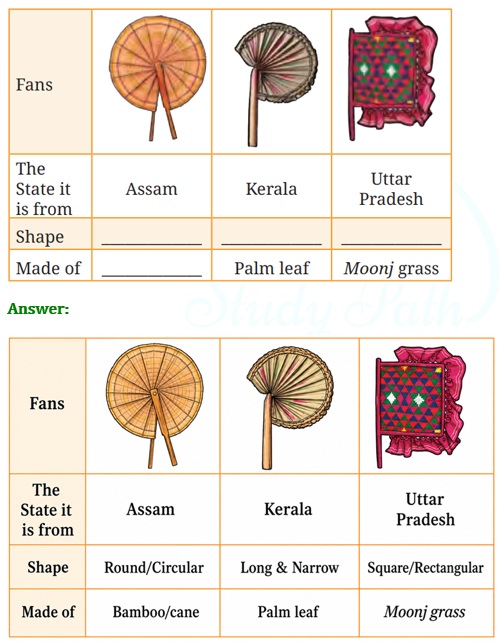
II. Study the pictures and complete the information.
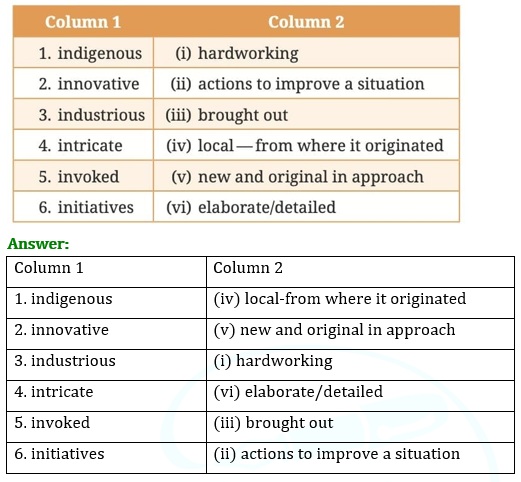
III. Match the underlined words in Column 1 with their meanings in Column 2.
Check Your Understanding (NCERT Textbook Page No. 73)
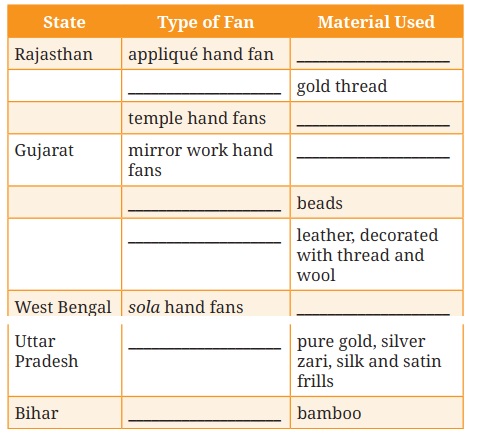
I. Work in pairs to complete the table on pankha. Share your answers with your classmates and teacher.
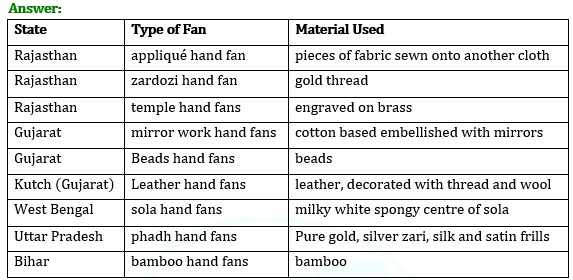
Answer:
Critical Reflection (NCERT Textbook Page No. 74-76)
I. Read the extracts given below and answer the questions that follow.
1. Over time, pankhas became significant cultural goods distributed through trade routes. They were considered exotic and stylish. Although there was substantial commonality in their use across India, different villages and towns developed their own varieties of traditional pankhas. Each place developed pankhas with distinct materials or a variety of intricate designs, that set them apart from one another.
(i) State whether the following sentence is true or false:
Pankhas were one of the most popular items of commerce.
Answer: False.
Reason: The passage says that pankhas became significant cultural goods distributed through trade routes, but it does not state that they were one of the most popular items of commerce.
(ii) Why has the word ‘traditional’ been used to describe pankhas?
Answer: The word “traditional” is used because pankhas have been made and used in India for a long time. Different regions developed their own types using local materials and intricate designs. These varieties reflect the cultural traditions of the regions where they were made.
(iii) Complete the following statement.
The sentence ‘They were considered exotic and stylish’ is an opinion and not a fact because _______________.
Answer: The sentence ‘They were considered exotic and stylish’ is an opinion and not a fact because it reflects the personal perception and judgment of people rather than a verifiable or measurable truth. Different people may have different views about what is exotic or stylish.
(iv) Infer one reason for commonality in the use of pankhas across India.
Answer: One reason for the common use of pankhas across India is that they served the same basic purpose of fanning people. Pankhas had been used in India since ancient times, including in temples and royal courts. Although their purpose was similar across the country, different villages and towns created their own varieties using distinct materials and intricate designs based on local culture and geography
(v) Select which one of the two statements is the correct assertion for the given reason.
Reason: Pankhas were made of indigenous materials, unique to the region, with elaborate designs.
A. Each kind of pankha could be distinguished from the other.
B. Pankhas were used by many people.
Answer: A. Each kind of pankha could be distinguished from the other.
2. With time and the advent of technology and innovative creations, the beautiful culture of pankhas runs the risk of slowly losing its presence among Indians. Once made for personal use, over time this handicraft has transformed into a commercial business and now provides some form of livelihood to India’s artisans. The slight increase in popularity and demand is significantly factored by the different versions of the pankha being crafted.
(i) Infer one negative impact of technological advancement on pankha.
Answer: Technological advancement has reduced the everyday need for traditional pankhas. Electric fans, air coolers and air conditioners provide easier and faster cooling. As their use increases, pankhas may become less common. This can put the traditional culture of pankhas at risk and affect artisans who depend on this craft for their livelihood.
(ii) Complete the statement with an appropriate reason.
The writer refers to ‘pankhas’ not just as an object but as a ‘culture’ because ___________.
Answer: The writer refers to ‘pankhas’ not just as an object but as a ‘culture’ because pankhas carry with them the history, artistry, traditions, and identity of the region they come from. Each pankha reflects the cultural values, materials and craftsmanship of its community, making it much more than just a functional object.
(iii) Select a line from the extract which depicts how the role of the pankha has changed over the years.
Answer: “Once made for personal use, over time this handicraft has transformed into a commercial business and now provides some form of livelihood to India’s artisans.” This line shows that pankhas have changed from being mainly personal-use items to becoming commercial handicrafts that provide livelihood to artisans.
(iv) List one way in which the increase in demand of pankhas might benefit artisans.
Answer: The increase in demand for pankhas can help artisans earn a better livelihood by giving them more opportunities to sell their handicrafts. It can also encourage them to continue making pankhas, helping to preserve this traditional craft for future generations.
(v) Select the factor that has contributed to the commercialisation of pankhas.
A. cultural preservation
B. economic demand
C. technological advancements
D. artisan initiative
Answer: B. economic demand.
II. Answer the Following Questions.
1. How does the title ‘Winds of Change’ capture the essence of the chapter?
Answer: The title “Winds of Change” captures the essence of the chapter because it shows how the traditional craft of pankha-making is changing with time. Technology and innovative creations have put this craft at risk of losing its presence. Although modern developments threaten its traditional use, new designs, growing demand, and initiatives such as workshops are helping to preserve the craft and provide livelihoods to artisans.
2. Support the following statement with any two relevant examples from the chapter.
‘The structure and design of pankhas are testimony to the cultural identity of the region.’
Answer: The structure and design of pankhas reflect the cultural identity of different regions. For example, Rajasthan’s appliqué fans are made by sewing colourful fabric pieces with ornamental needlework while zardozi hand fans are decorated with glittering and ornate gold threadwork. Similarly, Gujarat’s hand fans use mirror work, beads and silver handles, reflecting the region’s rich bead and embroidery traditions.
3. The chapter mentions pankhas running the risk of slowly losing their presence among Indians. Evaluate how the balance between preserving traditional craftsmanship and incorporating innovative designs in the creation of pankhas will help in this regard.
Answer: A balance between traditional craftsmanship and innovative designs can help preserve pankhas. Traditional methods, materials and regional designs should be maintained because they represent India’s cultural heritage. At the same time, new designs and creative ideas can make pankhas more attractive and increase their demand. Workshops and exhibitions can also spread awareness and support artisans’ livelihoods.
4. How might initiatives such as pankha-making workshops contribute to the preservation of this traditional craft?
Answer: Pankha-making workshops can help preserve the craft by spreading awareness about its beauty and cultural importance. They allow pankha makers to demonstrate their skills and regain popularity. Workshops can also provide artisans with a commercial platform, helping them earn a sustainable livelihood while keeping the traditional craft alive.
5. The writer mentions celebrating pankhas in the concluding part of the chapter. Assess how this could be beneficial to artisans and the craft.
Answer: Celebrating pankhas could benefit artisans by increasing awareness, appreciation, and demand for this traditional craft. It would give pankha makers a platform to showcase their skills and artistry and could help them earn a sustainable livelihood. At the same time, greater appreciation would help preserve the craft and keep its cultural heritage alive for future generations.
6. How does the restriction of the use of pankha for decorative purposes reflect the changing cultural role of these traditional fans in modern India?
Answer: The restriction of pankhas to decorative purposes shows that their role has changed with modernisation. Earlier, pankhas were used in practical ways, including in temples and royal courts. In modern times, they have become mainly traditional craft items used for decoration. Their continued use as decorations shows that people still value their cultural, artistic and traditional importance.
Vocabulary and Structures in Context (NCERT Textbook Page No. 76-79)
I. Read the following pairs of words from the text.

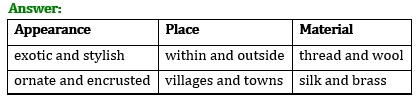
1. Classify the pairs of words given above in the following categories. One example has been done for you.
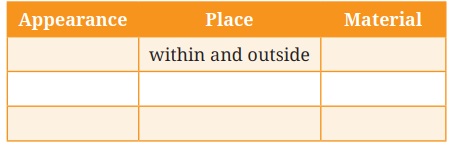
Now, find more such word pairs from the text and share them with your classmates and teacher.
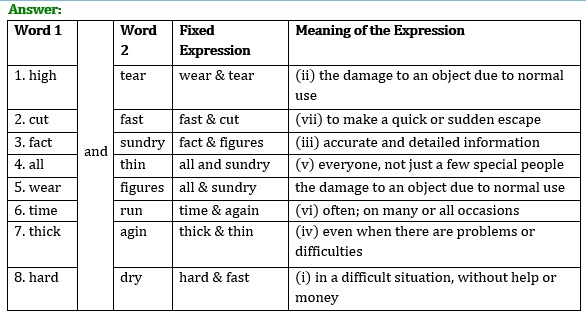
II. Find the word pairs for the following fixed expressions. Write the meanings of these expressions by selecting them from the box given below. One example has been done for you.
Some common expressions with ‘and’ have a fixed order which cannot be changed. The shortest expression comes first. For example, bread and butter (*not butter and bread)
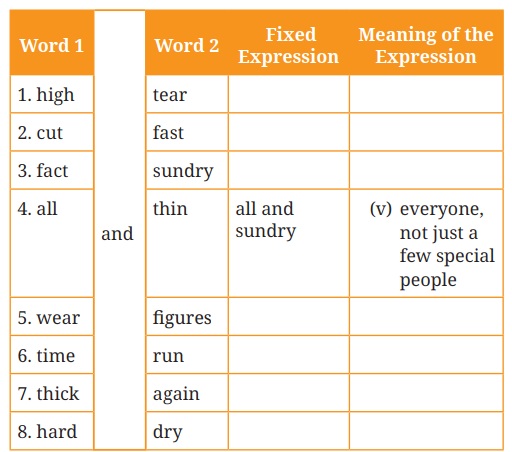
Now, match the following meanings with the correct word pairs created above.
(i) in a difficult situation, without help or money –
(ii) the damage to object due to normal use –
(iii) accurate and detailed information –
(iv) even when there are problems or difficulties-
(v) everyone, not just a few special people –
(vi) often; on many or all occasions-
(vii) To make a quick or sudden escape –
III. Read the following word combinations from the text.
- sustainable livelihood
- aesthetically pleasing
- appreciating the culture
The given phrases are conventional combinations just like fixed expressions. Such combinations are called collocations.
1. Choose the appropriate word collocations for the following sentences.
(i) The students have to (take/give) the English exam tomorrow.
(ii) The interviewer asked the candidate to (take/have) a seat.
(iii) My scooter (dashed against/ran into) a car.
(iv) I must (take/own) responsibility for my success.
(v) I would like to (tone up/improve) my grammar.
Answer:
(i) take – the correct collocation is “take an exam.”
(ii) have – “have a seat” is the conventional polite expression in this context.
(iii) ran into – means to collide with unexpectedly; the standard collocation.
(iv) take – “take responsibility” is the fixed expression for acknowledging accountability.
(v) improve – “improve grammar” is standard; “tone up” collocates with physical fitness, not language.
IV. Read the following sentences. Underline the verbs.
1. In modern times, pankhas have become traditional craft items in India.
2. Gujarat’s industrious home-based women workers have worked tirelessly in the handicraft of pankha-making.
3. Many tribes in India have adopted this handicraft.
4. Once made for personal use, this handicraft has transformed into a commercial business.
Answer: 1. In modern times, pankhas have become traditional craft items in India.
2. Gujarat’s industrious home-based women workers have worked tirelessly in the handicraft of pankha-making.
3. Many tribes in India have adopted this handicraft.
4. Once made for personal use, this handicraft has transformed into a commercial business.
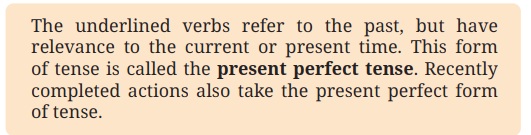
Now, fill in the blanks with the present perfect form of verbs in the following paragraph. One example has been done for you.
Puppets have long fascinated (fascinate) audiences worldwide. Puppeteers (i) _________ (create) intricate characters and captivating stories with their skillful artistry. They (ii) _________ (master) the delicate movements that bring these lifeless figures to life, entertaining both children and adults. Over the years, puppetry (iii) _________(evolve), using modern technology while preserving traditional techniques. Many puppeteers (iv) _________ (pass) down their craft through generations, ensuring its continuity. They (v) _________ (perform) in theatres, on television, and at festivals, conveying important cultural narratives.
Answer: Puppets have long fascinated audiences worldwide. Puppeteers (i) have created intricate characters and captivating stories with their skillful artistry. They (ii) have mastered the delicate movements that bring these lifeless figures to life, entertaining both children and adults. Over the years, puppetry (iii) has evolved, using modern technology while preserving traditional techniques. Many puppeteers (iv) have passed down their craft through generations, ensuring its continuity. They (v) have performed in theatres, on television, and at festivals, conveying important cultural narratives.
About the Chapter: Winds of Change
The lesson Winds of Change explores the history and variety of Indian hand fans, or pankhas. Students learn how local materials, designs, and cultural traditions influence these objects and how their uses have changed over time.
Students also consider the effect of modern technology on traditional crafts. The chapter highlights the value of preserving handmade skills and supporting artisans’ livelihoods while developing reading comprehension and descriptive vocabulary.