

NCERT Solutions for Class 9 English Kaveri Chapter 1 How I Taught My Grandmother to Read are provided here with simple and easy-to-understand explanations. This story is included in Unit 1 of the NCERT textbook Kaveri. It explores literacy, determination, and the respect shared between a learner and a teacher. These NCERT Solutions for Class 9 help students understand the main ideas, complete textbook activities, improve their language skills, and prepare for school examinations.
How I Taught My Grandmother to Read Class 9 Questions and Answers
Reflect and Respond (NCERT Textbook Page No. 1-2)
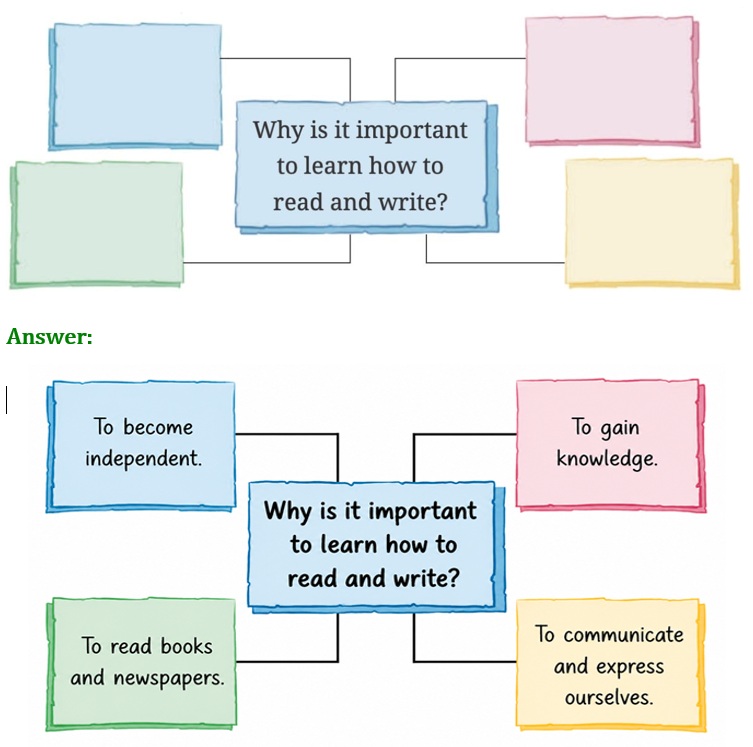
I. Complete the given word web.
II. Read the questions given below and share your answers.
1. Which language(s) do your grandparents or elderly relatives speak?
Answer: My grandparents speak Hindi and Punjabi.
2. How do they spend their time? How do you spend time with them?
Answer: They spend their time reading, praying, and watching TV. I spend time with them by talking, helping them, and listening to their stories.
3. What is your favourite experience with them?
Answer: My favourite experience is listening to their childhood stories and learning from them.
4. What is something that the elderly in your family cannot do easily but enjoy watching you do?
Answer: The elderly in my family cannot use mobile phones or modern gadgets easily, but they enjoy watching me use them and often ask me to show them how things work.
III. Read the following passage. Match the highlighted words with their meanings given in the box below.
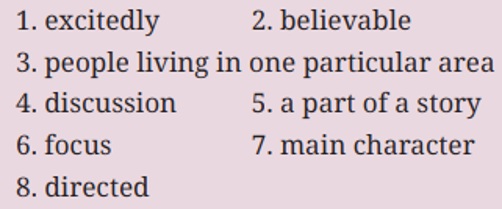
The casting for the (i) protagonist of our school’s annual play was done after a lot of (ii) debate as many good actors had auditioned for the role. We had decided to present an (iii) episode from an inspirational story. It was a life story of a group of children who worked with the (iv) community to spread literacy. Every day, we reached school early to practise with (v) concentration.We waited (vi) eagerly for the final presentation. All of us played our roles in a very (vii) convincing manner as our theatre teacher had (viii) guided us well.
Answer:
| Words | Meanings |
| (i) protagonist | 7. main character |
| (ii) debate | 4. discussion |
| (iii) episode | 5. a part of a story |
| (iv) community | 3. people living in one particular area |
| (v) concentration | 6. focus |
| (vi) eagerly | 1. excitedly |
| (vii) convincing | 2. believable |
| (viii) guided | 8. directed |
Check Your Understanding (NCERT Textbook Page No. 6-7)
I: Complete the cause and effect table given below based on Part I of the story. Share your answers with your classmates and teacher.
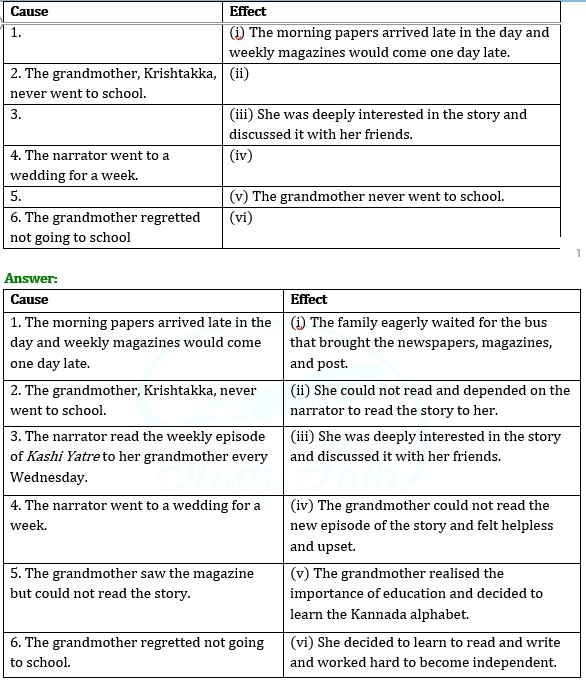
II: Do you think the narrator expected to see her grandmother in tears when she returned to the village? If yes, why? If no, why not? In the chapter “How I Taught My Grandmother to Read”.
Answer: No, the narrator did not expect to see her grandmother in tears when she returned to the village. She was surprised because she had never seen her grandmother cry, even in the most difficult situations. Her grandmother was usually strong and cheerful, so seeing her in tears worried and shocked the narrator. Later, she understood that her grandmother felt helpless because she could not read the latest episode of Kashi Yatre on her own.
III. How might the narrator help her grandmother to fulfil her desire to learn to read and write? In the chapter “How I Taught My Grandmother to Read”.
Answer: The narrator could help her grandmother by teaching her the Kannada alphabet. She could give her regular lessons and homework. She could make her practise reading, writing, repeating and reciting. With patience and encouragement, the narrator could help her grandmother become independent. She could also set a goal for her to read Kashi Yatre on her own.
Check Your Understanding (NCERT Textbook Page No. 9-10)
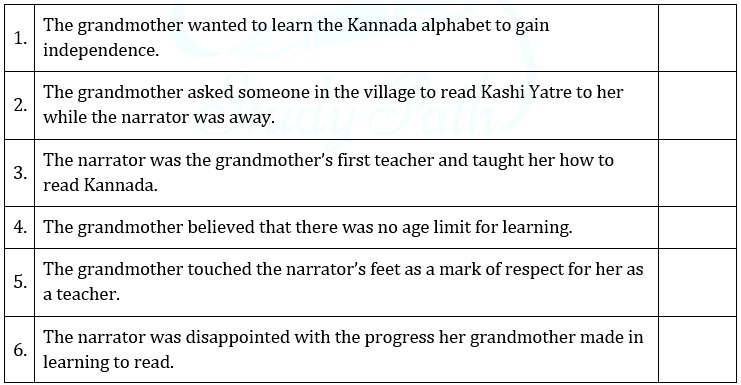
I. State whether the following sentences are true or false. Share your answers with your classmates and teacher.
Answer:
1. True
2. False
Reason: She did not ask anyone in the village to read Kashi Yatre to her because she felt too embarrassed
3. True
4. True
5. True
6. False
Reason: The narrator was not disappointed. In fact, she was proud and happy because her grandmother passed “with flying colours”.
Critical Reflection (NCERT Textbook Page No. 10-13)
I. Read the extract given below and answer the questions that follow.
When I came back to my village, I saw my grandmother in tears. I was surprised, for I had never seen her cry even in the most difficult situations. What had happened? I was worried.
‘Avva, is everything all right? Are you okay?’
I used to call her Avva, which means mother in the Kannada spoken in north Karnataka.
She nodded but did not reply. I did not understand and forgot about it. In the night, after dinner, we were sleeping in the open terrace of our house. It was a summer night and there was a full moon. Avva came and sat next to me. Her affectionate hands touched my forehead.
(i) Complete the following sentence with the appropriate option.
The phrase ‘never seen her cry in the most difficult situations’ tells us that the grandmother was _________ .
A. strong-willed
B. understanding
C. considerate
D. bold
Answer: A. strong-willed
(ii) Complete the following with the correct option from those given in the brackets.
Grandmother did not reply when the narrator asked if she was alright because she might have been too _________ (emotional/tired) to respond.
Answer: emotional
(iii) Identify the clue from the extract that indicates a rural setting with traditional customs.
Answer: The extract shows a rural setting through the description of the open terrace where the family slept on a summer night under the full moon, reflecting a simple village lifestyle and traditional customs.
(iv) Which lines of the extract establish a tender atmosphere?
Answer: Lines that establish a tender atmosphere:
“Avva came and sat next to me. Her affectionate hands touched my forehead.”
(v) Which of the following aspect is NOT emphasised in the given extract?
A. the emotional turmoil of the grandmother
B. the affectionate bond between the narrator and her grandmother
C. the grandmother’s regret over her lack of education
D. the narrator’s concern for her grandmother
Answer: C. the grandmother’s regret over her lack of education.
2. ‘I have decided I want to learn the Kannada alphabet from tomorrow onwards. I will work very hard. I will keep Saraswati Puja day during Dassara as the deadline. That day I should be able to read a novel on my own. I want to be independent.’
I saw the determination on her face. Yet I laughed at her.
‘Avva, at this age of sixty-two you want to learn the alphabet? All your hair is grey, your hands are wrinkled, you wear spectacles and you work so much in the kitchen…’
Childishly I made fun of the old lady. But she just smiled.
‘For a good cause if you are determined, you can overcome any obstacle. I will work harder than anybody but I will do it. For learning there is no age bar.’
(i) What does the grandmother’s statement, “I want to be independent,” reveal about her character?
A. She wanted to be literate.
B. She desires self-sufficiency.
C. She wants to prove her intelligence to others.
D. She feels pressured by society to learn.
Answer: B. She desires self-sufficiency
(ii) Fill in the blank with the appropriate option from those given in brackets.
The grandmother’s determination shows that learning has no _________ . (age limit/gender bias/cultural barriers).
Answer: age limit
(iii) Complete the following with a suitable reason.
The narrator laughs at her grandmother’s decision to learn the alphabet at the age of sixty-two because _________ .
Answer: she thought it was unusual for an elderly person with grey hair and wrinkled hands to start learning something new with so much responsibilities, specially at this age.
(iv) List any two qualities displayed by the grandmother.
Answer: Two qualities displayed by the grandmother are determination and perseverance.
(v) How can we say that the narrator is making assumptions about her grandmother?
Answer: The narrator initially laughs at her grandmother’s determination because she thinks that sixty-two is too old to start learning the alphabet. Seeing her grandmother’s grey hair, wrinkled hands, and spectacles, she assumes that studying at that age would be difficult. She also believes that her grandmother is already very busy with household work. Because of these childish assumptions, the narrator does not take her grandmother’s decision seriously at first, though she later realizes her strong determination.
II. Answer the following questions.
1: Why do you think the grandmother felt embarrassed to ask someone else to read to her while the narrator was away? In the chapter “How I Taught My Grandmother to Read”.
Answer: The grandmother felt embarrassed because she could not read and had to depend on others. She could have asked someone in the village to read the magazine for her, but she was too shy to do so. She felt helpless because she could not understand what was written in the magazine Kashi Yatre. Asking others for help would reveal that she had never been to school. This made her uncomfortable, so she preferred to wait for the narrator to return and read the story to her instead.
2: Why does the narrator initially laugh at her grandmother’s determination to learn at the age of sixty-two? In the chapter “How I Taught My Grandmother to Read”.
Answer: The narrator initially laughed because she could not imagine her sixty-two-year-old grandmother learning the Kannada alphabet. She noticed her grandmother’s grey hair, wrinkled hands, spectacles and busy kitchen work. The narrator thought these things would make learning difficult at her age. However, her grandmother confidently replied that “there is no age bar” for learning and decided to work hard.
3: What significance does the story of Kashi Yatre have in both the grandmother’s life and the story?
Answer: The story Kashi Yatre plays an important role in the grandmother’s life and in the narrative. It creates her deep interest in reading because she eagerly waits to know what happens next in the story. When the narrator is away and she cannot read the new episode, she feels helpless and dependent. This incident inspires her to learn the Kannada alphabet and become independent. Thus, the story becomes the main motivation for her decision to learn to read, driving the central theme of the story.
4: What does the grandmother’s desire to learn the Kannada alphabet reflect about her? In the chapter “How I Taught My Grandmother to Read”.
Answer: The grandmother’s desire to learn the Kannada alphabet reflects her strong determination, self-respect and desire for independence. She did not want to remain dependent on others for reading. Her experience with Kashi Yatre made her realise the importance of being able to read on her own. She set Saraswati Puja during Dassara as her deadline and worked hard every day. Her determination shows that she believed there is no age bar for learning.
5: What lessons can we infer from the grandmother’s action of touching the narrator’s feet? In the chapter “How I Taught My Grandmother to Read”.
Answer: The grandmother’s action of touching the narrator’s feet teaches us the importance of respecting teachers and education. Even though the narrator was her granddaughter and much younger, the grandmother respected her as a teacher who helped her learn to read. This shows that knowledge and learning should be honoured regardless of age or relationship. It also highlights humility and gratitude, as the grandmother openly expressed thanks for the help she received in becoming independent.
6: What does the following line tell us about the broader theme of the story?
‘For a good cause if you are determined, you can overcome any obstacle.’
Answer: The line highlights the main theme of determination and the power of learning. It shows that if a person is strongly determined to achieve a good goal, they can overcome any difficulty, including age or lack of education. In the story, the grandmother proves this by learning the Kannada alphabet at the age of sixty-two. Her success shows that education has no age limit and that strong willpower can help people achieve their goals and become independent.
7: How effectively does the story highlight the value of education in supporting personal independence? In the chapter “How I Taught My Grandmother to Read”.
Answer: The story How I Taught My Grandmother to Read highlights the value of education very effectively. The grandmother feels helpless and dependent when she cannot read Kashi Yatre without the narrator’s help. This makes her realise the importance of being literate. She learns the Kannada alphabet and finally reads the novel herself. Thus, education gives her confidence, independence, dignity and self-respect.
Vocabulary and Structures in Context (NCERT Textbook Page No. 13-16)
I. The expression ‘hide and seek’ is used in the text. This is called a binomial.
Binomials are expressions consisting of two words, usually linked by a conjunction like ‘and’ or ‘or’, that are commonly used together in a fixed order.
For example: odds and ends, right or wrong.
Match the binomials in Column 1 with their meanings in Column 2. You may refer to a dictionary.
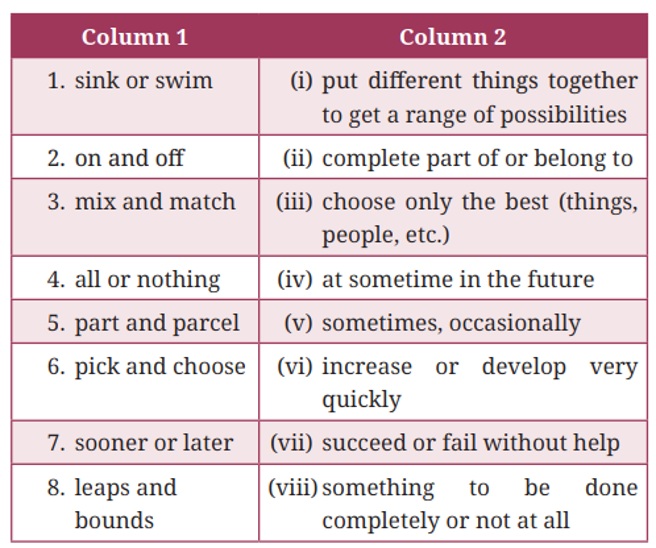
Now, use any five of the above binomials in sentences of your own.
Answer:
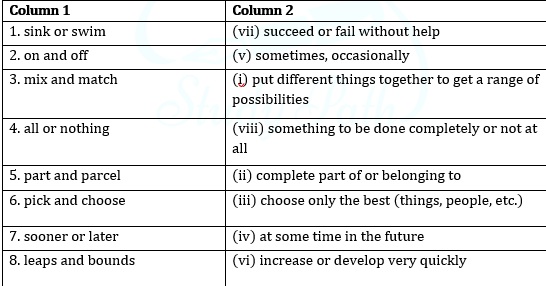
Binomials Used in Sentences are as follows:
- When she started living alone, it was a sink or swim situation for her.
- He attends his music classes on and off due to his busy schedule.
- You can mix and match these clothes to create different outfits.
- Learning from mistakes is part and parcel of growing up.
- The child’s reading skills improved by leaps and bounds after regular practice.
II. Read the following words from the text given in the box below.

These words are made by adding suitable prefixes (‘un’, ‘ir’, and ‘in’) to give an opposite or negative meaning to the words.
Now, make words by adding the suitable prefixes given in the box to the words from the text in Column 1. Write the prefixed words in Column 2. One example has been done for you.
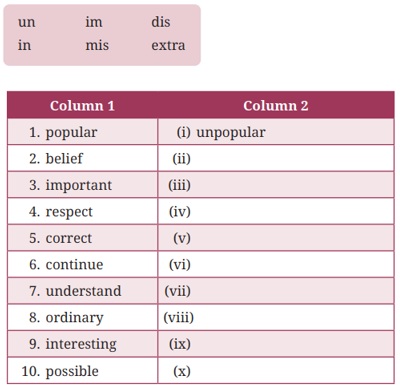
Answer:
| Column 1 | Column 2 |
| 1. popular | (i) unpopular |
| 2. belief | (ii) disbelief |
| 3. important | (iii) unimportant |
| 4. respect | (iv) disrespect |
| 5. correct | (v) incorrect |
| 6. continue | (vi) discontinue |
| 7. understand | (vii) misunderstand |
| 8. ordinary | (viii) extraordinary |
| 9. interesting | (ix) uninteresting |
| 10. possible | (x) impossible |
III. Identify any five words with prefixes from the story and make sentences using each.
Answer:
- Unhappy – The grandmother was unhappy because she could not read the magazine.
- Unusual – It was unusual for the grandmother to touch her granddaughter’s feet.
- Unfortunately – Unfortunately, the grandmother never went to school.
- Independent – Education helped the grandmother become independent.
- Irrespective – A teacher should be respected irrespective of age or gender.
IV. In the sentence, “I knew, then, that my student had passed with flying colours”, the phrase “passed with flying colours” is an idiom. It means outstanding performance.
Now, match the idioms related to ‘learning’ given in Column 1 with their meanings in Column 2. You may refer to a dictionary.
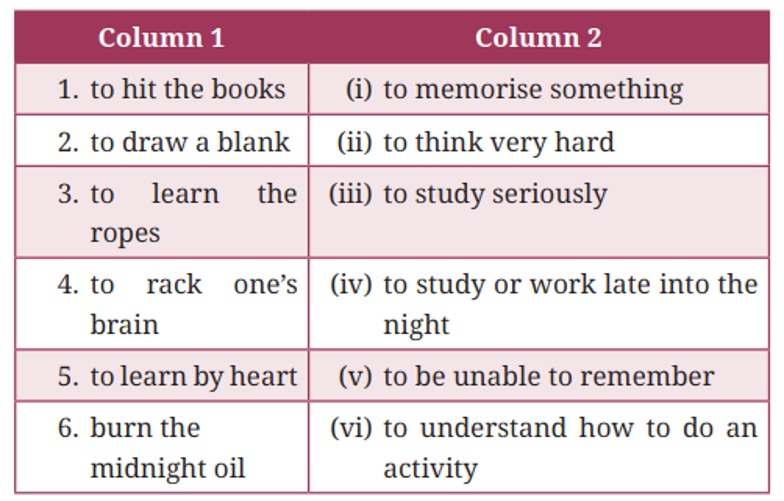
Now, use these idioms in sentences of your own.
Answer:
| Column 1 | Column 2 |
| 1. to hit the books | (iii) to study seriously |
| 2. to draw a blank | (v) to be unable to remember |
| 3. to learn the ropes | (vi) to understand how to do an activity |
| 4. to rack one’s brain | (ii) to think very hard |
| 5. to learn by heart | (i) to memorise something |
| 6. burn the midnight oil | (iv) to study or work late into the night |
Idioms used in Sentences are as follows:
- I need to hit the books before my exams begin.
- I drew a blank when the teacher asked me the answer.
- It took me a week to learn the ropes at my new job.
- I racked my brain to solve the difficult maths problem.
- She learnt the poem by heart for the competition.
- He burnt the midnight oil to complete his project.
V. Read the following sentences from the text and underline the verbs.
1. Secretly, I bought Kashi Yatre which had been published as a novel by that time.
2. I knew, then, that my student had passed with flying colours.
In sentence 1, verb ‘bought’ is in simple past tense.
In sentence 2, verb ‘had passed’ is in past perfect tense.
We use past perfect tense to indicate two completed actions-one occurring earlier (later past) and the other more recently (recent past). The more recent action is expressed in the simple past, while the earlier action takes the past perfect tense.
Examples
- By the time I reached the party, everyone had finished eating.
- When she returned home, her brother had finished the project.
(i) Fill in the blanks with simple past and past perfect tense form of the verbs given in brackets.
A. When the delegates _________ (arrive) at the conference, the keynote speaker _________ (already begin) the session.
B. After the students _________ (learn) how to identify fake news online, they _________ (start) verifying information before sharing it.
C. Before Kiran _________ (start) using digital payment platforms, she _________ (ensure) her understanding of online fraud prevention.
D. By the time Varun _________ (recognise) the importance of budgeting, he _________ (exhaust) most of his savings.
E. When Raghu _________ (log in) to the cybersecurity webinar, the instructor _________ (already discuss) the importance of strong passwords.
Answer:
A. arrived, had already begun
B. had learnt, started
C. started, had ensured
D. recognised, had exhausted
E. logged in, had already discussed
(ii) Fill in the blanks with the correct form of verbs given in brackets.
Last year my parents and I A. _________ (take) a financial planning course. When we B. _________ (review) our expenses, we realised we C. _________ (spend) too much on unnecessary purchases. After my parents D. _________ (discuss) ways to save, I E. _________ (open) a savings account. By the time we F. _________ (set) our budget, the course G. _________ (already introduce) investment strategies. We H. _________ (hurry) to take notes, but many participants I. _________ (complete) their financial plAnswer: Despite that, we J. _________ (enjoy) learning how to manage money wisely.
Answer:
A. took
B. reviewed
C. had spent
D. had discussed
E. opened
F. set
G. had already introduced
H. hurried
I. had completed
J. enjoyed
Listen and Respond (NCERT Textbook Page No. 17)
I. You will listen to a speaker talk about digital literacy.
As you listen, complete the following sentences with one to three exact words that you hear. (Transcript for teacher on page 259)
1. Literacy these days includes the ability to use _________ .
Answer: digital tools
2. Digital literacy is also about protecting _________ .
Answer: personal data
3. Digital literacy enables the elderly to _________ .
Answer: stay connected
4. Digital literacy encourages using the internet safely by helping us recognise _________ and _________ .
Answer: misinformation, scams and cyber threats.
5. The National Digital Literacy Mission helps people across the country by imparting _________ .
Answer: IT training
Writing Task (NCERT Textbook Page No. 19-20)
I. As a socially responsible citizen, you strongly believe that students can contribute significantly in promoting adult literacy. Write a letter to the Editor of a local newspaper emphasising the importance of student participation in adult literacy camps conducted by various organisations. Discuss the benefits of such initiatives for both students and society. Suggest effective ways to spread awareness and encourage more students to volunteer for this noble cause.
A letter to the editor is a formal letter in which the writer gives suggestions and creates awareness on an issue of public interest or an issue already raised in an article/write-up/published letter.
Points to Remember:
Format:
Name, designation, address
Date
Subject: 4-5 words in title case
Salutation: Sir/Madam
Body of the letter: In at least three paragraphs
Paragraph 1: Statement of problem: Raise the issue by citing some latest news items, survey report or personal experience, etc.
This is with reference to the article about _______ dated _________ in your newspaper.
As a concerned citizen I would like to draw your attention towards…
Paragraph 2: Analyse the issue in terms of its causes and consequences.
The issue at hand affects a large section of society and…
It is imperative that…
It would be beneficial if…
Such initiatives nurture a sense of…
By engaging in these programmes students…
Paragraph 3: Offer suggestions/solutions. Request the relevant authorities to take the action and request the editor to publish your views.
A possible solution to this issue could be…
One effective way to address this might be…
Authorities could consider implementing…
I trust this matter will be considered seriously for the benefit of all.
I am hopeful that necessary steps will be taken to…
I hope this letter gets published in the columns of your esteemed daily.
Complimentary close: Yours truly,
Language
Formal, clear, and specific
Short and to the point sentences
Purpose stated clearly and concisely
Relevant details to be given
Answer:
123, Domlur
Bengaluru – 560071
31 January, 2026
To
The Editor
The Daily Herald
Bengaluru
Subject: Promoting Student Participation in Adult Literacy
Sir/Madam,
As a concerned citizen, I would like to draw your attention towards the importance of student participation in adult literacy camps. Many adults still face difficulties because they cannot read or write. Students can play an important role in helping them learn basic reading and writing skills.
Such initiatives benefit both students and society. Students develop confidence, responsibility and a sense of service. Adult learners become more independent and can manage their daily activities better. Literacy also helps build a more educated and aware society.
Schools and organisations should organise regular literacy camps and encourage students to volunteer. Awareness can be spread through school assemblies, posters, social media and local campaigns. Certificates or recognition may also motivate more students to participate. I hope you will publish my views to encourage this noble cause.
Yours truly,
Amit Sharma
About the Chapter: How I Taught My Grandmother to Read
The story How I Taught My Grandmother to Read follows a young girl as she helps her grandmother learn to read. The grandmother’s desire for independence gives her the determination to practise despite her age. Their experience shows that learning can begin at any stage of life.
Students also explore humility, family relationships, and gratitude towards teachers. The chapter helps them understand the characters’ feelings and reflect on how education builds confidence and opens new possibilities.