

NCERT Solutions for Class 9 Science Chapter 13 Earth as a System: Energy, Matter, and Life are provided here with simple and easy-to-understand explanations. Based on the NCERT textbook Exploration, this chapter introduces interactions among Earth’s systems and the flow of energy and cycling of matter. These NCERT Solutions for Class 9 help students understand important concepts, complete textbook activities, and revise the chapter for school examinations.
Earth as a System: Energy, Matter, and Life Class 9 Questions and Answers
Think It Over (NCERT Textbook Page No. 252)
Question: How does the warming of Arabian Sea water affect the southwest monsoon in India?
Answer: Warming of the Arabian Sea water leads to increased evaporation from the sea. This adds more moisture to the air and causes fluctuations in the southwest monsoon. As a result, rainfall becomes irregular, bringing heavy rains and floods to some regions of India, while other regions experience drought due to insufficient rainfall.
Question: If a large forest is cleared, how can that affect the flow of a river in that area?
Answer: Trees release water vapour into the atmosphere through transpiration, which helps in bringing local rainfall. When forests are removed, transpiration decreases, leading to less rainfall. As a result, rivers receive less water.
In addition, without tree roots to hold the soil together, soil erosion increases. The eroded soil is washed into rivers, causing siltation, which reduces the river’s carrying capacity. As a result, the flow of the river may decrease and become irregular.
Question: What might happen to coastal cities in India if glaciers and polar ice keep melting faster?
Answer: If glaciers and polar ice keep melting faster, sea levels will rise, which may lead to the flooding of low-lying coastal areas. In the long run, this can threaten coastal cities in India by causing loss of land, damage to property, and disruption of ecosystems and human activities.
Question: How would increasing carbon dioxide levels in the atmosphere affect the ocean plankton?
Answer: When the level of carbon dioxide (CO2) in the atmosphere increases, the ocean absorbs more of it. This makes the sea water more acidic. Since ocean plankton use dissolved carbon dioxide for photosynthesis, this disturbance can affect their growth and survival. As plankton form the base of the marine food chain, changes in their population can also affect other marine organisms.
Pause and Ponder (NCERT Textbook Page No. 258)
1: Visit the website given below and study the effect of the concentration of greenhouse gas on surface temperature, https://phet.colorado.edu/en/simulations/greenhouse-effect
Answer: This is an activity to be performed using the PhET Greenhouse Effect simulation.
From the simulation, it is observed that as the concentration of greenhouse gases increases, the Earth’s surface temperature also increases. This is because greenhouse gases absorb the infrared radiation re-radiated by the Earth’s surface and prevent some of it from escaping into space. As more heat is trapped, the Earth’s surface becomes warmer. When the concentration of greenhouse gases is reduced, less heat is trapped, and the surface temperature decreases. This demonstrates how an increase in greenhouse gases leads to global warming.
Pause and Ponder (NCERT Textbook Page No. 261)
2: How does the cool mountain breeze benefit agriculture activity, particularly the crops and soil?
Answer: The cool mountain breeze, which flows down into the valley after sunset, benefits agriculture by:
- Regulating the temperature in hilly regions.
- Maintaining favourable moisture conditions.
- Supporting soil and crop health, thereby helping the healthy growth of crops.
3: What happens to the warm surface of water from the equator as it travels toward the poles? What impact does this movement have on the area?
Answer: The warm surface water from the equator flows towards the poles. As it moves, it gradually loses heat, becomes colder and denser, and sinks, while colder deep water flows back towards the equator. This movement transfers heat from the equator to the poles, reducing temperature differences across the Earth and helping to moderate the climate of different regions.
Pause and Ponder (NCERT Textbook Page No. 263)
4: The CO2 dissolved in the ocean is disturbed when the global temperature increases. What will happen to marine life?
Answer: As the global temperature increases, the solubility of CO₂ in seawater decreases, so more CO₂ escapes from the ocean into the atmosphere. This affects ocean plankton, which use dissolved carbon dioxide for photosynthesis. As a result, the growth and survival of plankton may be affected. Since plankton form the base of the marine food chain, changes in their population can affect many other marine organisms and disturb the marine ecosystem.
Pause and Ponder (NCERT Textbook Page No. 265)
5: What would happen to plants and animals on Earth if the biogeochemical cycles were disrupted and stopped? Explain by giving a few examples.
Answer: If the biogeochemical cycles were disrupted and stopped, the continuous movement of essential substances such as water, carbon, nitrogen and oxygen would stop. As a result:
- Plants would not receive the water and nutrients needed for photosynthesis and growth, so their growth would be affected.
- Animals would be affected because they depend on plants directly or indirectly for food and oxygen.
- The balance of gases in the atmosphere would be disturbed, affecting respiration and photosynthesis.
- Overall, ecosystems would become imbalanced, threatening the survival of both plants and animals.
OR
Biogeochemical cycles continuously recycle essential substances such as water, carbon, nitrogen and oxygen between the living and non-living components of the Earth. This recycling keeps these substances available for living organisms. If these cycles were disrupted and stopped, these essential substances would no longer be recycled, making it difficult for plants and animals to survive. For example:
Carbon cycle: If the carbon cycle stopped, carbon dioxide would not be recycled properly. Plants would not get enough carbon dioxide for photosynthesis, reducing food production for almost all living organisms.
Nitrogen cycle: If the nitrogen cycle stopped, nitrogen would not be converted into usable forms. Plants would not be able to make proteins and other essential substances, and animals depending on plants would also be affected.
Oxygen cycle: If the oxygen cycle stopped, oxygen would not be replenished in the atmosphere, making respiration difficult for living organisms.
Water cycle: If the water cycle stopped, fresh water would no longer circulate through evaporation, condensation and rainfall. As a result, plants and animals would not get enough water for survival.
Thus, the disruption of biogeochemical cycles would disturb ecosystems and eventually threaten life on Earth.
Pause and Ponder (NCERT Textbook Page No. 266)
6. Discuss how human activities increase the concentration of greenhouse gases in the atmosphere. What would you do as an individual to reduce the emission of greenhouse gas?
Answer: Human activities such as burning fossil fuels, deforestation, industrial activities, and agriculture increase the concentration of greenhouse gases in the atmosphere. Burning coal, petrol and diesel releases large amounts of carbon dioxide, deforestation reduces the number of trees that absorb carbon dioxide. Overuse of fertilisers and decomposition of biodegradable waste release greenhouse gases like methane (CH4) into the atmosphere. As a result, more greenhouse gases accumulate in the atmosphere, trapping more heat and causing global warming.
As an individual, I can help reduce greenhouse gas emissions by:
- Using public transport, cycling or walking instead of private vehicles whenever possible.
- Planting and protecting trees.
- Saving electricity by switching off lights and electrical appliances when not in use.
- Encouraging the use of renewable energy sources like solar and wind.
- Reducing, reusing and recycling materials to minimise waste and conserve resources.
Revise, Reflect, Refine (NCERT Textbook Page No. 261)
1: Choose the most appropriate option to describe the role of biogeochemical cycles in an ecosystem.
(i) To provide food directly to all organisms.
(ii) To recycle essential nutrients between biotic and abiotic components.
(iii) To create new elements for use by living things.
(iv) To remove pollutants and toxins from the organism.
Answer: (ii) To recycle essential nutrients between biotic and abiotic components.
Reason: Biogeochemical cycles continuously recycle essential nutrients such as water, carbon, nitrogen and oxygen between the biotic (living) and abiotic (non-living) components of the Earth, making them available to support life.
2: Which of the following is primarily responsible for warming of the Earth?
(i) Solar radiation is immediately absorbed by carbon dioxide, which then releases it as heat.
(ii) The atmosphere’s tiny particles absorb incoming solar radiation, which directly heats the Earth.
(iii) The Earth’s surface absorbs solar radiation, which is then re-radiated and trapped by greenhouse gases.
(iv) The Earth’s environment is heated only by the solar radiation reflected by the clouds.
Answer: The Earth’s surface absorbs solar radiation, which is then re-radiated and trapped by greenhouse gases.
Explanation: The Earth’s surface absorbs solar radiation and re-radiates it as infrared radiation. Greenhouse gases absorb some of this infrared radiation and prevent it from escaping into space, thereby warming the Earth.
3: Explain how climate change affects the water cycle. Illustrate with examples.
Answer: Climate change affects the water cycle by changing the pattern of evaporation, condensation and rainfall. As the Earth’s temperature rises, more water evaporates from oceans, rivers and lakes. This increases the amount of water vapour in the atmosphere and leads to changes in rainfall patterns.
As a result, some regions experience heavy rainfall and floods, while others face drought due to reduced rainfall. For example, the warming of the Arabian Sea has caused fluctuations in the southwest monsoon, bringing heavy rains to some parts of India while leaving others with very little rainfall. Also, higher temperatures cause glaciers and polar ice to melt faster, leading to a rise in sea level and increasing the risk of flooding in low-lying coastal areas.
4: Describe how albedo affects the Earth’s surface temperature and its climate.
Answer: Albedo is the fraction of incoming solar radiation that is reflected back into space by the Earth’s surface or atmosphere. It plays an important role in regulating the Earth’s temperature and climate.
Surfaces with high albedo, such as snow and ice, reflect a large amount of sunlight. As a result, they absorb less heat and help keep the Earth cooler. This is why polar regions remain very cold. Surfaces with low albedo, such as oceans and forests, absorb more solar radiation. This increases the Earth’s surface temperature.
When snow and ice melt due to global warming, the Earth’s albedo decreases because the darker land or ocean beneath absorbs more heat. This causes further warming and accelerates climate change. Thus, albedo plays an important role in controlling the Earth’s surface temperature and climate.
5: How are mountain and valley breezes formed? Suppose there are two mountains, one covered with grass and another covered with barren rocks; would the temperature of the two mountain breezes be different? If so, how?
Answer: Mountain and valley breezes are formed due to the unequal heating and cooling of mountain slopes and valleys.
During the day, the mountain slopes heat up faster than the valley. The air above the slopes becomes warm and rises, so cooler air from the valley moves upward to replace it. This is called a valley breeze. At night, the mountain slopes cool down faster than the valley. The air over the slopes becomes cool and dense and flows downhill into the valley. This is called a mountain breeze.
If one mountain is covered with grass and the other has barren rocks, the temperatures of their mountain breezes would be different. The rocky mountain heats up more during the day and cools down more rapidly at night than the grass-covered mountain. Therefore, the mountain breeze from the rocky mountain would be cooler, while the breeze from the grass-covered mountain would be comparatively warmer.
6: You have witnessed weather phenomena, such as winds, storms, rainfall, etc. Which atmospheric layer is mainly responsible for such phenomena and what is the primary reason for its occurrence?
Answer: The troposphere is the atmospheric layer mainly responsible for weather phenomena such as winds, storms, clouds and rainfall. It is the lowest layer of the atmosphere, with an average height of about 12 km.
The primary reason for the occurrence of such phenomena is that the troposphere is heated from the Earth’s surface, causing the air near the surface to become warm and rise. This sets the air in motion, leading to the formation of winds and storms. The troposphere also contains most of the water vapour, which condenses to form clouds and rainfall. Thus, nearly all weather phenomena take place in the troposphere.
7: Explain the processes involved in the nitrogen cycle. How would life on Earth be affected if nitrogen were not cycled?
Answer: The nitrogen cycle is the process by which nitrogen is continuously recycled between the atmosphere, soil and living organisms. It involves the following processes:
- Nitrogen fixation — Atmospheric nitrogen is converted into usable nitrogen compounds by nitrogen-fixing bacteria such as Rhizobium and azatobactor.
- Nitrification — Soil bacteria convert ammonia into nitrites and then into nitrates, which can be absorbed by plants.
- Assimilation — Plants absorb these nitrogen compounds from the soil and use them to make proteins and other essential substances. Animals obtain nitrogen by eating plants or other animals.
- Ammonification — When plants and animals die or produce wastes, decomposers break down the organic matter and return nitrogen compounds to the soil.
- Denitrification — Denitrifying bacteria convert nitrates back into nitrogen gas, which returns to the atmosphere and completes the cycle.
If nitrogen were not cycled, usable nitrogen would gradually become unavailable in the soil. Plants would not be able to make proteins and other essential substances, affecting their growth. Animals would also be affected because they depend on plants directly or indirectly for food. Thus, the disruption of the nitrogen cycle would disturb ecosystems and threaten life on Earth.
8: What are the impacts of deforestation on the Earth’s oxygen and carbon cycles? What are the other consequences of deforestation?
Answer: Deforestation has a major impact on both the oxygen and carbon cycles. Trees absorb carbon dioxide from the atmosphere during photosynthesis and release oxygen. When forests are cut down, fewer trees are available to absorb carbon dioxide and produce oxygen. As a result, the amount of carbon dioxide in the atmosphere increases, while the production of oxygen decreases. This disturbs both the carbon and oxygen cycles and contributes to global warming.
Deforestation also has several other consequences:
- It reduces transpiration, leading to less rainfall and affecting the water cycle.
- It increases soil erosion because tree roots no longer hold the soil together.
- It causes loss of habitat, threatening many plants and animals.
- It disturbs the balance of ecosystems and contributes to climate change
9: Explain with suitable diagram the path that carbon takes to go back to the atmosphere. You may start from plants using CO2 from the atmosphere.
Answer:
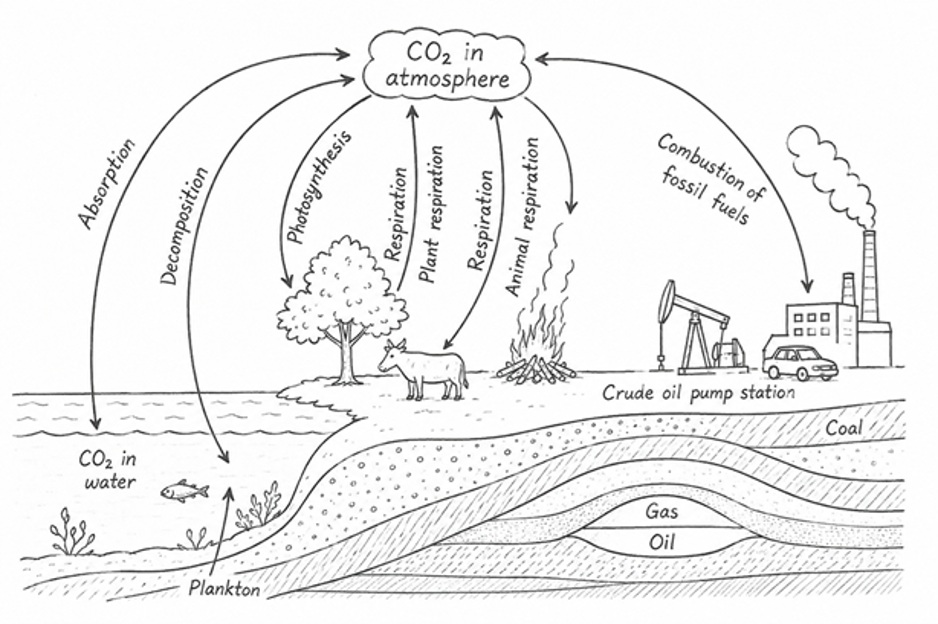
The path that carbon takes to return to the atmosphere is as follows:
- Plants take in carbon dioxide (CO2) from the atmosphere and convert it into glucose using sunlight through photosynthesis.
- Plants return some CO2 to the atmosphere through respiration.
- Animals eat plants (and other animals), and they also release CO2 back into the atmosphere through respiration.
- When plants and animals die, decomposition of their dead remains releases CO2 back into the air.
- In the slow cycle, some dead plants and animals get buried and are converted into fossil fuels (coal, oil and gas) over millions of years. When these fossil fuels are burnt (combustion), the carbon stored in them is released back into the atmosphere as CO2.
- The atmosphere and the ocean water also continuously exchange CO2.
In all these ways, the carbon that plants take from the atmosphere eventually returns to it, completing the carbon cycle.
10: Why is an excess of CO2 in the atmosphere considered undesirable even though it is required by plants?
Answer: Plants do require carbon dioxide (CO₂) for photosynthesis, and a certain amount of CO₂ is also necessary to keep the Earth warm enough to sustain life. However, the balance of CO₂ is critical, and an excess of it is undesirable. Excess CO₂ intensifies the greenhouse effect, leading to global warming. This causes the melting of glaciers and polar ice, raising sea levels and threatening low-lying coastal areas. It also leads to changes in rainfall patterns and more extreme weather events, such as fluctuations in the monsoon, which affect agriculture and water availability. In addition, excess atmospheric CO₂ disturbs the balance of carbon dioxide dissolved in the oceans, affecting plankton and other marine organisms and disturbing marine ecosystems.
11: How is heat lost from the surface of the Earth? What is its significance?
Answer: The Earth’s surface loses heat mainly by re-radiating the absorbed solar energy as infrared (heat) radiation. Some of this infrared radiation escapes into space, while some is absorbed and re-radiated by greenhouse gases in the atmosphere.
This process is significant because it helps maintain the Earth’s energy balance and regulates its temperature. Without this continuous loss of heat, the Earth’s surface would become excessively warm. At the same time, the greenhouse gases that absorb part of the outgoing heat keep the Earth warm enough to support life.
12: If the Earth were a flat disc instead of a sphere, how would the patterns of solar radiation and temperature be different?
Answer: If the Earth were a flat disc instead of a sphere, the pattern of solar radiation would be very different. The Sun’s rays would fall at nearly the same angle over most parts of the Earth’s surface, so the amount of solar energy received would be almost uniform.
As a result, there would be much smaller differences in temperature between different regions. The distinct hot tropical, temperate and polar zones would not exist as they do on the spherical Earth. This would also affect atmospheric circulation, winds and climate patterns, which depend on the unequal heating of the Earth’s surface.
13: Suppose there is a rise in atmospheric temperature on Earth. How would this affect the cryosphere, hydrosphere and biosphere?
Answer: A rise in atmospheric temperature would affect the three spheres as follows:
- Cryosphere — Higher temperatures would cause glaciers and polar ice to melt faster. This would reduce the amount of ice and snow stored in the cryosphere and raise sea levels.
- Hydrosphere — Rising temperatures would increase evaporation and disturb the water cycle, leading to changes in rainfall patterns. Some regions may experience heavy rainfall and floods, while others may face drought. The melting of glaciers and polar ice would also add more water to rivers and oceans, raising sea levels in the long run.
- Biosphere — Rising sea levels and the flooding of low-lying regions would cause habitat loss. The disturbance in the balance of carbon dioxide dissolved in the oceans would affect plankton and other marine organisms. Changing rainfall patterns would also affect crops and agriculture, leading to a decline in biodiversity as many species lose their natural habitats.
14: Explain how the Earth’s atmosphere helps in maintaining a suitable temperature for life to survive on the Earth.
Answer: The Earth’s atmosphere helps maintain a suitable temperature for life through the greenhouse effect. The Earth’s surface absorbs energy from the Sun and re-radiates it as infrared (heat) radiation. Greenhouse gases in the atmosphere absorb part of this outgoing heat and re-radiate it back towards the Earth’s surface, preventing all the heat from escaping into space.
As a result, the atmosphere keeps the Earth warm enough for liquid water and life to exist. At the same time, some heat escapes into space, preventing the Earth from becoming excessively hot. Thus, the atmosphere maintains a balanced temperature that supports life on Earth.
15: Describe the interrelationship between different spheres of the Earth. Illustrate with example how these spheres function in a delicate balance.
Answer: The Earth’s atmosphere, hydrosphere, lithosphere, cryosphere and biosphere are closely interconnected. Matter and energy continuously move between these spheres, and a change in one sphere affects the others. Together, they function in a delicate balance that supports life on Earth.
For example, plants in the biosphere absorb carbon dioxide from the atmosphere for photosynthesis and release oxygen. They also take up water from the hydrosphere and nutrients from the lithosphere. Through transpiration, plants release water vapour into the atmosphere, which helps in cloud formation and rainfall. Rainfall returns water to rivers, lakes and oceans, completing the water cycle. If forests are cut down, this balance is disturbed, leading to reduced rainfall, increased carbon dioxide in the atmosphere, soil erosion and changes in climate.
Thus, all the Earth’s spheres depend on one another, and the proper functioning of one sphere helps maintain the balance of the entire Earth system.
Class 9 Science Exploration Chapter 13 NCERT Questions and Answers
The chapter Earth as a System: Energy, Matter, and Life explores connections between the atmosphere, water, land, and living organisms. Students learn how these components interact and how energy and materials link different natural processes.
Students also consider the effects of human activities on environmental systems. The chapter encourages them to examine change, recognise interdependence, and think about responsible actions that support a sustainable future.