

NCERT Solutions for Class 9 Science Chapter 8 Journey Inside the Atom are provided here with simple and easy-to-understand explanations. Based on the NCERT textbook Exploration, this chapter introduces subatomic particles, atomic models, and the arrangement of particles within atoms. These NCERT Solutions for Class 9 help students understand important concepts, complete textbook activities, and revise the chapter for school examinations.
Journey Inside the Atom Class 9 Questions and Answers
Think It Over (NCERT Textbook Page No. 140)
Question: Are atoms the smallest indivisible particles?
Answer: No, atoms are not the smallest indivisible particles. For a long time, atoms were believed to be indivisible. Scientists discovered that atoms are made up of smaller subatomic particles—electrons, protons and neutrons.
Question: Why do electrons not fall into the nucleus even though they are attracted to protons in it?
Answer: According to Rutherford’s model, electrons should lose energy while revolving around the nucleus and eventually fall into it. However, atoms are actually stable.
Bohr’s model explained this by proposing that, electrons move only in fixed orbits or shells called stationary states. While an electron remains in a fixed shell, it does not lose energy, so it does not spiral inward and therefore it does not fall into the nucleus.
Question: Why did scientists keep modifying atomic models?
Answer: Scientists kept modifying atomic models because new experiments and discoveries showed that the existing models could not explain all the observed properties of atoms. Each new model was developed to overcome the limitations of the earlier one and give a better explanation of atomic structure.
For example, Thomson’s model could not explain the gold foil experiment, and Rutherford’s model could not explain the stability of the atom. So, scientists kept modifying the models to match new experimental results.
Pause and Ponder (NCERT Textbook Page No. 143)
1: Suppose you made up your own ‘atom’, as Thomson described, using clay for the positive charge and small beads for the electrons spread through it. What will happen if:
(i) the positive charge on the clay is lesser than the total negative charge of the beads?
(ii) by mistake, the clay itself carries a bit of negative charge? Would your model still represent a neutral atom?
Answer: (i) If the positive charge on the clay is less than the total negative charge of the beads, the model will have a net negative charge. Therefore, it will not represent a neutral atom.
(ii) If the clay itself carries a bit of negative charge, then there is no positive charge left to balance the negative charge of the beads. So, the negative charge will be greater than the positive charge, and the model will not be neutral.
2: Could an orange or a lemon, which also contain seeds inside soft pulp, be a good comparison? In what ways does it match Thomson’s idea and where does it fall short?
Answer: Yes, an orange or lemon can be a good comparison for Thomson’s idea. The soft pulp can represent the positively charged part of the atom, while the seeds can represent the electrons spread throughout it.
However, the comparison is not perfect. In an orange, the seeds are much larger while electrons are extremely tiny. Also, the pulp of an orange is not actually positively charged. So, it is only a simple analogy to understand Thomson’s model.
3: Why did Thomson conclude that electrons are present in all atoms?
Answer: Thomson concluded that electrons are present in all atoms because the cathode rays he studied were found to be made of negatively charged particles. Their nature was independent of the material of the cathode and the gas used in the cathode ray tube. This showed that electrons are a fundamental part of all atoms.
Pause and Ponder (NCERT Textbook Page No. 144)
4: What do you think would happen if α-particles were replaced with negatively charged particles in Rutherford’s gold foil experiment?
Answer: An α-particle is positively charged. If negatively charged particles were used instead of α-particles, they would be attracted towards the positively charged nucleus. Hence, they would be deflected towards the nucleus rather than being repelled by it. The pattern of scattering would be different from that of the α-particles, which are repelled by the nucleus.
5: Rutherford found that a few α-particles bounced back sharply. How does this single surprising result completely rule out Thomson’s ‘plum pudding model’ of the atom?
Answer: In Thomson’s plum pudding model, the positive charge was spread evenly throughout the atom. Such a spread-out charge could not cause a fast-moving α-particle to bounce back sharply. The sharp backward scattering showed that the positive charge and most of the mass were concentrated in a very small region called the nucleus. But nucleus, could not exist in Thomson’s model, where the positive charge was uniformly distributed. Hence, this observation completely ruled out the plum pudding model.
6: If you could ask Rutherford one question about his work, what would it be?
Answer: One question about Rutherford’s work would be —
“When you saw that a few α-particles bounced straight back, did you immediately think of a tiny dense nucleus, or did you first suspect an error in the experiment?”
7: Assertion (A): Rutherford concluded that most of the mass of an atom is concentrated in a small region at the centre called the nucleus.
Reason (R): According to Thomson’s model, electrons are embedded in a uniformly distributed positive charge sphere.
Choose the correct option:
(i) Both A and R are true, and R is the correct explanation of A.
(ii) Both A and R are true, but R is not the correct explanation of A.
(iii) A is true, but R is false.
(iv) A is false, but R is true.
Answer: (ii) Both A and R are true, but R is not the correct explanation of A.
Explanation
Assertion (A) is true because from the gold foil experiment, Rutherford concluded that most of the atom’s mass is concentrated in a tiny central nucleus.
Reason (R) is true as it correctly describes Thomson’s model, in which electrons are embedded in a uniformly distributed sphere of positive charge.
However, R is not the correct explanation of A because Rutherford’s conclusion came from the large-angle deflection and bouncing back of α-particles, not from Thomson’s description of the atom.
So, both statements are true, but R does not explain A is the correct option.
Pause and Ponder (NCERT Textbook Page No. 149)
8: Imagine you are a scientist who has discovered a new element. Name this element after yourself and justify that the symbol you have chosen follows the IUPAC rules.
Answer: Suppose a scientist named Rohan discovers a new element and names it Rohanium. A suitable symbol could be Ro.
The symbol follows the IUPAC rule of using one or two letters, with the first letter capitalised and the second letter, if present, written in lowercase.
9: What problems could arise if every scientist used different symbols for the same element?
Answer: If every scientist used different symbols for the same element, it would create a lot of confusion. For example:
- Scientists from different countries might not understand each other’s work properly.
- Chemical formulae and equations could look different, making them harder to understand and compare.
- It could cause mistakes and misunderstandings while sharing research, recording information, or teaching.
Pause and Ponder (NCERT Textbook Page No. 150)
10: An atom with an atomic number of 26 has 56 nucleons. Find out its number of electrons, protons and neutrons.
Answer: Given,
Atomic number (Z) = 26 and number of nucleons (mass number, A) = 56
Number of protons = Atomic number = 26|
Number of electrons = Number of protons = 26 (since the atom is neutral)
Number of neutrons = Mass number − Number of protons
= 56 − 26
= 30
Hence, the atom has 26 electrons, 26 protons and 30 neutrons.
11: The nucleus of an atom contains 20 protons. If its mass number is 41, find the number of neutrons in it.
Answer: Given,
Number of protons = 20 and mass number (A) = 41
Number of neutrons = Mass number − Number of protons
= 41 − 20
= 21
Hence, the number of neutrons in the atom is 21.
12: An atom has 18 neutrons and an atomic number of 17. What is its mass number?
Answer: Given,
Number of neutrons = 18 and atomic number (Z) = number of protons = 17
Mass number = Number of protons + Number of neutrons = 17 + 18 = 35
Hence, the mass number of the atom is 35.
13: An atom 23A has 11 electrons. Find the number of neutrons in it.
Answer: Given,
Mass number (A) = 23 and number of electrons = 11
Number of protons = Number of electrons = 11 (since the atom is neutral)
Number of neutrons = Mass number − Number of protons
= 23 − 11
= 12
Hence, the number of neutrons in the atom is 12.
Pause and Ponder (NCERT Textbook Page No. 152)
14: Identify the number of electrons in the outermost shell of the following elements:
(i) 126C
(ii) 199F
(iii) 2814Si
Answer:
(i) 126C
Atomic number = 6, so it has 6 electrons.
Electronic configuration = 2, 4
Number of electrons in the outermost shell = 4
(ii) 199F
Atomic number = 9, so it has 9 electrons.
Electronic configuration = 2, 7
Number of electrons in the outermost shell = 7
(iii) 2814Si
Atomic number = 14, so it has 14 electrons.
Electronic configuration = 2, 8, 4
Number of electrons in the outermost shell = 4
15: Write the electronic configuration of the elements having atomic numbers 12, 16 and 18.
Answer: The electrons are filled in the shells (K, L, M, …) following the rules that a shell can hold a maximum of 2n² electrons and that the outermost shell can have at most 8 electrons.
Atomic number 12 (Magnesium): 2, 8, 2
Atomic number 16 (Sulfur): 2, 8, 6
Atomic number 18 (Argon): 2, 8, 8
16: Solve this riddle: I am an atom with a mass number of 23 and 11 protons. I am a soft metal and react vigorously with water. Who am I and how many neutrons do I have? You can also create one such riddle.
Answer: Given,
Mass number (A) = 23 and number of protons = 11
Since the number of protons is 11, the atomic number is 11. The element with atomic number 11 is Sodium (Na), a soft metal that reacts vigorously with water.
Number of neutrons = Mass number − Number of protons
= 23 − 11
= 12
Hence, the atom is Sodium (Na) and it has 12 neutrons.
Sample riddle: “I have a mass number of 4 and 2 protons. I am a very light gas used in balloons. Who am I?” — Answer: Helium. It has 2 neutrons.
Pause and Ponder (NCERT Textbook Page No. 156)
17: Two different atoms have 11 protons each, but one has 12 neutrons, and the other has 13 neutrons. How do their atomic numbers and mass numbers compare? Are they the same element or different elements?
Answer: For both atoms, the number of protons is 11, so both have the same atomic number = 11.
Mass numbers:
First atom: 11 + 12 = 23
Second atom: 11 + 13 = 24
So, the two atoms have the same atomic number (11) but different mass numbers (23 and 24).
Since the atomic number determines the identity of an element, both atoms belong to the same element (Sodium). They are isotopes of each other.
18: If a bromine atom is available in the form of, say two isotopes, 7935Br (49.7%) and 8135Br (50.3%), calculate the average atomic mass of the bromine atom.
Answer: The average atomic mass is the weighted average of the masses of the isotopes, calculated using their percentage relative abundances.
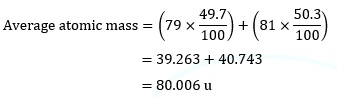
Hence, the average atomic mass of the bromine atom is approximately 80 u.
Revise, Reflect, Refine (NCERT Textbook Page No. 158-160)
1: Choose the correct options and explain the reason for the correct and incorrect options in the context of Ernest Rutherford’s gold foil experiment:
(i) The experiment clearly showed the existence of neutrons in the nucleus.
(ii) The results disproved the plum pudding model and led to the idea of a nucleus at the centre of the atom.
(iii) The large deflection of a few alpha particles indicated that most of the mass of the atom and positive charge are packed into a tiny centre.
(iv) The way alpha particles were deflected showed that electrons move around the nucleus.
Answer: The correct options are (ii) and (iii).
Explanation:
(i) Incorrect: The gold foil experiment did not show the existence of neutrons. It showed that the atom has a tiny, dense, positively charged nucleus. The neutron was discovered later by James Chadwick in 1932.
(ii) Correct: Thomson’s plum pudding model could not explain the large deflections and bouncing back of α-particles. These results disproved that model and led Rutherford to the idea of a dense nucleus at the centre of the atom.
(iii) Correct: The large deflection of a few α-particles showed that the positive charge and most of the mass of an atom are concentrated in a very small region called the nucleus.
(iv) Incorrect: The experiment helped Rutherford understand the nucleus and the distribution of positive charge and mass. It did not provide evidence about the detailed motion of electrons around the nucleus.
2: Which of the following statements are correct or incorrect according to the Bohr’s atomic model? Give a reason for each statement.
(i) Electrons lose energy while moving in fixed orbits and slowly fall into the nucleus.
(ii) Electrons can exist anywhere around the nucleus with no fixed energy.
(iii) Electrons revolve around the nucleus in orbits of fixed energy without losing energy.
(iv) Electrons can be found between energy levels as they move around the nucleus.
Answer: The correct option is (iii).
(i) Incorrect: According to Bohr, while moving in a fixed orbit (stationary state) an electron does not lose energy. Therefore, it does not slowly fall into the nucleus. This idea of losing energy was the problem with Rutherford’s model, which Bohr’s model solved.
(ii) Incorrect: Electrons cannot exist anywhere around the nucleus. They can revolve only in certain allowed orbits (shells), and each orbit has a definite, fixed amount of energy.
(iii) Correct: This is exactly Bohr’s postulate of stationary states. Electrons revolve around the nucleus in fixed orbits of definite energy, and while doing so they do not lose energy. This explains the stability of the atom.
(iv) Incorrect: Electrons can revolve only in the allowed shells and not in between them. They can move from one shell to another only by absorbing or releasing a fixed amount of energy.
3: The composition of the nuclei of three atomic species X, Y, and Z are given as follows.
| X | Y | Z | |
| Number of protons | 18 | 17 | 17 |
| Number of neutrons | 19 | 18 | 20 |
Explain the relation between the following:
(i) Y and Z
(ii) Z and X
Answer: First, let us find the atomic number and mass number of each species.
X: protons = 18, neutrons = 19, so atomic number = 18 and mass number = 18 + 19 = 37
Y: protons = 17, neutrons = 18, so atomic number = 17 and mass number = 17 + 18 = 35
Z: protons = 17, neutrons = 20, so atomic number = 17 and mass number = 17 + 20 = 37
(i) Y and Z: Both have the same atomic number (17) but different mass numbers (35 and 37). Atoms of the same element having the same atomic number but different mass numbers are called isotopes. Hence, Y and Z are isotopes.
(ii) Z and X: Both have the same mass number (37) but different atomic numbers (17 and 18). Atoms of different elements having the same mass number but different atomic numbers are called isobars. Hence, Z and X are isobars.
4: What conclusion did Rutherford draw about the position and characteristics of the atom’s positively charged part based on the few alpha particles that bounced back or were deflected at large angles in the gold foil experiment?
Answer: Rutherford concluded that the atom’s positive charge is concentrated in a very small, dense region at the centre, called the nucleus. He also concluded that the nucleus contains most of the atom’s mass, while most of the atom is empty space. The large deflections and bouncing back of a few α-particles provided evidence for this conclusion.
5: Explain and arrange the following statements in the correct chronological order to show how atomic models have evolved over time.
(i) Bohr’s model proposed that electrons move in fixed orbits around the nucleus, each with a definite energy.
(ii) Thomson’s model depicted the atom as a ‘plum pudding’ with electrons embedded in a sphere of positive charge.
(iii) Rutherford’s model proposed that atoms have a dense central nucleus.
(iv) Dalton’s model described atoms as indivisible particles.
Answer: The correct chronological order is: (iv) → (ii) → (iii) → (i)
Explanation:
(iv) Dalton’s model: In 1808, John Dalton proposed that matter is made up of tiny, indivisible particles called atoms.
(ii) Thomson’s model: In 1897, J. J. Thomson discovered electrons and proposed the plum pudding model, in which electrons were embedded in a sphere of positive charge.
(iii) Rutherford’s model: In 1911, Rutherford’s gold foil experiment led to the conclusion that the atom has a tiny, dense, positively charged nucleus at its centre.
(i) Bohr’s model: In 1913, Niels Bohr proposed that electrons move in fixed orbits or shells, each having a definite amount of energy.
6: Electrons move around the nucleus in orbits. Why do they not fly away from the atom? Explain what keeps them attracted to the nucleus.
Answer: Electrons do not fly away from the atom because they are negatively charged, while the nucleus is positively charged due to the presence of protons. As unlike charges attract each other, there is an electrostatic force of attraction between the positively charged nucleus and the negatively charged electrons. This attractive force keeps the electrons bound to the atom.
According to Bohr’s model, electrons revolve around the nucleus only in fixed orbits or energy levels. While moving in these fixed orbits, they do not lose energy. Therefore, they remain in their allowed orbits instead of falling into the nucleus or moving away from the atom.
7: Assertion (A): The discovery of subatomic particles helped in understanding the atomic structure.
Reason (R): The number of electrons is equal to the number of protons in an atom.
Choose the correct option:
(i) Both A and R are true, and R is the correct explanation of A.
(ii) Both A and R are true, but R is not the correct explanation of A.
(iii) A is true, but R is false.
(iv) A is false, but R is true.
Answer: (ii) Both A and R are true, but R is not the correct explanation of A.
Explanation
Assertion (A): The discovery of subatomic particles such as electrons, protons, and neutrons helped scientists understand that atoms are made up of smaller particles and improved our understanding of atomic structure.
So, it is true.
Reason (R): In a neutral atom, the number of electrons is equal to the number of protons, so their opposite charges balance each other.
So, it is true.
However, R is not the correct explanation of A. The fact that electrons equal protons explain the electrical neutrality of the atom, but it is not the reason why the discovery of subatomic particles helped in understanding atomic structure.
Hence, both statements are true, but R does not explain A is the correct option.
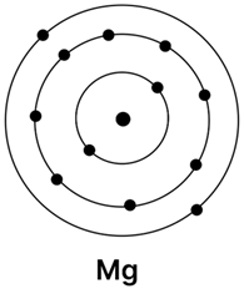
8: Magnesium is essential for many biological processes, including muscle contraction. For an atom of magnesium with a mass number of 24 and atomic number 12, determine the number of (i) protons, (ii) neutrons, (iii) electrons, and also illustrate the arrangement of electrons in a magnesium atom.
Answer: Given,
Mass number (A) = 24 and atomic number (Z) = 12
(i) Number of protons = Atomic number = 12
(ii) Number of neutrons = Mass number − Number of protons
= 24 − 12
= 12
(iii) Number of electrons = Number of protons = 12 (since the atom is neutral)
Arrangement of electrons (electronic configuration) of magnesium = 2, 8, 2
That is, the K-shell has 2 electrons, the L-shell has 8 electrons, and the M-shell has 2 electrons.
9: Find the following information for the elements shown in Fig. 8.17:
(i) Name of the element
(ii) Symbol
(iii) Total number of electrons
(iv) Number of valence electrons
(v) Valency of the element
(vi) Number of protons
(vii) Atomic number
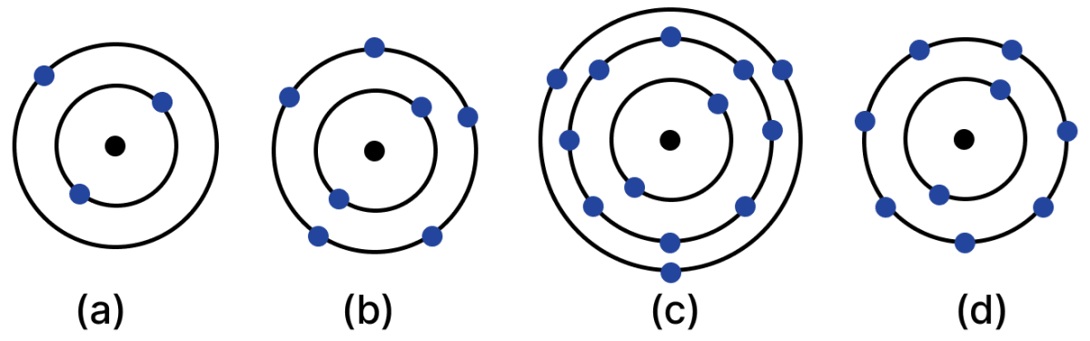
Answer: By counting the electrons in each shell, the electronic configuration of each atom can be found, and from this all the required information is obtained.
(a) Electronic configuration = 2, 1
(i) Name of the element : Lithium
(ii) Symbol : Li
(iii) Total number of electrons : 3
(iv) Number of valence electrons : 1
(v) Valency : 1 (loses 1 electron)
(vi) Number of protons : 3
(vii) Atomic number : 3
(b) Electronic configuration = 2, 5
(i) Name of the element : Nitrogen
(ii) Symbol : N
(iii) Total number of electrons : 7
(iv) Number of valence electrons : 5
(v) Valency : 3 (gains 3 electrons to complete the octet)
(vi) Number of protons : 7
(vii) Atomic number : 7
(c) Electronic configuration = 2, 8, 3
(i) Name of the element : Aluminium
(ii) Symbol : Al
(iii) Total number of electrons : 13
(iv) Number of valence electrons : 3
(v) Valency : 3 (loses 3 electrons)
(vi) Number of protons : 13
(vii) Atomic number : 13
(d) Electronic configuration = 2, 7
(i) Name of the element : Fluorine
(ii) Symbol : F
(iii) Total number of electrons : 9
(iv) Number of valence electrons : 7
(v) Valency : 1 (gains 1 electron to complete the octet)
(vi) Number of protons : 9
(vii) Atomic number : 9
10: Both Rutherford’s and Bohr’s models have electrons orbiting the nucleus. Why did Rutherford’s model fail to explain atomic stability, while Bohr’s model succeeded?
Answer: Rutherford’s model could not explain atomic stability because, according to the model, electrons revolve around the nucleus. A moving charged electron should continuously lose energy and move closer to the nucleus. Eventually, it should fall into the nucleus, making the atom unstable.
Bohr solved this problem by proposing that electrons can move only in fixed energy levels or shells around the nucleus. While an electron remains in one of these fixed levels, it does not lose energy. Therefore, electrons do not spiral into the nucleus, and the atom remains stable.
OR
According to Rutherford’s model, electrons revolve around the nucleus in circular paths. A charged particle moving in a circular path is constantly changing its direction, which means it is accelerating. An accelerating charged electron should continuously lose energy in the form of radiation, spiral inward, and finally fall into the nucleus. If this happened, the atom would be unstable. This would make the atom unstable, which contradicts the fact that atoms are stable. Rutherford’s model could not explain atomic stability.
Bohr solved this problem by introducing the idea of stationary states. He proposed that electrons revolve only in certain fixed orbits (shells), each having a definite energy, and that while moving in such an orbit an electron does not lose energy. Because the electron does not lose energy, it does not spiral into the nucleus. In this way, Bohr’s model successfully explained the stability of the atom.
11: An atom 70X has 31 electrons. How many neutrons are there in its nucleus?
Answer: Given,
Mass number (A) = 70 and number of electrons = 31
Number of protons = Number of electrons = 31 (since the atom is neutral)
Number of neutrons = Mass number − Number of protons
= 70 − 31
= 39
Hence, the number of neutrons in the nucleus is 39.
12: An atom has 79 protons and a mass number of 197. Calculate (i) the number of neutrons, and (ii) the number of electrons.
Answer: Given,
Number of protons = 79 and mass number (A) = 197
(i) Number of neutrons = Mass number − Number of protons = 197 − 79 = 118
(ii) Number of electrons = Number of protons = 79 (since the atom is neutral)
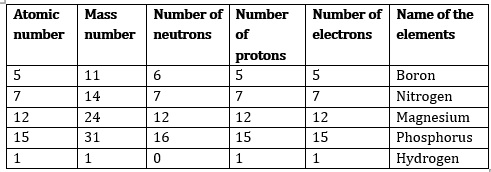
13: Complete the Table 8.5:
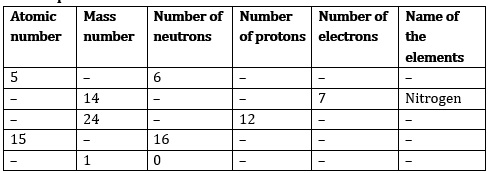
Answer: Using the relations: Atomic number = Number of protons = Number of electrons, and Mass number = Number of protons + Number of neutrons, the table is completed as follows.
14: Aman was discussing the structure of atom with his classmates. During the discussion, he learnt that an element X has a mass number of 35 and contains 18 neutrons. Based on this information, answer the following questions:
(i) How many electrons and protons does element X have?
(ii) What is its atomic number?
(iii) Identify the element X.
(iv) Write its electronic configuration.
(v) How many valence electrons does it have?
(vi) What will be the mass number if two neutrons are added to its nucleus?
(vii) What will be the relation of X with the new atom?
Answer: Given,
Mass number (A) = 35 and number of neutrons = 18
(i) Number of protons = Mass number − Number of neutrons = 35 − 18 = 17
Number of electrons = Number of protons = 17
So, element X has 17 protons and 17 electrons.
(ii) Atomic number = Number of protons = 17
(iii) The element with atomic number 17 is Chlorine (Cl).
(iv) Electronic configuration = 2, 8, 7
(v) Number of valence electrons = 7 (electrons in the outermost shell)
(vi) New mass number = 35 + 2 = 37 (the number of protons stays the same; only neutrons increase)
(vii) The new atom has the same atomic number (17) but a different mass number (37). Hence, X and the new atom are isotopes of each other.
15: In an atom, there are 12 protons and 12 neutrons in the nucleus. Now, imagine that all the electrons are replaced with some hypothetical particles that have the same charge as electrons but are 500 times heavier. What effect will this replacement have on the atom’s:
(i) Atomic number
(ii) Atomic mass
(iii) Mass number
(iv) Overall charge
Answer: The atom has 12 protons and 12 neutrons, so it has 12 electrons (atomic number 12). The replacement changes only the electrons; the nucleus (protons and neutrons) stays the same.
(i) Atomic number: It remains 12, because atomic number depends only on the number of protons.
(ii) Atomic mass: It would increase, because the new particles have the same charge as electrons but are 500 times heavier.
(iii) Mass number: It remains 24, because mass number is the total number of protons + neutrons. Since the nucleus is unchanged, the mass number remains 24.
(iv) Overall charge: It remains zero (neutral). The new particles carry the same charge as electrons (each −1) and their number is still 12. This balances the 12 protons (+12). So, the atom stays electrically neutral, and its overall charge is zero.
Class 9 Science Exploration Chapter 8 NCERT Questions and Answers
The chapter Journey Inside the Atom explores how experiments led to ideas about atomic structure. Students learn about electrons, protons, and neutrons and examine models that explain the nucleus and the distribution of electrons.
Students also study atomic number, mass number, and the relationship between electronic arrangement and valency. The chapter helps them use particle information to describe atoms and understand how evidence has shaped atomic models.