

NCERT Solutions for Class 9 Science Chapter 6 How Forces Affect Motion are provided here with simple and easy-to-understand explanations. Based on the NCERT textbook Exploration, this chapter introduces balanced and unbalanced forces, inertia, momentum, and the laws governing motion. These NCERT Solutions for Class 9 help students understand important concepts, complete textbook activities, and revise the chapter for school examinations.
How Forces Affect Motion Class 9 Questions and Answers
Think It Over (NCERT Textbook Page No. 94)
Q: Why does a canoe move forward when the canoeist pushes water backwards with their paddle and why does it move faster when they push harder?
Answer: When the canoeist pushes the water backwards with the paddle, the water applies an equal and opposite force on the paddle in the forward direction. This forward force moves the paddle and the canoe ahead. This is an example of Newton’s third law of motion. When the canoeist pushes harder on the water, the water exerts a larger forward force on the paddle. As a result, the canoe accelerates and moves faster.
Q: Suppose the same canoeist uses the same paddle force in two different canoes, one empty and one carrying another passenger. In which case will the canoe move faster?
Answer: The canoe will move faster when it is empty.
According to Newton’s second law of motion,
The empty canoe has less mass than the canoe carrying another passenger. Therefore, the same paddle force produces a larger acceleration, making the empty canoe move faster.
Pause and Ponder (NCERT Textbook Page No. 97)
1: A weightlifter lifts a barbell (Fig.). List two forces that are acting on the barbell. Are these forces balanced if the weightlifter keeps the barbell steady?
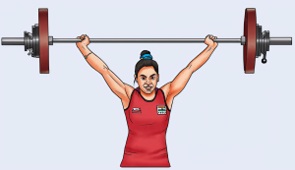
Answer: The two forces acting on the barbell are:
- The gravitational force (weight) of the barbell, acting downwards.
- The upward force applied by the weightlifter on the barbell.
Yes, these forces are balanced if the weightlifter keeps the barbell steady. Since the upward force is equal to the downward gravitational force, the net force is zero, so the barbell remains at rest.
2: Two players R and S are participating in an arm-wrestling match (Fig. 6.9). At the instant, when the arms tilt to the front direction (out of the page towards you), are the forces exerted by the players balanced? If not, which player exerted the larger force?
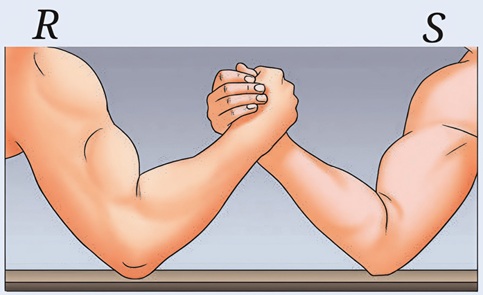
Answer: No, the forces exerted by the players are not balanced. If the forces were balanced, the net force would be zero and the arms would remain steady. Since the arms tilt towards the front (out of the page), the player who is pushing in that direction is exerting the larger force. Therefore, player R exerted the larger force.
Pause and Ponder (NCERT Textbook Page No. 101)
3: An object is moving with a constant velocity. Is there a net force acting upon it?
Answer: No. If an object is moving with a constant velocity, no net force is acting on it. The forces acting on the object, if any, are balanced, so its velocity does not change. According to Newton’s first law of motion, an object continues to move with a constant velocity unless a net force acts on it.
4: Suppose, no net force is acting on an object. Which of the following situations are possible?
(i) Object remains at rest if at rest.
(ii) Object keeps moving with a constant velocity if already moving.
(iii) Object is moving with a constant acceleration.
Answer: Situations (i) and (ii) are possible.
According to Newton’s first law of motion, when no net force acts on an object, an object at rest remains at rest, and an object already in motion continues to move with a constant velocity.
Situation (iii) is not possible, because a constant non-zero acceleration means the velocity is changing, which requires a net force to act on the object.
5: In the real world, it is difficult to find a situation where no forces are acting on an object. But by applying additional forces, a condition can be achieved where the net force on the object is zero. Explain with the help of an example.
Answer: A condition of zero net force is achieved when all the forces acting on an object balance each other.
For example, consider a box being pushed across a floor. The applied force acts in the forward direction, while the force of friction acts in the opposite direction. If the applied force is equal to the force of friction, the two forces balance each other, making the net force zero. In this case, according to Newton’s first law of motion, the box continues to move with a constant velocity.
Pause and Ponder (NCERT Textbook Page No. 106)
6: A toy car of mass 100 g is moving with a constant velocity of 0.5 m s–1. What is the net force acting on the toy car?
Answer: The toy car is moving with a constant velocity, so its acceleration is zero.
According to Newton’s second law of motion,
Force = mass × acceleration
= 0.1 kg × 0 [∵ 100 g = 0.1 kg]
= 0 N
Hence, the net force acting on the toy car is zero (0 N).
7: Two children of different masses are sitting on identical swings. To impart identical initial acceleration, for which child would you require to apply a larger force? Explain why.
Answer: We know, Force = mass × acceleration (F = ma).
According to Newton’s second law of motion, the force required to produce an acceleration depends on the mass of the object. Since the heavier child has greater mass, a greater force is needed to produce the same acceleration as that of the lighter child.
8: How are glass items packed for transportation using a bubble wrap or hay protected from damage?
Answer: Glass items are packed with bubble wrap or hay because these materials act as cushioning. They increase the time of impact and absorb the shock when the package is dropped or bumped. This reduces the force acting on the glass and prevents it from breaking.
Pause and Ponder (NCERT Textbook Page No. 110)
9: Why does a fireperson sometimes struggle when holding the pipe issuing water?
Answer: When water is forced out of the pipe at high speed, it carries momentum in the forward direction. According to Newton’s third law of motion, an equal and opposite reaction force acts on the pipe, pushing it backwards. Since a large amount of water is ejected every second, this reaction force is very large. Therefore, the fireperson has to apply a strong force to hold the pipe steady and often struggles to control it.
10: Suppose a spacecraft is moving in a region of space where the gravitational force acting upon it is negligible. Suggest how can it change its velocity.
Answer: If the gravitational force acting on a spacecraft is negligible, it can change its velocity by firing its rockets or thrusters. When the rocket ejects gases backward at high speed, the gases exert an equal and opposite reaction force on the spacecraft according to Newton’s third law of motion. This reaction force changes the spacecraft’s velocity, allowing it to speed up, slow down or change direction.
Revise, Reflect, Refine (NCERT Textbook Page No. 112 – 114)
1: Using a horizontal force F, a table is moved across the floor at a constant velocity. How much is the frictional force exerted by the floor on the table?
Answer: Since the table is moving with a constant velocity, its acceleration is zero. Therefore, the net force acting on the table is zero. For the net force to be zero, the frictional force must balance the horizontal force. Hence, the frictional force exerted by the floor on the table is equal to F, acting in the direction opposite to the motion.
2: For a ball moving on a smooth frictionless surface, choose the appropriate option that will make the following statements physically correct.
(i) If no net force is applied on the ball, the velocity of the ball will remain the same/increase/decrease.
(ii) If a net force is applied on the ball in the direction of its motion, the magnitude of the velocity of the ball will remain the same/increase/decrease.
(iii) If a net force is applied on the ball in a direction opposite to the direction of its motion, the magnitude of the velocity of the ball will remain the same/increase/decrease.
Answer: (i) If no net force is applied on the ball, the velocity of the ball will remain the same.
(ii) If a net force is applied on the ball in the direction of its motion, the magnitude of the velocity of the ball will increase.
(iii) If a net force is applied on the ball in a direction opposite to the direction of its motion, the magnitude of the velocity of the ball will decrease.
3: Two blocks P and Q on a smooth horizontal surface are shown in Fig. 6.36a and Fig. 6.36b. Two forces of magnitudes 4 N and 5 N are acting in opposite directions on block P, while block Q is moving with a constant velocity.
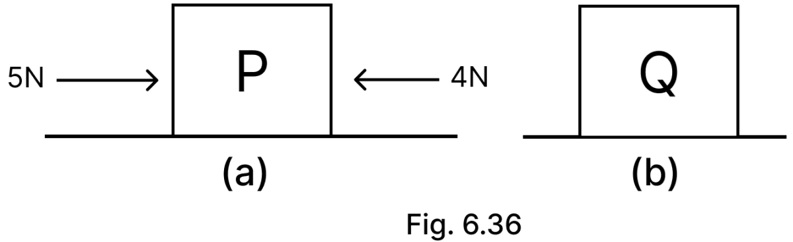
Which of the following statement is correct?
(i) P experiences a net force and Q does not experience a net force.
(ii) P does not experience a net force and Q experiences a net force.
(iii) Both P and Q experience a net force.
(iv) Neither P nor Q experiences a net force.
Answer: (i) P experiences a net force and Q does not experience a net force.
Reason: On block P, two unequal forces of 5 N and 4 N act in opposite directions.
∴ The net force on P = 5 N – 4 N = 1 N,
So, P experiences a net force.
Block Q is moving with a constant velocity, which means its acceleration is zero and the net force acting on it is zero.
4: While practising for the snake boat race (Vallum kalli in Kerala), 100 oarsmen are
rowing a boat together. Out of these, 95 row backwards to propel the boat forward. But by mistake, 5 oarsmen row in the opposite direction. If each oarsman applies a horizontal force of 200 N, what is the net force on the snake boat? (Ignore drag forces, air friction, etc.)
Answer: Given,
Force applied by each oarsman = 200 N
Number of oarsmen propelling the boat forward = 95
Number of oarsmen rowing in the opposite direction = 5
∴ Forward force = 95 × 200 = 19000 N
Backward force = 5 × 200 = 1000 N
Net force = Forward force – Backward force
= 19000 – 1000
= 18000 N
Hence, the net force on the snake boat is 18000 N in the forward direction.
5: When a net force acts on an object, we observe that the object accelerates:
(i) opposite to the direction of force, with acceleration proportional to the force acting on the object.
(ii) opposite to the direction of force, with acceleration proportional to the mass of the object.
(iii) in the direction of force, with acceleration inversely proportional to the force acting on the object.
(iv) in the direction of force, with acceleration proportional to the force acting on the object.
Answer: (iv) in the direction of force, with acceleration proportional to the force acting on the object.
Reason — According to Newton’s second law of motion, when a net force acts on an object, the object accelerates in the direction of the net force. The magnitude of acceleration is directly proportional to the magnitude of the net force and inversely proportional to the mass of the object.
6: The position-time graph for four objects A, B, C and D moving along a straight line are given in Fig. 6.37. A net force acts on:
(i) Object A
(ii) Object B
(iii) Object C
(iv) Object D
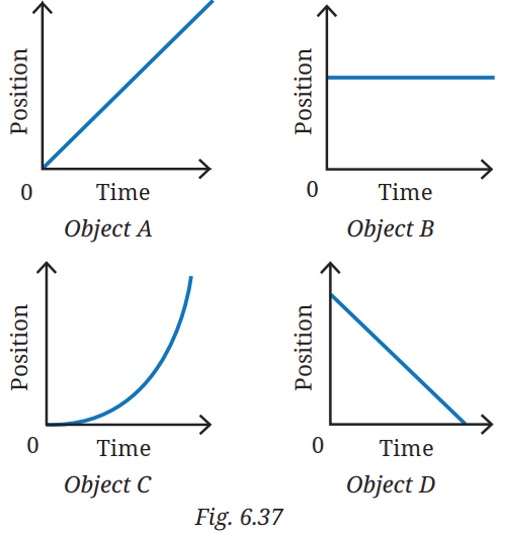
Answer: (iii) Object C
Reason — A net force acts on an object only when its velocity changes, i.e., when it is accelerating. For objects A and D, the position-time graphs are straight lines, indicating motion with a constant velocity (no net force). For object B, the position-time graph is a horizontal line, indicating that it is at rest (no net force). For object C, the position-time graph is a curve, indicating that its velocity is changing (it is accelerating). Hence, a net force acts on object C.
7: A sailor jumps out from a small boat to the shore (Fig. 6.38). As the sailor jumps forward, will the boat move? If yes, in which direction and why.
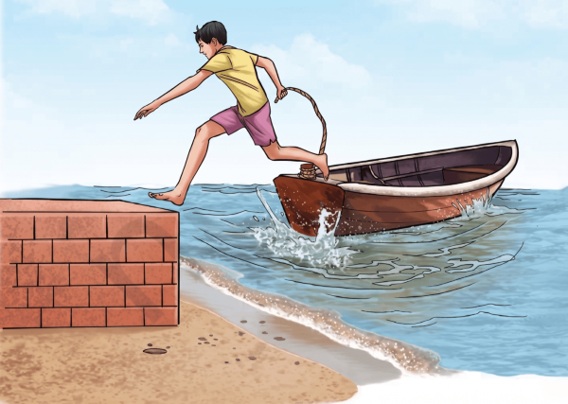
Answer: Yes, the boat will move. It will move backwards, i.e., in the direction opposite to the direction in which the sailor jumps.
This happens because of Newton’s third law of motion. As the sailor jumps forward towards the shore, the sailor’s feet apply a force on the boat in the backward direction. In turn, the boat exerts an equal and opposite force on the sailor, pushing the sailor forward. Due to the backward force exerted by the sailor, the boat moves backwards.
8: During a high jump event, a landing mat or sand bed is placed for the athlete to fall upon (Fig. 6.39). Explain the reason behind it.
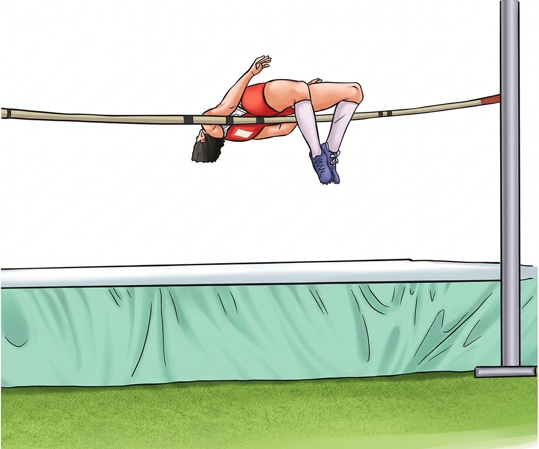
Answer: A landing mat or sand bed increases the time taken by the athlete’s body to come to rest after landing. Due to this, the magnitude of acceleration is reduced. According to Newton’s second law of motion, F = ma, smaller acceleration means smaller impact force. Hence, the mat or sand bed reduces the force on the athlete and prevents injury.
9: A hand cart loaded with vegetables collides with an identical but empty hand cart. During the collision:
(i) the loaded cart exerts a force of larger magnitude on the empty cart.
(ii) the empty cart exerts a force of larger magnitude on the loaded cart.
(iii) neither cart exerts a force on the other.
(iv) the loaded cart and the empty cart both exert an equal magnitude of force on each other.
Answer: (iv) the loaded cart and the empty cart both exert an equal magnitude of force on each other.
Reason — According to Newton’s third law of motion, whenever one object exerts a force on another object, the second object simultaneously exerts an equal and opposite force on the first object. Therefore, during the collision, both carts exert forces of equal magnitude on each other, irrespective of their masses.
10: The acceleration-mass graph for the acceleration produced by a force on objects of different masses is plotted in Fig. 6.40. Plot the force-mass graph for this case.
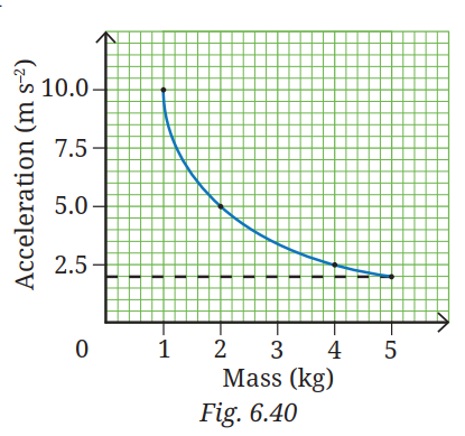
Answer: From the acceleration-mass graph (Fig. 6.40), reading the values:
| Mass (kg) | Acceleration (m s–2) | Force (F = ma) in N |
| 1 | 10.0 | 1 × 10.0 = 10 |
| 2 | 5.0 | 2 × 5.0 = 10 |
| 4 | 2.5 | 4 × 2.5 = 10 |
| 5 | 2.0 | 5 × 2.0 = 10 |
We know, Force = mass × acceleration (F = ma).
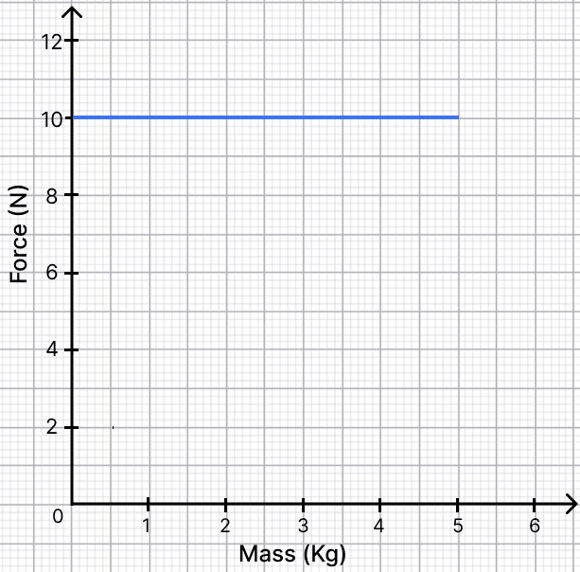
On calculating the force for each mass, the value of the force comes out to be the same, i.e., 10 N, for all the masses. This is because the same force was applied on objects of different masses.
Hence, the force-mass graph is a straight line parallel to the mass axis at F = 10 N, as shown below.
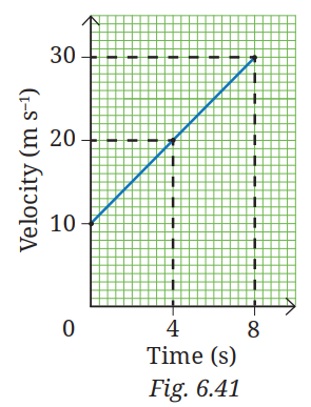
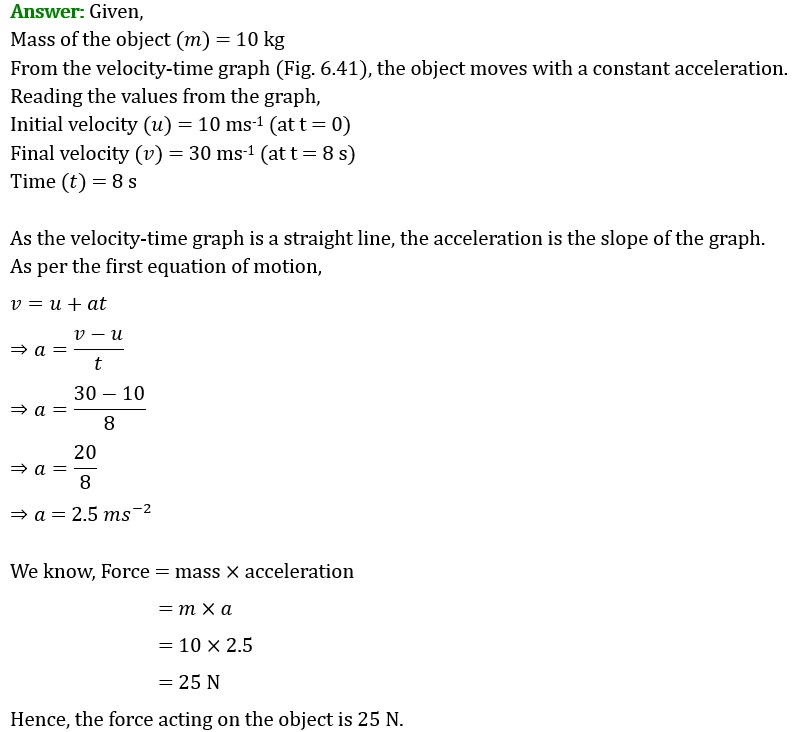
11: The velocity-time graph of an object of mass 10 kg moving along a straight line is shown in Fig. 6.41. Calculate the force acting on the object by using the graph.
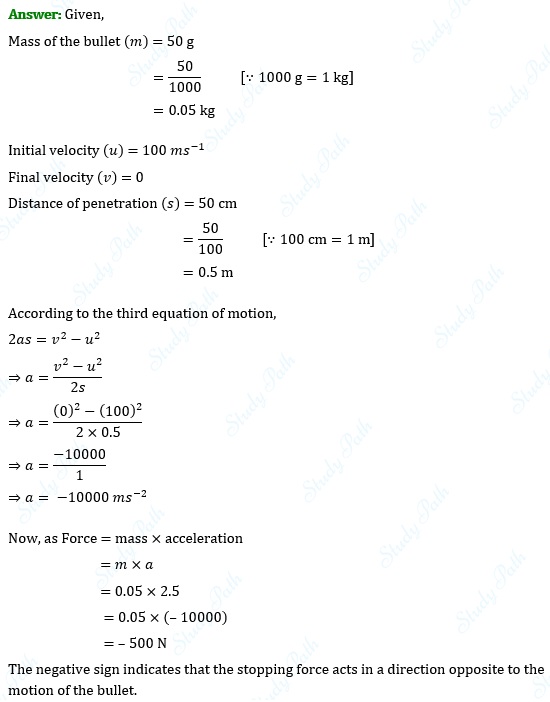
12: A bullet of mass 50 g moving with a speed of 100 m s–1 enters a heavy stationary wooden block and stops after penetrating a distance of 50 cm. Estimate the stopping force acting on the bullet (assume that the bullet undergoes constant acceleration within the block).
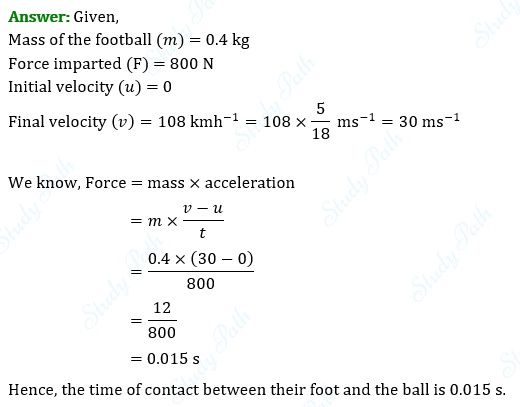
13: An ace footballer converted a penalty shot by kicking the football with a speed of 108 km h–1. The estimated force they imparted was 800 N. The mass of the football was 0.4 kg. Calculate the time of contact between their foot and the ball.
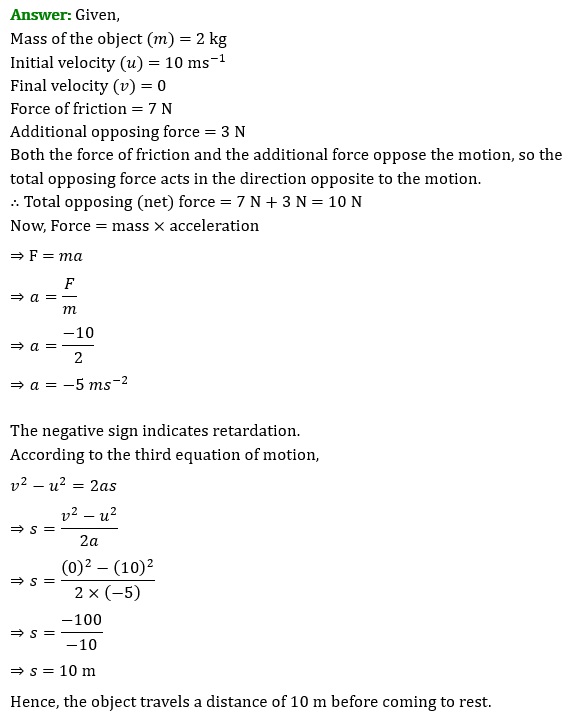
14: An object of mass 2 kg moving with a constant velocity of 10 m s–1 encounters a rough patch where the force of friction on the object is 7 N. At the same time, an additional constant force of 3 N opposing the motion is applied on the object. After entering the rough patch, how much distance does the object travel before coming to rest?
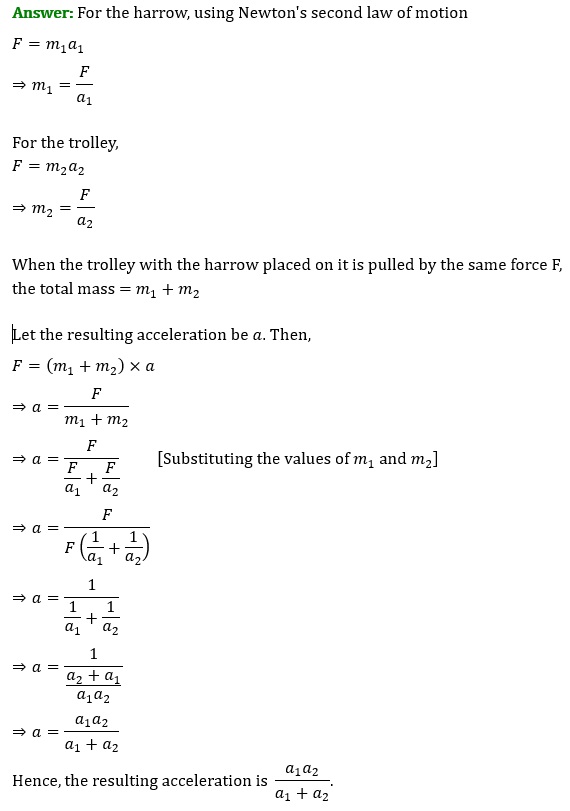
15: A tractor pulls a harrow (a ploughing tool) of mass m1 with a net force F resulting in an acceleration of a1. The same tractor pulls a trolley of mass m2 with a force F producing an acceleration of a2. If the tractor now pulls the trolley with the harrow placed on it (with the same force F), then obtain an expression for the resulting acceleration in terms of a1 and a2. Ignore friction.
16: When the pole of a bar magnet is brought close to a magnetic compass, the bar magnet and the compass needle (which is also a magnet) exert a magnetic force on each other. As per Newton’s third law of motion, both the forces are equal in magnitude and opposite in direction. However, the compass needle moves, whereas the bar magnet does not move (Fig. 6.42). Explain why.
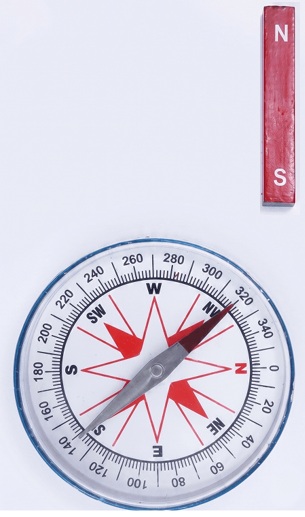
Answer: The bar magnet and the compass needle exert equal and opposite magnetic forces on each other, as stated by Newton’s third law of motion. However, these equal forces do not produce equal accelerations because the masses of the two objects are different.
According to Newton’s second law of motion,
For the same force, acceleration is inversely proportional to mass. The compass needle has a very small mass, so the force produces a noticeable acceleration in it and it moves. The bar magnet has a much larger mass, so the same force produces an extremely small acceleration in it. Therefore, the bar magnet appears to remain at rest while the compass needle moves.
Class 9 Science Exploration Chapter 6 NCERT Questions and Answers
The chapter How Forces Affect Motion explores how interactions between objects can change their motion. Students learn about inertia and Newton’s laws and connect the effect of a force with an object’s mass and acceleration.
Students also examine momentum, action and reaction, and everyday situations involving forces. Activities and numerical problems encourage them to identify interacting objects, apply physical principles, and explain observations logically.