

NCERT Solutions for Class 9 Science Exploration Chapter 5 Exploring Mixtures and their Separation are provided here with simple and easy-to-understand explanations. Based on the NCERT textbook Exploration, this chapter introduces solutions, suspensions, colloids, and methods used to separate mixtures. These NCERT Solutions for Class 9 help students understand important concepts, complete textbook activities, and revise the chapter for school examinations.
Exploring Mixtures and their Separation Class 9 Science Questions and Answers
Think It Over (NCERT Textbook Page No. 73)
Question: Why do suspended particles settle in muddy water over time but not in milk?
Answer: Muddy water is a suspension. Its particles are large, visible to the naked eye and heavy so they gradually settle at the bottom when the mixture is left undisturbed.
Milk, on the other hand, is a colloid. The particles present in milk are much smaller than those in a suspension and remain uniformly dispersed in the liquid. Therefore, they do not settle down even after standing for a long time.
Question: How is evaporation different from boiling?
Answer: Evaporation is the slow conversion of a liquid into vapour from the surface of the liquid at a temperature below its boiling point. It is a surface phenomenon and may take place at any temperature.
Boiling is the process in which a liquid changes into vapour throughout the liquid when it reaches its boiling point. It is a rapid process and bubbles are formed throughout the liquid.
Question: Why do you see bright rays of sunlight when it passes through small gaps between the leaves of a dense tree?
Answer: We see bright rays of sunlight passing through small gaps between the leaves because milk droplets, dust particles and tiny water droplets present in the air scatter the sunlight. The scattered light makes the path of the sun’s rays visible to our eyes. This phenomenon is known as the Tyndall effect, which is shown by colloids.
Pause and Ponder (NCERT Textbook Page No. 76)
1: A common talcum powder contains 4 % m/m zinc oxide, which acts as an antiseptic. How much zinc oxide is present in 300 g of the talcum powder?
Answer: Given,
Concentration of zinc oxide = 4 % m/m
This means 4 g of zinc oxide is present in 100 g of talcum powder.
∴ Mass of zinc oxide present in 300 g of talcum powder= 4/100 × 300 =12 g
Hence, 12 g of zinc oxide is present in 300 g of the talcum powder.
2: Your mother gives you a bottle of orange juice concentrate to mix with water and serve it to your visiting friends. She asks you to mix two tablespoons of the concentrate with water in a glass tumbler. If each tablespoon measures 15 mL and you make 150 mL of juice per person, what is the % v/v of orange juice concentrate in the mixture you prepared?
Answer: Given,
Volume of one tablespoon = 15 mL
Volume of orange juice concentrate (solute) = 2 ×15 = 30 mL
Total volume of juice (solution) = 150 mL
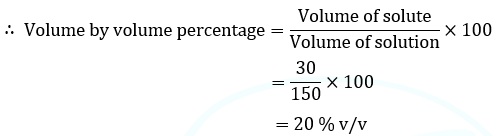
Hence, the orange juice concentrate is 20 % v/v in the mixture prepared.
3: Vinegar, used as a food preservative and additive, contains 5 % v/v acetic acid. Glacial acetic acid is a liquid, i.e., 100% acetic acid. If you want to make vinegar from glacial acetic acid, how would you proceed?
Answer: Vinegar contains 5 % v/v acetic acid, which means 5 mL of acetic acid is present in 100 mL of solution.
Since glacial acetic acid is 100% acetic acid, to prepare vinegar, take 5 mL of glacial acetic acid and add sufficient water to make the total volume of the solution 100 mL.
Similarly, to prepare a larger quantity of vinegar, mix 5 parts of glacial acetic acid with 95 parts of water so that the final solution contains 5% v/v acetic acid.
Pause and Ponder (NCERT Textbook Page No. 79)
4: Refer to the solubility curves given in Activity 5.2. If equal masses of hot, saturated solutions of compounds ‘A’ and ‘B’ are cooled from 80 °C to 60 °C, which solution is likely to deposit more solid?
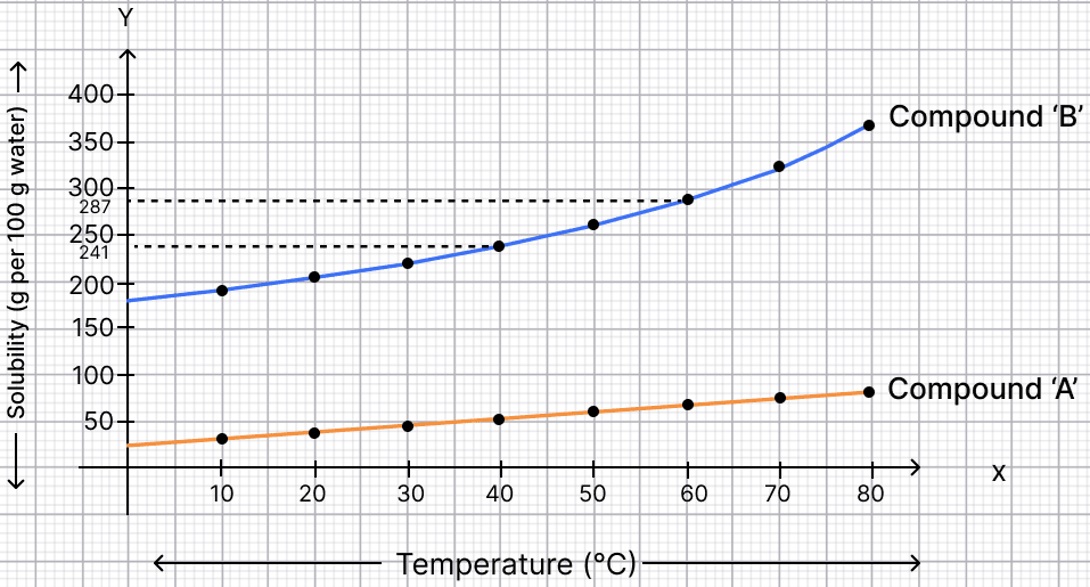
Answer: The solution of compound ‘B’ is likely to deposit more solid.
From the solubility curves, the solubility of compound ‘B’ changes steeply with temperature, whereas the solubility of compound ‘A’ changes only slightly. On cooling from 80 °C to 60 °C, the solubility of compound ‘B’ decreases much more than that of compound ‘A’. Hence, a larger amount of compound ‘B’ separates out as solid from its saturated solution.
5: Will there be any change in the size of common salt crystals if the rate of evaporation is increased or decreased? Explain.
Answer: Yes, the size of common salt crystals will change.
If the rate of evaporation is decreased the particles get more time to arrange themselves properly, so larger and well-shaped crystals are formed.
If the rate of evaporation is increased (fast evaporation), the particles have less time to arrange themselves, so smaller crystals are formed.
Thus, slow evaporation produces larger crystals, while fast evaporation produces smaller crystals.
Pause and Ponder (NCERT Textbook Page No. 82)
6: State whether the following statements are True or False. Also, correct the False statements.
(i) Salt can be separated from a salt solution by evaporation or distillation.
(ii) Distillation can be used for separation of two liquids even when these have the same boiling point.
(iii) In paper chromatography, the solvent level should be above the sample spot at the beginning of the experiment.
(iv) Evaporation and crystallization are the same processes.
Answer:
(i) True.
Reason: Salt can be separated from a salt solution by evaporation or distillation.
(ii) False.
Reason: Distillation can be used only when the two liquids have different boiling points.
(iii) False.
Reason: In paper chromatography, the solvent level should be below the sample spot at the beginning of the experiment, otherwise the spot would dissolve directly into the solvent.
(iv) False.
Reason: Evaporation and crystallization are different processes. Evaporation only removes the solvent to leave behind the solute, which may not be pure, whereas crystallization gives a pure solid in the form of crystals from a saturated solution, based on the differences in solubility at different temperatures.
Pause and Ponder (NCERT Textbook Page No. 84)
7: Why do immiscible liquids form two separate layers in a separating funnel?
Answer: Immiscible liquids do not mix with each other. They usually have different densities. The liquid with higher density settles at the bottom, while the liquid with lower density floats on top. Therefore, they form two separate layers in a separating funnel.
8: Is sublimation different from evaporation? Justify.
Answer: Yes, sublimation is different from evaporation.
In sublimation, a solid changes directly into vapour without passing through the liquid state. On cooling, the vapour changes directly back into a solid. Camphor and naphthalene are examples of substances that sublime.
In evaporation, a liquid changes into vapour from its surface at temperatures below its boiling point.
Therefore, sublimation involves a solid changing directly into vapour, whereas evaporation involves a liquid changing into vapour.
Pause and Ponder (NCERT Textbook Page No. 88)
9: Clouds are made up of tiny water droplets or ice crystals floating in the air. Based on what you know about solutions, suspensions and colloids, what type of mixture do you think clouds are and why?
Answer: Clouds are colloids because they consist of tiny water droplets or ice crystals dispersed in air. These particles are very small and remain suspended in the air for a long time instead of settling down like the particles in a suspension. Hence, clouds are considered a colloidal mixture.
10: Why do cities with a lot of smoke and dust in the air often look hazy?
Answer: Cities with a lot of smoke and dust often look hazy because the tiny smoke and dust particles remain suspended in the air as a colloid. These particles scatter the light passing through the air. This scattering of light by the particles (Tyndall effect) makes the air look hazy in cities that have a lot of smoke and dust.
Revise, Reflect, Refine (NCERT Textbook Page No. 90-93)
1: Which of the following mixtures are correctly classified as homogeneous (Hm) and heterogeneous (Ht)? Choose the correct option.
(i) Air — Hm, Milk — Ht, Sugar solution — Hm, Smoke — Hm
(ii) Brass — Ht, Fog — Ht, Vinegar — Ht, Muddy water — Hm
(iii) Copper sulphate solution — Hm, Salt solution — Hm, Milk — Hm, Bronze — Hm
(iv) Muddy water — Ht, Milk — Ht, Blood — Ht, Brass — Hm
Answer: (iv) Muddy water — Ht, Milk — Ht, Blood — Ht, Brass — Hm
Reason: Muddy water is a suspension, while milk and blood are colloids. Therefore, they are heterogeneous mixtures. Brass is an alloy and is a homogeneous mixture.
The other options are incorrect because smoke is heterogeneous, not homogeneous; brass and vinegar are homogeneous, not heterogeneous; and milk is a colloid, so it is considered heterogeneous, not homogeneous.
2: Choose the correct options, and explain the reason for the correct and incorrect options.
Which among the following mixtures show the Tyndall Effect? A mixture of:
(a) air and dust particles
(b) copper sulfate and water
(c) starch and water
(d) acetone and water
(i) a and b
(ii) b and d
(iii) a and c
(iv) c and d
Answer: (iii) a and c
Reason: The Tyndall effect is shown by colloids and suspensions, whose particles are large enough to scatter light. It is not shown by true solutions because their particles are too small to scatter light.
(a) Air and dust particles form a suspension or colloidal mixture. Therefore, it shows the Tyndall effect.
(c) Starch and water form a colloid. Therefore, it shows the Tyndall effect.
(b) Copper sulfate and water does not show the effect. It forms a true solution whose dissolved particles are too small to scatter light appreciably.
(d) Acetone and water are true solutions. Their particles are too small to scatter light, so they do not show the Tyndall effect.
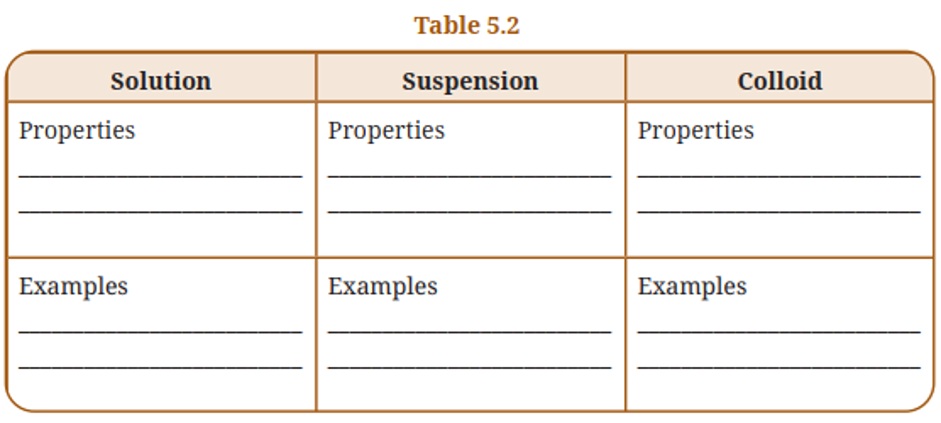
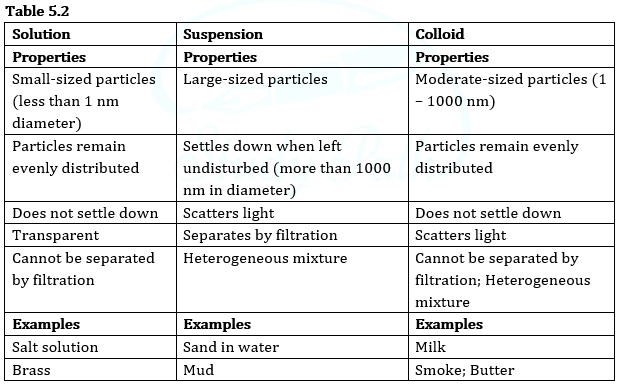
3: A mixture can be categorised as a solution, a suspension, or a colloid, each possessing distinct properties. Utilise the words or phrases provided in the box to fill in the Table 5.2. Words and phrases may be used more than once.
Words and Phrases
Large-sized particles; Particles remain evenly distributed; Small-sized particles (less than 1 nm diameter); Moderate-sized particles (1 – 1000 nm); Settles down when left undisturbed (more than 1000 nm in diameter); Does not settle down; Scatters light; Separates by filtration; Transparent; Salt solution; Milk; Sand in water; Smoke; Heterogeneous mixture; Cannot be separated by filtration; Mud; Butter; Brass.
Complete the Table 5.2.
Answer:
4: Solve the following problems:
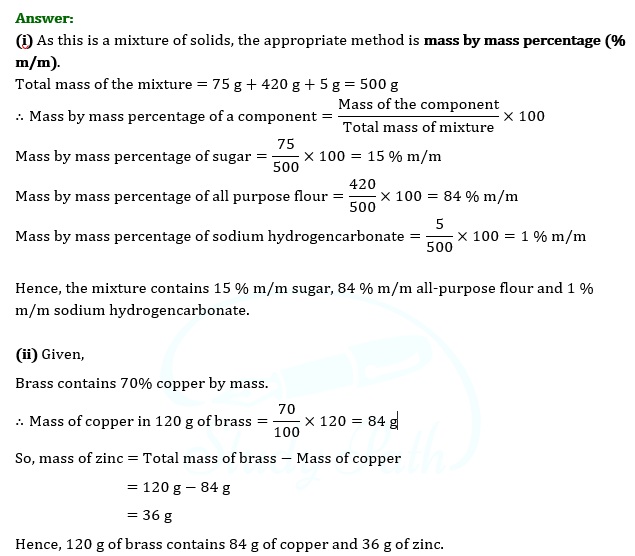
(i) A cake recipe uses dry ingredients, namely 75 g of sugar for 420 g of all-purpose flour and 5 g of sodium hydrogencarbonate. Express the concentration of each component in the mixture using an appropriate method.
(ii) A brass alloy contains 70% copper by mass. Calculate the quantities of copper and zinc present in 120 g of brass.
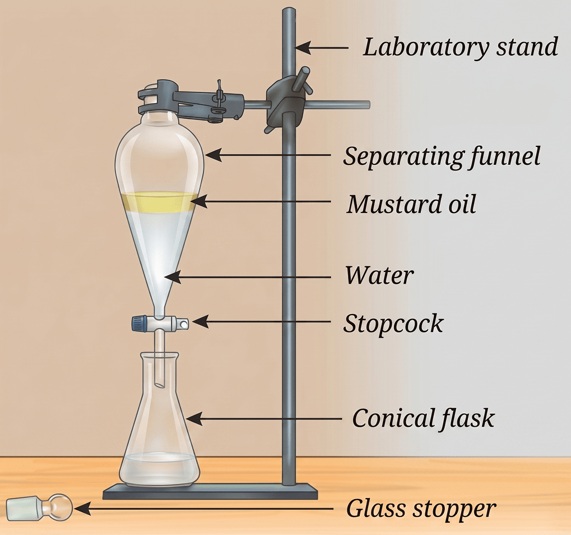
5: The label on a cooking oil pack says one litre (910 g). If this oil is mixed with water, will it form a separate layer? If so, which substance will be on top? How will you separate the two layers? Also, draw the diagram of the apparatus used.
Answer:
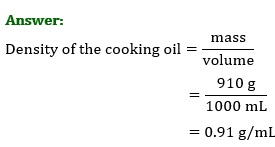
The density of oil (0.91 g/mL) is less than the density of water (1 g/mL). Also, oil and water are immiscible liquids.
Hence, yes, the oil will form a separate layer. Since oil is lighter than water, the oil will be on top and water will form the lower layer.
The two layers can be separated using a separating funnel. The mixture is poured into the separating funnel and allowed to stand undisturbed so that two layers form. The stopcock is opened slowly to drain out the lower layer of water. The stopcock is then closed, and the oil is collected separately.
6: Assertion (A): Solutions do not exhibit the Tyndall effect.
Reason (R): The particles in solutions are larger than 100 nm, so they cannot scatter light.
Choose the correct option:
(i) Both A and R are true, and R is the correct explanation of A.
(ii) Both A and R are true, but R is not the correct explanation of A.
(iii) A is true, but R is false.
(iv) A is false, but R is true.
Answer: (iii) A is true, but R is false.
Explanation:
Assertion (A) is true because the particles in a solution are too small to scatter light, so solutions do not exhibit the Tyndall effect.
Reason (R) is false because the particles in a solution are very small (less than 1 nm in diameter), not larger than 100 nm. It is because of their very small size that they cannot scatter light.
Therefore, A is true, but R is false is the correct option.
7: How would you separate the mixtures given in Table 5.3? Mention the reason for choosing your method. If a mixture cannot be separated, explain why.
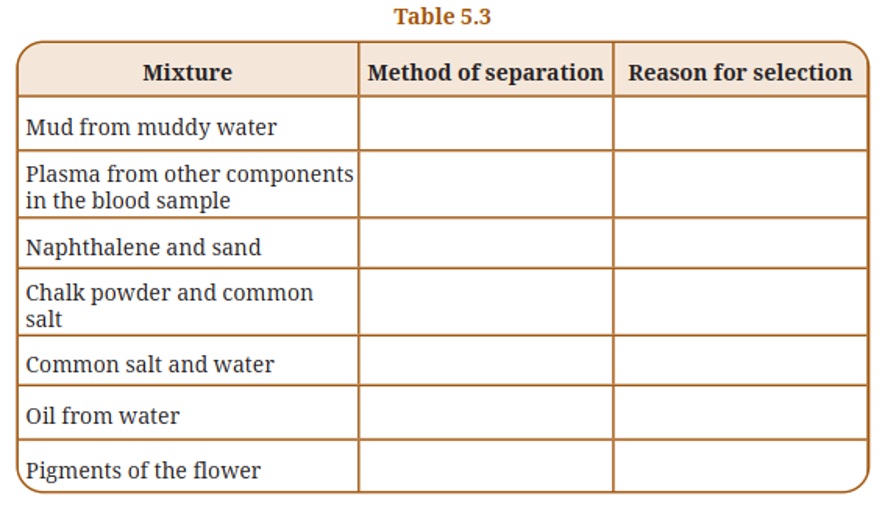
Answer:
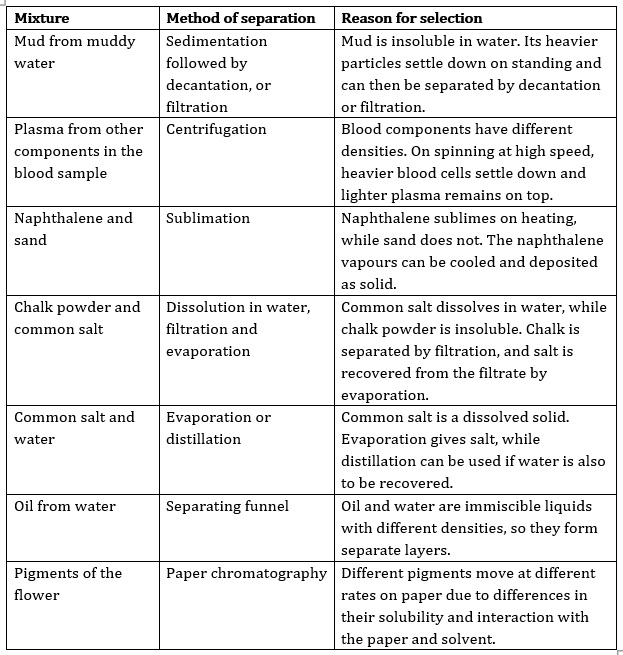
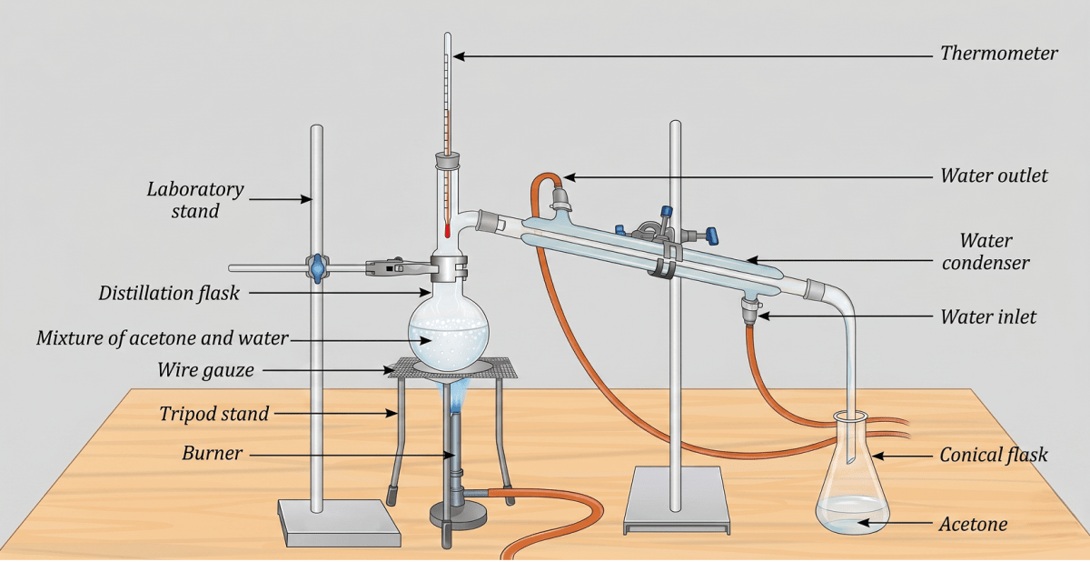
8: Two miscible liquids, A and B, are present in a mixture. The boiling point of A is 60 °C and the boiling point of B is 90 °C. Suggest a method to separate them. Also, draw a labelled diagram of the method suggested.
Answer: The difference in the boiling points of the two miscible liquids = 90°C − 60°C = 30°C.
Since the difference is more than 25°C, the two liquids can be separated by distillation.
On heating the mixture, liquid A, which has the lower boiling point (60°C), vaporises first. These vapours pass through the condenser, where they cool and condense back into liquid A. Liquid A is collected as the distillate. Liquid B, with the higher boiling point (90°C), remains behind in the distillation flask.
9: Compare evaporation, crystallization and distillation. In which situation, would you prefer each of these over the others?
Answer: Evaporation is the process in which the solvent is removed by heating, leaving behind the solute as a solid. It is preferred when we want to obtain a dissolved solid from a solution and do not need to recover the solvent. For example, common salt can be obtained from salt solution by evaporation.
Crystallization is used to obtain pure crystals of a solid from a saturated solution. It is preferred when a pure solid is required, especially when soluble impurities are present or when the solid may decompose on strong heating. For example, copper sulfate can be purified by crystallization.
Distillation is used to separate two miscible liquids with different boiling points or to recover the solvent from a solution. It is preferred when both the liquid and the dissolved substance, or two different liquids, need to be separated, such as acetone and water.
10: Blood is an example of a colloidal mixture. (i) What would happen if blood behaved like a true suspension inside the body? (ii) In a blood sample, identify the dispersed phase and the dispersion medium.
Answer: (i) If blood behaved like a true suspension, its particles would settle down instead of remaining uniformly dispersed. As a result, blood would not remain uniform, and the transport of oxygen, nutrients and other substances throughout the body would be affected.
(ii) In a blood sample:
Dispersed phase — Blood cells (mainly red blood cells, white blood cells and platelets)
Dispersion medium — Plasma (the liquid part of blood)
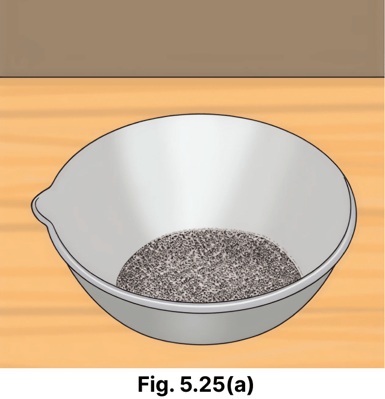
11: You are given a mixture of sand, common salt and naphthalene (Fig. 5.25a). The Fig. 5.25b depicts various steps used to separate the components of this mixture. Identify and write down the correct sequence of separation techniques.
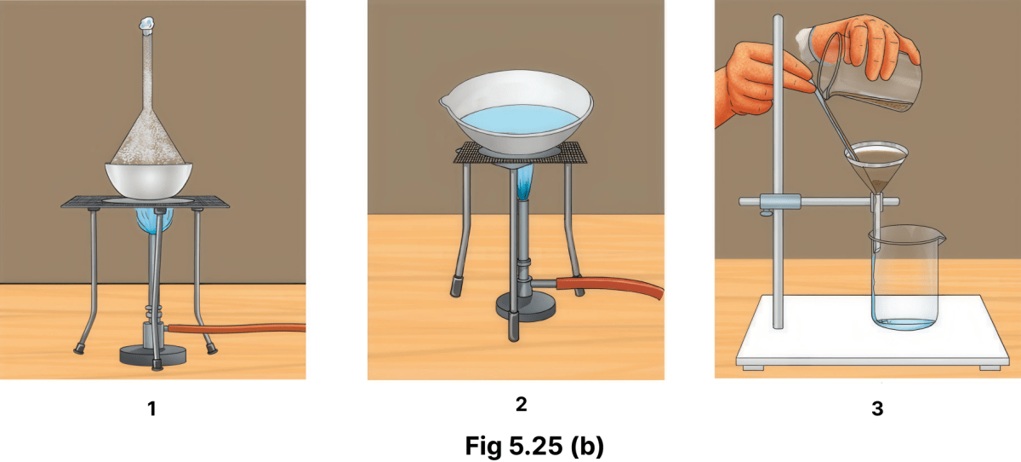
Answer: The correct sequence of separation techniques is Sublimation → Filtration → Evaporation.
Step 1 — Sublimation: The mixture is heated. Naphthalene sublimes and is collected as a solid, while sand and common salt are left behind.
Step 2 — Filtration: Water is added to the remaining mixture of sand and salt. Common salt dissolves while sand does not. On filtering, sand remains on the filter paper as the residue, and the salt solution passes through as the filtrate.
Step 3 — Evaporation: The salt solution (filtrate) is heated so that water evaporates, leaving behind the common salt.
12: Why is distillation an effective method for separating a mixture of water and acetone?
Answer: Distillation is an effective method for separating a mixture of water and acetone because they are miscible liquids with a large difference in their boiling points. Acetone boils at about 56°C, while water boils at 100°C. On heating the mixture, acetone vaporises first. Its vapour is then cooled in a condenser and collected as a liquid, while water remains behind in the distillation flask.
13: Answer the following questions with the help of the data given in Table 5.4.
(i) What mass of potassium nitrate would be needed to prepare its saturated solution in 50 g of water at 40°C?
(ii) A student makes a saturated solution of potassium chloride in water at 80°C and leaves the solution to cool at room temperature (25°C). What would she observe as the solution cools? Explain.
(iii) What is the effect of a change in temperature on the solubility of salts? Also, compare the changes in the solubility of the four given salts with increasing temperature from 10°C to 80°C.
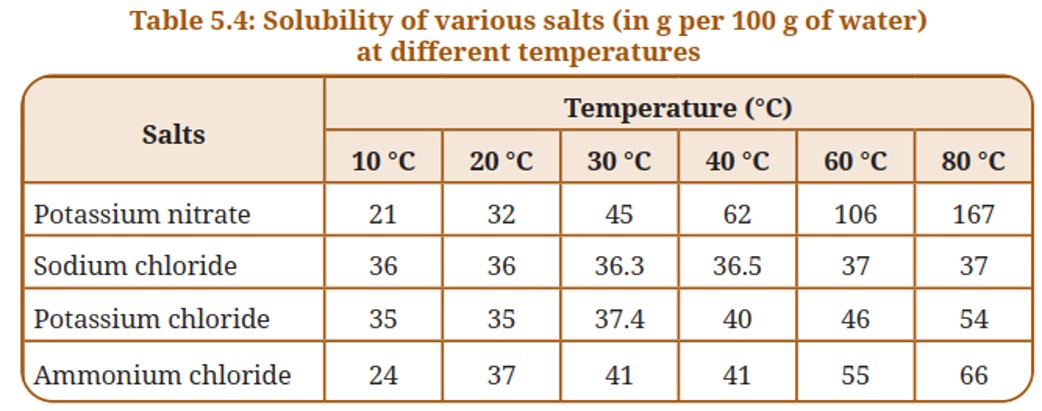
Answer: (i) From Table 5.4, the solubility of potassium nitrate at 40°C is 62 g per 100 g of water.
∴ Mass of potassium nitrate needed for 50 g of water = 62/100×50 = 31 g
Hence, 31 g of potassium nitrate is needed to prepare a saturated solution in 50 g of water at 40°C.
(ii) The solubility of potassium chloride is 54 g per 100 g of water at 80°C and about 36 g per 100 g of water at 25°C. As the saturated solution cools, the solubility of potassium chloride decreases. As a result, the solution cannot hold all the dissolved potassium chloride, and the excess separates out as solid crystals.
(iii) Generally, the solubility of a solid salt in water increases with an increase in temperature.
Comparing the change in solubility from 10 °C to 80 °C:
- Potassium nitrate: 21 → 167, an increase of 146 g (largest increase, very steep).
- Ammonium chloride: 24 → 66, an increase of 42 g.
- Potassium chloride: 35 → 54, an increase of 19 g.
- Sodium chloride: 36 → 37, an increase of only 1 g (almost no change).
Thus, potassium nitrate shows the greatest increase in solubility with temperature, while sodium chloride shows the least change.
The order of increase is
Potassium nitrate > Ammonium chloride > Potassium chloride > Sodium chloride.
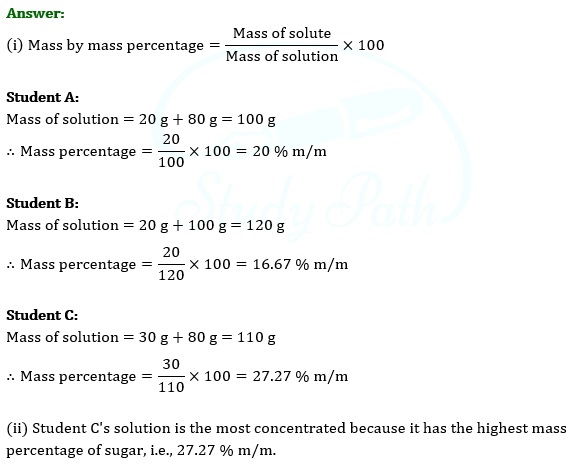
14: Three students, A, B and C, are preparing sugar solutions for an experiment:
- Student A dissolves 20 g of sugar in 80 g of water.
- Student B dissolves 20 g of sugar in 100 g of water.
- Student C dissolves 30 g of sugar in 80 g of water.
(i) Calculate the mass percentage (% m/m) concentration of sugar in each student’s solution.
(ii) Whose solution is the most concentrated? Explain why.
15: Examine Fig. 5.26.
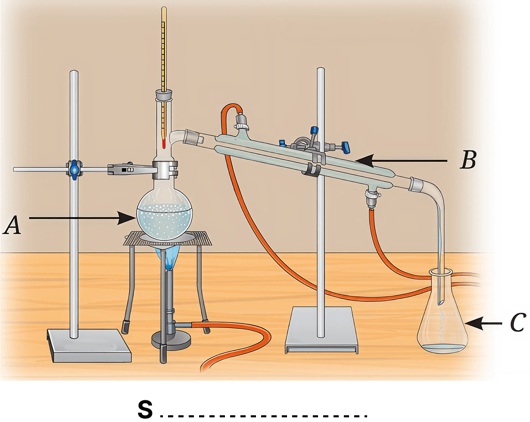
(i) Identify the separation technique marked as ‘S’.
(ii) Label the apparatus A, B and C.
(iii) Which of the following mixtures can be separated by the technique identified above? Use the data given in Table 5.5. Mixtures:
(a) water — acetone
(b) water — salt
(c) acetone — alcohol
(d) sand — salt
(e) alcohol — chloroform
(f) alcohol — benzene
Table 5.5: Boiling points of some compounds

Answer:
(i) The separation technique marked as ‘S’ is distillation.
(ii) The labelled apparatus are:
A — Distillation flask
B — Water condenser
C — Conical flask
(iii) Distillation can separate a liquid from a solution containing a dissolved solid. It can also separate two miscible liquids when their boiling points differ by at least about 25°C.
(a) Water — acetone: difference = 100°C − 56°C = 44°C. Since the difference is more than 25°C, they can be separated by distillation.
(b) Water — salt: salt is a dissolved solid in water. Water can be recovered by distillation, so they can be separated by distillation.
(c) Acetone — alcohol: difference = 78°C − 56°C = 22°C. This is less than 25°C, so they cannot be separated by simple distillation.
(d) Sand — salt: both are solids, so they cannot be separated by distillation.
(e) Alcohol — chloroform: difference = 78°C − 61°C = 17°C. This is less than 25°C, so they cannot be separated by simple distillation.
(f) Alcohol — benzene: difference = 80°C − 78°C = 2°C. This is less than 25°C, so they cannot be separated by simple distillation.
Hence, the mixtures (a) water — acetone and (b) water — salt can be separated by distillation.
The Quest Continues
Q. Can we create artificial blood that works just as real blood for all patients?
Answer: Artificial blood that works exactly like real blood for all patients has not yet been developed. Real blood performs many functions, such as transporting oxygen and nutrients, fighting infections, helping in blood clotting, and removing wastes. Reproducing all these functions in one artificial product is very difficult.
Scientists are developing artificial blood substitutes, but they cannot completely replace real blood in every situation. Therefore, artificial blood is not yet a complete substitute for real blood for all patients.
Class 9 Science Exploration Chapter 5 NCERT Questions and Answers
The chapter Exploring Mixtures and their Separation explores types of mixtures and the properties of their components. Students compare solutions, suspensions, and colloids and learn how observations help distinguish them.
Students also investigate separation techniques based on properties such as particle size, solubility, and boiling point. Activities help them understand why particular methods work and how separation is used in homes, laboratories, and industry.