

NCERT Solutions for Class 9 Science Exploration Chapter 2 Cell – The Building Block of Life are provided here with simple and easy-to-understand explanations. Based on the NCERT textbook Exploration, this chapter introduces cell structure, cell organelles, and the processes that allow cells to function. These solutions help students connect scientific ideas with familiar examples and complete textbook activities with confidence.
Cell – The Building Block of Life Class 9 Science Questions and Answers
Think It Over (Page no. 8)
Question 1: Where does a cell come from?
Answer: A new cell comes from a pre-existing cell by cell division. Cells grow only up to a certain size and then divide to form new cells. This helps in growth and in replacing old, dead, or damaged cells.
Question 2: How have technological interventions facilitated the creation of new knowledge in understanding the world beyond the naked eye?
Answer: Technological interventions such as the invention and improvement of light microscopes and electron microscopes have enabled scientists to observe cells and their tiny structures, which cannot be seen with the naked eye. Better magnification, resolution, and contrast have helped scientists gain new knowledge about the structure and functions of cells.
Question 3: How is the cell structural and functional unit of life?
Answer: The cell is the structural and functional unit of life because all living organisms are made up of cells. Similar cells form tissues, tissues form organs, and organs form organ systems. Even in these higher levels of organisation, the cell remains the basic unit of structure and performs all the essential life functions.
Question 4: How does a cell multiply?
Answer: A cell multiplies by cell division. Before dividing, the cell grows and copies its genetic material (DNA). It then divides to form two daughter cells. Cell division helps in the growth of the body and replaces old, dead, or damaged cells.
Pause and Ponder (Page no. 14)
Question 1: What argument would you give for the necessity of a cell wall in plants usually fixed in one place versus in animals usually moving from one place to the other?
Answer: Plants are usually fixed in one place, so they need a rigid cell wall to provide support, maintain shape, and protect the cell. Animals move from one place to another, so their cells do not have a cell wall. The absence of a cell wall makes animal cells flexible, allowing movement and changes in shape.
Question 2: What consequences would you predict for a plant cell if its cell wall were to become as flexible as a cell membrane?
Answer: If the cell wall became as flexible as the cell membrane, the plant cell would lose its rigidity and fixed shape. It would not be able to provide proper support and protection, and the plant would become weak and unable to remain upright. The cell would also become more likely to burst when excess water enters by osmosis because it would lack the rigid protection normally provided by the cell wall.
Question 3: Why is it important to cut the two potato pieces in roughly equal size and measure their initial weight before placing them in different liquids?
Answer: The potato pieces are cut to the same size and weighed before the experiment to make the test fair. This ensures that any change in weight is caused by the movement of water and not by differences in the size or weight of the potato pieces.
Pause and Ponder (Page no. 19)
Question 4: Do white flowers contain any pigment? Give reasons.
Answer: No. White flowers do not contain coloured pigments. They have colourless plastids (leucoplasts), so they appear white.
OR
Yes, white flowers do contain pigments. They usually lack coloured pigments such as anthocyanins but may contain colourless or very faint pigments like flavones. Their white appearance is mainly due to the reflection of light by the petal cells rather than the complete absence of pigments.
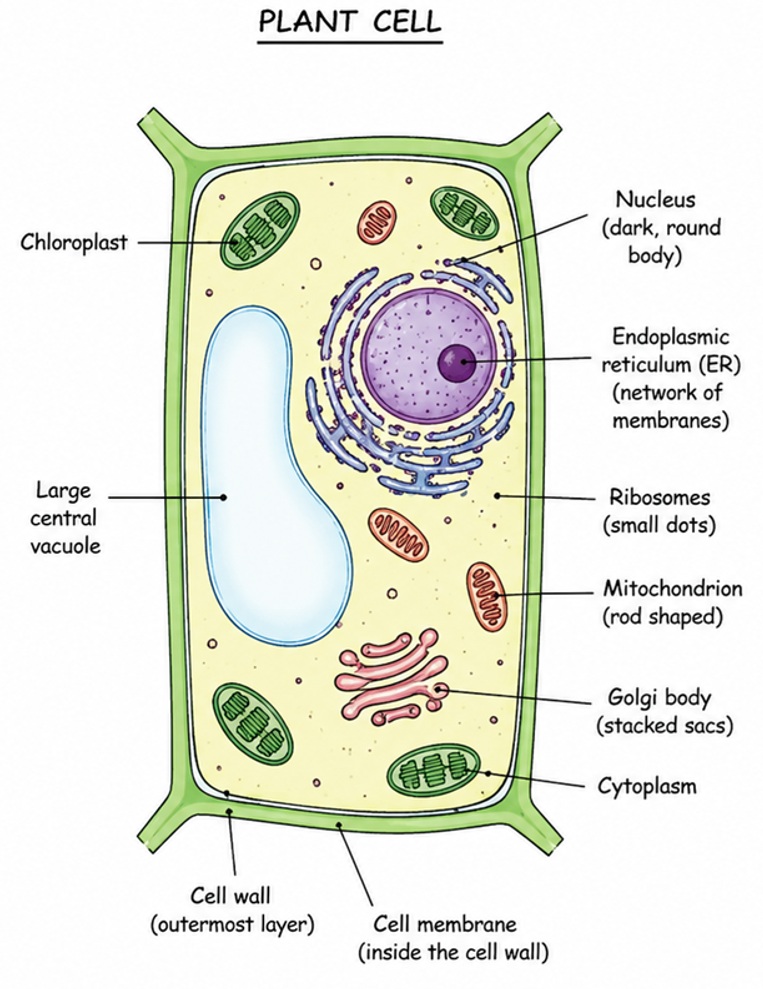
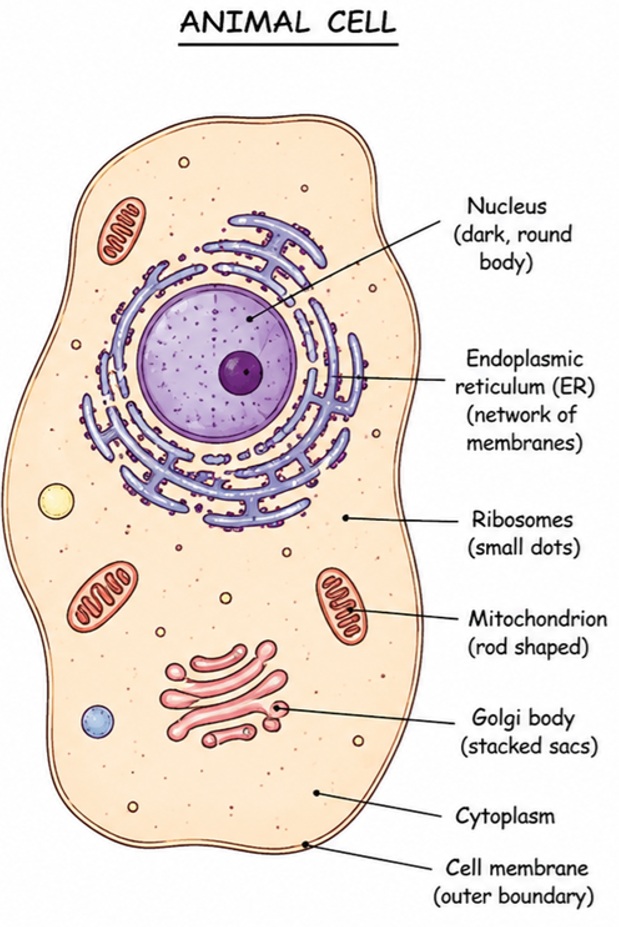
Question 5: Draw a well-labelled schematic diagram of a plant or an animal cell using these clues-
- Nucleus appears as a dark and round body inside the cell.
- ER spreads like a network of extended nuclear envelope.
- Mitochondria and chloroplasts are rod shaped.
Answer:
Pause and Ponder (Page no. 22)
Question 6: Instead of many small ones, why does a cell not have a single giant mitochondrion? How does this relate to the concept of surface area?
Answer: A cell has many small mitochondria instead of one giant mitochondrion because many small mitochondria provide a larger total surface area. A larger surface area allows more chemical reactions to take place for energy production. It also helps distribute energy efficiently to different parts of the cell.
Question 7: If the skin cells start dividing by meiosis instead of mitosis, what do you think will happen to a cut on the skin?
Answer: If skin cells started dividing by meiosis instead of mitosis, the cut on the skin would not heal properly. Meiosis produces cells with half the number of chromosomes and is meant for forming reproductive cells, not body cells. Normally, skin cells divide by mitosis to produce new cells for growth and to replace old, dead, or damaged cells. Therefore, the wound would heal very slowly or may not heal properly at all.
Revise, Reflect, Refine (Page 24)
Question 1: Differentiate between the following pairs of terms based on the clues given in parentheses:
- Cell membrane and cell wall (permeability)
- RER and SER (structure)
- Chloroplasts and chromoplasts (pigments)
Answer:
| Cell membrane | Cell wall |
| It is selectively permeable, allowing only certain substances to pass through. | It is freely permeable, allowing most substances to pass through. |
| RER (Rough Endoplasmic Reticulum) | SER (Smooth Endoplasmic Reticulum) |
| Has ribosomes attached to its surface, giving it a rough appearance. | Does not have ribosomes, so its surface appears smooth. |
| Chloroplasts | Chromoplasts |
| Contain the green pigment chlorophyll. | Contain yellow, orange, or red pigments (carotenoids). |
Question 2: Two similar animal cells are placed in two different solutions:
- Cell X is placed in pure water.
- Cell Y is placed in a concentrated salt solution.
Cells are observed after some time. Cell X swells, and Cell Y shrinks. Which statement provides the correct explanation for the above observations?
Options:
(i) Salt molecules moved into Cell Y, causing it to shrink.
(ii) Water moved into Cell X and more water moved out of Cell Y than the salt solution entered in it.
(iii) Water moved into Cell X and moved out of Cell Y through the cell membrane.
(iv) Solute movement caused osmosis in both cells.
Answer: (iii) Water moved into Cell X and moved out of Cell Y through the cell membrane.
Reason: Water enters Cell X (placed in pure water) by osmosis, so it swells. Water moves out of Cell Y (placed in a concentrated salt solution) by osmosis, so it shrinks. In both cases, water moves through the cell membrane from a region of higher water concentration to a region of lower water concentration. This matches the explanation given in the textbook.
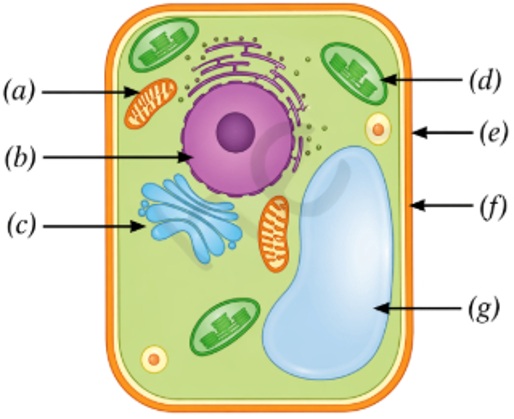
Question 3: Look at the diagram of a cell in figure. Identify the parts labelled from (a) to (g) and correctly match them with their functions given below:
(i) Controlling all the activities of a cell.
(ii) Site of cellular respiration.
(iii) Storage organelle that also provides rigidity to the cell.
(iv) Separates the cell contents from surroundings.
(v) Provides structural rigidity to the cell.
(vi) Packs and stores materials received from ER.
(vii) Helps in manufacturing food.
Answer:
| Label | Part identified | Function |
| (a) | Mitochondria | (ii) Site of cellular respiration |
| (b) | Nucleus | (i) Controlling all the activities of a cell |
| (c) | Golgi apparatus | (vi) Packs and stores materials received from ER |
| (d) | Chloroplast | (vii) Helps in manufacturing food |
| (e) | Cell wall | (v) Provides structural rigidity to the cell |
| (f) | Cell membrane | (iv) Separates the cell contents from surroundings |
| (g) | Vacuole | (iii) Storage organelle that also provides rigidity to the cell |
Question 4: Which of the following option(s) of the pairs of cell organelles are correctly placed under the given categories?
| Option | Present in the plant cells | Absent in the animal cells |
| (i) | Leucoplast | Cell wall |
| (ii) | Mitochondria | Ribosome |
| (iii) | Cell wall | Golgi apparatus |
| (iv) | Lysosome | Endoplasmic reticulum |
Answer: (1) Pair (i) is correct.
Explanation: Leucoplast is present in plant cells and absent in animal cells.
Cell wall is present in plant cells and absent in animal cells.
The other options are incorrect because:
(ii) Mitochondria and ribosomes are present in both plant and animal cells.
(iii) Golgi apparatus is present in both plant and animal cells.
(iv) Endoplasmic reticulum is present in both plant and animal cells.
Question 5: Two students, Renu and Rohit, were having a discussion on the plastids. Renu emphasised that all parts of the plants, even roots, contain plastids. However, Rohit did not agree with the statement and told her that plastids are absent in plant roots since the roots are underground and do not need to perform photosynthesis. Who is correct? Justify your answer.
Answer: Renu is correct.
Justification: All parts of a plant, including the roots, contain plastids. However, roots do not contain chloroplasts because they do not perform photosynthesis. Instead, root cells mainly contain leucoplasts, which are colourless plastids that store food such as starch, oils, and proteins.
Question 6: Mitochondria and chloroplasts are two important organelles in a plant cell. Discuss how these two organelles are structurally and functionally similar to each other, and different from each other.
Answer:
| Similarities | Differences |
| Both are double membrane-bound organelles. | Mitochondria carry out cellular respiration and release energy (ATP), whereas chloroplasts carry out photosynthesis to prepare food. |
| Both contain their own DNA and ribosomes and can make some of their own proteins. | The inner membrane of mitochondria is folded into cristae, while chloroplasts contain thylakoids arranged in stacks called grana. |
| Both are involved in energy conversion in the cell. | Mitochondria are found in both plant and animal cells, whereas chloroplasts are found only in plant cells and some algae. |
Question 7: Which of the following pairs of cell organelles contains DNA?
(i) Chloroplasts, Ribosomes
(ii) Mitochondria, Nucleus
(iii) Golgi bodies, Ribosomes
(iv) Nucleus, Lysosomes
Answer: (ii) Mitochondria, Nucleus
Question 8: A researcher carried out an experiment in which she took two carrots of similar size. She placed one carrot in plain water and the other carrot in concentrated salt solution. After 24 hours she recorded her observations.
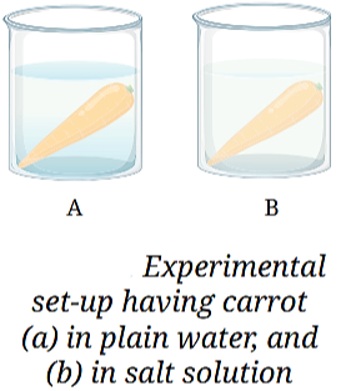
(i) What hypothesis does she want to test through this experiment?
(ii) What would you suggest for the improvement of this experiment?
(iii) Why does the carrot in plain water stay stiff and crunchy, but the carrot in concentrated salt solution become rubbery and limp?
Answer:
(i) The researcher wants to test that water moves into or out of plant cells through the process of osmosis depending on the surrounding solution.
(ii) Improvements that can be suggested:
- Use carrot pieces of equal size and weight
- Measure initial and final mass/length
- Keep time and temperature constant
- Repeat for accuracy
(iii) Reason for the observations:
- The carrot kept in plain water stays stiff and crunchy because water enters its cells by osmosis, making the cells turgid.
- The carrot kept in concentrated salt solution becomes rubbery and limp because water moves out of its cells by osmosis, causing the cells to lose turgidity.
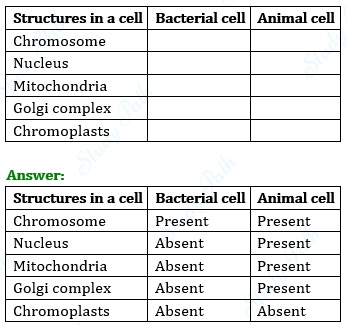
Question 9: Indicate the presence or absence of following structures in bacterial and animal cells:
Question 10: Carry out the following experiment:
Take four peeled potato halves and scoop each one out to make potato cups. One of these potato cups should be made from a boiled potato. Place each of the potato cups in a beaker containing water. Now, set up the experiment as follows:
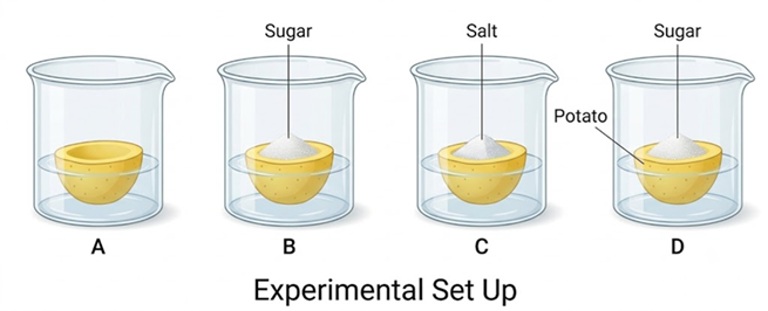
(a) Keep Cup A empty.
(b) Add one teaspoon sugar in Cup B.
(c) Add one teaspoon salt in Cup C.
(d) Add one teaspoon sugar in the boiled potato in Cup D.
Observe the four potato cups at least two hours and answer the following questions:
(i) Explain why water gathers in the hollowed portion of Cup B and Cup C.
(ii) Why is Cup A necessary for this experiment?
(iii) Explain why water does not gather in the hollowed portions of Cups A and D.
Answer:
(i) Cups B and C contain sugar and salt, respectively, which create a concentrated (hypertonic) solution inside the potato cups. The water in the beaker is more dilute (hypotonic). Therefore, water moves through the living potato cells from the beaker into the potato cups by the process of osmosis. As a result, water collects in the hollowed portions of Cups B and C.
(ii) Cup A serves as the control for the experiment. Since it contains neither sugar nor salt, it shows that water does not collect in the hollow unless there is a concentration difference to cause osmosis.
(iii) In Cup A, water does not gather because there is no sugar or salt in the hollow to create a concentration difference, so osmosis does not occur.
In Cup D, water does not gather because the potato has been boiled. Boiling damages the cell membrane, so it no longer acts as a selectively permeable membrane and osmosis cannot take place.
Question 11: Identify the pair that incorrectly matches the cell organelle with its function.
(i) Ribosome — Protein synthesis
(ii) SER — Lipid and cellulose synthesis
(iii) Lysosome — Digestion of foreign agents
Answer: Incorrect pair: SER – Lipid and cellulose synthesis
Reason: The Smooth Endoplasmic Reticulum (SER) is involved in the synthesis and storage of fats (lipids) and hormones. It is not involved in cellulose synthesis
Question 12: What outcome do you expect, if all the mitochondria are removed from a eukaryotic cell?
Answer: The cell would die.
Reason: Mitochondria are the main site of ATP (energy) production through cellular respiration. Without them, the cell cannot produce enough energy to carry out essential functions like transport, synthesis, and division, leading to cell death.
Question 13: Which phenomenon inhibits the formation of tumors in the human body? Can plants also develop tumors? Explain.
Answer: The phenomenon that inhibits the formation of tumours in the human body is contact inhibition.
In many animal cells, cell division normally stops when cells come in contact with neighbouring cells. This prevents uncontrolled cell division and tumour formation. However, cancer cells lose this control and keep dividing uncontrollably, which leads to the formation of tumors.
Yes, plants can also develop tumours. However, plant tumours remain localised and do not spread to other parts of the plant like malignant tumours in animals.
Question 14: The cell membrane of a cell is made up of proteins and lipids. Which cell organelles help in the synthesis of cell membrane? Write the path of these compounds from their site of synthesis to the cell membrane and show this through a labelled diagram.
Answer: The cell membrane is made up of proteins and lipids, and the following organelles help in their synthesis:
- Proteins are synthesised by ribosomes attached to the Rough Endoplasmic Reticulum (RER).
- Lipids are synthesised by the Smooth Endoplasmic Reticulum (SER).
Path of these compounds to the cell membrane:
- Proteins are synthesised by ribosomes on the RER, and lipids are synthesised by the SER.
- From the ER, these proteins and lipids are transported to the Golgi apparatus.
- The Golgi apparatus modifies, sorts and packages them into vesicles.
- These vesicles move towards the cell membrane and fuse with it, thereby contributing the proteins and lipids to the cell membrane.
So, the path is: Ribosomes on RER (proteins) + SER (lipids) → Golgi apparatus → Vesicles → Cell membrane (Plasma membrane)
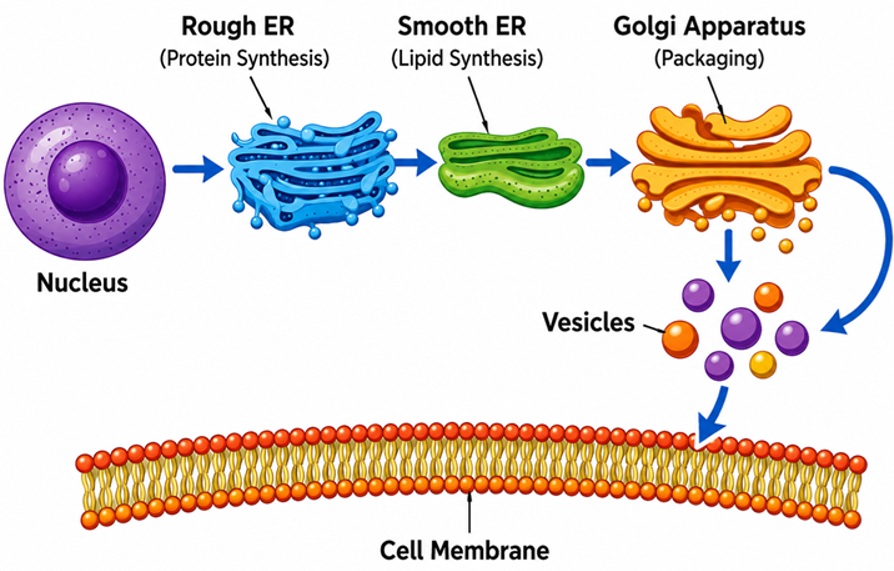
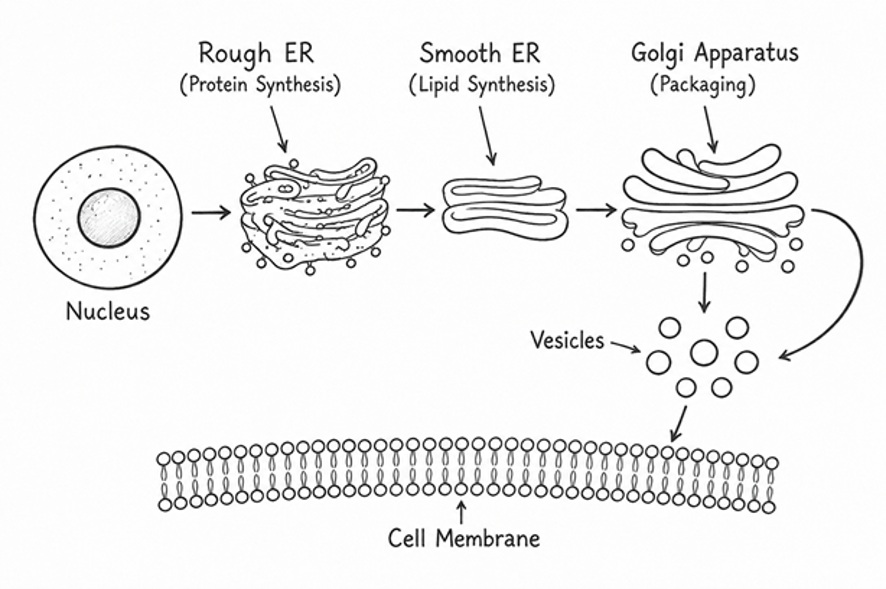
For exam paper students can draw the following diagram
Question 15: What would happen if gametes are formed by mitotic divisions?
Answer: Gametes are normally formed by meiosis, in which the number of chromosomes is reduced to half (the gametes become haploid). During fertilisation, two gametes combine and the original chromosome number is restored.
If gametes were formed by mitotic division instead of meiosis, they would have the full number of chromosomes instead of half. When two such gametes fused during fertilisation, the offspring would have double the normal number of chromosomes. With each generation, the chromosome number would continue to double. This would disrupt the genetic stability of the species and lead to abnormalities.
Question 16: A farmer, Deepa, was very happy with the harvest of amla (Indian Gooseberry) and lemons on her farm. However, she could sell only one-fourth of the produce in the local market. Recognising that a significant amount of produce may be lost post-harvest, she employed a traditional yet scientifically sound method to extend the shelf life of amla and lemons. She turned perishable produce into profitable products, such as pickles and sharbat. She used the excess produce to prepare pickles, murabbas, and sharbat by adding appropriate amounts of salt, sugar, or jaggery to small pieces of fruit and their juices. These were then stored in small glass bottles for sale, helping her prevent the wastage of post-harvest produce. This shift from farming to agro-processing would strengthen food security and boost the local economy, creating a sustainable model that cuts waste while increasing her income. Based on the above passage answer the following questions:
(i) Which scientific concept has the farmer applied in the preservation of the farm produce?
(ii) How does the addition of high concentrations of salt and sugar create an environment that prevents the growth of spoilage-causing bacteria and fungi?
(iii) Suggest a healthy recipe of this kind for food preservation.
(iv) What are the scientific values addressed in this case?
Answer: (i) The farmer has applied the scientific concept of osmosis. By adding high concentrations of salt and sugar she creates a concentrated solution that helps preserve the food.
(ii) High concentrations of salt and sugar create a concentrated (hypertonic) environment around the microorganisms. By osmosis, water moves out of the microbial cells, from their higher water concentration inside to the lower water concentration outside. This loss of water dehydrates the microbes and prevents them from growing and multiplying, thereby stopping spoilage of the food.
(iii) Amla murabba prepared with jaggery or lemon pickle preserved with salt are healthy examples of food preservation.
(iv) The scientific values shown are:
- Application of scientific knowledge (osmosis) in daily life.
- Prevention of food wastage.
- Promotion of food preservation and sustainability.
- Resourcefulness and entrepreneurship by converting excess produce into useful products.
The Quest Continues
Question: What is the future of the development of synthetic cells using non-living chemicals? If a synthetic cell is developed, what may be the related ethical issues?
Answer: The development of synthetic cells using non-living chemicals may help scientists better understand how life begins. In the future, synthetic cells could be used in medicine, research, environmental protection, and the production of useful substances.
However, if synthetic cells are developed, some ethical issues may arise, such as:
- Creation of life raises moral concerns
- Risk of misuse (biological weapons)
- Uncontrolled spread or ecological imbalance
- Questions about ownership/patenting of life forms
- Need for strict regulation and biosafety controls
About the Chapter: Cell: The Building Block of Life
The chapter Cell: The Building Block of Life explores the cell as the basic structural and functional unit of living organisms. Students learn about plant and animal cells, the plasma membrane, the nucleus, and other cell components and relate their structures to their functions.
Students also study movement of substances across cell membranes and compare different kinds of cells. Microscopic observations and activities help them understand how cells obtain materials, maintain their internal environment, and support the life of an organism.
These NCERT Solutions for Class 9 Science Exploration Chapter 2 help students understand important concepts, complete textbook activities, and revise the chapter for school examinations.