

NCERT Solutions for Class 6 English Chapter 15 Ila Sachani – Embroidering Dreams with her Feet help students understand the inspiring story of a talented embroidery artist from Gujarat. The lesson describes how Ila Sachani overcame physical challenges and learned the traditional art of Kathiawar embroidery using her feet. Here, we provide answers to the textbook questions and activities from Poorvi in simple, student-friendly language.
Class 6 English Poorvi Chapter 15 Ila Sachani: Embroidering Dreams with her Feet NCERT Solutions
Let us do these activities before we read Page (151)
I. Look at the given picture and information. Discuss the questions with your teacher and classmates.
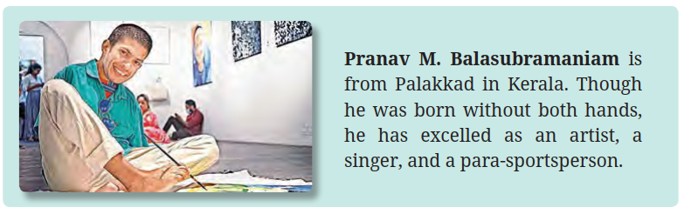
1. Do you think Pranav’s task is simple? Why or why not?
Answer: No, Pranav’s task is not simple because he was born without both hands. It is very difficult to do daily activities and learn skills like painting or sports without hands. However, Pranav worked hard and proved that nothing is impossible with determination and courage.
2. How does Pranav’s special ability make you feel?
Answer: Pranav’s special ability makes me feel very inspired and proud. Even without hands, he did not give up and achieved great success. His courage and hard work teach me to stay strong and never lose hope in life.
3. What qualities do you think were important for Pranav to become successful?
Answer: The qualities that were important for Pranav to become successful are hard work, determination, patience, courage, and self-confidence. These qualities helped him to overcome his difficulties and achieve his goals.
4. What message does Pranav’s story give us?
Answer: Pranav’s story gives us the message that nothing is impossible if we work hard and believe in ourselves. It teaches us to never give up, even when life is difficult, and to always stay positive and determined to reach our goals.
II. Look at the picture of Kathiawar embroidery. Discuss in pairs.
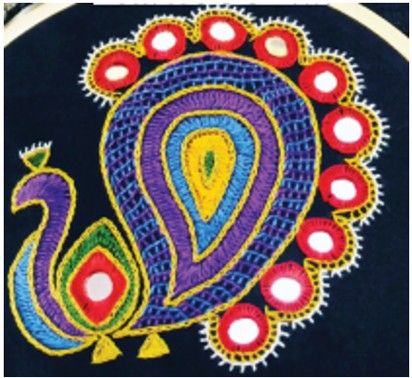
1. List the steps you think are needed to create this embroidery.
Answer: The steps needed to create kathiawar embroidery are listed below:
- Select the fabric.
- Draw the design on the fabric.
- Thread the needle.
- Start embroidering the design with the needle and thread.
- Add embellishments like mirrors or beads if desired.
- Finish the embroidery and trim any excess threads.
2. Discuss if these steps can be done with feet, instead of hands.
Answer: Yes, these steps can be done with feet, but it requires a high level of skill and practice to achieve the precision needed for detailed embroidery.
3. What efforts would be needed if someone has to embroider with their feet? Do you think it is possible?
Answer: If someone has to embroider with their feet, they would need a lot of practice, patience, and strong willpower. They must learn to control their toes and legs carefully to hold the needle and thread. It would also need focus and determination to make neat designs.
Yes, it is possible, as shown by Ila Sachani, who became an expert in embroidery using her feet.
Let us Discuss (155)
Read the paragraphs and write the main idea for each. Then, match the main idea with two supporting details.
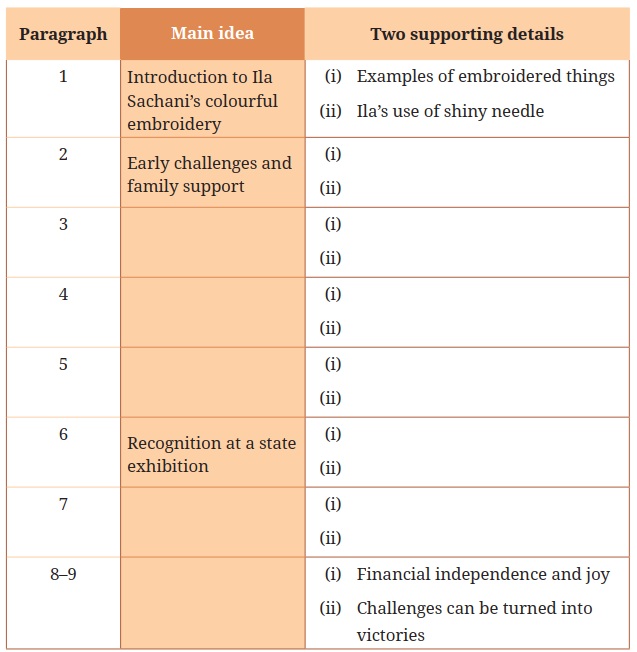
Answer:
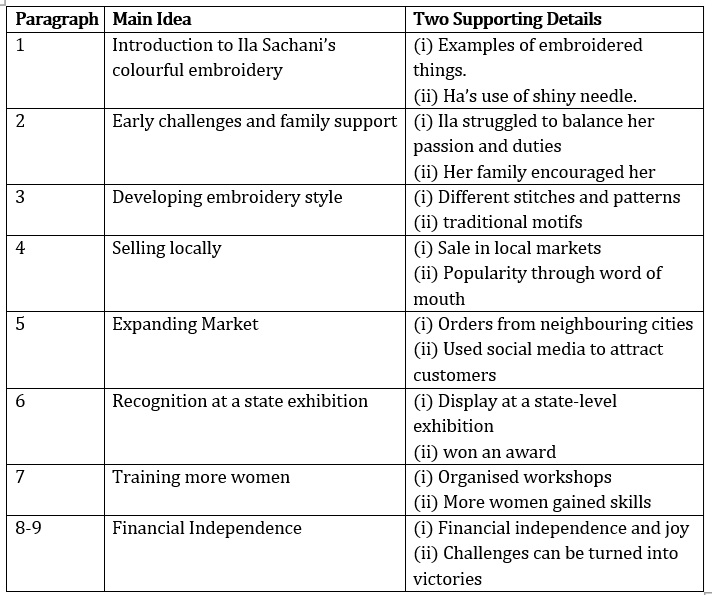
Let us think and reflect (Page 156)
I. Read the following lines and answer the questions that follow.
Unlike other children, she could not use her hands in the usual way. While other small hands drew figures in the sand or plucked wild flowers, she wondered why she could not join them. She too wanted to hold a chalk in her hands and draw figures on a slate.
1. Choose the correct option to fill in the blank.
‘Unlike other children’ means that Ila was _____________. (unaware/ different/simple)
Answer: ‘Unlike other children’ means that Ila was different. (unaware/ different/simple)
2. What could Ila have felt when she could not join others in things they did?
Answer: Ila most likely felt depressed, left out, and frustrated when she could not join others in the things they did.
3. Complete the following with a suitable reason.
Ila could not draw figures on the slate because ___________.
Answer: Ila could not draw figures on the slate because she could not use her hands like others could.
II. What creative ways did Ila and her family use to overcome the challenges she faced?
Answer: Her mother and grandmother taught her embroidery using her feet. Her parents also helped her learn to eat, comb her hair, and do daily work with her legs. With their love, support, and her own hard work, Ila was able to overcome all her challenges.
III. How did ‘new independence’ help Ila?
Answer: The ‘new independence’ helped Ila to earn money, gain confidence, and find happiness in her work. It made her feel proud that she could do everything on her own.
IV. Why was the first state exhibition an important event in Ila’s life?
Answer: The first state exhibition was an important event in Ila’s life because it gave her work public recognition. People saw her beautiful embroidery made with her feet and admired her talent. It also opened new opportunities for her to show her art in other exhibitions.
V. What does the sentence, ‘art has the power to rise above physical boundaries and touch the soul’, tell us about the power of art?
Answer: The sentence means that art is not limited by physical ability. It shows that true art comes from the heart and mind, and it can inspire and move people deeply, no matter how it is made.
6. How can we be helpful and encouraging like Ila’s family and friends when someone faces challenges?
Answer: We can be helpful and encouraging like Ila’s family and friends by supporting others with kindness and patience. We should believe in their abilities and motivate them to keep trying.
7. How can Ila’s story help others to overcome challenges in their lives?
Answer: Ila’s story can help others to overcome challenges by showing that hard work, courage, and determination can make anything possible. It teaches people to never give up and to believe in themselves. Her story inspires everyone to turn challenges into success with a positive attitude.
Let us learn (Page 156)
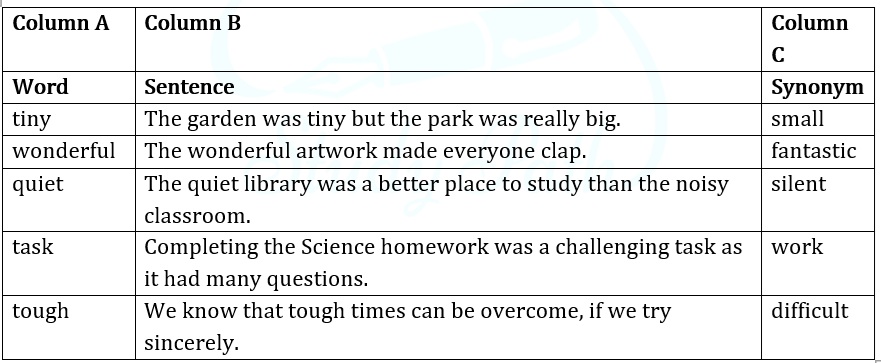
I. Read the words from the text given in Column A. Then, try to understand what they mean by reading the sentences in Column B. Now, match the word to its correct synonym in Column C. There are two extra synonyms given. You may refer to the dictionary
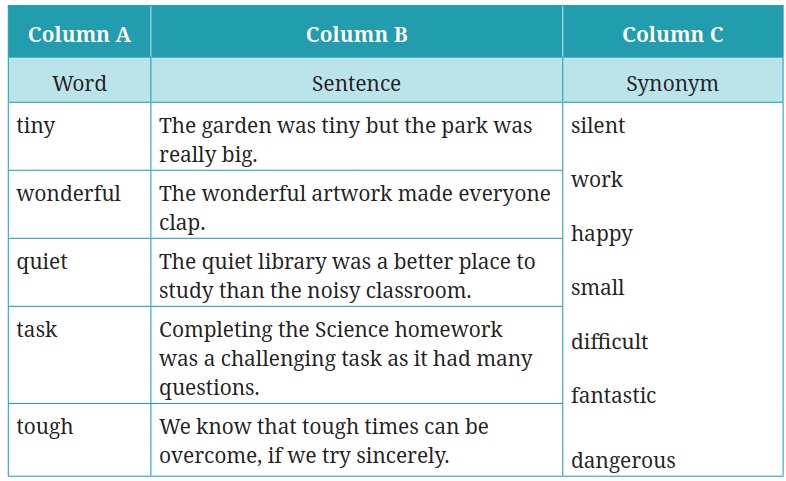
Answer:
II. Unscramble the antonyms of the words in Column A. An example has been given for you.
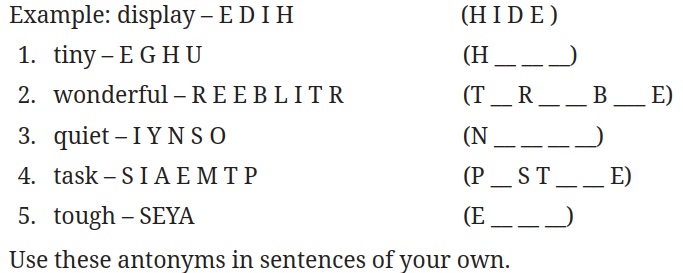
Answer:
1. tiny – E G H U (HUGE)
2. wonderful – R E E B L I T R (T E R RI B L E)
3. quiet – I Y N S O (NOISY)
4. task – S I A E M T P (P A S T IM E)
5. tough – SEYA (EASY)
Use these antonyms in sentences of your own.
Answer: Huge – The huge elephant walked slowly through the jungle.
Terrible – The movie was terrible, and I didn’t enjoy it at all.
Noisy – We had to tell our noisy neighbours not to disturb us at night.
Pastime – My favourite pastime is window shopping because it does not cost any money.
Easy – This question is easy to solve.
III. Read the sentences from the text and focus on the highlighted words.
- You will see lots of bright colours.
- There are many lovely things like cushions and bedcovers.
- They taught her to create many beautiful patterns using her feet!
- She learned many styles.
- She received many awards.
1. The highlighted words tell us about the quantity. Choose what the words show.
(i) Unmentioned quantity
(ii) Large quantity
Answer: The highlighted words, namely ‘lots of’ and ‘many’, indicate a large quantity.
(b) Let us now understand what words of quantity tell us.
Fill in the blanks to complete an example for each word of quantity. Hints are given in the brackets
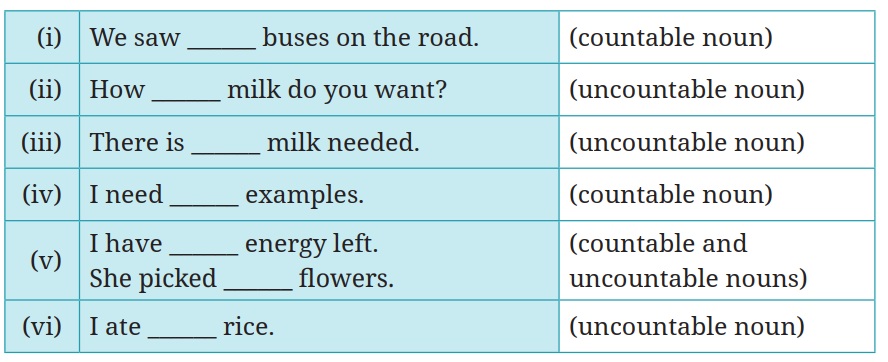
Answer:
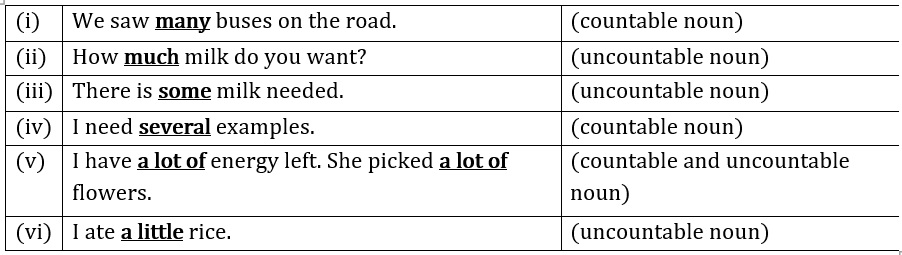
Now, create two sentences for each word of quantity (i-vi), and share them with your teacher and classmates.
Answer:
(i) Many:
There are many cars stuck on the bridge. (countable)
I met many old friends at the school reunion. (countable)
(ii) much:
I do not drink much water even in summer. (uncountable)
We don’t have much time in hand before the concert begins. (uncountable)
(iii) some:
Some people like to argue endlessly about silly things. (countable)
I have some time to help you with your homework. (uncountable)
(iv) several:
There are several different routes to get to the top, but the one we use is the safest. (countable)
Several days have passed since Rani left, but we still miss her much. (countable)
(v) a lot of:
I saw a lot of parrots on the guava tree. (countable)
I am afraid that I have caused you a lot of stress. (uncountable)
(vi) a little:
We need a little milk for the baby. (uncountable)
She earned a little praise for her work after school which involved teaching a few destitute children. (uncountable)
Let us listen (Page 158)
You will listen to a talk about Kathiawar embroidery. As you listen, circle the correct option. (refer to page 164 for transcript)
1. Form
(i) old
(ii) new
Answer: (i) old
2. Colours
(i) soft
(ii) bright
Answer: (ii) bright
3. Stitches
(i) running stitch
(ii) chain stitch
Answer: (ii) chain stitch
4. Seen on
(i) children’s caps
(ii) pants
Answer: (i) children’s caps
5. Things used
(i) small mirrors
(ii) shapes of buttons
Answer: (i) small mirrors
6. Designs
(i) elephants and horses
(ii) squares and triangles
Answer: (ii) squares and triangles
Let us explore (Page 159)
1. Does anyone in your family or neighbourhood do embroidery? Find out what type of embroidery they do and how they learnt it.
Answer: Yes, my grandmother does embroidery. She makes beautiful floral designs on pillow covers and handkerchiefs. She learnt embroidery from her mother when she was young. She uses colourful threads and needles to make different patterns. She says embroidery makes her feel happy and peaceful.
NCERT Solutions for Class 6 English Unit 5 Ila Sachani: Embroidering Dreams with her Feet
Ila Sachani: Embroidering Dreams with her Feet is an inspiring account of a woman who turned her challenges into opportunities through determination and hard work. Ila was born into a farmer’s family in Amreli, Gujarat, and could not use her hands in the usual way. Her mother and grandmother, who were skilled in Kathiawar embroidery, taught her to create beautiful patterns using her feet. Although threading a needle was difficult at first, she continued practising and became an expert at a young age. Her talent gradually became popular, and she received several awards, including the President’s Medal. The story highlights how dedication, family support and a positive attitude can help people achieve their dreams.
We hope these NCERT Solutions for Class 6 English Poorvi help students understand the story, revise its important lessons and prepare confidently for their examinations.