

NCERT Solutions for Class 6 English Poorvi Chapter 8 What a Bird Thought help students understand a beautiful poem about a young bird’s changing understanding of the world. The poem describes how the bird’s surroundings gradually expand as it grows from living inside an eggshell to exploring the open sky. Here, we provide answers to the textbook questions and activities from Poorvi in simple, student-friendly language.
Class 6 English Poorvi Chapter 8 What a Bird Thought NCERT Solutions
Let us do these activities before we read (Page 85)
I. Look at the picture and discuss what you see in the picture with your teacher and classmates.
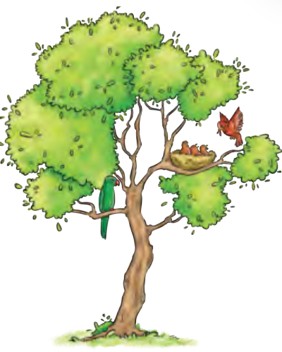
Answer: In the picture, I see a big green tree with many birds. There is a nest on one branch. Inside the nest, there are small baby birds waiting for food. The mother bird is flying toward them with food in her beak. On another branch, a green parrot is sitting and eating a fruit. The tree looks full of life and gives shade, food, and shelter to the birds. It shows how nature cares for all living things.
Think of a time when you worked hard. What did you do then?
- How did it help you?
- How did it make you feel?
- Also, discuss in groups.
Answer: One time, I worked very hard to prepare for my maths test. I studied every day and practiced many sums. It helped me understand the lessons better and I scored good marks in the exam. I felt very happy and proud of myself because my hard work gave me success. It also taught me that if we work hard, we can achieveanything we want.
II. Where are the places you see birds? What do you see the birds doing?
Answer: I see birds in many places like on trees, in parks, near ponds and lakes, and sometimes on electric wires.
I see the birds flying in the sky, sitting on trees, singing or chirping, building nests, and looking for food. Some birds feed their babies, and some pick grains from the ground.
III. Do you want to fly like a bird? Why?
Answer: Yes, I would love to fly like a bird because it would be amazing to see the world from above and travel freely wherever I want.
IV. What does a baby bird think about its world?
Answer: A baby bird thinks its world is small, safe, and cozy. It feels warm and comfortable in its nest with its mother. It sees its mother as its protector and provider.
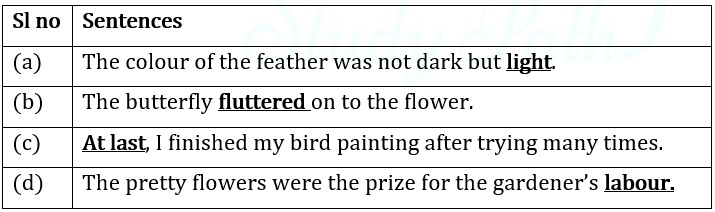
V. Read the sentences and replace the underlined words with their correct meanings.
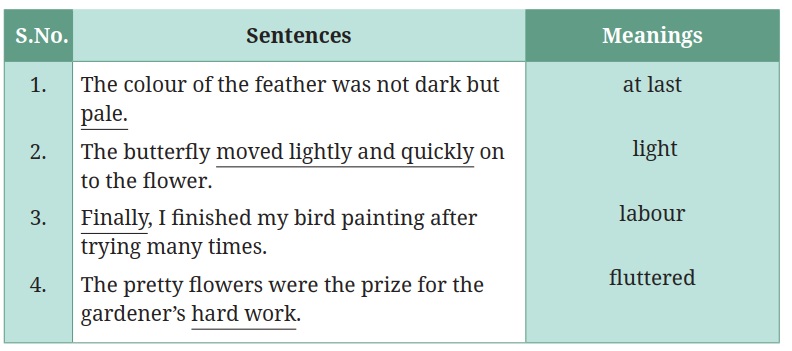
Answer:
Let us discuss (Page 87)
I. Read the poem again. Identify the main idea of each stanza. There are two extra given.
(1) The bird steps out into the world. ____________
(2) The bird lived happily in a small world. _____________
(3) The bird becomes blind due to leaves. _____________
(4) The bird flies away as an adult. ______________
(5) The bird is unhappy with the straw nest. ____________
(6) The bird lived in a cosy nest with its mother. ____________
Answer: The main idea of each stanza is as follows:
| First Stanza | (2) The bird lived happily in a small world. |
| Second Stanza | (6) The bird lived in a cosy nest with its mother. |
| Third Stanza | (1) The bird steps out into the world. |
| Fourth Stanza | (4) The bird flies away as an adult. |
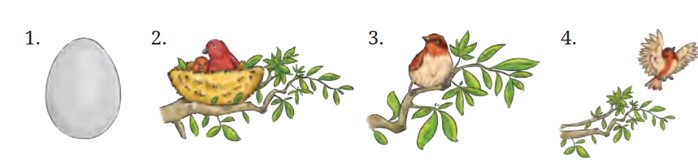
II. Look at the pictures 1 – 4 and write the matching line from the poem for each.
Answer:
1. I thought the world was small and round,
2. I lived next in a little nest
3. I said the world is made of leaves,
4. At length I flew beyond the tree.
III. Answer the following with a word from the poem and check the answers with your partner.
(a) What was the shape of the bird’s first house? _ O _ _ _
(b) What was the bird’s second nest made of? _ _ R _ _
(c) What did the bird see when it came out of its nest? L _ _ _ E _
(d) What did the bird do at the end? _ _ _ W
Answer: (a) The shape of the bird’s first house was round.
(b)The bird’s second nest was made of straw.
(c)When it came out of its nest, the bird saw leaves.
(d) At the end the bird flew away.
Let us think and reflect (Page 88)
I. Write whether the following sentences are True or False.
1. The bird changed its house two times.
2. The neighbours tell the bird about the world.
Answer: 1. The bird changed its house two times – True
2. The neighbours do not know enough about the world – False.
II. Read the following lines from the poem and answer the questions given below.
1. I thought the world was made of straw,
And nestled by my mother.
(i) Who lived in the nest along with the baby bird?
Answer: The baby bird’s mother lived with it.
(ii) Complete the following by choosing the correct option.
The bird thought the world was made of straw because __________.
A. it lived in a straw hut
B. its nest was made of straw
C. its mother fed straw to it
D. there was straw all around
Answer: B. its nest was made of straw.
(iii) Which word tells us that the baby bird was warm and comfortable?
Answer: The word ‘nestled’ tells us that the baby bird was warm and comfortable.
2. I said the world is made of leaves,
I have been very blind.
(i) Why did the bird think the world was made of leaves?
Answer: The bird thought the world was made of leaves because it saw only leaves when it first left its nest.
(ii) What does the set of words ‘I said’ mean?
A. flew
B. shouted
C. spoke
D. cried
Answer: (c) spoke
(iii) Fill in the blanks to complete the sentence.
The bird felt that it had been very blind because it could not __ __ __ the leaves from __ n __ __ __ e the nest.
Answer: The bird felt that it had been very blind because it could not see the leaves from inside the nest.
III. Why did the baby bird think that its first world was small, round and blue?
Answer: The baby bird thought its first world was small, round, and blue because it lived inside a pale blue shell egg, which was small and round in shape.
IV. Where did the bird go when it fluttered from its straw nest?
Answer: The bird went beyond the tree to see the world when it fluttered from its straw nest.
V. What quality did the bird say it had, when it flew away?
Answer: The bird said it had become fit for grown-up labours when it flew away. It means the bird was ready and strong enough to face the world on its own.
VI. Who do you think were the bird’s neighbours? Why do you think so? Discuss.
Answer: I think the bird’s neighbours were other birds and animals living in the same tree. I think so because these creatures share the same space, making the tree their home, and so they would be considered neighbours.
Let us learn (Page 89)
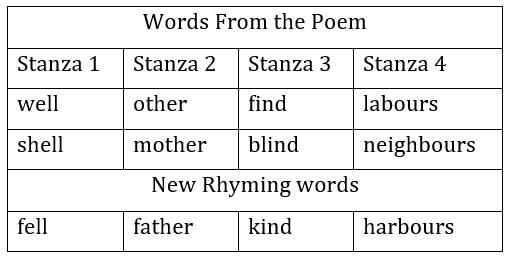
I. Let us write some rhyming words. One has been done for you.
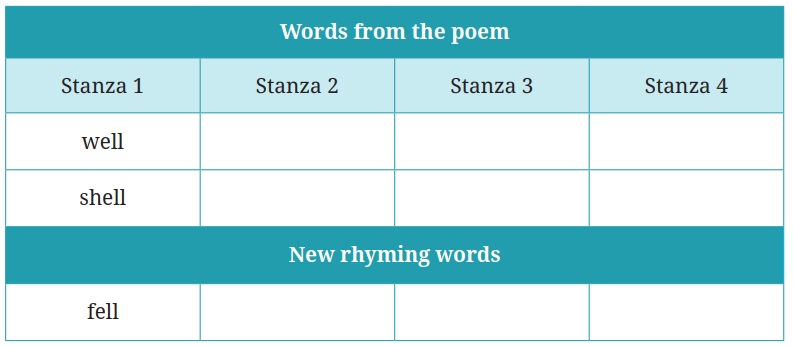
Answer:
Now, complete a new stanza with rhyming words at the end of each line.
I fly high and I fly low,
But one thing I surely k __ __ __,
Whenever I wish to rest,
My little nest is the __ __ __t.
Answer:
I fly high and I fly low,
But one thing I surely know
Whenever I wish to rest,
My little nest is the best.
II. The poet uses words like ‘pale’, ‘blue’, ‘round’, ‘straw’ and ‘little’ to describe the bird’s nest.
Read a few more describing words.

Now, use the describing words given in the box to create six sentences based on the given picture.
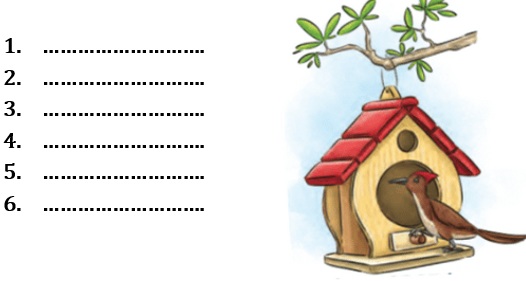
Answer:
1. The bird has pointed beak.
2. The tree has many green leaves.
3. The bird is brown in colour.
4. The bird lives in a small nest on the tree.
5. The cage is hanging from the branch of a tree.
6. The nest has a round entrance.
Let us listen (Page 90)
You will listen to a short poem. As you listen, fill in the missing words. You can listen to the poem more than once. (refer to page 102 for transcript)
I’m a parrot, my name is Paro,
My feathers are __ __ __ g __ __ and they glow.
In the morning, I spread my wings,
___ ___ ___ around and see wonderful things.
Come with me through the skies so ___ l ___ ___,
To places old and places new.
Among the ___ ___ e ___ ___, where the breeze is light,
Many new st __ __ __ ___ s, oh, what a sight!
Answer:
I’m a parrot, my name is Paro,
My feathers are bright and they glow.
In the morning, I spread my wings,
Fly around and see wonderful things.
Come with me through the skies so blue.
To places old and places new.
Among the trees, where the breeze is light,
Many new stories, oh, what a sight!
Let us speak (Page 90)
Speak with your classmates about which bird you would like to be. Include the following points.
Which bird are you? [I am ……….…….]
Answer: I am a parrot.
What do you look like? [I am ……….……. in colour. I am a big/small bird. I have ……….…….].
Answer: I am green in colour. I am a small sized bird. I have a red beak and shiny feathers.
Where do you live? [I live in ……….……. It is (where) ……….…….]
Answer: I live in a tree near a garden. It is where I can find the fruits I love to eat.
What do you do during the day? [ I ……….……. I also ……….…….]
Answer: I fly from tree to tree and eat fruits and seeds. I also talk to other parrots.
Do you have any message for humans? [ I want to tell the humans ……….…….]
Answer: Yes, I have an important message for humans.
I want to tell the humans to take care of trees and never harm birds, because trees are our homes.
Let us write (Page 91)
I. Read how the bird perceived its world.
My world was small, round and light blue at first. After that my world was warm and comfortable. It was made of straw. In this world I could only see leaves whenever I stepped out. In the end, my world became big. It had the sky and the earth as a part of it.
II. Now, discuss with your teacher and classmates how you think the world would look to the following.
(1) a baby
(2) a fish
Answer: (1) A baby: The world of a baby is small and safe. The baby sees its mother, father, toys, and room. It feels warm, happy, and cared for. Everything is new and exciting to the baby.
(2) A fish: The world of a fish is full of water. It sees other fishes, plants, and stones under the water. It feels free swimming around and its world looks blue and shiny.
III. Now, write five sentences each, for both (1) and (2), in your notebooks. You can take help from the example given in 1.
Answer:
A baby:
- My world is soft and warm.
- I see faces smiling at me.
- My world is full of toys and blankets.
- I feel safe with my parents.
- I cry when I am hungry.
A fish:
- My world is full of water.
- I see colourful plants and stones.
- I swim with other fish.
- I breathe through my gills.
- I feel happy in my underwater home.
Let us explore (Page 91)
I. The bird’s first home was made of a shell. Later its home was among leaves and made of straw.
Look at your home carefully and make a list of all the materials it is made of.
Answer: My home is made of bricks, cement, concrete, steel, glass, wood, and tiles.
Q. Why do you think our homes are not made of straw?
Answer: Our homes are not made of straw because straw is weak and catches fire easily. It may blow away in the wind, or get damaged by rain.
Q. If you had to own a home of your choice, what would it look like and what materials would you like to use?
Answer: If I had to own a home of my choice, it would be a big, bright house with many windows and a lovely garden. I would use bricks, wood, and glass to build it. I would decorate it with colourful plants and flowers to make it look beautiful and peaceful.
Q. How is a home different from a house? Discuss with your classmates and teacher.
Answer: A house is only a structure made of bricks, cement, wood, and glass. It gives us shelter.
A home is where we live with our family with love and care. It gives us comfort, warmth, and happiness.
So, a house is just a building, but a home is where we feel we belong.
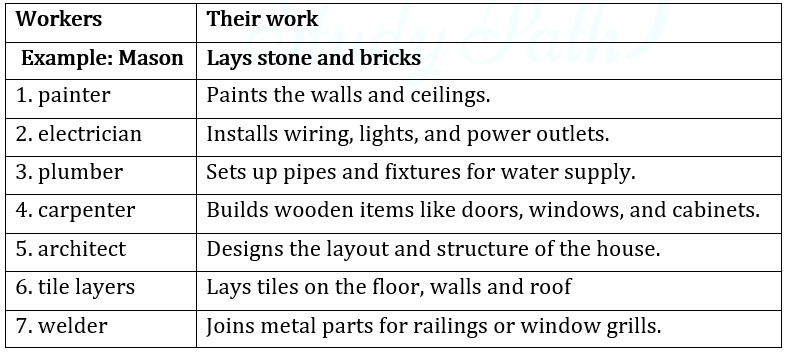
Look at the list of some workers who build houses. Find out the work they do and write, as shown in the example. You can think of other workers and add them too.
| Workers | Their work |
| Example: Mason | Lays stone and bricks |
| 1. painter | |
| 2. electrician | |
| 3. plumber | |
| 4. carpenter | |
| 5. architect | |
| 6. | |
| 7. |
Answer:
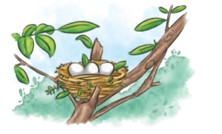
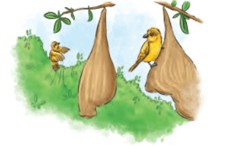
II. Look at the different kinds of nests and homes the birds make. Have you seen any? Discuss these types of nests with your teacher and classmates.
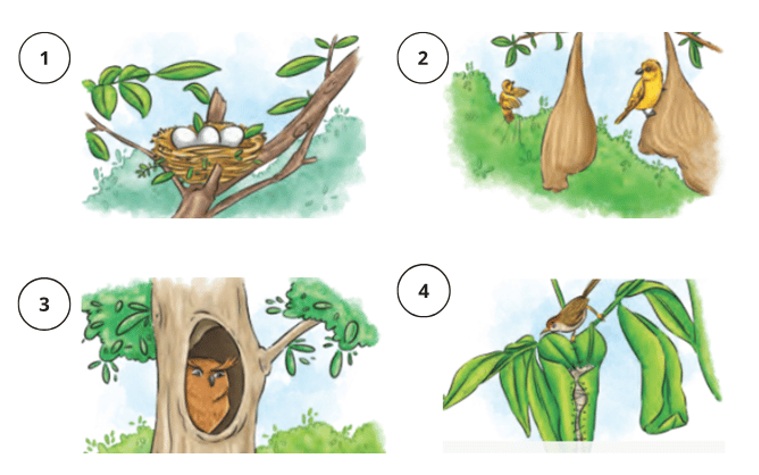
Answer:
Traditional Nest in a Tree
- Description: A nest of twigs, leaves, and other plant materials. It is typically found in the branches of trees.
- Birds: Common birds like robins, sparrows, and pigeons build such nests.
- Personal Observation: It’s often built safely among the branches.
Hanging Nest
- Description: These nests are suspended from branches and made of woven grass and other flexible materials.
- Birds: Birds like weaver birds and orioles build these intricate, hanging nests.
- Personal Observation: These nests are fascinating due to their intricate construction and are often found in areas with abundant vegetation.
Cavity Nest
- Description: A nest is built inside a hole in a tree trunk.
- Birds: Woodpeckers, owls, and some parrots use tree cavities for nesting.
- Personal Observation: These nests provide excellent protection from predators and the elements. Have you seen any trees with holes that might be homes for birds?
Leaf Nest
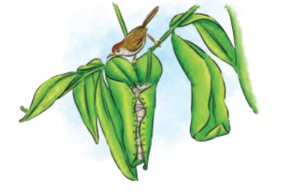
- Description: A nest made by stitching or folding leaves together.
- Birds: Tailorbirds and some species of warblers build these unique nests.
- Personal Observation: These nests are cleverly constructed using natural materials and can often be found in dense foliage.
Discussion with Classmates
- Types of Birds: Discussion on the kinds of birds that build each nest and how their nesting habits suit their environments.
- Construction Techniques: Talking about the different techniques birds use to build their nests, like weaving, stitching, or using cavities.
By discussing these nests, I’ll gain a better understanding of the diverse and fascinating ways birds create homes for their young.
NCERT Solutions for Class 6 English Unit 3 What a Bird Thought
What a Bird Thought is a poem by an anonymous poet that describes the world from the perspective of a growing bird. At first, the bird lives inside a small, round and pale blue eggshell and believes that the world is just like its little home. After hatching, it lives in a straw nest with its mother and thinks that the world is made of straw. When it begins to explore the surroundings, it sees leaves and believes that the world is made of them. Finally, the bird flies beyond the tree and discovers a much larger world. It realises that there is still so much to explore and understand.
We hope these NCERT Solutions for Class 6 English Poorvi help students understand the poem, revise its important lessons and prepare confidently for their examinations.