

NCERT Solutions for Class 6 English Chapter 4 The Unlikely Best Friends help students understand a heartwarming story by Subba Rao about the special friendship between an elephant and a dog. The story teaches important lessons about friendship, kindness, love and companionship. Here, we provide answers to the textbook questions and activities from Poorvi in simple, student-friendly language.
Class 6 English Poorvi Chapter 4 The Unlikely Best Friends NCERT Solutions
Let us do these activities before we read (Page 39)
I. Friends are an important part of our lives. Why do you think so? Share your ideas with your friend. What do you do when you are with your friends and how do you feel?
Answer: Friends are an important part of our lives because they make us happy, share our joys, and support us in difficult times. With friends, we never feel lonely and we learn how to care, share and cooperate.
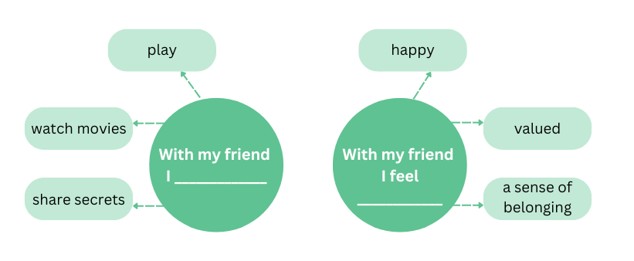
When I am with my friends, I talk, laugh, play games and sometimes study together. We enjoy sharing our thoughts, secrets and even food. I feel relaxed, cheerful and confident when I am with them.
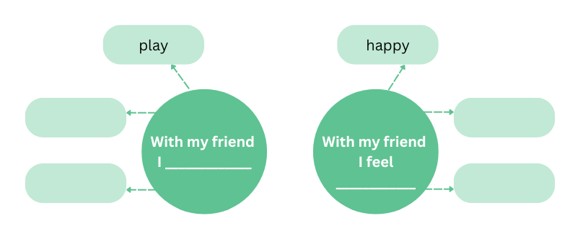
Now, complete the following sentences by writing in the shapes given below. Share your completed sentences with your classmates and teacher. One has been done for you.
Answer:
II. The title of the chapter is ‘The Unlikely Best Friends’.
(1) What can be the meaning of ‘unlikely’? Discuss in groups, and then discuss with your teacher.
Answer: The word ‘unlikely’ means not expected to happen or not probable. For example, “It is unlikely to rain today” means the chances of rain are very low.
(2) Can you think of some unlikely friends? Share your answer with your teacher.
Answer: Yes, here are a few examples of unlikely friends:
1. Cats and dogs.
2. A lion and a mouse.
Let us discuss (Page no 42)
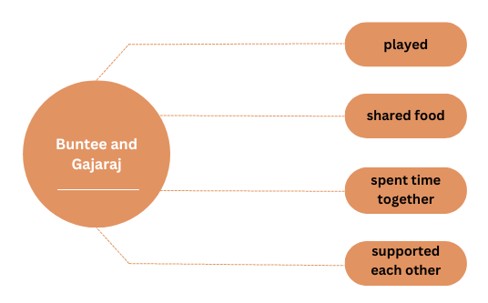
1. Talk about the things that Gajaraj and Buntee did together. Now, write in the shapes given below. One has been done for you.
Buntee and Gajaraj _____________? Played
Answer:
2. Why did the farmer hug Buntee?
Answer: The farmer hugged Buntee because he was very happy to see his lost dog again. He had been searching for Buntee ever since the dog went missing. When he finally found him, he felt deeply relieved and hugged him with love.
3. Do you think Buntee will leave Gajaraj and go home with the farmer?
Answer: I don’t think Buntee will leave Gajaraj and go back to the farmer. Buntee and Gajaraj have become close friends. They care for each other and are happy together. Even though Buntee lived with the farmer before, his strong bond with Gajaraj may stop him from going back.
Let us discuss (Page no 45)
1. Why did Gajaraj not eat his food?
Answer: Gajaraj did not eat his food because he was very sad. He missed his friend Buntee, who had been taken away by the farmer. Feeling lonely without him, Gajaraj lost interest in eating. His sadness made him stop eating.
2. Who were friends at the end of the story?
Answer: At the end of the story, the two friends, Gajaraj and Buntee, were joyfully reunited. Seeing how much the animals cared for each other, the farmer and the mahout also became friends. In this way, both the animals and their caretakers became friends.
Let us think and reflect (Page 45)
1. Read the following lines and answer the questions that follow.
(a) In spite of royal comforts, Gajaraj was sad because he had no friends. The mahout, or elephant trainer, was the only one he ever interacted with. The mahout was a kind man who served Gajaraj food, and gave him a bath in the elephant pond daily. He was a good caretaker, but not a friend.
(i) Complete with one word:
mahout : kind : : Gajaraj : __________
Answer: mahout : kind : : Gajaraj : lonely
(ii) The mahout was a good caretaker because he gave ________to Gajaraj and a ______in the pond.
Answer: The mahout was a good caretaker because he gave food to Gajaraj and a bath in the pond.
(iii) What do you think is the difference between a friend and a caretaker?
Answer: A friend is someone with whom we can play, share our feelings and spend happy moments. A caretaker is a person who looks after our needs and requirements. The mahout was Gajaraj’s caretaker, taking care of him by giving food and a bath, while Buntee was Gajaraj’s friend, someone he could play with and be happy.
(b) “Are you missing your friend?” asked the farmer remembering the happy look on Buntee’s face while sitting on the elephant’s back. “I cannot see you go hungry,” said the farmer, “If you miss your friend so much, go to him.” The farmer removed the rope with which he had tied the dog.
(i) The farmer uses the word __________________ to refer to the elephant.
Answer: The farmer uses the word friend to refer to the elephant.
(ii) How did the farmer know that Buntee was hungry?
Answer: The farmer knew that Buntee was hungry because Buntee had not touched his food since he was brought home.
(iii) Why did the farmer remove the rope with which he had tied Buntee?
Answer: The farmer removed the rope with which he had tied Buntee because he realised that the dog was missing his friend Gajaraj. The kind farmer wanted to free Buntee so he could return to the stable and reunite with Gajaraj. He knew this would make both animals happy.
(iv) Complete with one word:
Gajaraj : Buntee : : __________ : farmer
Answer: Gajaraj : Buntee : : mahout : farmer
2. Give two examples to show that Gajaraj was very happy to have a friend.
Answer: Here are two examples that show Gajaraj was happy to have a friend:
- Gajaraj playfully splashed water on Buntee while bathing, showing joy and a desire to have fun with his new friend.
- Gajaraj gently picked up Buntee with his trunk and gave him a ride on his back, showing his love and excitement
3. How did the mahout come to know that Gajaraj was sad?
Answer: The mahout came to know that Gajaraj was sad because the elephant stopped eating for two days.
4. Why do you think Buntee licked the farmer’s hand?
Answer: I think Buntee licked the farmer’s hand to show love and thank him. Buntee was happy that the farmer let him stay with his best friend, Gajaraj.
5. What was ‘unlikely’ about the friendship of Gajaraj and Buntee?
Answer: The friendship of Gajaraj and Buntee was ‘unlikely’ because they were very different. Gajaraj was a big, strong elephant while Buntee was a small, gentle dog. Despite their differences in size and nature they became best friends.
Let us learn (Page no 46)
1. Gajaraj was sad without a friend and when he met Buntee, he was filled with joy. ‘Sad’ and ‘filled with joy’ are opposites. Opposites can also be formed by adding some letters before a word. For example, un- unhappy, in- incorrect, dis- disconnect, mis- misuse. Now, take help from the words given as hints and fill up their opposites in the puzzle. (Note: All the words are from the story you have just read.)
We are opposites!
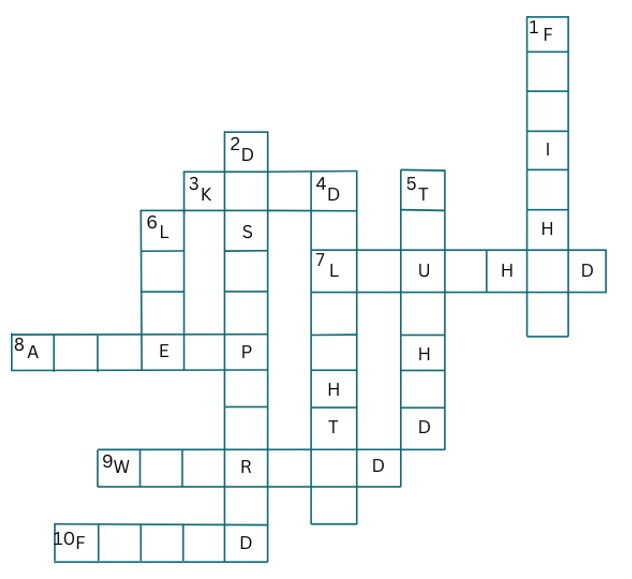
Answer:
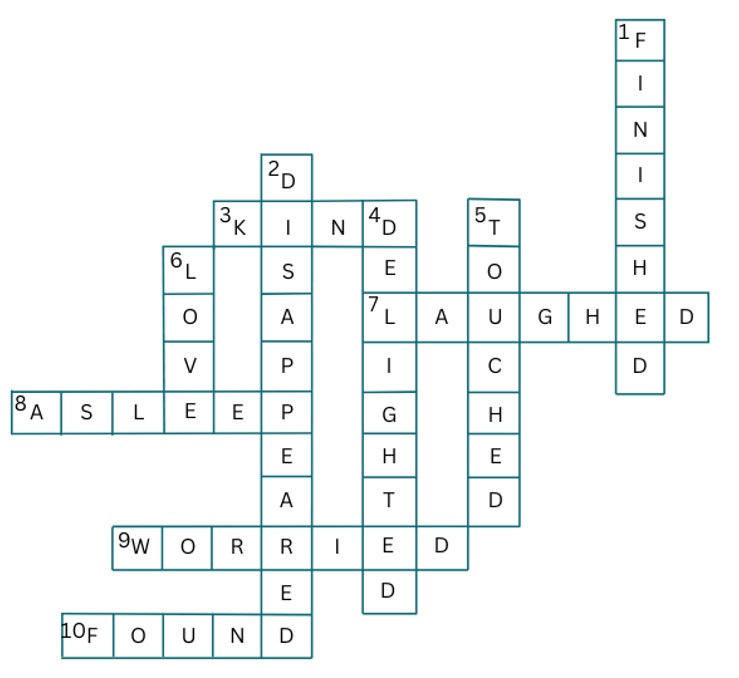
2. Now, complete the paragraph with some of the words you have used in the puzzle.
My pencil was _____________. I was very ________________ as it was a gift from my friend. I woke up my elder brother who was ____________ on the bed. I told him that my pencil seemed to have ________________. He _______________ and told me to look under my pillow. I was ___________________ when I ______________ the pencil there.
Answer: My pencil was missing. I was very sad as it was a gift from my friend. I woke up my elder brother who was asleep on the bed. I told him that my pencil seemed to have disappeared. He laughed and told me to look under my pillow. I was delighted when I found the pencil there.
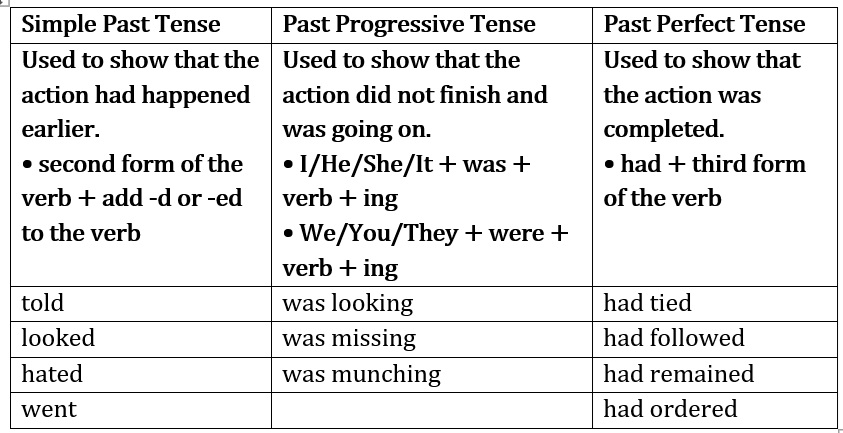
3. The words that tell us about an action are called verbs. In the story, the author tells us what happened before. To do that, the past form of the action word (verb) is used. Let us learn about the three forms of past tense.
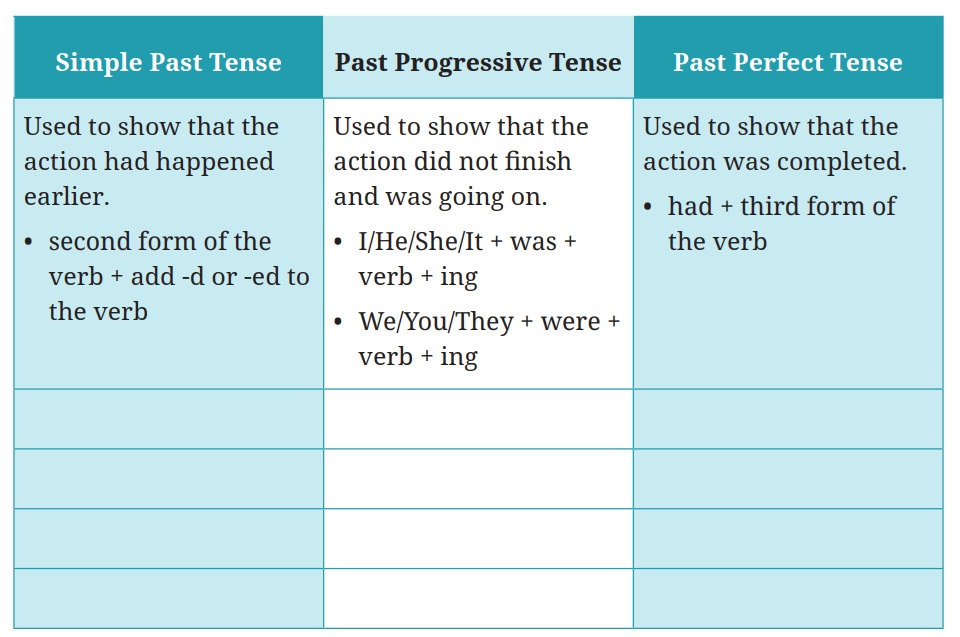
Given below are some verbs from the story. Put the verbs in their correct column in the table given above.
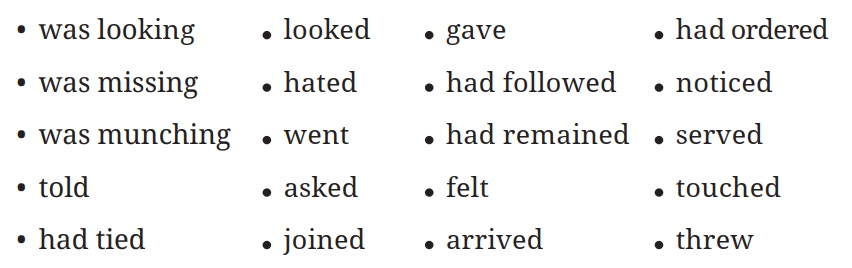
Answer:
Select the correct form of the verb to complete the passage. Check your answers with the teacher.
The farmer came back and ____________ (noticed/was noticing/had noticed) that Buntee was sad. He ____________ (tied/ was tying/had tied) Buntee with a rope the day before. He ____________ (asked/was asking/had asked) Buntee why he was sad. Farmer ____________ (felt/was feeling/had felt) that Buntee ____________ (missed/was missing/had missed) Gajaraj and set him free.
Answer: The farmer came back and noticed (noticed/was noticing/had noticed) that Buntee was sad. He had tied (tied/ was tying/had tied) Buntee with a rope the day before. He asked (asked/was asking/had asked) Buntee why he was sad. Farmer felt(felt/was feeling/had felt) that Buntee was missing (missed/was missing/had missed) Gajaraj and set him free.
4. ‘…neither the farmer nor the mahout noticed that the two friends were in tears.’
The words ‘neither’, ‘nor’ are used to state that the farmer and the mahout did not notice the same thing. ‘Neither, nor’ connect two negative choices. For example: Neither Rohit nor I want to play football.
When you need to choose between two things that you want, you may use ‘either, or’. For example: Rohit wants to play either cricket or kho-kho.
It means Rohit wants to play cricket or Rohit wants to play kho-kho.
Discuss the given sentences with your teacher to practice.
- Neither Shikha nor Anuj like to tell stories.
- Either Bhavesh or Abha made this painting.
Answer: Sentence 1. Neither Shikha nor Anuj likes to tell stories.
The sentence means that both Shikha and Anuj do not like to tell stories.
“Neither” and “nor” are used to connect two negative choices, indicating that neither of the two subjects (Shikha and Anuj) likes storytelling.
Example usage: Neither my friends nor my siblings want to be my video gaming partner.
Sentence 2. Either Bhavesh or Abha made this painting.
The sentence means that only one of the two people, Bhavesh or Abha, made the painting.
“Either” and “or” are used to present two possibilities, indicating that it must be one or the other, but not both.
Example usage: Either Ram or Rani will lead the choir.
These conjunctions help clearly specify whether we are discussing two negative options or two positive choices. They are useful for making our statements precise and avoiding ambiguity.
Let us listen (Page no 49)
1. You will listen to a story about ‘Unlikely Friends’. Use exact words from the story to fill up the missing details in the paragraph. (refer to page 71 for transcript)
Answer: The leopard is a wild animal but it became a friend of a cow. When the leopard grew up, it left the village. It came in the night to meet the cow. The leopard would sit beside the cow. They also played together. The villagers were surprised at their friendship.
2. Now, listen to the story again and number the sentences in correct order.
The first one has been done for you.
The leopard stopped coming regularly.
1. The cow took care of the leopard cub as a mother.
The leopard came to meet the cow at night.
The leopard left the village after growing up.
Answer:
4. The leopard stopped coming regularly.
1. The cow took care of the leopard cub as a mother.
3. The leopard came to meet the cow at night.
2. The leopard left the village after growing up.
Let us speak (Page no 50)
Gajaraj and Buntee had a wonderful time with each other even if they were ‘unlikely’ friends. Talk to your friend and find out your common likes and dislikes. Share your answers with the class.
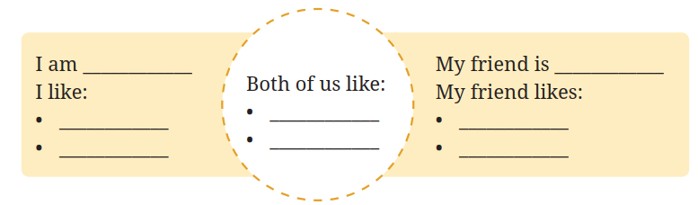
Answer:
I am Rupa
I like:
- Baking
- Reading
My friend is Shilpa
My friend likes:
- Eating
- sports
Both of us like:
- going for walks
- trying out street food
Now, tell your classmates about your friend. You may take help of the cues given below.
- My friend and I like to play. Both of us want ___________.
- I like to ___________ but my friend likes to ___________.
- We are different as she/he is ___________ and I am ___________.
Answer:
- My friend and I like to play. Both of us want to win.
- I like to read but my friend likes to play sports.
- We are different as she is outgoing and I am an introvert.
Let us write (Page 51)
Write six sentences about your friend with the help of the facts collected in the above task. Mention how you are not only similar but also different. You may take help of the words given
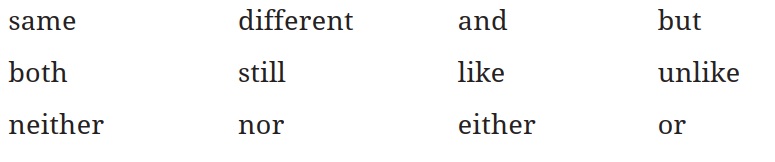
Answer: My friend and I both enjoy spending time together, but we have different interests.
I like to read, whereas my friend likes to play sports.
Unlike me, my friend is outgoing, while I am reserved.
Neither she nor Ilike to be bored, so we find activities that we both enjoy. Either we play games together or we find tasty street food to try out, and this keeps our friendship strong. We have our differences, but we still enjoy spending time together.
NCERT Solutions for Class 6 English Unit 2 The Unlikely Best Friends
We hope these NCERT Solutions for Class 6 English Poorvi help students understand the story, revise its important lessons and prepare confidently for their examinations.
The Unlikely Best Friends is a story about Gajaraj, a royal elephant who has all the comforts but feels lonely because he has no friend. One evening, a hungry stray dog enters his stable. Gajaraj shares his food with the dog, and soon they become close friends. The dog, named Buntee, enjoys playing and spending time with the elephant. However, their friendship faces a challenge when a farmer takes Buntee away. Both animals become sad and stop eating because they miss each other. Seeing their strong bond, the farmer allows Buntee to return to Gajaraj. The story highlights that true friendship is based on love, care and companionship.