

NCERT Solutions for Class 6 English Chapter 3 Rama to the Rescue help students understand an interesting folk tale from Tamil Nadu presented in the form of a comic. The story teaches an important lesson about clever thinking, cooperation and presence of mind. Here, we provide answers to the textbook questions and activities from Poorvi in simple, student-friendly language.
Class 6 English Poorvi Chapter 3 Rama to the Rescue NCERT Solutions
Let us do these activities before we read (Page no. 20)
I. Identify the following people.
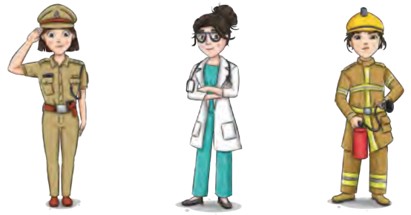
How do they help us when we are in trouble?
Answer:
(i) Police Officer: Police officers make sure everyone follows the rules. They protect people, maintains law and order and catches criminals.
(ii) Doctor: When we fall sick or get hurt, doctors give us treatment and medicines. Doctors save lives and help us recover from illness or injury.
(iii) Firefighter: Firefighters put out fires and save people and buildings. They rescue people trapped inside and save property from burning.
II. Choose the correct option to complete the sentence.
The word ‘rescue’ means to ______________________
(a) make fun of someone
(b) save someone
(c) ask someone for help
Answer: (b) save someone
III. Work in pairs.
Put a tick mark at the end of the phrases describing those who need to be rescued. Share your answers with your teacher and classmates.
(a) A man stuck in a building on fire.
(b) A woman buying vegetables in the market.
(c) A dog who has hurt its leg.
(d) A tree being cut down in a forest
Answer: (a) A man stuck in a building on fire. ✔
(c) A dog who has hurt its leg. ✔
(d) A tree being cut down in a forest. ✔
IV. The policeman in the story you are about to read is called the kotwal. Some people call him thaanedar. What do you call a policeman in your language? Share it with your classmates and teacher.
Answer: In my language, we call a policeman “policewala.”
V. Imagine you are alone at home and you face a problem. Answer the following questions and share your answers with your teacher and classmates.
(a) Will you solve the problem yourself or wait for someone to help you?
Answer: I will first try to solve the problem myself. If it is too difficult or unsafe, I will wait for someone to help me.
(b) How will you deal with the problem? Give a reason.
(i) Be worried about the problem and give up.
(ii) Feel angry that only you have the problem.
(iii) Think quickly about ways to solve the problem.
Answer: I will choose (iii) Think quickly about ways to solve the problem, because this is the best way to stay calm and find a safe solution instead of wasting time worrying or getting angry.
Let us discuss (Page no 22)
I. Circle the odd one–
1. The characters are: husband, wife, children
Answer: the odd one out is ‘children’.
2. Who entered the house? guest, robber, Kotwal
Answer: the odd one out is ‘guest’.
Let us discuss (Page no. 23)
I. Write whether True or False.
1. The man tells his plan to his wife.
2. The thief wants to know where they kept their jewels.
Answer:
1. False
2. True
Let us discuss (Page no. 25)
I. Work in pairs to match the words in Column A with the meanings in Column B. Check your answers by sharing them with your teacher and classmates.
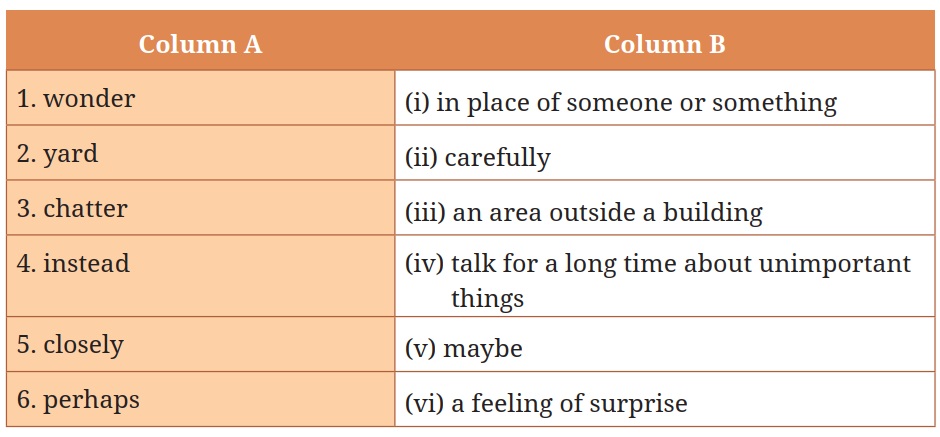
Answer:
| Column A | Column B |
| 1. wonder | (f) a feeling of surprise |
| 2. yard | (c) an area outside a building |
| 3. chatter | (d) talk for a long time about unimportant things |
| 4. instead | (a) in place of someone or something |
| 5. closely | (b) carefully |
| 6. perhaps | (e) maybe |
II. Fill in the boxes with suitable words as you read the story.
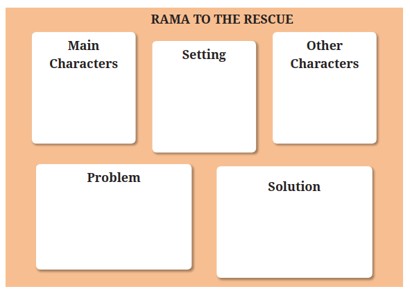
Answer:
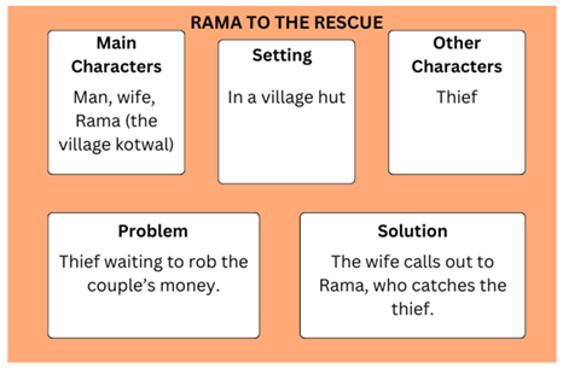
Let us think and reflect (Page no. 26)
I. Read the following lines and then answer the questions that follow.
(a) Man: What’s the matter? What are you looking at?
Wife: Ssssh! Listen!
Man: Somebody is trying to get in.
Wife: I … I think he has got in … the noise has stopped.
(i) What makes the man say the first line?
Answer: The man says these words because he notices his wife staring anxiously at something.
(ii) Choose the correct option.
The wife says ‘Ssssh! Listen!’. What does the word ‘Ssssh’ mean here?
A. sleep
B. help
C. rest
D. be silent
Answer: D. be silent
(iii) How can you tell that the wife was listening carefully?
Answer: The wife was listening carefully because she told her husband to be silent and noticed that the noise had stopped. This shows that she was paying close attention to the sounds around the house.
(b) Rama, the village kotwal, ran to the house from which he heard his name being called.
Rama: Oh, Oh! Some thief has dug his way into this house.
(i) Fill in the blank with the correct word from the given lines.
The villagers caught the thief and took him to the_____________________.
Answer: The villagers caught the thief and took him to the kotwal.
(ii) Choose the correct option.
What do the words “Oh, oh!” show here?
A. surprise
B. anger
C. pain
D. happiness
Answer: A. surprise
(iii) How can you tell that the kotwal was good at his job?
Answer: The kotwal was good at his job because as soon as he heard his name being called, he quickly ran to the house. He understood that a thief had entered. He immediately took action and caught the robber.
II. Give one reason why the man and his wife were not able to fall asleep.
Answer: The man and his wife were not able to fall asleep because they heard noises in the house and realised that a thief was trying to get inside.
III. What did the thief wish would happen? Did it happen?
Answer: The thief wished that the couple would either talk about where they had kept their money or fall asleep. No, it did not happen because they stayed awake and called out loudly for the kotwal. The Kotwal entered into the house and arrested the thief.
IV. How did the man and his wife get help from the kotwal?
Answer: The man and his wife got help from the kotwal by cleverly calling out his name aloud and attract his attention. Rama the kotwal heard his name being called out. So, he rushed to the couple’s house and caught the thief.
V. Do you think cleverness can help us solve our problems? Why do you say so?
Answer: Yes, cleverness can help us solve our problems because it allows us to think quickly and act wisely in difficult situations. In the story “Rama to the Rescue”, the man and his wife used their cleverness by calling out the kotwal’s name. This trick confused the thief, brought the kotwal to their house and saved them from danger.
Let us learn (Page 27)
I. Study the highlighted words in the following lines.
- I’m feeling so sleepy…
- It’s a thief.
- They’re awake.
The highlighted words given in the above sentences have one letter missing in each. What are they? Share them with your teacher and classmates.
Now, write the full words with the missing letter.
The missing letters are marked by an apostrophe (ʼ).
Answer:
(a) I am feeling so sleepy… (‘a’ was missing)
(b) It is a thief. (‘i’ was missing)
(c) They are awake. (‘a’ was missing)
II. Expand the following words. Two examples have been done for you. Use the contracted form of these words in sentences of your own.
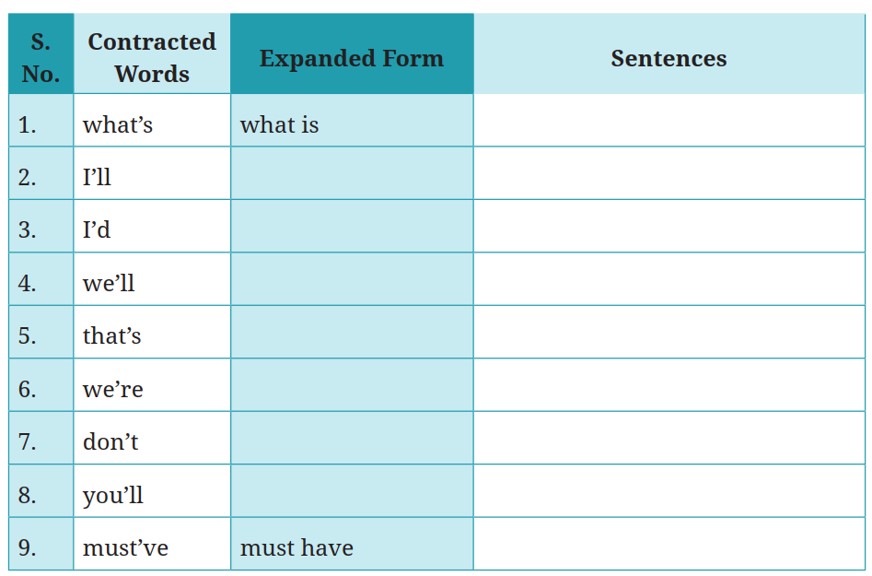
Answer:
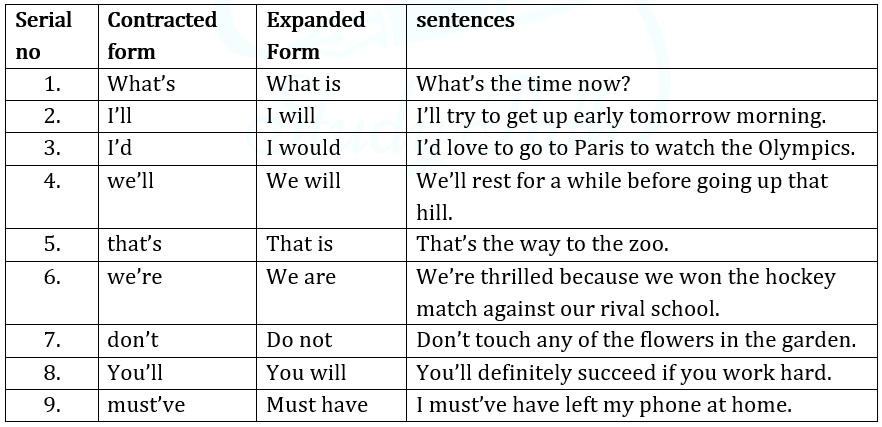
III. Study the highlighted words and the words in the brackets in the following sentences from the story.
(a) I am feeling so sleepy. [am + feel + ing]
(b) What are you looking at? [are + look + ing]
(c) Somebody is trying to get in. [is + try + ing]
(d) They are saying something. [are + say + ing]
(e) Perhaps, they are talking about their money. [are + talk + ing]
Now, choose the correct option.
The sentences (a)-(e) refer to actions that _________________.
[are going on at the time of speaking/happened in the past/will take place in the future].
Answer: The sentences (a)-(e) refer to actions that are going on at the time of speaking.
Verbs that describe what someone or something is doing at the moment of speaking are in the present progressive tense.
IV. Fill in the blanks to complete the following sentences.
1. I ______________ in Grade 6. [am + study + ing]
2. My friend ______________ a story book. [is + read + ing]
3. We ______________ a board game. [are + play + ing]
4. I ______________ a new language. [am + learn + ing]
5. The teachers ______________ in the staff room. [are + sit + ing]
6. My mother ______________ food in the kitchen. [is + cook + ing]
Answer:
1. I am studying in Grade 6. [am + study + ing]
2. My friend is reading a story book. [is + read + ing]
3. We are playing a board game. [are + play + ing]
4. I am learning a new language. [am + learn + ing]
5. The teachers are sitting in the staff room. [are + sit + ing]
6. My mother is cooking food in the kitchen. [is + cook + ing]
V. Study the picture and fill in the blanks with the present progressive form of verbs.
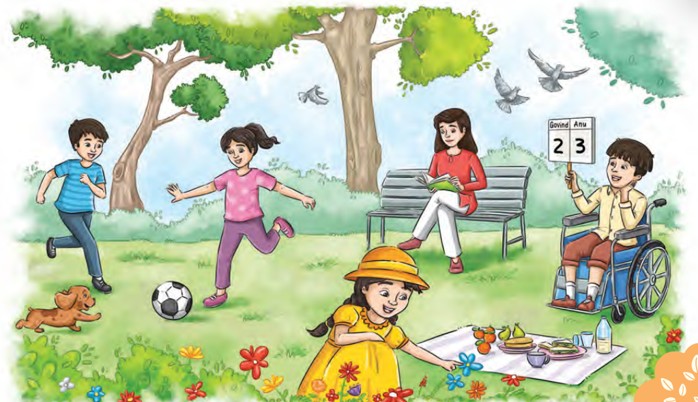
1. Govind and Anu _____________ football.
Answer: Govind and Anu are playing football.
2. Pema ___________ flowers.
Answer: Pema is touching flowers.
3. Anil _____________ the scorecard.
Answer: Anil is holding the scorecard.
4. The mother ___________ a book.
Answer: The mother is reading a book.
5. The dog __________ to catch the ball.
Answer: The dog is running to catch the ball.
6. The birds _________ in the sky.
Answer: The birds are flying in the sky.
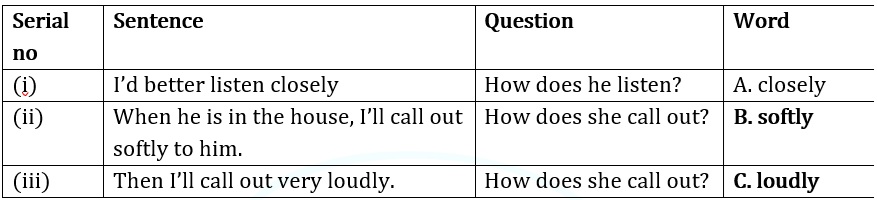
VI. Study the following sentences from the story and complete the table.
One example has been done for you.
(a) I’d better listen closely.
(b) When he’s in the house, I’ll call out softly to him.
(c) Then I’ll call out very loudly…
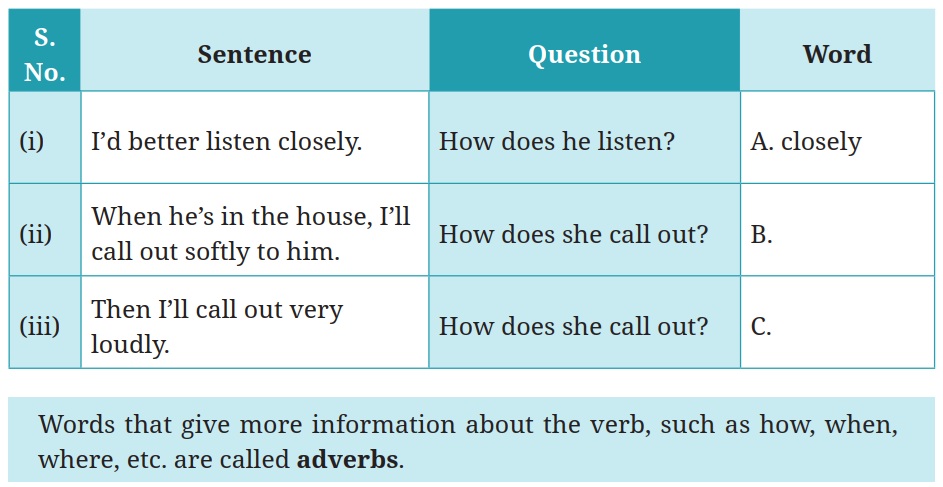
Answer:
VII. Fill in the blanks with suitable adverbs from the box given below. There are two extra words that you do not need.

1. He solved the mathematics problem _____________.
2. The car moved _____________ along the highway.
3. The musician played the guitar _____________.
4. Shobha danced _____________.
5. Rohit left the house _____________.
Answer:
1. He solved the mathematics problem quickly.
2. The car moved smoothly along the highway.
3. The musician played the guitar beautifully.
4. Shobha danced gracefully.
5. Rohit left the house hurriedly.
VIII. Fill in the blanks with suitable adverbs from the box given below. There are two extra words that you do not need.

Once upon a time in a small forest, animals lived (1) ___________. The wise old tortoise moved (2) ___________ but always won the race against the proud rabbit. The ants worked (3) ___________, gathering food for the winter. The kind-hearted lion ruled the jungle (4) ___________, giving everyone a chance to speak. The birds sang (5) ___________, making everyone in the forest happy.
Answer: Once upon a time in a small forest, animals lived (1) peacefully. The wise old tortoise moved (2) slowly but always won the race against the proud rabbit. The ants worked (3) tirelessly, gathering food for the winter. The kind-hearted lion ruled the jungle (4) honestly, giving everyone a chance to speak. The birds sang (5) sweetly, making everyone in the forest happy.
XI. Study the following sentences from the story and choose the correct option.
(1) Oh, hum! What a hard day it has been!
(2) Ah, at last, they’ve stopped their chatter!
(3) What should we do?
(4) What should we name our child?
(i) Sentence (1) expresses a feeling of __________. (tiredness/joy)
(ii) Sentence (2) expresses a feeling of __________. (wonder/relief)
(iii) Sentences (3) and (4) ask __________. (answers /questions)
Answer: (i) Sentence (1) expresses a feeling of tiredness. (tiredness/joy)
(ii) Sentence (2) expresses a feeling of relief. (wonder/relief)
(iii) Sentences (3) and (4) ask questions. (answers /questions)
X. Punctuate the following sentences and write whether they are exclamatory or interrogative sentences.
(1) Wow, what an intelligent man he is
(2) Oh how big the hole is
(3) Do you like to read comic books
(4) What is your favourite story
Answer:
(1) Wow, what an intelligent man he is! (Exclamatory)
(2) Oh, how big the hole is! (Exclamatory)
(3) Do you like to read comic books? (Interrogative)
(4) What is your favourite story? (Interrogative)
Let us listen (Page 32)
You will listen to a security guard making an announcement to the people in the neighbourhood. As you listen, fill in the blanks with only one word that you hear. (refer to page 38 for transcript)
The security guard announced that (1) ____________ has been happening in that area. He advised everyone to stay safe and the kids to tell the (2) ____________ as soon as they find anything different. They should not forget that (3) ____________ is the main thing. He asked them to call (4) ____________ when they need immediate help.
Answer: The security guard announced that (1) robbery has been happening in that area. He advised everyone to stay safe and the kids to tell the (2) adults as soon as they find anything different. They should not forget that (3) safety is the main thing. He asked them to call (4) 100 when they need immediate help.
Let us speak (page 32)
I. Listen to your teacher pronounce the contractions and repeat after your teacher.

Now, speak these contractions clearly along with your teacher and classmates.

Answer: Practise saying these abbreviations repeatedly till they become easy to pronounce.
II. Discuss in pairs:
1. Why do you think it’s important for people to keep their house and themselves safe? Tick the suitable reasons.
(i) To be safe from injury
(ii) To keep family members and pets safe
(iii) To stop accidents from happening
(iv) To make sure they visit the doctor regularly
(v) To stop robbery
(vi) To pay the electricity bill
(vii) To save money
Answer:
(i) (✓)
(ii) (✓)
(iii) (✓)
(iv) (✗)
(v) (✓)
(vi) (✗)
(vii) (✗)
2. Now, use the given hints to share your reasons in complete sentences with your teacher and classmates.
- I think it’s important because … /
- I feel it’s necessary as … /
- The reason we need to look at safety is …
Answer: I think it’s important because we must be safe from injury so we don’t get hurt.
I feel it’s necessary as we must protect our family members and ensure that our pets safe.
The reason we need to look at safety is to stop accidents from happening and keep things secure.
3. Use the given hints to share three ideas on how people can keep their houses and themselves safe. Share with your classmates and teachers.
- I think they should … /
- I suppose they could … /
- They must … /
- They should … /
- How about … /
- It might be better to …
Answer: I think they should install security cameras and alarms to scare away thieves.
I suppose they could check and fix electrical appliances and fixtures regularly to stop fires.
They must lock doors and windows properly to keep intruders out.
They should have a first aid kit and know basic first aid for emergencies.
How about installing fire extinguishers and teaching all family members to use them?
It might be better to keep all dangerous objects out of reach of children to prevent accidents.
Let us write (Page 34)
The next day, the neighbour asked the man in the story about what had happened. As the man, tell the neighbour what had happened in your own words. Remember to include the following:
when ………….
where …………
what ……………
how ……………
why ……………
You may begin this way:
My wife and I were about to go to sleep last night when we heard someone …
Answer: My wife and I were about to go to sleep last night when we heard someone trying to get into our house. It happened in our bedroom at home. A thief had entered, and we could hear the noises he was making. We did not panic but thought of a clever plan. My wife and I called out the name of the kotwal, Rama, first softly and then very loudly. The kotwal who was nearby heard his name and quickly came to our house. He caught the thief and saved us from danger. We did this because we wanted to protect ourselves without letting the thief know our real plan.
Let us explore (Page no 34)
1. Find out from your teacher or parents what you would do in the following situations.
Who will you call if …
- you see fire
- you see someone getting hurt
- you see a wounded animal
- you see someone suspicious
- you find a lost child
- you get lost
Answer:
If I see a fire: I will call the fire department.
If I see someone getting hurt: I will call an ambulance or emergency medical services.
If I see a wounded animal: I will call an animal rescue centre or veterinarian.
If I see someone suspicious: I will call the police.
If I find a lost child: I will call the police or child helpline.
If I get lost: I will call my, parents, guardians, or the police for assistance.
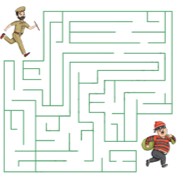
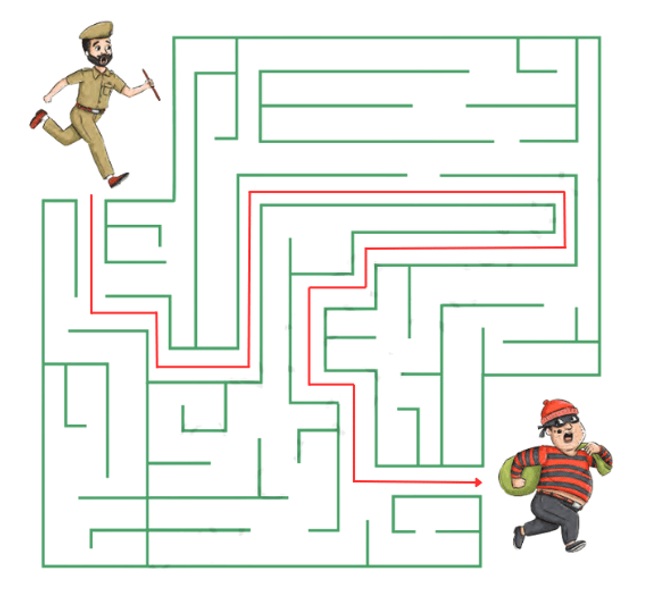
2. Find the right path for the kotwal to catch the thief.
Answer:
NCERT Solutions for Class 6 English Unit 1 Rama to the Rescue
We hope these NCERT Solutions for Class 6 English Poorvi help students understand the story, revise its important lessons and prepare confidently for their examinations.
Rama to the Rescue is a folk tale from Tamil Nadu presented as a comic by Amar Chitra Katha. The story takes place in a village where a husband and wife hear a thief entering their house at night. Instead of panicking, they come up with a clever plan. They pretend to discuss the name of their future child and repeatedly call out “Rama”. The thief does not realise that Rama is also the name of the village kotwal (policeman). Hearing his name, the kotwal arrives at the house and catches the thief. The story highlights the importance of quick thinking and teamwork in difficult situations.