

NCERT Solutions for Class 6 Social Science Chapter 13 The Value of Work help you understand the importance of different types of work in our daily lives and society. This chapter explores how people contribute through their skills, knowledge, time and effort. It introduces the ideas of economic and non-economic activities and explains why every form of work deserves respect. Here, we provide answers to the textbook questions and activities from Exploring Society: India and Beyond in simple, student-friendly language.
Class 6 SST Exploring Society Chapter 13 The Value of Work NCERT Solutions
The Big Questions (Page No. 183)
1. What are the different types of activities that people engage in?
Answer: People engage in two main types of activities:
(i) economic activities
(ii) non-economic activities
(i) Economic Activities: Economic activities are actions that are performed for earning money. For example:
- A pilot flying aircraft and receiving a salary
- A shopkeeper selling goods
- A farmer selling produce in the market
- A carpenter making and selling furniture
- A lawyer charging a fee to fight a case
- A construction worker operating machines and earning wages
(ii) Non-Economic Activities: Non-economic activities do not generate income or wealth but are performed out of love, care, or a sense of duty. For example:
- Parents cooking food for the family
- Youth teaching grandparents to use mobile phones
- Community members planting trees together
- Volunteers teaching students for free
- Organising festivals or cleanliness drives as community service
2. What is their contribution to our everyday lives?
Answer: Both economic and non- economic activities contribute to our daily lives.
Economic activities:
- Help people earn money to support their families.
- Provide essential services like healthcare, education, transport, and food.
- Create products we use every day, like clothes, furniture, and gadgets.
- Support the growth of the economy through business, trade, and jobs.
Non-economic activities:
- Build strong family and community bonds through love, care, and support.
- Encourage voluntary help, like teaching for free or caring for the elderly.
- Improve mental and emotional health by creating a sense of purpose and satisfaction.
- Support community welfare, like cleanliness drives or tree plantation.
LET’S EXPLORE (Page no. 185)
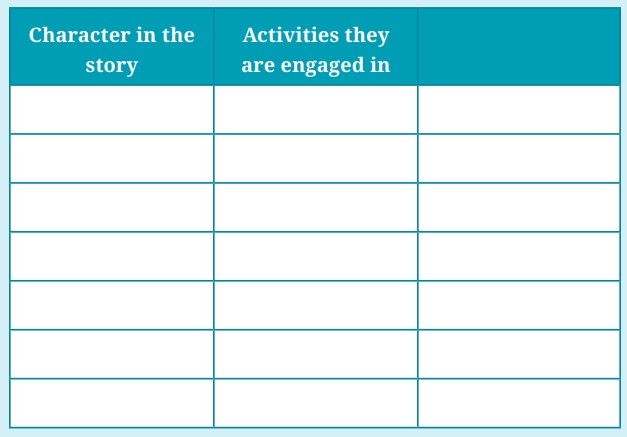
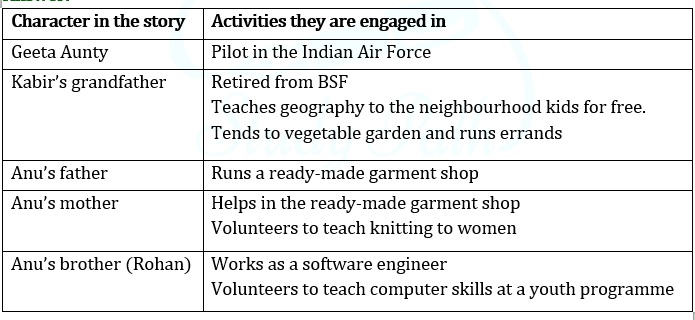
What activities did the people in Anu’s and Kabir’s story engage in? Mention them in the table given below:
Answer:
LET’S EXPLORE (Page no. 187)
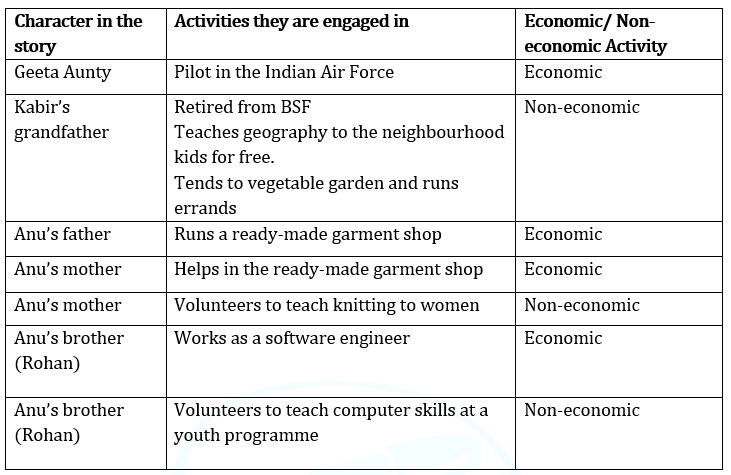
Question: In the table given on page 185, did you notice the third empty column? Label this column ‘economic / non-economic activity’. Now classify them according to the nature of activity.
Answer:
THINK ABOUT IT (Page no. 187)
Question: When Kabir’s grandfather voluntarily teaches the neighbourhood kids for free, is that an economic activity or a non-economic activity? How is it different from your teachers teaching you at school? Discuss with your classmates.
Answer: When Kabir’s grandfather teaches the neighbourhood children without taking any money, it is called a non-economic activity. He does it to help others, not to earn. It shows care and kindness. But when our school teachers teach us, they get a salary. That means it is their job, and they are paid for it. So, it is an economic activity. The difference is that one is done for free, and the other is done for payment. Both are useful, but only one earns money.
Question: What are some non-economic activities that are important to you and your family? Why are they valuable?
Answer: Some non-economic activities that are important to me and my family include:
- Cooking meals at home
- Helping each other with studies or work
- Taking care of grandparents
- Celebrating festivals together
- Cleaning the house as a family
These activities are valuable because they bring our family closer, show love and care, and create a happy and peaceful home. Even though no money is earned, they make our life better and more meaningful.
THINK ABOUT IT (Page no. 189)
Question: On your way from home to school today, can you recall the various economic activities that people are engaged in? In what ways do you think those people are paid?
Answer: On my way from home to school today, I observed people engaged in many economic activities. Some of them are listed below with the methods of payment:
Garbage collector:
Activity: He collects garbage from the neighbourhood dustbins.
Mode of Payment: He is paid a salary by the Municipal Corporation.
Vegetable vendor:
Activity: He sells fresh vegetables which he brings from the whole sale market.
Mode of Payment: He is paid in cash by customers who buy vegetables.
Barber:
Activity: He cuts hair or gives people a shave.
Mode of payment: His clients pay him in cash or by using a digital wallet.
Bus Driver:
Activity: He drives our school bus.
Mode of payment: He gets his wages from our school.
Auto Drivers:
Activity: He transports people along fixed routes in the city.
Mode of payment: His passengers pay him in cash.
Delivery boy:
Activity: He delivers goods ordered online by people.
Mode of payment: He is paid by the Company for each delivery made.
LET’S EXPLORE (Page no. 191)
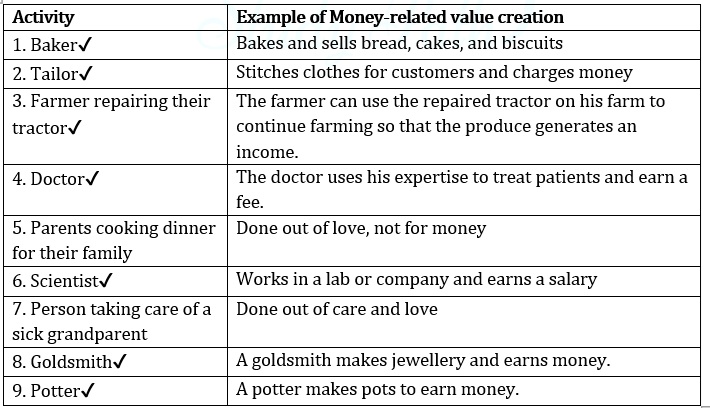
Put a ✔ against those activities/professions that you think create monetary value. Can you add two activities and examples of money related value creation to the empty row at the end?
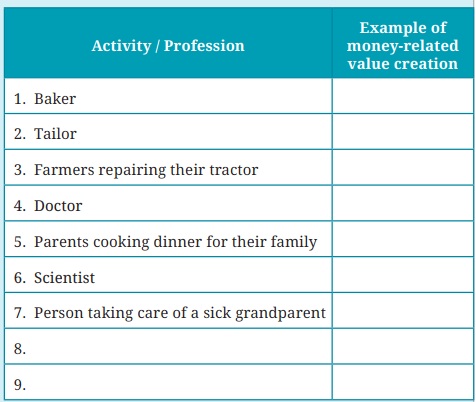
Answer:
THINK ABOUT IT (Page no. 193)
Question: Many communities in India have similar practices that involve community participation. Can you identify a few from your area?
Answer: In Delhi, several community practices involve participation and collaboration. Here are a few examples:
- Cleanliness Drives: Residents often arrange cleanliness drives in local parks and neighbourhoods, encouraging everyone to join in keeping the area tidy.
- Festival Celebrations: During festivals like Diwali, Holi, or Eid, communities come together to decorate public spaces, organize celebrations, and share meals, fostering a sense of unity.
- Tree Plantation Drives: Schools, local clubs, and residents plant trees in parks and along roads to keep the environment green.
- Food Donation Drives: Communities often organize food donation drives to support those in need, especially during festivals or in times of crisis.
- Health Camps: Local health organizations often hold free health check-up camps, inviting community members to participate and learn about health and wellness.
Question: We celebrate many festivals in India. During these festivals, people gather to organise all the various activities. They decorate the place together and share the food that they cook. Are these non-economic activities? Why do you think they still hold value?
Answer: Yes, the activities people organise during festivals in India like decorating the place together and sharing the food they cook are considered non-economic activities. Even without money involved, these activities are very important because:
- They bring people together and strengthen community bonds.
- They create a sense of joy, belonging, and togetherness.
- They help people share responsibilities and celebrate unity.
- They teach values like cooperation, respect, and teamwork.
Question: Can you identify community programmes that have been undertaken by your school or in your locality? What did you observe during these programmes?
Answer: Yes, here are a few community programmes that have been organised by my school and in my locality:
1. Cleanliness Drive (Swachh Bharat Abhiyan)
- Students and teachers cleaned classrooms, school grounds, and nearby streets.
- Observation: Everyone worked together with excitement and pride. It taught us teamwork and the importance of hygiene.
2. Tree Plantation Drive
- We planted saplings around the school and nearby areas.
- Observation: We learned about the importance of trees and felt responsible for taking care of them.
3. Free Health Check-up Camp
- Organised by a local club with the help of doctors.
- Observation: Many elderly people came for check-ups. Volunteers helped them, showing care and support.
4. Festival Celebrations (e.g., Holi, Durga Puja)
- Community members decorated streets, cooked food, and managed events.
- Observation: Everyone participated happily. There was a strong feeling of unity and joy.
Questions, activities and projects (Page no. 193)
1. How are economic activities different from non-economic activities?
Answer: Economic Activities: People do these activities to fulfil their financial needs. These are done to earn a livelihood or get something of value in return. They create jobs and help the economy grow and prosper.
For example: A shopkeeper selling goods, a doctor treating patients for a fee, or a factory worker making products, a teacher imparting education for a livelihood.
Non-Economic Activities: These activities are performed for personal satisfaction, emotional support, or social reasons, without any expectation of payment.
For example: Parents helping their children with their homework, volunteering at a charity, youngsters looking after their grandparents.
To sum up, economic activities are mainly about earning money, while non-economic activities focus on caring, sharing, and helping selflessly without expecting payment.
2. What kind of economic activities do people engage in? Illustrate with examples.
Answer: People engage in various economic activities depending on their skills, education and opportunities. For example:
- Farming: A farmer grows crops and sells them in the market, earning money from the sale.
- Business: A shopkeeper sells goods like groceries or clothes, making a profit from the sales.
- Professional Services: A doctor provides medical services and earns a fee or salary for treating patients.
- Manufacturing: Workers in a factory produce goods like cars or electronics, receiving wages for their labour.
- Teaching: Teachers provide education and receive a salary from the school or educational institution.
3. There is great value attached to people who are engaged in community service activities. Comment on this statement. (Page 161)
Answer: People who are involved in community service activities are highly valued because
- People who volunteer or help in their community improve the lives of others—like teaching poor children, cleaning public spaces, or planting trees.
- Community service brings people together. It teaches teamwork, kindness, and cooperation.
- Acts of service inspire others to do good, creating a caring and respectful society.
- Cleanliness drives, tree plantations, and awareness campaigns help the country progress.
OR
People who are engaged in community service activities are truly valuable to society. Even though they do not work for money, their efforts make a big difference in the lives of others. They help people selflessly, whether it is by teaching children, cleaning public spaces, planting trees, or assisting during difficult times. Their work brings people together and creates a sense of unity and care in the community. Such individuals inspire others to do good and spread kindness. Although they may not receive any payment, the positive impact they have on society is priceless.
4. What are the various ways in which people are compensated for various economic activities? Give some examples. (Page 161)
Answer: People are compensated for economic activities in various ways, such as through money, goods, or services. Here are some examples:
- Salaries: People working in offices, banks, schools receive regular payments for their work.
Wages: People working on hourly or daily basis, such as construction workers or drivers, are paid wages based on the amount of work they do. - Profits: Business owners, such as shopkeepers, whole sellers, farmers make money by selling goods or products.
- Fees: Professionals like doctors, lawyers, or hairdressers charge a fee for their services.
- Commission: Sales agents earn a percentage of the sales they make.
- Rent: People who own land or buildings are paid rent by others for using their property.
NCERT Solutions for Class 6 Social Science Chapter 13 The Value of Work
We hope these NCERT Solutions for Class 6 Social Science help students understand the textbook activities, revise important concepts and prepare confidently for their examinations.
Chapter 13, The Value of Work, explains how different activities contribute to individuals, families and society. Students learn to distinguish between economic activities, which involve the production or exchange of goods and services, and non-economic activities, which are performed without the expectation of monetary payment. The chapter also highlights the importance of dignity of labour, cooperation and respect for all kinds of work. It helps students understand that both paid and unpaid activities have value in our lives.