

NCERT Solutions for Class 6 Social Science Chapter 12 Grassroots Democracy – Part 3: Local Government in Urban Areas help you understand how towns and cities are governed and how local bodies manage public services. This chapter introduces urban local government institutions, such as Municipal Corporations, Municipal Councils and Nagar Panchayats. Here, we provide answers to the textbook questions and activities from Exploring Society: India and Beyond in simple, student-friendly language.
Class 6 SST Exploring Society Chapter 12 Grassroots Democracy – Part 3: Local Government in Urban Areas NCERT Solutions
The Big Questions (Page no. 174)
1. What are urban local bodies and what are their functions?
Answer: Urban Local Bodies are local government structures responsible for managing the governance and administration of cities and towns. They are decentralized because the power to make decisions is shared with the local people instead of being controlled by a central authority at the top.
Urban local bodies can be classified as shown below based on the size and population of the cities:
(i) Municipal Corporation for cities with population above 10 lakhs
(ii) Municipal Council for urban centres with population between 1 and 10 lakhs
(iii) Nagar Panchayat for cities and towns with smaller populations.
The functions of Urban Local Bodies are as follows:
- Provide basic services like garbage collection, street lighting, and drainage.
- Maintain infrastructure such as roads, parks, burial grounds, and community halls.
- Collect local taxes and fines (like property tax and water charges).
- Implement government schemes at the local level.
- Ensure public safety by reporting issues like water leakage, broken roads, or low-hanging electric wires.
- Promote social and economic development of their area.
- Raise awareness and run campaigns (e.g. for cleanliness or against single-use plastics).
2. Why are they important in governance and democracy?
Answer: Urban local bodies are important in governance and democracy because they bring the government closer to the people. Here’s why:
- They promote participatory democracy by allowing citizens to directly take part in local decisions.
- They respond quickly to local problems like water leaks, garbage disposal, or road repairs.
- They ensure better delivery of services such as sanitation, public health, and street maintenance.
- They make people more aware and responsible for their neighbourhoods.
- They create a sense of community involvement, helping citizens feel that their voice matters.
Let’s Explore (Page no. 174)
Question: Why is a city like Kolkata, Chennai or Mumbai more complex and diverse than a village or a town?
Answer: A city like Kolkata, Chennai, or Mumbai is more complex and diverse than a village or a town because:
- These cities have millions of people, while villages have only a few thousand.
- People from diverse backgrounds, cultures, languages, and professions live together in cities.
- Cities offer many types of work in offices, factories, shops, and services unlike villages which mainly depend on farming.
- Life in cities is busier and more fast-paced compared to the calm and slower life in villages.
- Cities need more roads, transport, electricity, water supply, and waste management systems.
These factors make cities harder to manage, so urban governance has to be more organised and efficient.
LET’S EXPLORE (Page no. 175)
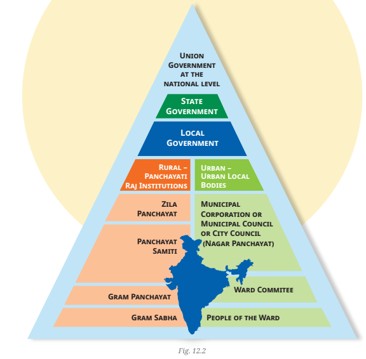
Question: In Fig. 12.2 above, what similarities and differences do you notice between the Panchayati Raj system and the urban local government?
Answer: Similarities between Panchayati Raj System and Urban Local Government:
- Both the Panchayati Raj System and Urban Local Government systems address governance at the local level.
- Both systems have representatives elected by the people living in those areas.
- Power is decentralized in both systems means local representatives make decisions instead of a central authority.
- Both help provide services like roads, water, and sanitation to people in their areas.
Differences between Panchayati Raj System and Urban Local Government:
| Panchayati Raj (Rural) | Urban Local Government |
| Works in villages and rural areas | Works in towns and cities |
| It includes Gram Sabha, Gram Panchayat, Panchayat Samiti, Zila Parishad | It includes Ward Committee, Nagar Panchayat, Municipal Council, Municipal Corporation |
| Focus on agriculture, rural roads, water for farming, etc. | Focus on waste disposal, street lights, traffic, city water supply, etc. |
| It looks after a smaller population. | It looks after a larger and denser population. |
LET’S EXPLORE (Page no. 177)
Question: Can you think of four or five more actions that responsible citizens might take to help their area of the city?
Answer: Five actions that responsible citizens can take to help their area of the city:
- Follow waste segregation rules and encourage neighbours to do the same.
- Report issues like broken streetlights, open manholes, or leaking water pipes to local authorities.
- Participate in ward meetings or local clean-up drives.
- Avoid littering in public spaces and promote cleanliness.
- Help spread awareness about government schemes and civic responsibilities in the community.
Think About It (Page no. 179)
Indore in Madhya Pradesh has been awarded the cleanest city in India under the Swachh Survekshan government scheme for seven years in a row. What could have been the role of Indore citizens in this achievement?
Answer: The citizens of Indore played a major role in making their city the cleanest in India. Here’s how they likely contributed:
- Followed waste segregation rules by separating dry and wet waste at home.
- Cooperated with municipal workers during garbage collection and cleanliness drives.
- Avoided littering and used dustbins responsibly in public places.
- Reported cleanliness issues like overflowing bins or illegal dumping.
- Participated in awareness campaigns and encouraged others to maintain hygiene and cleanliness.
Their active involvement showed strong community responsibility and made the Swachh Survekshan success possible.
LET’S EXPLORE (Page no. 179)
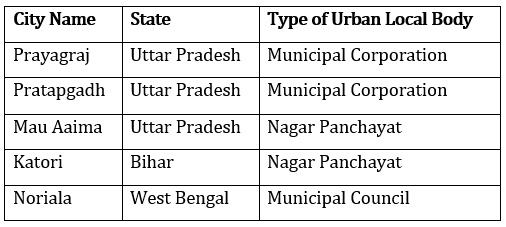
Question: Select a few cities, from your State and from a few neighbouring States. These may include the city you live in or the city nearest to your town or village. How will you find out if they have a Nagar Panchayat, Municipal Council or Municipal Corporation? Draw a table with the names of the cities and the type of urban local body each of them has.
Answer: To find out if a city has a Nagar Panchayat, Municipal Council, or Municipal Corporation, we can:
- Check Government Websites
- Visit the City’s Municipal Office
- Look at Local Government Reports
- Use Online Maps or Databases
Here’s an example table
Question: How do urban local bodies fund their activities? (Hint: Look carefully at the pictures of the functions performed by Indore Municipal Corporation in Figure 12.4 on page 178.) Are some of them paid services?
Answer: Urban local bodies get their funds from several sources, including:
- Local Taxes and Fees: They collect taxes like property tax and water charges from residents and businesses.
- Paid Services: Some services, like maintaining public parks or markets, might have entry fees or rental fees
- Government Grants: They receive money from state and central governments for specific projects or to improve infrastructure.
- Loans and Bonds: They may also borrow money or issue bonds to fund big projects, such as building roads or improving water supply systems.
Questions, activities and projects (Page no 181)
1. On your way to school, you and your friends notice that a water pipe is leaking. A lot of water is being wasted on account of the leak. What would you and your friends do in such a situation?
Answer: If my friends and I noticed a leaking water pipe on the way to school, we would:
- Inform an adult like a teacher, parent, or neighbour about the problem.
- Report the leak to the local urban body or the nearest ward office.
- Use a helpline or app (if available) to register a complaint with the water supply department.
- Spread awareness among others not to waste water and to report such issues quickly.
- Follow up to see if the problem was fixed, showing that we care for our area.
By taking these steps, we would help prevent water wastage and support our local government’s efforts.
2. Invite a member of an urban local body near you to your class. Discuss with them their role and responsibilities. Prepare a set of questions to ask them so that the meeting is fruitful.
Answer: Here’s a list of questions that we can ask him when he visits our class to help make the discussion meaningful and informative:
Questions for a Member of Ward Committee:
- What is your role in the urban local body? What are your main responsibilities?
- How are issues like garbage collection, street cleaning, and drainage handled in our city?
- What steps do you take to ensure public safety (e.g., fixing streetlights, handling open manholes)?
- How do you handle complaints or suggestions from local residents?
- What are the biggest challenges you face in managing urban services?
- How can students and young citizens like us help in improving our locality?
- Can you explain how local taxes and funds are used to maintain services?
- Are there any programmes or schemes we should know about that benefit our neighbourhood?
3. Discuss with adult members of your family and neighbourhood, and make a list of their expectations from the urban local bodies.
Answer: After discussing with adult members of my family and a few neighbours about their expectations from the urban local bodies, I have prepared a list of their common expectations from urban local bodies:
- Regular garbage collection and clean streets.
- Proper water supply and quick repair of leakages.
- Clean and safe public spaces like parks and community halls.
- Well-maintained roads without potholes.
- Proper drainage system to avoid waterlogging during rains.
- Functioning streetlights for safety at night.
- Quick response to complaints and transparent communication.
- Affordable and timely public services like water tankers, mobile toilets, etc.
- Control of stray animals and pests.
10. Effective handling of emergencies like floods or building collapses.
4. Make a list of characteristics of a good urban local body.
Answer: A good urban local body should have the following characteristics:
- Transparency and accountability in operations.
- Efficient and prompt service delivery.
- Active citizen participation and engagement.
- Responsiveness to local needs and issues.
- Equitable distribution of resources and services.
- Effective planning and implementation of development projects.
- Strong leadership and management.
These qualities help create a smoothly functioning, citizen-friendly urban local body.
5. What are the similarities and differences between the Panchayati Raj system in rural areas and the urban local bodies?
Answer: Similarities between Panchayati Raj System and Urban Local Government:
- Both the Panchayati Raj System and Urban Local Government systems address governance at the local level.
- Both systems have representatives elected by the people living in those areas.
- Power is decentralized in both systems means local representatives make decisions instead of a central authority.
- Both help provide services like roads, water, and sanitation to people in their areas.
Differences between Panchayati Raj System and Urban Local Government:
| Panchayati Raj (Rural) | Urban Local Government |
| Works in villages and rural areas | Works in towns and cities |
| It includes Gram Sabha, Gram Panchayat, Panchayat Samiti, Zila Parishad | It includes Ward Committee, Nagar Panchayat, Municipal Council, Municipal Corporation |
| Focus on agriculture, rural roads, water for farming, etc. | Focus on waste disposal, street lights, traffic, city water supply, etc. |
| It looks after a smaller population. | It looks after a larger and denser population. |
NCERT Solutions for Class 6 Social Science Chapter 12 Grassroots Democracy – Part 3: Local Government in Urban Areas
We hope these NCERT Solutions for Class 6 Social Science help students understand the textbook activities, revise important concepts and prepare confidently for their examinations.
Chapter 12, Grassroots Democracy – Part 3: Local Government in Urban Areas, explains how local self-government works in towns and cities. Students learn about different urban local bodies and their responsibilities in managing public services and addressing community needs. The chapter explores the roles of elected representatives, councillors and municipal authorities. It also highlights how citizens can participate in local decision-making and help improve the quality of life in urban areas.