

NCERT Solutions for Class 6 Social Science Chapter 10 Grassroots Democracy – Part 1: Governance help you understand how democracy works at the local level and how people participate in the decision-making process. This chapter explains how people can raise their concerns, take part in discussions and contribute to the development of their communities. Here, we provide answers to the textbook questions and activities from Exploring Society: India and Beyond in simple, student-friendly language.
Class 6 SST Exploring Society Chapter 10 Grassroots Democracy – Part 1: Governance NCERT Solutions
The Big Questions (Page no 149)
1. What is the meaning of ‘governance’?
Answer: Governance means the process of taking decisions, making rules, organizing the life of society, and ensuring that these rules are followed. It helps to maintain order and harmony in the community.
2. Why do we need a government?
Answer: We need a government because when many people live together in a society, there can be disagreements, confusion, and disorder. To maintain peace and harmony, rules and laws are needed.
The government is the group or system that:
- Makes rules for how people should behave and interact.
- Ensures those rules are followed.
- It offers essential services like healthcare, education, transportation etc.
- It builds and maintains roads, bridges, airports, and other facilities.
- The government provides food, medical services, and education at affordable prices.
- The government protects the country from enemy attacks.
- Through courts and legal systems, the government ensures that justice is delivered.
Without a government, people might not follow rules, and society would not be able to function properly.
3. What is the meaning of ‘democracy’? Why is it important?
Answer: Democracy means “rule of the people.” The word comes from the Greek words dēmos, meaning people, and kratos, meaning rule or power. In a democracy, people choose their representatives by voting. These elected representatives speak, make laws, and take decisions on behalf of the people.
Democracy is important because it gives people the right to choose their leaders and have a say in how they are governed. It helps make sure that the government is fair and works for the good of everyone.
LET’S EXPLORE (Page no 150)
Question: Describe the two pictures given in Fig. 10.1 on page 151 —what differences do you see between them?
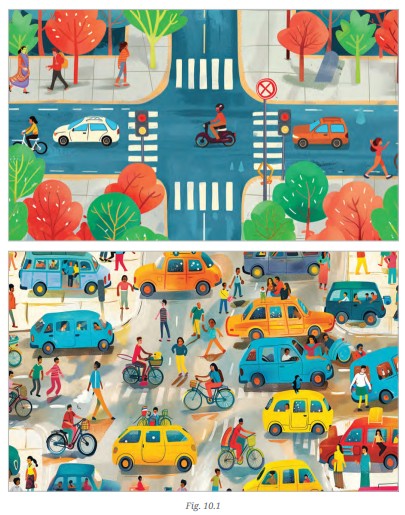
Answer: The first picture depicts an orderly and organised city road scene, while the second picture depicts a chaotic and disorderly road scene.
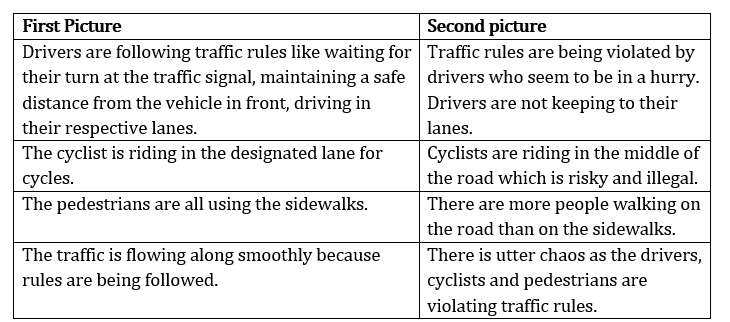
Question: How do you connect this with our discussion on rules?
Answer: These pictures prove that rules are essential to maintain discipline. When rules are strictly followed as in the first picture, everything is smooth and systematic. The reverse is true for the second picture where rules are not followed and there is chaos as a result.
Question: What are some of the rules in your school? Who made them?
Answer: Some of the rules in my school are as follows:
- Students must wear the proper school uniform.
- Everyone should arrive at school on time.
- Silence must be maintained in the library.
- Mobile phones are not allowed during school hours.
- Homework must be completed and submitted on time.
- Students should show respect to teachers and classmates.
- Littering is not allowed; cleanliness must be maintained.
These rules are made by the school principal, teachers, and the school management.
LET’S EXPLORE (Page no 153)
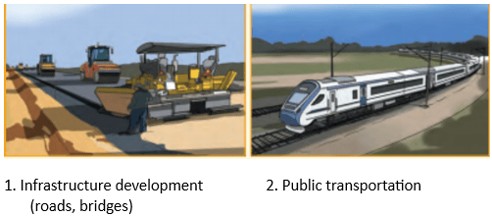
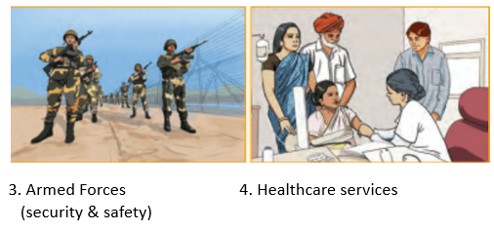
Question: Can you identify the categories of public service or other activities that are represented in the ten pictures in Fig. 10.2 on page 152?
Answer: The images show different public services or activities:
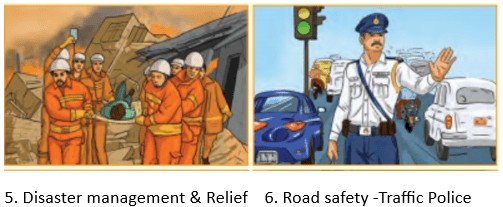
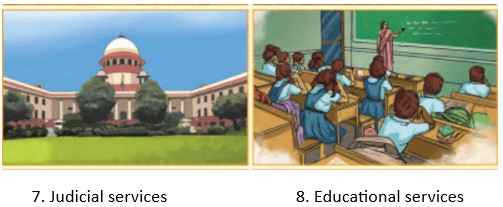
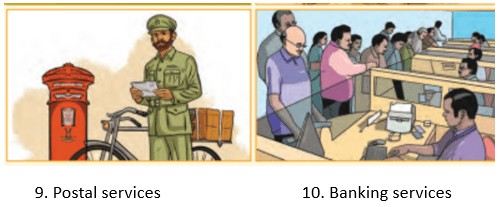
Question: What role do you think the government plays in each of these activities?
Answer: The government is responsible for providing all kinds of public services like health, education, security, and more to all citizens. It makes sure these services are delivered to everyone on time and as seamlessly as possible.
Question: Can you think of other aspects of your daily life where the government plays an important role?
Answer: There are many other aspects of our daily life where the government plays an important role to make our lives better, for example:
(i) The government ensures steady flow of electricity.
(ii) It provides regular supply of clean water.
(iii)The government appoints inspectors to check the quality and prices of food items and milk.
(iv) It provides internet access for communication and information.
(v) It maintains parks, green spaces and playgrounds.
(vi) It is responsible for lighting of roads and installing CCTVs as a preventive measure.
(vii) It ensures that garbage is collected and disposed of properly to keep our surroundings clean.
(viii) The government makes rules to reduce air pollution, water and noise pollution
(ix) The government promotes recycling and manages waste, so less garbage is dumped in the environment.
(x) The governments initiates programs to plant trees and protect forests, which helps reduce pollution and keep the air fresh.
Let’s Explore (Page no. 154)
Question: Explain how the three government organs are at work in the case of the cybercriminals described above. How do they intervene?
Answer: The three organs of government—the Legislature, the Executive, and the Judiciary work together to deal with cases like the case of the cybercriminals. Here’s how they intervene:
1. The Legislature: The Legislature makes laws that define what cybercrimes are and the punishments for committing them.
2. The Executive: The executive is responsible for implementing these laws. It includes the police, investigation agencies, and other authorities who enforce the laws.
3. The Judiciary: The judiciary examines the case in court, decides whether the accused is guilty, and gives suitable punishment according to the law.
This example shows how all three organs function together to maintain justice and order.
Questions, activities and projects (Page no. 161)
1. Test yourself —What is the meaning of democracy? What is the difference between direct democracy and representative democracy?
Answer: Democracy means that the people of a country have the power to choose their rulers. The word ‘democracy’ comes from two Greek words: ‘dēmos’ meaning ‘people’ and ‘kratos’ meaning ‘rule’ or ‘power’. So, democracy means ‘rule of the people’. In a democracy, people choose their leaders by voting. These elected leaders speak for the people and work to solve their problems by making laws.
Direct Democracy: In a direct democracy, all citizens participate directly in making decisions and laws. This means that every single citizen votes on each important issue.
Representative Democracy: In a representative democracy, citizens elect leaders or representatives who make decisions and frame laws on their behalf. In India, people vote for representatives like MLAs and MPs who make laws and decisions in the assemblies.
2. Recall the three organs of government. What are their different roles?
Answer: The three organs of the government are the legislature, the executive, and the judiciary.
- Legislature: The legislature makes new laws, updates old ones, and discusses matters important to the country. In India, it includes elected representatives like MPs and MLAs.
- Executive: The executive is responsible for implementing the laws made by the legislature. It includes the President or Governor (as nominal heads), the Prime Minister or Chief Minister, ministers, and government officers.
- Judiciary: The judiciary is the system of courts that interprets the law, ensures justice, and decides whether someone has broken the law. It can also check whether the actions of the legislature and executive are fair and lawful.
3. Why do we need three tiers of government?
Answer: We need three tiers of government because different issues arise at different levels of society. One single government cannot effectively manage the needs of such a large and diverse country like India. Therefore, the government works at three levels — central, state and local.
- Central or Union Government: The central or national government manages the affairs of the whole country, like defense, foreign relations, atomic energy, currency etc.
- State Government: It takes care of issues specific to each state, such as education, public health, police services, agriculture, irrigation etc.
- Local Government: Local governments deal with matters in villages, towns, or cities, such as water supply, roads, and cleanliness.
4. Project: Many of you will remember the lockdown that took place during the COVID-19 pandemic. Make a list of all the actions that were taken at that time? Which tiers of government were involved in managing the situation?
What was the role of each of the organs of government?
Answer: Actions Taken During the COVID-19 Lockdown were
- Nationwide lockdown was imposed.
- Implementation of social distancing and mask mandates.
- Establishment of quarantine centres and hospitals.
- Distribution of food and essentials to vulnerable populations.
- Financial relief packages for affected industries and individuals.
- Online education systems were set up.
Tiers of Government Involved:
- Central Government: Imposed the nationwide lockdown, provided financial relief, and coordinated international efforts for medical supplies.
- State Government: Managed the health response within states, enforced lockdown measures, and provided state-specific relief efforts.
- Local Government: Handled the distribution of essentials, maintained law and order at the local level, and set up quarantine centres.
Role of Each Organ of Government:
- Legislature: Passed emergency laws and approved funding for healthcare, economic relief, and vaccine distribution and gave emergency powers to the executive to handle the crisis.
- Executive: Implemented the lockdown, managed public health responses, and coordinated resources across states.
- Judiciary: Ensured that the actions taken during the lockdown were within legal boundaries and addressed any legal disputes arising from the lockdown measures.
NCERT Solutions for Class 6 Social Science Chapter 10 Grassroots Democracy – Part 1: Governance
We hope these NCERT Solutions for Class 6 Social Science help students understand the textbook activities, revise important concepts and prepare confidently for their examinations.
Chapter 10, Grassroots Democracy – Part 1: Governance, introduces students to the basic ideas of democracy and governance. Students learn how decisions are made for the welfare of society and why citizens should participate in public affairs. The chapter explains the importance of democratic values, people’s involvement, accountability and institutions that help govern communities. It also highlights how active participation at the grassroots level strengthens democracy.