

NCERT Solutions for Class 6 Social Science Chapter 9 Family and Community help you understand the importance of families and communities in our daily lives. This chapter explores how people support one another, share responsibilities and work together to meet common needs. Here, we provide answers to the textbook questions and activities from Exploring Society: India and Beyond in simple, student-friendly language.
Class 6 SST Exploring Society Chapter 9 Family and Community NCERT Solutions
The Big Questions? (Page 137)
1. Why is the family unit important?
Answer: The family is the basic and most ancient unit of society. It is where people first learn to live together, share, and take care of one another. In a family children grow up with love and care, which helps them learn values like responsibility, respect, and empathy. Each member of the family has a role, and everyone depends on each other for support.
In addition, the family unit plays a crucial role in teaching social and moral values. It is like a ‘school’ where children learn essential values like ‘ahimsa’ (non-violence), ‘dana’ (giving), ‘seva’ (service), and ‘tyaga’ (sacrifice). These values help in building a good society by teaching people to be caring, responsible and thoughtful.
2. What is a community and what is its role?
Answer: A community is a group of people who live in the same area or share common interests, traditions, values or goals.
Role of a Community:
- Community members help each other in times of need.
- People work together to solve common problems and achieve shared goals.
- A community gives people a feeling of unity, friendship and security.
- Communities help preserve traditions, customs and cultural values.
- Communities encourage people to care for others and contribute to society.
Let’s Explore (Page no 138)
Question: What types of families do you see in your neighbourhood? List the type with the number of households for each type.
Answer: Types of Families in My Neighbourhood
| Family Type | Number of Households |
| Joint Family | 5 |
| Nuclear Family | 12 |
| Single-Parent Family | 2 |
Question: What types are more frequent? Why do you think this is so?
Answer: In my neighbourhood, most households are nuclear families, where only parents and children live together. It is because many people move to cities for jobs or education and prefer to live in separate homes. Life in cities is often fast-paced, and space is limited, so it becomes easier for small families to manage. Also, modern lifestyles and personal choices lead many couples to live independently.
Let’s Explore (Page no 139)
Question: Make a list of all the members of your family you can think of, including a few distant relatives. List their terms in your mother tongue or regional language and try to find the equivalent in English. Two examples are below for Hindi:
Answer:
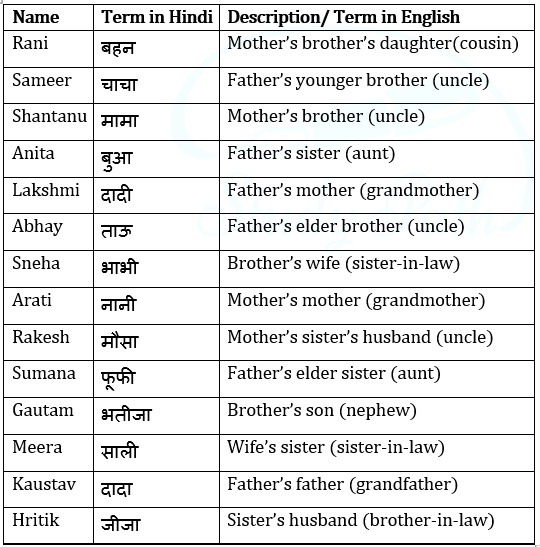
The above table shows that there are many subtle differences in relationships in Hindi which require multiple words to translate accurately in English. For example, “चाचा” , “ताऊ” , “मामा”, “मौसा” are all grouped under the word ‘uncle’ in English, but in Hindi they spell out different relationships like ‘father’s younger brother’, ‘father’s elder brother’, ‘mother’s brother’ and ‘mother’s sister’s husband’ respectively.
LET’S EXPLORE (Page no 141)
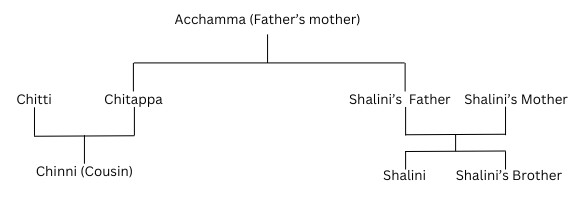
Draw a simple tree of this family of seven members.
Answer:
Question: Why do you think Shalini’s parents bought clothes for everyone?
Answer: Shalini’s parents bought clothes for everyone because they wanted to support their family members who were going through a difficult time. Her uncle had lost his job, and they could not afford new clothes for the festival. Instead of thinking only about themselves, Shalini’s parents shared what they had so that everyone could celebrate together happily. This shows the values of kindness, care, and togetherness that are important in a family.
Question: What would you have done if you were in Shalini’s place?
Answer: If I were in Shalini’s place, I would have felt proud and happy that my family was helping others. This activity shows us the importance of family unity and the joy of giving and sharing with our loved ones.
THINK ABOUT IT (Page no. 142)
Question: Why does Tenzing’s father consult his wife for special expenses?
Answer: Tenzing’s father consults his wife for special expenses because he respects her opinion. This shows mutual respect, cooperation, and shared responsibility in managing household matters. It also reflects the value of working together as a team and planning wisely for the family’s needs.
Question: How do you feel about his participation in household chores?
Answer: Tenzing’s father’s participation in household chores feels very positive and encouraging. It shows that he supports gender equality and understands that household responsibilities should be shared. By helping with cleaning, gardening, and cooking, he sets a good example for his children and creates a cooperative and respectful family environment.
Question: What roles do the grandparents fulfil?
Answer: In Tenzing’s family, the grandparents play very important and active roles:
- Grandmother cooks food and shares stories full of wisdom and humour, helping pass on values and life lessons.
- Grandfather helps Tenzing with homework, takes him to the school bus stop, and is involved in social work in the colony.
- He helps the community by registering complaints during power failures. and collecting money to help neighbours in need.
LET’S EXPLORE (Page no 143)
Question: In the stories of Shalini and Tenzing, we see examples of joint families. What do you think are the aspects of modern living that make some couples opt for a nuclear family (i.e., living apart from older generations or other relatives)?
What could be some advantages as well as disadvantages of the two kinds of families?
Answer: In modern living, some couples choose nuclear families (living separately from extended family) due to several reasons such as:
- Job opportunities in cities or different places.
- Space and privacy in smaller urban homes.
- Desire for independence in making decisions and raising children.
- Different lifestyles or habits from older generations.
Advantages of a Joint Family:
- There are more people to help with household tasks and take care of children or the elderly.
- Expenses are shared among family members.
- Living with grandparents and other relatives helps children learn about family traditions and values.
Disadvantages of a Joint Family:
- Lack of privacy.
- Conflicts due to different opinions or habits.
- More responsibilities to adjust with many people.
Advantages of a Nuclear Family:
- More freedom and privacy.
- Quick decisions without needing approval from other family members.
- Flexible lifestyle.
Disadvantages of a Nuclear Family:
- Less support in emergencies or with childcare.
- More pressure on parents for everything.
- Possible loneliness, especially for elders or children.
Questions, activities and projects (Page no. 148)
1. What are some of the rules you follow in your family and neighbourhood? Why are they important?
Answer: Some rules which I follow in my family are
- Respect elders and listening to them.
- Help with household chores.
- Finish homework before watching TV or playing.
- Speak politely and truthfully
Some rules which I follow in my neighbourhood are
- Keep the locality clean:
- Maintain silence at night
- Do not litter in public spaces
- Help neighbours in times of need
- Participate in community events
These Rules Are Important because:
- They maintain order and peace.
- Help people live together respectfully.
- Encourage cooperation and care.
- Build a safe, clean, and happy environment for everyone.
2. Do you think some rules are unfair to a few people in the family or community? Why?
Answer: Yes, some rules might appear unfair to certain people in the family or community. Here are some examples:
In the Family:
- Unequal expectations based on gender: For example, in some families, girls may be expected to do more householdchores than boys, even when both have schoolwork. This can feel unfair and burdensome.
- Lack of freedom for children or younger members: Sometimes, parents make all decisions without asking what the children think, even about things that affect them. This can make children feel left out or unimportant.
In the Community:
- Rules that ignore the needs of some groups: For instance, in a housing society, if meetings are held during working hours, people who go to work or women with small children may not be able to attend, and their voices go unheard.
- Unfair access to resources: If some people get more water or better parking spaces just because they are influential or loud, it creates an unfair situation for others.
3. Describe several situations that you have observed where community support makes a difference. You can draw or write about these.
Answer: Here are some situations observed by me where community support makes a difference:
- Health Crisis: A neighbour fell seriously ill, prompting the community to organise meal deliveries and assistance schedules. This collective effort ensured the ill neighbour received proper care and the family had necessary support, alleviating stress during a difficult period.
- Natural Disaster: After a devastating cyclone, community members came together to provide food, temporary shelter, clothes and emotional support to affected families. Volunteers helped rebuild homes and provided medical aid.
- Educational Support: A retired teacher in our colony began giving free evening tuition to children whose parents couldn’t afford extra classes. This initiative improved the children’s academic performance and provided them with opportunities.
NCERT Solutions for Class 6 Social Science Chapter 9 Family and Community
We hope these NCERT Solutions for Class 6 Social Science help students understand the textbook activities, revise important concepts and prepare confidently for their examinations.
Chapter 9, Family and Community, explores how families and communities form the foundation of society. Students learn about different family structures, relationships, shared responsibilities and the values developed within families. The chapter also explains how communities bring people together through cooperation, mutual support, shared resources and common activities. It highlights the importance of belonging, respect and working together for the well-being of everyone.