

NCERT Solutions for Class 6 Social Science Chapter 6 The Beginnings of Indian Civilisation help you understand the early development of civilisation in the Indian subcontinent. This chapter introduces students to the Harappan Civilisation, its important cities, town planning, trade, crafts and everyday life. Here, we provide answers to the textbook questions and activities from Exploring Society: India and Beyond in simple, student-friendly language.
Class 6 SST Exploring Society Chapter 6 The Beginnings of Indian Civilisation NCERT Solutions
The Big Questions (Page 86)
1. What is a civilisation?
Answer: A civilisation is an advanced stage of human society marked by organised government, towns and cities, agriculture, trade, specialised occupations, and a system of writing. It also has a shared culture, including art, architecture, and religious beliefs.
OR
Civilisation is an advanced stage of human society marked by several key features:
- Civilisations have large, organized communities or cities where people live and work together.
- There is a system of government and administration to manage activities of a complex society.
- Civilisations have planned cities or towns with well-designed roads, efficient water management, including drainage systems.
- Civilizations trade goods with nearby and distant places.
- Civilisations often have writing systems to record important information and communicate.
- Civilizations express cultural ideas through art, architecture, literature, oral traditions, and customs.
- They use advanced tools and techniques to make life easier and more productive.
- Productive farming to provide enough food, which supports both city and rural life.
2. What was the earliest civilisation of the Indian Subcontinent?
Answer: The earliest civilisation of the Indian subcontinent was the Harappan or Sindhu-Sarasvati civilization, also known as the Indus Valley Civilization. It was one of the world’s oldest civilizations. It emerged around 2600 BCE and located in the fertile plains of the Indus River and its tributaries. The people of the Indus Valley Civilisation engaged in trade, had a system of writing, and developed various crafts and technologies. This civilisation is known for its well-planned cities, advanced drainage systems, and impressive architecture, including the cities of Harappa and Mohenjo-Daro.
3. What were its major achievements?
Answer: The Indus Valley Civilisation had several major achievements that made it one of the most advanced ancient cultures:
- Cities were well-planned featuring a grid layout, well-designed buildings, and advanced drainage systems.
- Cities like Harappa and Mohenjo-daro had streets laid out in a precise pattern and houses made of baked bricks.
- The cities had a sustainable water management system, evident in the construction of large reservoirs, wells, and underground drains.”
- Development of a variety of crafts, including bead-making and metallurgy.
- The Indus Valley people engaged in extensive trade such as beads, metals, and textiles with neighbouring regions.
- They developed advanced agricultural techniques, including irrigation systems to grow crops like wheat, barley, and cotton.
- The Harappans were brisk traders having extensive trade networks both within the region and with distant civilizations overseas.
- The civilisation developed a writing system with symbols, although it remains undeciphered.
LET’S EXPLORE (Page 89)
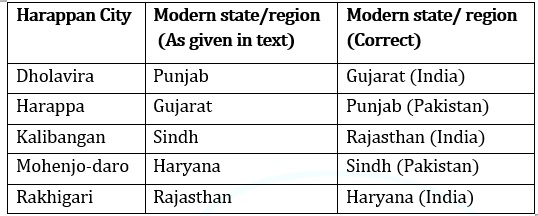
Some of the important cities of this civilisation are marked in the map (Fig. 6.3). As a class activity, can you try to match, these cities with the modern states or regions in the table given below? (Page 89)
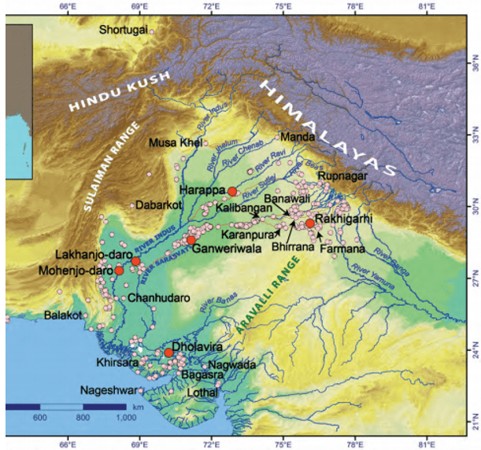
Figure: Map of some of the main settlements of the Indus-Sarasvat civilisation. Notice the natural boundaries formed by the mountain ranges (in brown colour).
| Harappan City | Modern state/ region |
| Dholavira | Punjab |
| Harappa | Gujarat |
| Kalibangan | Sindh |
| Mohenjo-daro | Haryana |
| Rakhigari | Rajasthan |
Answer:
THINK ABOUT IT (Page 91)
You may have come across the term ‘Indus Valley civilisation’ and noticed that we have not used it. A look at the map (Fig. 6.3 on page 89) explains why the term ‘Valley’ is obsolete, as we now know that the civilisation extended much beyond the Indus region.
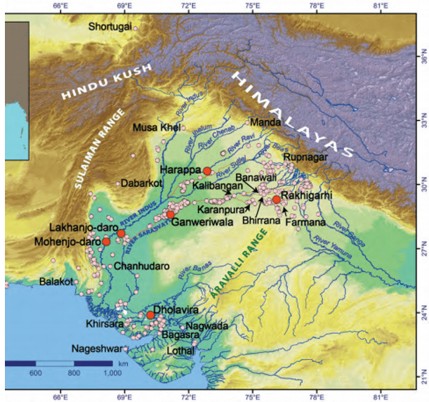
Answer: The term ‘Indus Valley Civilization’ is sometimes used to describe this ancient civilization. However, it’s not fully accurate because the civilization spread far beyond just the Indus Valley. Looking at the map (Fig. 6.3), we see that it covered a large area, including parts of today’s India and Pakistan, extending well beyond the Indus region. So, using the name ‘Indus Valley Civilization’ is obsolete, as it doesn’t reflect the full size and reach of this civilization.
LET’S EXPLORE (Page 99)
Looking at these three Harappan seals with some writing signs, what goes through your mind? Would you like to suggest any interpretations? Let your imagination run!
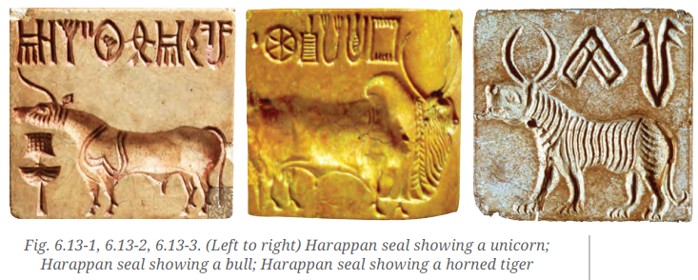
Answer: The three Harappan seals depict a unicorn, a bull and a horned tiger. Looking at the three Harappan seals, several ideas come to mind:
- Unicorn Seal: This might symbolize a clan or deity, representing purity or power in Harappan society.
- Bull Seal: The Bull might be a symbol of power, endurance, hard work and prosperity in agricultural communities.
- Horned Tiger Seal: The Tiger is a fierce predator and the addition of horns suggests a supernatural version of the creature. It could be a symbol of a protective force.
The script which is seen above the animals has not been deciphered yet. The signs may represent names or trademarks These seals were most likely used by traders to mark ownership of items or quality of items.
THINK ABOUT IT (Page 102)
Looking at the objects on pages 100 and 101 — or any other pictures in this chapter — can you make out what activities or aspects of life were important for the Harappans?
Answer: Judging by the objects depicted on pages 100 and 101, we can see that there were several activities which were important for the Harappans:
(i) The bronze mirror and terracotta pot show that the Harappans used practical tools for their daily necessities just like us.
(ii) The whistle and the games board show that both adults and children enjoyed playing games for recreation.
(iii) Stone weights show that standard weights and measures were important for regular business transactions.
(iv) The bronze chisel exhibit bears witness to their advanced skills in metallurgy and also their skilled craftsmanship which could fashion tools of daily use.
(v) The statue of the Priest King, the seated three-headed figure surrounded by animals as well as the swastika symbol suggest that Harappans pursued religious practices.
(vi) The figure in namaste pose shows that greetings were culturally significant. The bronze figurine of the dancing girl exhibits their artistic skill.
LET’S EXPLORE (page 102)
Complete the story found on the Lothal pot. How was such a story remembered for more than 4,000 years, in your opinion?
Answer: Story: The design and pattern found on the Lothal pot portrays the famous story of a thirsty crow. A thirsty crow finds a pot with a little water at the bottom. Unable to reach the water, the clever crow drops pebbles into the pot. As the water level rises, the crow was able to drink it and satisfy his thirst.
In my opinion, this story like many others was passed down through generation via oral traditions or storytelling. The visual representation on the pot was a way of circulating the story and ensuring that these stories survived even in the absence of written records.
Consider the ‘Dancing Girl’ figurine. What do you make of the attitude the figurine expresses? Observe her bangles covering an entire arm, a practice still visible in parts of Gujarat and Rajasthan. Where else in this chapter can you spot bangles worn in this manner. What conclusion should we draw from this? (Page 102)
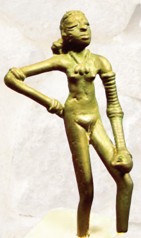
Answer: The figurine of the dancing girl shows that the Harappans were proficient in blending and casting metal. It also reflects that dance in was part of the culture.
The ‘Dancing Girl’ figurine shows confidence and grace. The girl’s posture with hand on hip and right arm resting on her hip suggests a carefree and possibly celebratory attitude.
She wears bangles covering her left arm while there are four on her right arm. This emphasizes the significance of jewelry in their society. This style of wearing bangles is still followed by women in Gujarat and Rajasthan reflecting the lasting influence of ancient Harappan culture on modern India.
We can draw the conclusion that this style of wearing bangles and the attitude of the figurines mean that fashion and cultural traditions are deep-rooted with some practices still carrying on from Harappan period.
Questions, Activities and Projects (Page 104)
1. Why does the civilisation studied in this chapter have several names? Discuss their significance.
Answer: The civilisation studied in this chapter, often referred to as the Indus Valley Civilisation, is known by several names due to various historical, geographical, and cultural reasons. These are as follows:
- Indus valley Civilisation: This name was used because the civilisation was first discovered in the valley along the river Indus and its tributaries. The findings at sites in Mohenjo-Daro and Harappa which were located in the Indus region gave it this name.
- Harappan Civilisation: The term Harappan comes from the city of Harappa, which was the first site excavated in the 1920s.
- Sindhu-Sarasvati Civilization: Sarasvati Civilisation, based on the reference to the Sarasvati River, mentioned in ancient texts and believed to have once flowed through the region.
2. Write a brief report (150 to 200 words) summing up some of the achievements of the Indus-Sarasvati civilisation.
Answer: The Indus-Sarasvati Civilization, also known as the Harappan Civilization, was one of the oldest civilisations that thrive around 2500 BCE. It had well-planned cities like Harappa, Mohenjo-daro, and Dholavira. These cities had grid pattern streets and excellent drainage systems, with reservoirs and public baths for water management.
Farming was very important to the Harappan people. They grew different crops like wheat, barley, and cotton. They were perhaps the first in Eurasia to grow cotton. They also used tools like the plough, which shows they had advanced farming methods for their time.
In Indus-Sarasvati civilisation craftsmanship and trade were highly developed. The people were good at making things like pottery, beads, toys and other artifacts. The Harappans were skilled in metallurgy, producing bronze tools and various ornaments. They traded these goods both nearby and with distant places like Mesopotamia.
They had developed a form of writing, but the script found on the seals they left behind has not been deciphered yet. Their buildings were strong, with large public structures and protective walls, showing their skill in construction and city planning.
The achievements of the Indus-Sarasvati Civilization in city planning, trade, and water management make it a very important part of early human history.
3. Imagine you have to travel from the city of Harappa to Kalibangan. What are your different options? Can you make a rough estimation of the amount of time each option might take?
Answer: Let’s assume that the distance between Harappa and Kalibangan was approximately 300 kilometers. During ancient times the means of transport were limited. People could walk or use a bullock cart if they could afford them. They could also travel most of the way by boat using the Indus River.
I could probably walk 15 kilometers a day, so it would take me 300/15 = 20 days. If had taken a bullock cart, the journey could have taken 15 days. Time required by boat will be depended on the speed of the boat also the speed of the river water.
4. Let us imagine a Harappan man or woman being transported to an average kitchen in today’s India. What are the four or five biggest surprises awaiting them?
Answer: If a Harappan were transported to a regular modern Indian kitchen, there would be several things which would surprise him/her, for example:
- Seeing electric stoves, microwaves, and refrigerators would be surprising as they didn’t have these in ancient times.
- The availability of wide range of spices and ingredients would be a big change from the local ingredients they were familiar with.
- Continuous access to clean water through taps would be a significant surprise.
- The variety of packaged and processed foods, such as snacks and ready-to-eat meals, would be new to them.
- Modern cookware like non-stick pans and stainless-steel utensils would be a pleasant surprise.
5. Looking at all the pictures in this chapter, make a list of the ornaments / gestures / objects that still feel familiar in our 21st century.
Answer: The following is a list of ornaments, gestures, and objects from the Indus-Sarasvati (Harappan) civilization that have withstood the test of time and still feel familiar to us today:
Ornaments:
- Beaded Necklaces
- Bangles
- Earrings
- Anklets
Gestures:
- Hands Raised in Greeting
- Dancing Poses
Objects:
- Pottery
- Combs
- Toys
- Seals and Stamps
- Tools
6. What mindset does the system of reservoirs at Dholavira reflect?
Answer: The system of reservoirs at Dholavira shows that the people were cleaver, innovative, and able to plan in advance. The construction of such reservoirs reflects advanced engineering skills. The people were aware of the necessity for conserving and managing water which was limited in their region. The complex water management system shows they understood how to use water wisely for farming and daily life. They paid a lot of attention to water management, which shows that they valued cleanliness, public health, and sustainable living.
7. In Mohenjo-daro, about 700 wells built with bricks have been counted. They seem to have been regularly maintained and used for several centuries. Discuss the implications.
Answer: The existence of 700 wells in Mohenjo-daro built with bricks which were regularly maintained and used for centuries has several significant implications:
- The people of Mohenjo-daro were highly skilled in construction and knew how to build strong, long-lasting wells.
- They understood the importance of having a steady water supply for daily life.
- Since the wells lasted for hundreds of years, it also suggests that the people of Mohenjo-daro had a well-organized system for taking care of these wells.
- The stress on water management suggests that the people of Mohenjo-daro prioritised public health, hygiene and access to clean water.
8. It is often said that the Harappans had a high civic sense. Discuss the significance of this statement. Do you agree with it? Compare with citizens in a large city of India today.
Answer: Yes, Harappans had a high civic sense. I agree with the statement for the following reasons:
- Harappan cities were well planned, with streets, houses, markets, and public buildings arranged in a neat grid pattern.
- They had advanced systems for managing water. These helped keep their cities clean and prevented flooding.
- The Harappans had well-maintained sewage systems and took care of waste disposal.
- The people worked together in a disciplined way to ensure their cities ran smoothly and stayed well-organized.
Comparison to Modern Cities:
In today’s world, some people follow rules and keep their surroundings clean, but others do not. They often litter or ignore civic responsibilities. The Harappans however seemed to work together as a community to maintain cleanliness, order and public welfare. This shows that the Harappans had a strong sense of civic responsibility and were in harmony with their environment.
NCERT Solutions for Class 6 Social Science Chapter 6 The Beginnings of Indian Civilisation
We hope these NCERT Solutions for Class 6 Social Science help students understand the textbook activities, revise important concepts and prepare confidently for their examinations.
Chapter 6, The Beginnings of Indian Civilisation, explores one of the earliest urban civilisations of the world. Students learn about the rise of the Harappan Civilisation, its major settlements, well-planned cities, drainage systems, buildings and methods of trade. The chapter also introduces the people’s occupations, crafts, agricultural practices and the reasons behind the growth and eventual decline of some Harappan settlements.