

NCERT Solutions for Class 6 Social Science Chapter 8 Unity in Diversity: The Many in the One help you understand how people from different backgrounds, languages, religions and cultures live together in India. This chapter explores the different forms of diversity found in our country and explains how shared traditions, values and experiences create a sense of unity among people. Here, we provide answers to the textbook questions and activities from Exploring Society: India and Beyond in simple, student-friendly language.
Class 6 SST Exploring Society Chapter 8 Unity in Diversity: The Many in the One NCERT Solutions
The Big Questions (Page 126)
1. What is meant by ‘unity in diversity’ in the Indian scenario?
Answer: ‘Unity in diversity’ in India means that people live together with a sense of unity despite differences in their languages, religions, cultures, traditions, food habits and clothing. India is a country of great diversity, but its people are united by shared values, history, festivals and a common national identity. People respect one another’s traditions and live together peacefully.
2. What aspects of India’s diversity are the most striking?
Answer: Some of the most striking aspects of India’s rich diversity include:
- Languages: India is home to 325 languages with 25 scripts and hundreds of dialects. There are 22 official languages and most states have their own language.
- Religions: Major religions like Hinduism, Islam, Christianity, Sikhism, Buddhism, and Jainism coexist in the country.
- Food: Indian food is different in each region. In the North, people eat more wheat-based foods like chapati, while in the South, rice and coconut are common in meals, Rice and fish are popular in Bengal, Assam and Odisha.
- Geography: India has various types of land forms – from the tall Himalayan mountains in the North to the beaches in the South.
- Art and Architecture: India is known for the variety of classical dance forms, music, and beautiful architecture. From ancient temples, forts and palaces to modern buildings, each place has its own unique style.
- Textiles and Clothing: People in different parts of India wear different types of clothes. In some areas, women wear sarees, while in other places, they may wear salwar kameez or lehengas.
- Traditions: Each community has its own customs, like different types of wedding ceremonies and festivals. For example, Durga Puja is celebrated in Bengal, while Onam is important in Kerala, Rath Yatra in Odisha.
3. How do we make out the unity underlying the diversity?
Answer: We can see the unity behind India’s diversity through the shared cultural values, beliefs and traditions that connect people across the country. Even though people speak different languages, wear different clothes and follow different customs, there are many similarities that bind them. For example, the same festivals like Makara Sankranti are celebrated across India under different names. Foods may vary in preparation, but they often use the same grains and spices. The epics like the Ramayana and Mahabharata are known and respected in many languages and regions. This shows that beneath the visible differences, there is a deep sense of togetherness and belonging.
LET’S EXPLORE (Page 129)
Question: Explain how the example of the sari reflects both unity and diversity (in 100-150 words).
Answer: The sari is a symbol of Indian culture and tradition, and a perfect example of unity in diversity. It is a plain length of cloth made from different fabrics, mostly cotton and silk. Across India, there is a rich variety of saris—such as Banarasi from Uttar Pradesh, Kanjivaram from Tamil Nadu, Paithani from Maharashtra, and Chanderi from Madhya Pradesh each reflecting the unique heritage and craftsmanship of its region.
Sari is worn in most parts of India. Even though the sari is just a single piece of cloth, it is worn in many different ways in various regions, like the Nivi style in Andhra Pradesh or the Bengali style in West Bengal. Though the basic form of sari remains same in every region yet it represents diversity in fabrics, colours, patterns, and wearing style. This shows how unity and diversity go hand in hand in India.
LET’S EXPLORE (Page 130)
(i) What is your favourite festival and how is it celebrated in your region? Do you know whether it is celebrated in any other part of India, maybe under a different name?
Answer: My favourite festival is Diwali. It is celebrated with a lot of joy and excitement in my region. People decorate their homes with lights and colourful rangoli. They pray to Goddess Lakshmi and burst fireworks. Families come together, share sweets, and give gifts to each other.
Diwali is called the Festival of Lights and is celebrated all over India. But in some places, it has different names and customs. For example, in West Bengal, it is called Kali Puja, and people worship Goddess Kali.
(ii) During October–November, many major festivals take place in India. Make a list of the few main ones and their various names in different parts of the country.
Answer: Major Indian Festivals in October–November and the various names they are known by in different parts of the country are given below:
- Diwali: Called Deepavali in South India and Kali Puja in West Bengal.
- Navratri/Dussehra: Known as Durga Puja in West Bengal and Odisha, and Vijayadashami in Karnataka and Maharashtra.
- Eid-ul-Fitr: Muslims across India celebrate with feasts and prayers.
- Bhai Dooj: Called Bhai Phonta in West Bengal and Bhau Beej in Maharashtra.
These festivals show the diversity and unity in India’s cultural traditions.
LET’S EXPLORE (Page 134)
In a class discussion, try to identify the episode depicted in the painting shown in and important details associated with it.
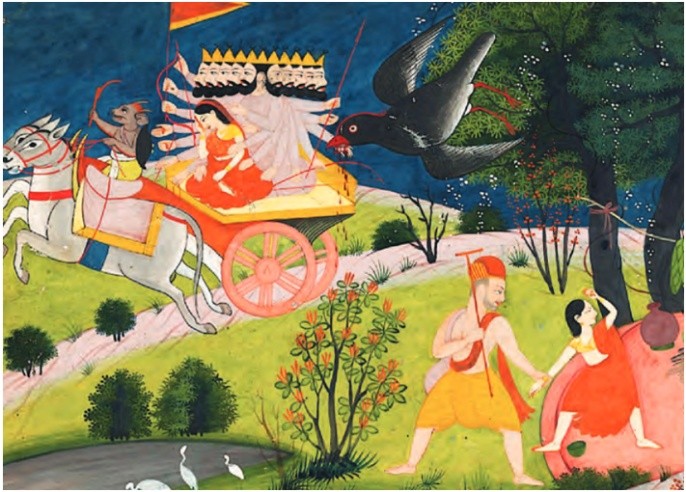
Answer: The painting shows a scene from the Ramayana the moment when Sita is taken away by Ravana. This happens when Sita steps out of the protective line, called the Lakshman Rekha, which was drawn by Lakshman to keep her safe.
Important Details Associated with This Episode:
- Lakshman Rekha: Lakshman drew a magical line around the cottage to protect Sita before he went in search of Rama who was chasing the golden deer in the forest. This line had powers to protect Sita and stop evil from crossing it.
- Ravana’s Trick: Ravana came in the form of a sage (sadhu) and asked Sita for food. Wanting to help Sita stepped out of the line and Ravana abducted her.
- The Consequence: This moment is very important in the Ramayana. Sita abduction leads to the war between Rama and Ravana and shows the fight between good (Rama) and evil (Ravana).
- Sita’s Role: Sita wanted to do her duty by helping a sage which shows her kindness and respect for others even when she was unsure.
This part of the story teaches us that looks can be misleading, and it is important to stay careful and follow what is right, even in hard times.
Questions, activities and projects (Page 136)
1. Conduct a class discussion on the two quotations at the start of the chapter.
Answer: Quotation 1: “Oh, grant me my prayer, that I may never lose the bliss of the touch of the one in the play of the many.” – Rabindra Nath Tagore
Quotation 2: “The principle of unity in diversity which has always been normal to [India] and its fulfilment the fundamental course of her being and its very nature, the Many in the One, would place her on the sure foundation of her Swabhava and Swadharma.” – Sri Aurobindo
In the first quote, Tagore prays that he never loses the joy (bliss) of feeling close to God, even when he experiences many different things in life. This shows that he believes everything is connected through God, even if the world seems full of differences.
In the second quotation, Sri Aurobindo says that India has always been a land where many diverse people have lived together in peacefully. Even though there are many religions, languages, and traditions, we are still united as one. This unity in diversity is the strength and true nature of our country.
Both Tagore and Aurobindo talk about staying connected and united, even when there are many differences around us.
2. Read the National Anthem and its translation in the preliminary pages of this textbook. Where do you see the diversity? And where the unity? Write two or three paragraphs on this.
Answer: The National Anthem of India shows the idea of ‘unity in diversity’ very beautifully. Words like “Punjab, Sindh, Gujarat, Maratha, Dravida, Utkala, Banga” show India’s cultural and regional diversity. These names represent different parts of India, each with its own language, customs, and way of life.
The lines “Vindhya Himachala, Yamuna, Ganga, Ucchala Jaladhi Taranga” talk about India’s mountains, rivers, and seas. This shows the geographical diversity from the high Himalayas to the flowing rivers and the coastal waves. All of these things affect how people live in different parts of India.
The words “Bharata Bhagya Vidhata” (the one who decides India’s destiny) show unity. They mean that all people of India, no matter where they come from, share the same future and hopes.
The phrase “jan-gana-mangal” means the welfare of all people, reminding us that we should work together for the good of everyone. And the repeated words “Jaya he” (Victory to you) show the pride and joy of all Indians standing together as one nation.
So, we can see how beautifully the National Anthem “jana gana mana” represents the spirit of ’unity in diversity’.
3. Select a few stories from the Pañchatantra and discuss how their message is still valid today. Do you know of any similar stories from your region?
Answer: Some stories from the Panchatantra which carry timeless messages are discussed below:
The Monkey and the Crocodile
In this story, a crocodile tries to trick his monkey friend and eat his heart. But the monkey stays calm and uses his intelligence to escape.
- Lesson: Stay calm in difficult times and use your brain to solve problems.
- Why it’s still valid: In today’s world too, smart thinking and staying calm under pressure help us handle tricky situations.
The Lion and the Clever Rabbit
A cruel lion kills many animals. The animals decide to send one animal each day to him. A clever rabbit goes one day and tricks the lion into jumping into a well.
- Lesson: Intelligence can defeat strength.
- Why it’s still valid: It teaches us that even small or weak people can succeed if they are clever and wise an idea that still inspires us today.
The Tortoise and the Geese
A tortoise wants to fly with two geese, holding a stick with his mouth. But he talks in mid-air, falls, and dies.
- Lesson: Don’t speak without thinking. Self-control is important.
- Why it’s still valid: Today, in school, work, or on social media, we must be careful with our words and actions.
A Similar Story from My Region:
In Bengal, we have the folk tale of Gopal Bhar, a witty court jester known for solving problems with humour and intelligence. In one story, he tricks a dishonest merchant by pretending to be even greedier, showing how wit can expose lies.
- Lesson: Intelligence and humour can be powerful tools to bring out the truth.
4. Collect a few folk tales from your region and discuss their message.
Answer: Here are a few folk tales from West Bengal, along with their messages:
Gopal Bhar and the Greedy Merchant
Gopal Bhar, a clever court jester in the king’s court, once dealt with a dishonest merchant who was cheating poor people. Gopal pretended to be even greedier and exposed the merchant’s lies in front of everyone.
- Message: Cleverness and honesty can defeat greed and dishonesty.
The Clever Jackal
In this tale, a jackal saves himself from a tiger by pretending to be the protector of the jungle. The tiger, thinking the jackal is powerful, runs away.
- Message: Intelligence is more powerful than strength.
The Brahmin and the Thief
A kind Brahmin tries to carry a goat as a gift. A few tricksters make him believe the goat is a dog, so he leaves it behind.
- Message: One should not blindly believe what others say. Use your own judgment.
The Wise Old Woman
A poor old woman cleverly solves a village problem that even the leaders couldn’t fix.
- Message: Wisdom does not depend on age, wealth, or position—anyone can be wise.
5. Is there any ancient story that you have seen being depicted through a form of art? It could be a sculpture, a painting, a dance performance, a movie … Discuss with your classmates.
Answer: One of the most popular ancient stories is the Mahabharata. It has been portrayed in various forms of art, including sculptures, paintings, dance performances, and even movies. The Mahabharata has also been adapted into films and TV shows.
6. Discuss in class the following quotation by India’s first prime minister, Jawaharlal Nehru, when he travelled to many parts of India before Independence:
“Everywhere I found a cultural background which had exerted a powerful influence on their lives. … The old epics of India, the Ramayana and the Mahabharata and other books, in popular translations and paraphrases, were widely known among the masses, and every incident and story and moral in them was engraved on the popular mind and gave a richness and content to it. Illiterate villagers would know hundreds of verses by heart and their conversation would be full of references to them or to some story with a moral, enshrined in some old classic.”
Answer: Jawaharlal Nehru’s quote shows how India’s cultural and literary heritage shaped the minds of people even before Independence. Stories from the Ramayana and Mahabharata were a part of daily life especially in villages. Even without books many people remembered the stories through oral tradition. These epics taught lessons about duty, truth and right living. They helped shape values and still influence Indian life today. These stories also bring unity in a country with so much diversity.
NCERT Solutions for Class 6 Social Science Chapter 8 Unity in Diversity: The Many in the One
We hope these NCERT Solutions for Class 6 Social Science help students understand the textbook activities, revise important concepts and prepare confidently for their examinations.
Chapter 8, Unity in Diversity: The Many in the One, explores India’s rich cultural diversity and the factors that bring people together. Students learn about the different languages, religions, food habits, clothing styles, festivals, art forms and traditions found across the country. The chapter explains how people can have different customs and ways of life while sharing common values, experiences and a sense of belonging to one nation.