

NCERT Solutions for Class 6 Social Science Chapter 7 India’s Cultural Roots help you explore the rich cultural and spiritual traditions that have developed in India over thousands of years. This chapter covers important traditions such as the Vedic traditions, the teachings of Buddhism and Jainism, and the contributions of other thinkers. Here, we provide answers to the textbook questions and activities from Exploring Society: India and Beyond in simple, student-friendly language.
Class 6 SST Exploring Society Chapter 7 India’s Cultural Roots NCERT Solutions
The Big Questions (Page 105)
1. What are the Vedas? What is their message?
Answer: The Vedas are ancient Indian texts that form the foundation of Hinduism. They are written in Sanskrit and are considered to be among the most ancient texts in the world. The word ‘Veda’ comes from the Sanskrit word ‘vid’ which means ‘knowledge’. There are four Vedas – Rig Veda, Yajur Veda, Sama Veda and Atharva Veda. They consist of thousands of hymns (prayers in the forms of song and poem).
The main message of the Vedas is to seek knowledge, truth, and to live a good and honest life called Dharma. They teach that people should live in harmony with nature and try to understand their place in the universe.
2. What new schools of thought emerged in India in the 1st millennium BCE? What are their core principles?
Answer: During the early part of the 1st millennium, various new schools of thought emerged from the teachings of the Vedas.
- Yoga: It introduced ways to help people become more aware of themselves and their thoughts.
- Vedanta: It taught that everything – people, nature, and the whole universe is part of one divine power called Brahman, which is the ultimate truth and reality.
- Buddhism: It was founded by Siddhartha Gautama (Buddha). His main teaching was ahimsa which means not hurting any living being. He also taught the Four Noble Truths and the Eightfold Path, which focus on ending suffering and reaching nirvana (a state of peace and freedom) through good behavior, meditation, and wisdom.
- Jainism was founded by Mahavira. It teaches non-violence (ahimsa), anekantavada (accepting different viewpoints), and aparigraha (not being attached to things).
- Charvaka School (Lokayata) rejected the idea of life after death. However, its ideas faded over time as they did not gain widespread acceptance.
3. What is the contribution of folk and tribal traditions to Indian culture?
Answer: Folk and tribal traditions have made significant contributions to Indian culture through their rich oral traditions and practices. These traditions often involve the worship of natural elements such as mountains, rivers, trees, plants, and animals, which are regarded as sacred. Tribal communities have their own deities, legends, and rituals, many of which have influenced mainstream Hinduism. For instance, deities like Jagannath and various forms of the mother-goddess have tribal origins. Tribal cultures, like Hinduism, believe in a higher deity or supreme entity. This has made tribal and folk traditions an important and valuable part of India’s cultural heritage.
LET’S EXPLORE (Page 109)
Do you know the term for a society where people select their leaders? How do you think people can benefit from such a situation? What could happen if they live under leaders that they did not choose? (Hint: Think back to what you’re learning in the theme ‘Governance and Democracy’!) Write your thoughts in a paragraph of 100–150 words.
Answer: A society where people select their leaders is called a democracy. In a democracy, people can enjoy many benefits. When leaders are chosen by the people, they are more likely to work for the benefit of everyone. Leaders who are chosen by the people are answerable to them. This means they are more likely to listen and respond to the needs of the people.
However, a government which establishes itself without the consent of the people is likely to be autocratic or a dictatorship like the British. If people live under leaders they did not choose, they may feel disconnected from the government, leading to dissatisfaction. This can cause problems and protests. On the other hand, a democracy helps make things fair and open. It protects people’s rights and makes the society safer and more peaceful.
THINK ABOUT IT (Page 110)
Have you heard or read any other story that conveyed an important message? What values did it teach you?
Answer: Yes, I have heard many stories which convey important messages. One story that comes to mind is The Tortoise and the Hare. It teaches the value of patience and perseverance. The hare was fast and confident but became careless and took a break during the race. Meanwhile, the slow but steady tortoise kept going without giving up and eventually won. This story shows that being consistent and patient is often more important than being fast or overconfident. It reminds me that hard work and not giving up can lead to success.
LET’S EXPLORE (Page 115)
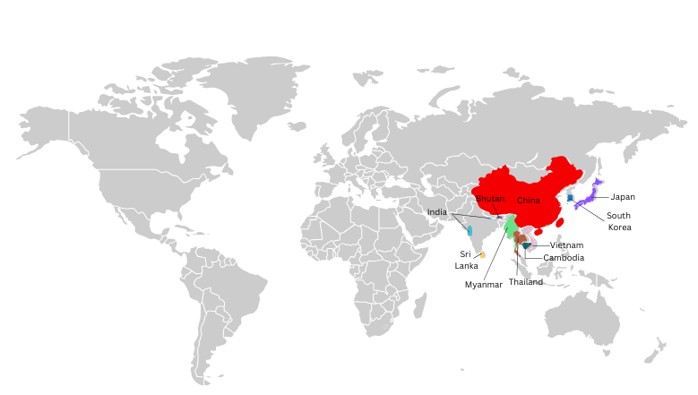
Discuss the way the Buddha is depicted in the above panel. Can you name some states of India or some other countries where Buddhism is a major religion even today? Try to plot these on a world map.
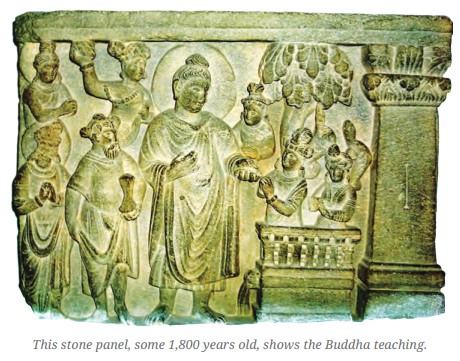
Answer: This stone panel, which is around 1800 years old, depicts Buddha standing with his followers around him. His standing pose shows that he is teaching or guiding others. One disciple is shown with folded hands, showing respect, as Buddha speaks to him. The other people around Buddha are also shown with joined hands, listening to his words with devotion. This artwork shows Buddha as a kind and wise teacher, helping his followers learn and move towards enlightenment.
States in India where Buddhism Is a major religion even today are: Sikkim, Arunachal Pradesh, Ladakh, Himachal Pradesh (Dharamshala) and Maharashtra (Nagpur region)
Countries where Buddhism is widely practised even today are Bhutan, Sri Lanka, Thailand, Myanmar, Japan, Cambodia, and China (Tibet).
LET’S EXPLORE (Page 118)
Observe the above panel (from a Jain temple in New Delhi). What is striking about it? What messages does it carry?
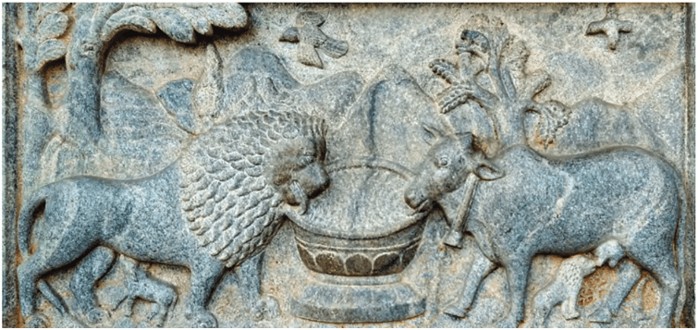
Answer: The above panel shows the image of a lion and a cow drinking from the same lotus shaped bowl placed between them. part of this scene is that the lion cub is drinking milk from the cow, while the cow’s own calf is resting close to the lion. This unusual and touching moment stands for peace, harmony, and living together even between natural enemies.
It shows the Jain belief in non-violence (ahimsa) and the idea that all living beings, no matter how different, can live together peacefully. This image highlights how Jainism teaches kindness, tolerance and the belief that with spiritual effort even the strongest conflicts in nature can be overcome.
Questions, activities and projects (Page 123)
1. If you were Nachiketa, what questions would you like to ask Yama? Write them down in 100-150 words.
Answer: If I were Nachiketa, I would ask Yama following questions
- What happens to us after we die?
- If the soul is eternal and lives on, where does it go?
- How to live a pious and peaceful life and ask?
- How can we attain moksha (freedom from the cycle of life and death),
- What should we do to ensure that we attain moksha?
- Why people suffer and what the purpose of life is, saying,
- Why do we face pain and difficulties in our daily lives?
2. Explain a few central ideas of Buddhism. Briefly comment upon them.
Answer: According to Buddhism human suffering comes from ignorance and attachment. To help end suffering one must let go of desires. Buddhism teaches non-violence and sincere inner discipline reduce human suffering.
By following the Eight-fold path which includes being kind, speaking truthfully and living with wisdom, good behaviour and mindfulness, one can overcome suffering and lead a balanced and peaceful life.
The Buddha also teaches about the concepts of ‘Karma’ and ‘Rebirth’. Karma means that that our actions, good or bad, affect our future. Rebirth means that after death, we are born again, and how we live this life affects our next one.
3. Discuss in class the quotation of the Buddha which begins with “Not by water is one made pure, though many people may bathe here [in sacred rivers]” to make sure that its meaning has been understood by all.
Answer: The Buddha’s quote means that just bathing in holy rivers or doing rituals doesn’t make a person truly pure and spiritual. Real purity comes from living truthfully and following dharma. Being kind and honest is more important than doing outside rituals.
4. Explain a few central ideas of Jainism. Briefly comment upon them.
Answer: Jainism emphasizes three main principles: ahimsa, anekantavada and aparigraha.
- Ahimsa means non-violence. Mahavira, the great Jain teacher taught that all living beings should not be harmed, hurt or mistreated.
- Anekantavada means many perspectives. It teaches that the truth has many sides and cannot be fully understood from just one point of view.
- Aparigraha means non-possession. This concept tells us to not hold onto material things and to only keep what we really need to live a simple life.
- Jainism also teaches that all living creatures, from humans to tiny organisms, are connected and depend on each other.
5. Consider and discuss in class André Béteille’s thought (see page 122).
Answer: André Béteille’s thought explains how tribal religions and Hinduism have influenced each other over the ages. He says that while many people accept that tribal religions have been shaped by Hinduism, the converse is also true. It is a fact that Hinduism also took ideas and practices from tribal traditions. This means that different religions and cultures in India have shared and exchanged ideas.
Tribal customs may have added new gods, rituals, and practices to Hinduism, while Hindu ideas may have shaped tribal beliefs too. This ongoing exchange has helped build the rich and diverse culture of India today.
6. Make a list of popular gods and goddesses in your region and the festivals they are associated with.
Answer: Here’s a list of popular gods and goddesses in Delhi and the festivals they are associated with:
- Lord Ganesha
Festival: Ganesh Chaturthi - Goddess Durga
Festival: Durga Puja, Navratri - Lord Rama
Festival: Dussehra, Diwali (celebrating his return to Ayodhya) - Lord Krishna
Festival: Janmashtami - Lord Shiva
Festival: Maha Shivaratri - Goddess Saraswati
Festival: Saraswati Puja (during Vasant Panchami)
7. As a class activity, list two or three tribal groups from your region or State. Document some of their art and belief systems.
Answer: Tribal Group: Tharu
- Art: Known for intricate wall paintings and traditional jewelry.
- Belief Systems: Practice animism, worshiping nature spirits and deities.
Tribal Group: Bhil
- Art: Famous for vibrant Pithora paintings depicting folklore and deities.
- Belief Systems: Worship ancestors and deities like Bhil Raja and Waghdeo.
Tribal Group: Gond
- Art: Renowned for Gond paintings featuring animals, trees, and deities.
- Belief Systems: Follow animistic traditions, worshiping clan gods and nature elements like trees and rivers.
True or False
1. The Vedic hymns were written on palm-leaf manuscripts.
Answer: False
Reason: The Vedic hymns were originally passed down orally from generation to generation before being written down.
2. The Vedas are India’s oldest texts.
Answer: True
3. The Vedic statement ekam sat viprā bahudhā vadanti reflects a belief in the unity of cosmic powers.
Answer: True
The statement means that “The Existent (Supreme reality) is one, but sages give it different names. It reflects a belief in the unity of cosmic powers.
4. Buddhism is older than the Vedas.
Answer: False
Reason: The Vedas were in existence much before Buddhism.
5. Jainism emerged as a branch of Buddhism.
Answer: False
Reason: Jainism and Buddhism are distinct schools of thought and emerged independently around the same time.
6. Both Buddhism and Jainism advocated for peaceful coexistence and the avoidance of harm to all living beings.
Answer: True
7. Tribal belief systems are limited to belief in spirits and minor deities.
Answer: False
Reason: Tribal belief systems believe in a multiplicity of deities, but many tribal groups have a concept of a Supreme Being or higher divinity.
NCERT Solutions for Class 6 Social Science Chapter 7 India’s Cultural Roots
We hope these NCERT Solutions for Class 6 Social Science help students understand the textbook activities, revise important concepts and prepare confidently for their examinations.
Chapter 7, India’s Cultural Roots, explores the foundations of India’s diverse cultural and philosophical traditions. Students learn about the Vedas, the ideas expressed in ancient Indian texts and the teachings of important spiritual thinkers. The chapter introduces the contributions of Buddhism and Jainism, along with other traditions that influenced Indian society. It also explains how ideas about knowledge, values, nature and ways of life have been passed down through generations.