

NCERT Solutions for Class 6 Social Science Chapter 2 Oceans and Continents help you explore the major landmasses and water bodies found on Earth. In this chapter, you will learn about the seven continents, five oceans, distribution of land and water, and the importance of oceans in supporting life. Here, we provide complete answers to all the important textbook questions and activities from Exploring Society: India and Beyond.
Class 6 SST Exploring Society Chapter 2 Oceans and Continents NCERT Solutions
The Big Questions? (Page – 27)
1. What are oceans and continents? What are their names and their distribution?
Answer: Oceans are large bodies of saltwater covering about 71% of Earth’s surface. They play a crucial role in regulating the planet’s climate, providing rain, and supporting marine life. There are five oceans on the Earth.
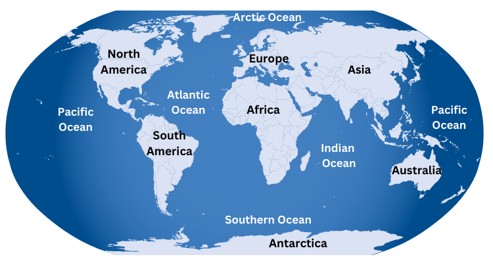
- The Pacific Ocean is the largest and deepest ocean, located between Asia, Australia, and the Americas.
- The Atlantic Ocean is the second-largest ocean, between the Americas to the west and Europe and Africa to the east.
- The Indian Ocean is the third largest ocean located between Africa, Asia, Australia, and the Indian subcontinent.:
- The Southern Ocean surrounds Antarctica and stretches up to 60° south latitude.
- The Arctic Ocean is the smallest and shallowest ocean, located around the Arctic region, north of Europe, Asia, and North America.
Continents are large landmasses that form Earth’s primary land areas and support diverse ecosystems and human civilizations. There are seven continents.
- Asia: It is the largest continent, mostly in eastern hemisphere. It occupies about 1/3 rd of the Earth’s land area. It is separated from Europe by the Ural Mountains.
- Africa: It is the second largest continent situated in the south of Europe and between Atlantic and Indian Ocean.
- North America: North America is bound by three oceans – the Arctic, the Atlantic and the Pacific oceans. It is located in the western hemisphere.
- South America: South America is located to the south of North America, including countries like Brazil, Argentina, and Peru. It is surrounded by Pacific Ocean, Atlantic Ocean and the Southern Ocean.
- Antarctica: This continent lies to the extreme end of the Southern Hemisphere. The South Pole is almost at the centre. It is the coldest continent.
- Europe: Europe is located to the west of Asia. In the north it is bound by the Arctic Ocean, west by the Atlantic Ocean and south by the Mediterranean Sea.
- Australia: It is the smallest of the seven continents located in the Southern Hemisphere. It is bound on all sides by seas and oceans and thus also known as island continent.
2. In what ways do oceans and continents impact life on Earth, including human life?
Answer: Oceans play a vital role in regulating the Earth’s climate, providing rain through the water cycle, and sustaining marine life.
- Oceans are responsible for producing more than half of the world’s oxygen through tiny ocean plants called phytoplankton.
- Oceans support a rich diversity of marine life,
- They serve as a major source of food for humans.
- They have influenced human history by enabling trade, migration, and cultural exchanges between distant regions.
- Oceans also affect human life through natural disasters like tsunamis and cyclones.
Continents, on the other hand, host diverse ecosystems that provide habitats for various plants and animals.
- They are home to human civilizations, shaping cultures, economies, and societies.
- Continents offer fertile lands for agriculture, resources for industries, and space for human settlement.
- Continents are rich in resources like minerals, fossil fuels and forests, which are essential for industries and energy.
- The landmasses of continents affect weather patterns by interacting with atmospheric conditions and influencing wind and rain patterns.
Both oceans and continents play a crucial role in shaping the climate of the Earth. They affect all aspects of plant and animal life, and therefore, human life too. We see their impact throughout our history and culture, and in our daily lives.
LET’S EXPLORE (Page 29)
Question: What are the circular lines in each map called? And do you know what the lines radiating out of the two poles are called? (Hint: you studied them in the previous chapter, but here they are presented differently.)
Answer: The circular lines in the map are called Latitudes. The lines radiating out of the two poles are Longitudes.
Question: Which hemisphere holds more water?
Answer: The Southern Hemisphere holds more water.
Question: What do you think could be the approximate proportion of water to land in the Northern Hemisphere? And in the Southern Hemisphere? Discuss in groups. (Page 29)
Answer: The Northern Hemisphere has a higher proportion of land to water, while the Southern Hemisphere has a higher proportion of water to land.
- Northern Hemisphere has Approximately 61% water and 39% land.
- Southern Hemisphere has Approximately 81% water and 19% land.
Question: Are all the oceans connected with one another, or are there separations between them? (Page 29)
Answer: All the oceans are connected with one another. There are no separations between them.
OR
Yes, all the oceans are connected to each other. Here’s how they are interconnect:
- The Pacific Ocean connects to the Atlantic Ocean through the Southern Ocean near Antarctica.
- The Atlantic Ocean connects to the Indian Ocean through the Southern Ocean and around the southern tip of Africa.
- The Indian Ocean connects to the Pacific Ocean through the Southern Ocean and around the southern tip of Australia.
- The Arctic Ocean connects to the Atlantic Ocean through the North Sea and the Bering Strait.
THINK ABOUT IT (Page 31)
Question: If there is such abundance of water on the planet, why is there so much talk of ‘water scarcity’ or a ‘water crisis?
Answer: It is a fact that the Earth has an abundance of water. The oceans together hold most of the water available on the planet. But this water is salty and unfit for human consumption, agriculture, or most industrial uses.
On the other hand, only a fraction of Earth’s water is freshwater, which is essential for drinking, farming and many other activities. This limited freshwater supply is unevenly distributed around the world, leading to water scarcity in many regions. Human activities, pollution, overuse, and climate change also causing water crises in various parts of the world.
Question: What ways of saving water are you aware of? Which ones have you seen practised at home, at your school, and in your village, town or city?
Answer: Some convenient and efficient ways to save water include:
(i) Turning off taps when not in use.
(ii) Fixing leaking pipes and taps promptly.
(iii) Using rainwater for gardening and cleaning.
(iv) Using water-efficient appliances and reusing water where possible.
At home: In our family, we make sure to turn off taps when not in use and fix any leaks to prevent water wastage.
At school: Teachers encourage us not to waste water in the washrooms and to report any leaking taps.
In the city: I have seen water harvesting systems installed in some buildings and houses to help conserve water.
LET’S EXPLORE (Page 32)
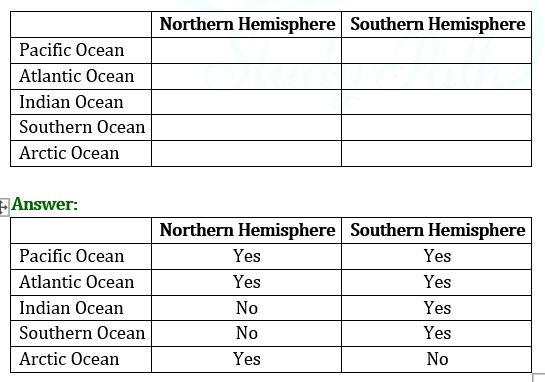
Question: Locate the five oceans and, in the table below, mark the hemisphere or hemispheres they belong to.
LET’S EXPLORE (Page 36)
Question: Counting the numbers of squares, name the largest continent and the smallest.
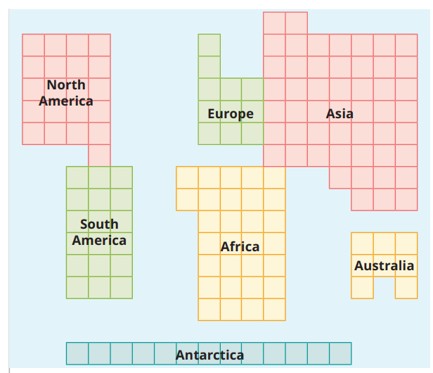
Answer: Largest continent = Asia (44 squares)
Smallest continent = Australia (8 squares)
Question: Which one is larger — North America or South America? Africa or North America? Antarctica or Australia?
Answer: North America (17squares) and South America (18 squares)
∴ South America is larger
Africa (30 squares) and North America (17 squares)
∴ Africa is larger
Antarctica (13 squares) and Australia (8 squares)
∴ Antarctica is larger
Question: Re-colour the diagram by having a single colour for Europe and Asia and rename the result as ‘Eurasia’. Compare its size with South America’s. (Page 36)
Answer:
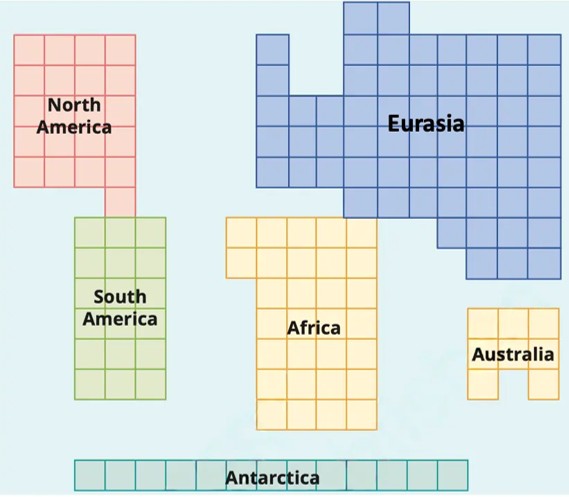
Eurasia has 54 squares and South America 18 squares.
∴ Eurasia is much larger than South America.
Question: Write down the list of continents from the smallest to the largest.
Answer:
- Australia
- Europe
- Antarctica
- South America
- North America
- Africa
- Asia
Questions, activities and project (Page 39)
1. Explain the following terms:
(a) Continent
(b) Ocean
(c) Island
Answer: (a) Continent: A continent is a large, continuous expanse of land on Earth. The world can be divided into seven continents: Asia, Africa, North America, South America, Antarctica, Europe and Australia. Asia is the largest continent and Australia is the smallest.
(b) Ocean: An ocean is a vast body of saltwater that covers a large portion of the Earth’s surface. Oceans cover almost three-fourths of the Earth’s surface thus our planet appear mostly blue from space. There are five major oceans: the Pacific Ocean, Atlantic Ocean, Indian Ocean, Arctic Ocean, and Southern (or Antarctic) Ocean.
(c) Island: An island is a piece of land that is completely surrounded by water. Islands are smaller than continents. India has more than 1300 islands, including the Andaman and Nicobar Islands in the Bay of Bengal and the Lakshadweep Islands in the Arabian Sea.
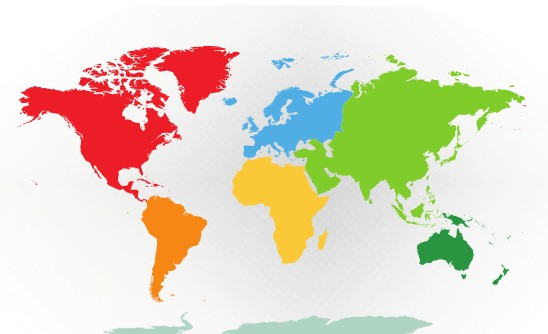
2. Let us draw – Without looking at the maps in this chapter, draw the continents free hand on a sheet of paper and colour them. Then compare your drawing with the map of oceans and continents in the chapter.
Answer:
3. Let us do – On the outline map of the world given below, label all the continents and oceans.
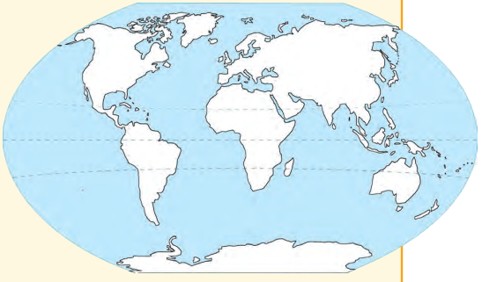
Answer:
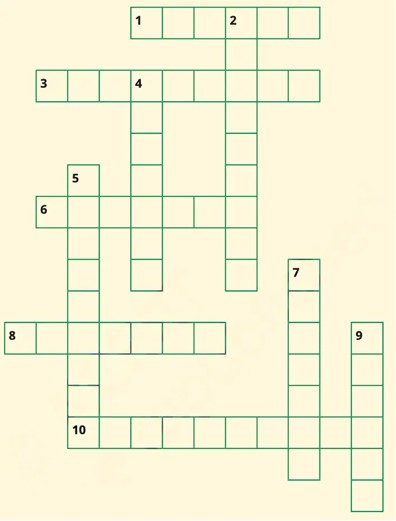
4.Solve this Crossword
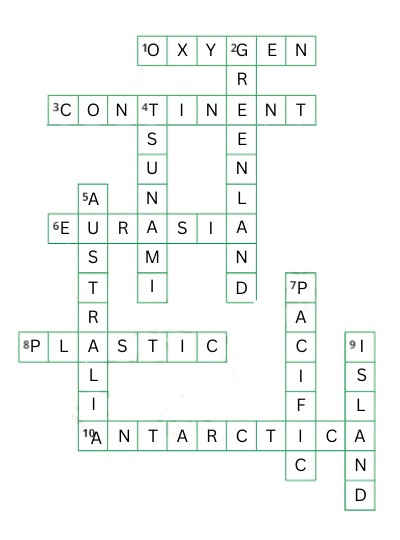
Answer:
Across
1. Abundantly produced by the oceans – Oxygen
3. A large expanse of landmass – Continent
6. A large continent of which India is a part – Eurasia
8. A major source of pollution of the oceans – Plastics
10. The coldest continent – Antarctica
Down
2. The largest island on Earth – Greenland
4. A huge destructive wave from the ocean – Tsunami
5. The smallest continent – Australia
7. The largest body of water on the Earth – Pacific
9. A landmass (but not a continent) surrounded by the sea or ocean – Island
NCERT Solutions for Class 6 Social Science Chapter 2 Oceans and Continents
We hope these NCERT Solutions for Class 6 Social Science help students understand the textbook activities, revise important concepts and prepare confidently for their examinations.
Class 6 Social Science Chapter 2, Oceans and Continents, introduces students to the distribution of land and water on Earth. It explains why our planet is often called the Blue Planet and describes the five major oceans and seven continents. Students also learn about islands, the importance of oceans in regulating climate, marine life and natural disasters that originate in oceans. The chapter helps learners understand how land and water bodies influence the environment and support life on Earth.