

NCERT Solutions for Class 6 Social Science Chapter 4 Timeline and Sources of History help you explore how we learn about the past and understand historical events. In this chapter, you will learn about timelines, different sources of history and how historians collect and study evidence to reconstruct the past. Here, we provide complete answers to all the important textbook questions and activities from Exploring Society: India and Beyond.
Class 6 SST Exploring Society Chapter 4 Timeline and Sources of History NCERT Solutions
The Big Questions (Page 59)
1. How do we measure historical time?
Answer: We measure historical time using calendars and timelines. Different cultures have developed unique ways of marking time, often based on significant events, such as the reign of a ruler or the birth of an important person.
At present, the Gregorian calendar is commonly used worldwide, where years are counted as “CE” (Common Era) for dates after the birth of Jesus Christ and “BCE” (Before Common Era) for dates before that. Historical time can be divided into decades (10 years), centuries (100 years) and millennia (1000 years).
2. How can various sources help us understand history?
Answer: The various sources helpful in understanding history are as follows:
- Archaeological Sources: These include artefacts like pottery, coins, toys, Jewellery, tools, weapons, pots, pans, bones, grains etc. These objects tell us about the daily life, trade and culture of people who lived long ago. Remains of Buildings and Monuments show us the different architectural styles, religious practices and the importance of different places in history.
- Literary Sources: Written records like ancient manuscripts, religious texts, books, poems, chronicles, old diaries, inscriptions on coins or rocks provide detailed information of past events.
- Artistic Sources: Paintings, sculptures, murals, rock paintings help us understand the aesthetics, religious beliefs, daily life of the past.
- Oral Sources: Stories, legends, and folk tales passed down through generations give us cultural and historical information.
- Scientific Methods: Carbon dating and DNA analysis determine the age of artefacts and fossils and trace genetic links and migration patterns of ancient populations.
3. How did early humans live?
Answer: Early humans lived as hunters and gatherers. They hunted wild animals, caught fish, and collected fruits, roots, nuts, and seeds. They moved from place to place in search of food and water, living in caves or temporary shelters. They used tools made of stone, wood, and bone and later learnt to use fire for cooking, warmth, and protection.
OR
Early humans lived in the following ways:
- They hunted animals and gathered fruits, roots, nuts, and seeds for food.
- They moved from place to place in search of food and water.
- They used simple tools made of stone, bone, and wood.
- They lived in caves or simple huts made of branches and leaves.
- They used fire for cooking, warmth, and protection from wild animals.
- They wore animal skins to protect themselves from cold.
- They communicated through gestures and spoken sounds and expressed themselves through cave paintings.
- They lived in small groups and worked together to find food and protect one another.
THINK ABOUT IT (Page 60)
Question: How do you think understanding the past will help us understand the present world?
Answer: If we study and understand the past, we can compare and see how things have developed and changed over time. We can understand from where we got the traditions that we follow and why we do things in a particular way. We can learn about the political system of the past and compare it with today’s political system.
LET’S EXPLORE (Page 63)
Such calculations are simple, but there is a catch. In the Gregorian calendar, there is no ‘year zero’. The year 1 CE follows immediately the year 1 BCE. Draw a simple timeline marking every year from 2 BCE to 2 CE; you will see that because of the absence of a year zero, only 3 years have passed between those two dates.
Answer:
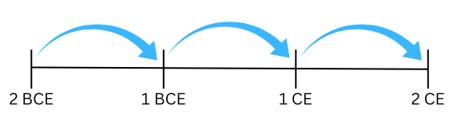
LET’S EXPLORE (Page 65)
Create a timeline stretching from 1900 CE to the current year and place the dates of birth of your grandparents, parents, siblings and yourself. Also, mark the years that the 20th century CE begins with and ends with.
Answer:
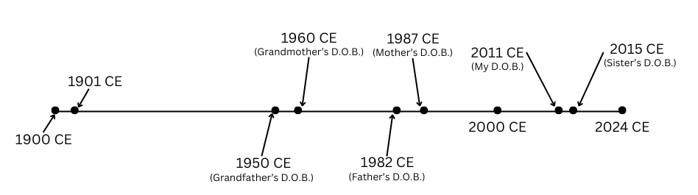
LET’S EXPLORE (Page 68)
There are a few images of different sources of history on the next page. Who and what do you think the objects show? Write down in the boxes next to the images any information that you get from these objects.
Answer:
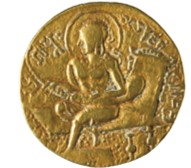
This is a coin from Gupta dynasty.The coin prominently features emperor Samudragupta playing a veena, a traditional Indian musical instrument. It reveals that he appreciated culture and had an aesthetic side. We can tell that gold was valued as a precious metal which was used for minting coins.
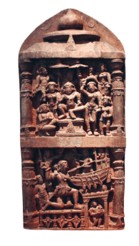
A 12th-century hero stone depicting a naval battle is a significant historical artifact that offers valuable insights into the martial and maritime traditions of the time. Hero stones, or “Virakals” in Kannada, are commemorative monuments often erected to honor warriors who died in battle.
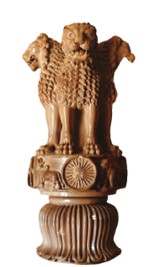
The Lion Capital of Ashoka is one of the most famous and iconic artifacts from ancient India. The Lion Capital shows four lions. They are standing back-to-back on top of a base that depicts four animals – a horse, an ox, an elephant, and a lion. The lions represent strength, courage, and pride. The lotus at the bottom is symbolic of purity.
LET’S EXPLORE (Page 70)
In the picture, look at some activities of early humans in a rock shelter. Which ones can you recognise? Give a brief description for each.
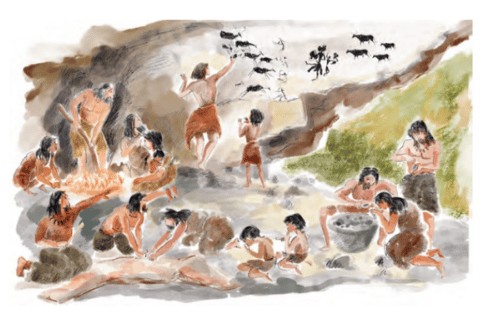
Answer: The picture depicts a rock shelter which has many inmates. It seems to be a community of hunter-gatherers. The men and women are wearing animal hides. The men have long hair and are wearing necklaces around their necks.
The following activities are observed:
- Hunting and Preparing Food: Some people are seen preparing animal hides and cooking meat over a fire, showing their dependence on hunting for food and the importance of fire for cooking and warmth.
- Lighting a fire: A man had lit a fire and is tending it. This community knew the use of fire.
- Tool Making: A few individuals are working with stones, likely making tools. This highlights their skill in creating tools for hunting, cutting, and daily tasks.
- Art and Communication: One person is painting or carving images of animals on cave walls, indicating early forms of communication, art, and possibly religious or cultural expression.
LET’S EXPLORE (Page 71)
Observe the scene on the next page. It depicts an agricultural community from a few millenniums ago. List the main activities you can identify.
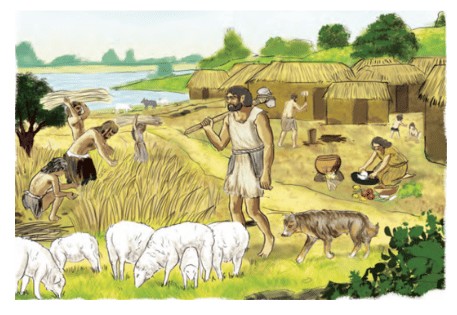
Answer: This picture depicts a rural settled community. There are huts built near a river which provides fresh water essential for living. The huts are placed very close to each other presumably for security reasons.
The following activities are visible:
- Farming: Individuals are harvesting crops, likely grains or wheat, indicating the cultivation of land and the practice of agriculture.
- Shepherding: A man is herding sheep with a dog, showing the domestication of animals and livestock management.
- Building: A man is seen cutting a tree trunk to be used presumably for building or repairing a hut.
- Cooking: A woman is engaged in preparing food. There are vegetables near the woman which indicates that this community grew their own vegetables too.
- Community living and rearing children: This seems to be a close-knit community. Each member has a given task. Children grow up playing under the watchful eyes of the women.
Questions, Activities and Projects (Page 74)
1. As a project, write the history of your family (or village if you live in one), using sources of history at your disposal. Ask your teacher to guide you.
Answer: Using old photos, documents, and family stories, I traced my family history.
Great-Grandparents:
- Paternal Great-Grandfather: Ram Singh, farmer, born in 1890 in a small village in Uttar Pradesh. Information from family stories and an old photograph.
- Maternal Great-Grandmother: Sita Devi, homemaker, born in 1895 in a nearby village. Information from an old diary.
Grandparents:
- Paternal Grandfather: Mohan Singh, a teacher, was born in 1920 in Uttar Pradesh. Information from his teaching certificates and family anecdotes.
- Maternal Grandmother: Radha Devi, homemaker, born in 1925. Information from her marriage certificate and my mother’s recollections.
Parents:
- Father: Suresh Singh, an engineer, was born in 1960. Information from his engineering degree and personal conversations.
- Mother: Meena Singh, a doctor, was born in 1965. Information from her medical degree and personal stories.
2. Can we compare historians to detectives? Give reasons for your answers.
Answer: Yes, we can compare historians to detectives for several reasons:
- Investigation: Both historians and detectives investigate events. Historians research past events using various sources, while detectives examine crime scenes and evidence.
- Evidence Gathering: Just like detectives collect evidence from a crime scene, historians gather various sources of information, such as documents, artifacts, oral histories, and archaeological findings.
- Analysis: Both analyse the evidence to reconstruct events. Historians piece together historical narratives, while detectives build a timeline of the crime.
- Critical Thinking: Both require critical thinking to interpret evidence accurately and identify biases or false leads.
- Drawing Conclusions: Both historians and detectives draw conclusions based on the evidence they have gathered. Detectives may solve a case and historians may provide an explanation of historical events.
3. A few exercises with dates:
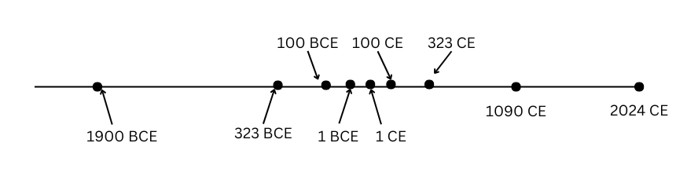
Q. Place these dates chronologically on the timeline: 323 CE, 323 BCE, 100 CE, 100 BCE, 1900 BCE, 1090 CE, 2024 CE.
Answer:
Q. If King Chandragupta was born in 320 CE, which century did he belong to? And how many years was that after the Buddha’s birth?
Answer: King Chandragupta belonged to the 4th Century CE.
Buddha was born in 560 BCE, so King Chandragupta was born (560 + 320 – 1) = 879 years after Buddha’s birth.
Q. Rani of Jhansi was born in 1828. Which century did she belong to? How many years was that before India’s Independence?
Answer: Rani of Jhansi belonged to the 19th Century CE.
India’s independence was in 1947. To calculate how many years before that Rani of Jhansi was born: (1947 – 1828) = 119 years. So, Rani of Jhansi was born 119 years before Independence.
Q. Turn ‘12,000 years ago’ into a date.
Answer: We are in the year 2024 CE (Common Era).
Subtracting 12,000 from 2024, we have
2024 – 12,000 = – 9976.
Now, – 9976 is negative, which means we are 9,976 years BCE (Before Common Era) period.
But in the timeline, there is no year 0. The timeline jumps directly from 1 BCE to 1 CE. So, when we subtract 12,000 years, we need to account for the missing “year zero.” To adjust for this, we add 1 to the calculation.
So, 9976 BCE becomes 9977 BCE after adjusting for the missing year. Therefore, 12,000 years ago would convert into 9977 BCE.
4. Plan a visit to a nearby museum: the visit should be prepared with some prior research on the kind of exhibits the museum holds. Keep notes during the visit. Write a brief report afterwards, highlighting what was unexpected / interesting / fun about the visit and the exhibits.
Answer:
Museum Visit Report
Date of Visit: 11 March, 2025
Museum Name: State Museum of History
The visit to the State Museum of History was enlightening and enjoyable. Highlights included the detailed exhibit on ancient civilizations, showcasing well-preserved tools, pottery, and clothing. The interactive digital displays allowed for an engaging exploration of historical events. Unexpectedly, the special exhibit on medieval armour and weapons was particularly fascinating, revealing intricate craftsmanship. Viewing original historical documents and diverse cultural artifacts provided a tangible connection to the past. The museum also featured a fun children’s section with hands on activities. The guided tour was engaging, offering interesting anecdotes and lesser known facts about the exhibits. Overall, the visit was a memorable experience, offering valuable insights into various historical periods and cultures.
5. Invite to your school an archaeologist or a historian and ask them to speak on the history of your region and why it’s important to know it.
Answer: Do it yourself.
NCERT Solutions for Class 6 Social Science Chapter 4 Timeline and Sources of History
We hope these NCERT Solutions for Class 6 Social Science help students understand the textbook activities, revise important concepts and prepare confidently for their examinations.
Class 6 Social Science Chapter 4, Timeline and Sources of History, introduces students to the study of the past and explains how historical events are arranged in chronological order. It describes different sources of history, such as archaeological remains, inscriptions, coins, manuscripts and monuments, which help us understand ancient societies and their way of life. Students also learn about the importance of dates, timelines and historical evidence in studying the past. The chapter helps learners understand how historians use different sources to discover and reconstruct events from earlier times.