

Looking for NCERT Solutions for Class 6 Science Curiosity Chapter 7 Temperature and its Measurement? Here, you will find easy-to-understand answers to all the important questions and activities from the NCERT Class 6 Science textbook. These solutions are prepared in simple language to help students understand the concepts, complete their homework and prepare for examinations.
Class 6 Science Chapter 7 Temperature and its Measurement NCERT Questions and Answers
Textbook Intext Questions
Question 1. Can it always be correctly judged, that a person has fever, only by touching the person? (Page – 123)
Answer: It cannot always be correctly judged that a person has fever, only by touching the person as we are not able to calculate accurate temperature of the body.
OR
It cannot always be correctly judged that a person has fever, only by touching the person. If a person has a normal body temperature and the hand touching that person is cold, the person will feel to be warm to the hand. If the hand touching a person is warm, the person with fever may be felt as at normal temperature. For correct judgement that a person has fever or not, we must use clinical thermometer correctly.
Question: Do small children generally have slightly higher body temperatures as compared to adults? (Page – 128)
Answer: Yes, small children usually have slightly higher body temperatures compared to adults because their bodies are working hard to grow quickly, which makes more heat.
For kids, a normal body temperature is usually between 37.0°C and 37.5°C. For adults it’s a bit lower usually between 36.1°C and 37.2°C.
Question: Do old people, even when healthy, generally have lower body temperatures than young adults? (Page – 129)
Answer: Yes, even healthy older people generally have lower body temperatures than young adults. As people age, their bodies slow down and don’t produce as much heat. For older adults, normal body temperature is often around 36.2°C to 36.8°C, which is slightly lower than the typical range for younger adults.
Question: Can a clinical thermometer be used for measuring the temperature of boiling water? Or for measuring the temperature of ice? (Page – 129)
Answer: A clinical thermometer has a range of 35 °C to 42 °C. The temperature of boiling water is 100 °C or more and the temperature of ice is 0 °C or below which are beyond the range of clinical thermometer. Therefore, a clinical thermometer cannot used for measuring the temperatures of boiling water or of ice.
Let us enhance our learning (Textbook Questions Page – 137)
1. The normal temperature of a healthy human being is close to _____.
(i) 98.6 °C
(ii) 37.0 °C
(iii) 32.0 °C
(iv) 27.0 °C
Answer: (ii) 37.0 °C
2. 37 °C is the same temperature as _____.
(i) 97.4 °F
(ii) 97.6 °F
(iii) 98.4 °F
(iv) 98.6 °F
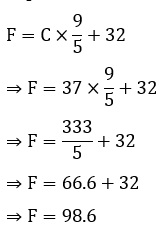
Answer: (iii) 98.4 °F
Explanation: To convert Celsius to Fahrenheit, use the formula:
3. Fill in the blanks:
(i) The hotness or coldness of a system is determined by its _____.
(ii) The temperature of ice-cold water cannot be measured by a _____ thermometer.
(iii) The unit of temperature is degree _____.
Answer: (i) The hotness or coldness of a system is determined by its temperature.
(ii) The temperature of ice-cold water cannot be measured by a clinical thermometer.
(iii) The unit of temperature is degree Celsius.
4. The range of a laboratory thermometer is usually _____.
(i) 10 °C to 100 °C
(ii) -10 °C to 110 °C
(iii) 32 °C to 45 °C
(iv) 35 °C to 42 °C
Answer: (i) 10 °C to 100 °C
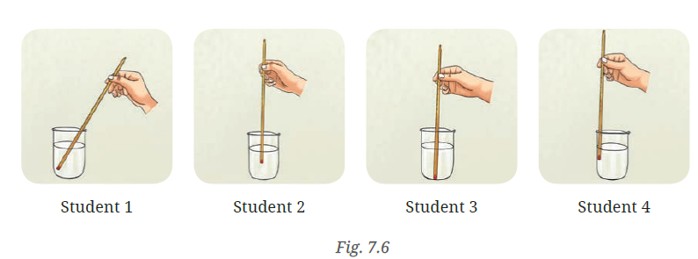
5. Four students used a laboratory thermometer to measure the temperature of water as shown in Fig. 7.6:
Who do you think followed the correct way for measuring temperature?
(i) Student 1
(ii) Student 2
(iii) Student 3
(iv) Student 4
Answer: (ii) Student 2 measured the temperature of the water by following the correct way, as the thermometer was placed in an upright position without touching the sides or the bottom of the beaker.
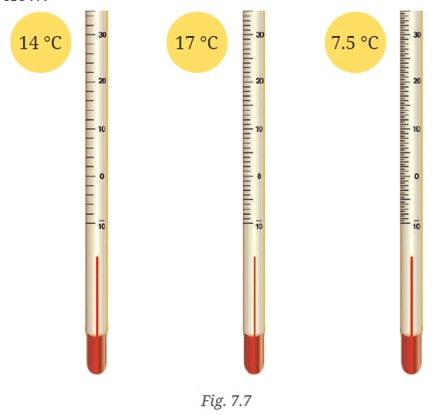
6. Colour to show the red column on the drawings of thermometers (Fig. 7.7) as per the temperatures written below:
Answer:
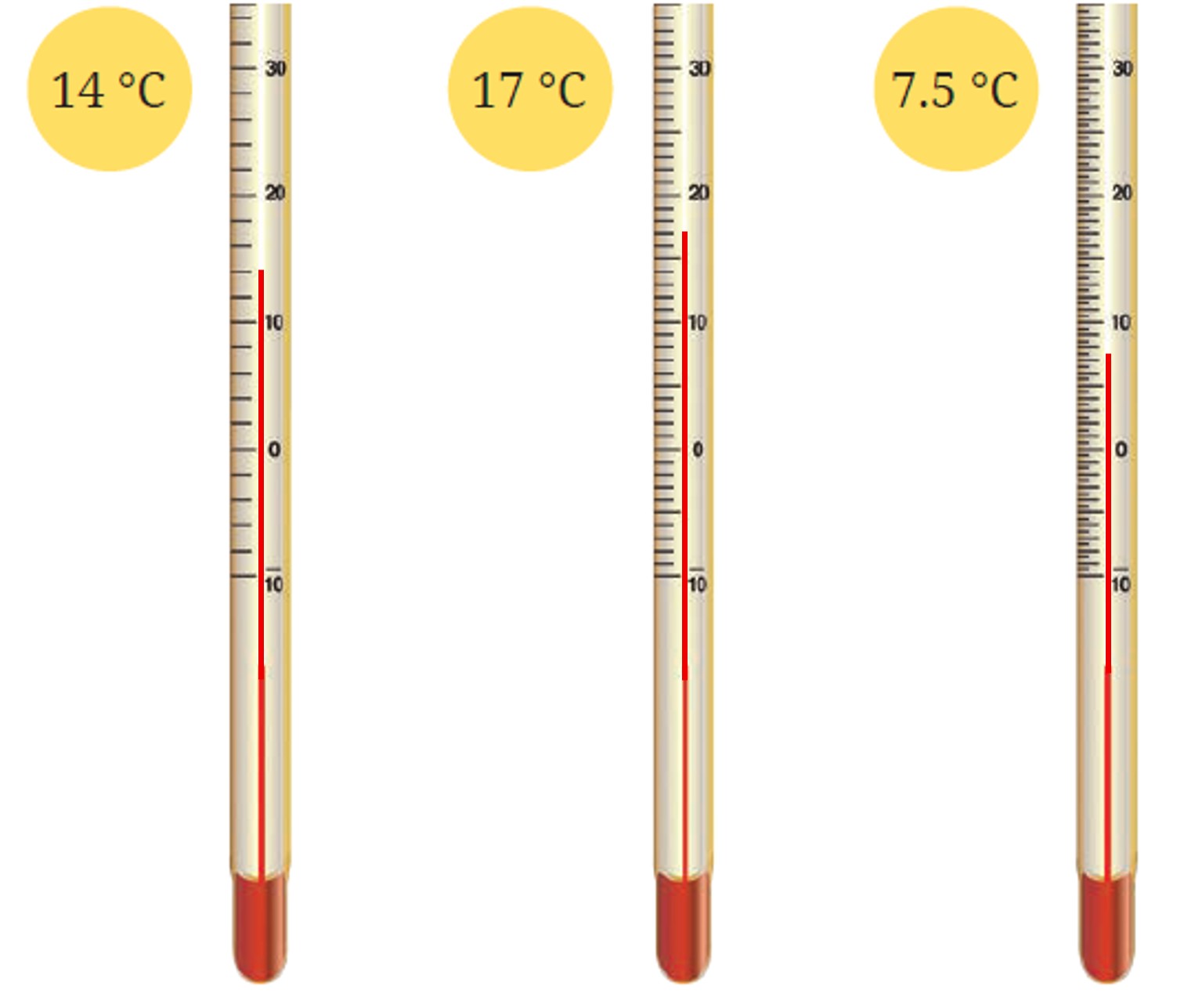
- In the first thermometer for 14°C, colour up to two small lines above mark 10 (each small line indicates 2 degrees Celsius).
- In the second thermometer for 17°C, colour up to seven small lines above mark 10 (each small line indicates 1 degree Celsius).
- In the third thermometer for 7.5°C, colour up to fifteen small lines above mark 0 (each small line indicates 0.5 degree Celsius).
Red lines are marked alongside the respective thermometers for information.
7. Observe the part of thermometer shown in Fig. 7.8 and answer the following questions:

(i) What type of thermometer is it?
(ii) What is the reading of the thermometer?
(iii) What is the smallest value that this thermometer can measure?
Answer: (i) The given thermometer has a minimum temperature marking of -10 degrees. Since laboratory thermometers typically have a temperature range from -10°C to 110°C, this indicates that it is a laboratory thermometer.
(ii) The reading of the thermometer is 26°C.
(iii) Since the minimum temperature marking on the thermometer is -10°C, this is the lowest temperature it can measure.
8. A laboratory thermometer is not used to measure our body temperature. Give a reason.
Answer: A laboratory thermometer is not used to measure human body temperature because
- Laboratory thermometers have a wider temperature range (often -10°C to 110°C or more), which reduces their precision in the narrow human body temperature range (36°C to 38°C).
- Laboratory thermometers respond quickly to temperature changes, so after removal from the body, the temperature reading begin to decrease rapidly making it unsuitable for measuring body temperature.
9. Vaishnavi has not gone to school as she is ill. Her mother has kept a record of her body temperature for three days as shown in Table 7.4.
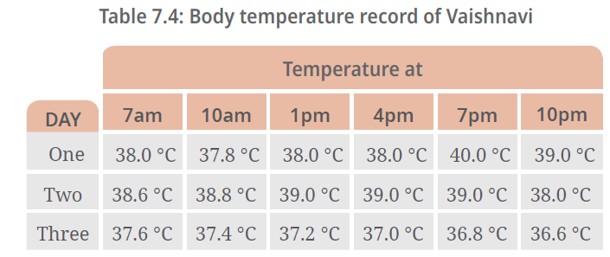
(i) What was Vaishnavi’s highest recorded temperature?
(ii) On which day and at what time was Vaishnavi’s highest temperature recorded?
(iii) On which day did Vaishnavi’s temperature return to normal?
Answer: (i) Highest Temperature: 40.0° C
(ii) Vaishnavi’s highest temperature was recorded at 7 p.m. on Day one.
(iii) Vaishnavi’s temperature returned to normal on Day three.
10. If you have to measure the temperature 22.5 °C, which of the following three thermometers will you use (Fig. 7.9)? Explain.
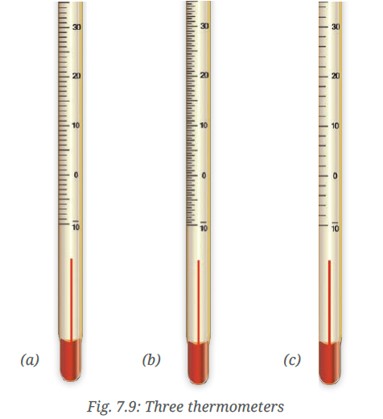
Answer: Thermometer (b) would be the best choice, as it has markings that allow for reading half- degree increments, making it possible to accurately measure a temperature of 22.5°C.
11. The temperature shown by the thermometer in Fig. 7.10 is

(i) 28.0 °C
(ii) 27.5 °C
(iii) 26.5 °C
(iv) 25.3 °C
Answer: (ii) 27.5 °C
12. A laboratory thermometer has 50 divisions between 0 °C and 100 °C. What does each division of this thermometer measure?
Answer: 50 divisions of the thermometer = 100°C
∴ 1 division of the thermometer=100°C ÷ 50 = 2°C
13. Draw the scale of a thermometer in which the smallest division reads 0.5 °C. You may draw only the portion between 10 °C and 20 °C.
Answer:

14. Someone tells you that she has a fever of 101 degrees. Does she mean it on the Celsius scale or Fahrenheit scale?
Answer: If someone says she has a fever of 101 degrees, then she is referring to the Fahrenheit scale. Normal human body temperature is around 37°C so, 101°C would be an intolerable temperature for the body to bear.
We hope these NCERT Solutions for Class 6 Science help students understand the textbook activities, revise important concepts and prepare confidently for their examinations.
Temperature and its Measurement Class 6 Science Chapter 7 NCERT Solutions
Class 6 Science Chapter 7, Temperature and its Measurement, introduces students to the concept of temperature and its importance in our daily lives. It explains the difference between hot and cold objects and why we need proper instruments to measure temperature accurately. Students also learn about different types of thermometers, how to read temperature and the precautions to follow while using them. The chapter helps learners understand how temperature measurement is useful in everyday situations, such as checking body temperature and observing weather conditions.
Class 6 Science Chapter 7 – What Will You Learn?
The chapter Temperature and its Measurement helps students understand how temperature tells us whether an object is hot or cold. It explains why our sense of touch is not always reliable for judging temperature and how thermometers help us obtain accurate measurements.
The important concepts covered in this chapter are:
- Hot and Cold Objects: Understanding how objects differ in temperature and why our sense of touch may sometimes be misleading.
- Meaning of Temperature: Learning what temperature is and how it indicates the degree of hotness or coldness of an object.
- Measurement of Temperature: Understanding why temperature should be measured using suitable instruments rather than relying only on touch.
- Thermometers: Exploring different types of thermometers used to measure temperature in everyday life and scientific activities.
- Clinical Thermometer: Learning how a clinical thermometer is used to measure human body temperature.
- Laboratory Thermometer: Understanding the use of laboratory thermometers for measuring the temperature of different substances during experiments.
- Celsius Scale: Learning about the Celsius scale and how temperature readings are expressed in degrees Celsius (°C).
- Precautions While Using Thermometers: Understanding the correct way to handle and read thermometers to obtain accurate measurements.