

Looking for NCERT Solutions for Class 6 Science Curiosity Chapter 9 Methods of Separation in Everyday Life? Here, you will find easy-to-understand answers to all the important questions and activities from the NCERT Class 6 Science textbook. These solutions are prepared in simple language to help students understand the concepts, complete their homework and prepare for examinations.
Class 6 Science Chapter 9 Methods of Separation in Everyday Life NCERT Questions and Answers
Textbook Intext Questions
Question: A small amount of puffed rice is mixed with chana dal. Can you think of separating the mixture by any method other than handpicking? (Page – 165)
Answer: Puffed rice can be separated from chana dal using the winnowing method. Since puffed rice is lighter than chana dal, it is blown away by the wind, while the heavier chana dal falls straight down, effectively separating the two.
Question: Valli is unable to separate husk from rice in a closed room. How can you help her?(Page – 166)
Answer: Valli can use winnowing with the help of a fan in the closed room. Since husk is lighter than rice, the fan’s airflow will blow the husk away, while the heavier rice grains will fall straight down. In this way, the husk and rice will be separated.
Question: Have you ever observed sieves being used at construction sites to separate pebbles and stones from the sand? (Page – 166)
Answer: Yes, sieves are used at construction sites to separate pebbles and stones from sand. This is done using a mesh with specific-sized holes to filter out materials of different sizes. The smaller sand particles pass through the holes, while the larger pebbles and stones are retained on top.
Question: Have you ever observed white patches on the dark coloured clothes you wear during hot summers? How are these patches formed? (Page – 168)
Answer: Yes, I have noticed white patches on dark coloured clothes during hot summers. These patches are often formed due to salt and minerals excreted from the body along with sweat. As the sweat evaporates, the salt and minerals are left behind, which appear as white patches on the fabric.
Question: Observe the figure. Does it answer the question? Can you name the process involved? (Page – 169)
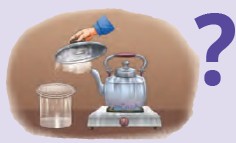
Answer: The process involved is condensation.
Question: How many layers of cloth do I need to use to get clear water? (Page – 171)
Answer: To get clear water, you should use 3 to 4 layers of cloth. Using multiple layers ensures better filtration by successively trapping finer impurities, resulting in clearer water.
Question: Can you name one kitchen appliance which runs on electricity that is used to prepare buttermilk? (Page – 174)
Answer: A blender is a kitchen appliance that runs on electricity and is commonly used to prepare buttermilk. During the churning process, the butter rises to the top and is separated from the liquid i.e. buttermilk.
Let us enhance our learning (Exercise Questions)
1. What purpose does handpicking serve in the process of separation?
(i) Filtration
(ii) Sorting
(iii) Evaporation
(iv) Decantation
Answer: (ii) Sorting
Explanation: Hand-picking is used to sort or remove unwanted materials from a mixture based on visible differences, like size or colour.
2. Which of the following substances are commonly separated using the churning method?
(i) Oil from water
(ii) Sand from water
(iii) Cream from milk
(iv) Oxygen from air
Answer: (iii) Cream from milk
Explanation: During churning, the cream being lighter floats on the top of the milk and can be separated from the milk.
3. Which factor is usually essential for the filtration?
(i) Apparatus size
(ii) Presence of air
(iii) Pore size
(iv) Presence of air Temperature of the mixture
Answer: (iii) Pore size
Explanation: Very fine pore size is essential for filtration so that even small impurities are left behind on the filter paper.
4. State with reason(s) whether the following statements are True [T] or False [F]. Also, correct the False statement(s).
(i) Salt can be separated from salt solution by keeping it under the Sun. [ ]
(ii) Handpicking should be used only when the quantity of one component is less. [ ]
(iii) A mixture of puffed rice and rice grains can be separated by threshing. [ ]
(iv) A mixture of mustard oil and lemon water can be separated by decantation. [ ]
(v) Sieving is used to separate a mixture of rice flour and water. [ ]
Answer:
(i) True [T]
Explanation: When the salt solution is kept under the sun, the water evaporates due to the heat and the salt left behind.
(ii) True [T].
Explanation: When the quantity of one component is less, the process of handpicking is convenient.
(iii) False [F].
Explanation: A mixture of puffed rice and rice grains can be separated by winnowing. Puffed rice is lighter than rice grains and is carried further away by the wind, separating the both the components.
(iv) True [T].
Explanation: The mustard oil floats on top of lemon water and hence can be separated by decantation.
(v) False [F].
Explanation: Sieving is used to separate a mixture of solids of different sizes and not a mixture of solid and liquid. Rice flour and water require filtration to be separated.
5. Match the mixtures in Column I with their method of separation in Column II.
| Column I | Column II |
| (i) Gram flour mixed with black gram | (a) Handpicking |
| (ii) Chalk powder mixed with water | (b) Magnetic separation |
| (iii) Corn mixed with potatoes | (c) Decantation |
| (iv) Iron powder mixed with sawdust | (d) Sieving |
| (v) Oil mixed with water | (e) Filtration |
Answer:
| Column I | Column II |
| (i) Gram flour mixed with black gram | (d) Sieving |
| (ii) Chalk powder mixed with water | (e) Filtration |
| (iii) Corn mixed with potatoes | (a) Handpicking |
| (iv) Iron powder mixed with sawdust | (b) Magnetic separation |
| (v) Oil mixed with water | (c) Decantation |
6. In what situations would you use decantation instead of filtration to separate solids from liquids?
Answer: We use decantation instead of filtration to separate solids from liquids when the solid particles are heavy enough to settle at the bottom of the container. Examples, stone chips mixed with water.
7. Can you relate the presence of nasal hair to any separation process?
Answer: Nasal hair traps the dust and other impurities from the air and prevents their entry inside our body while breathing. So, nasal hair acts as a natural filter for the air we breathe. This is similar to the process of separation by filtration.
8. During the COVID-19 pandemic, all of us wore masks. Generally, what material are they made of? What is the role of these masks?
Answer: Masks are generally made of materials such as cotton and plastics like polyester and polypropylene. These masks prevent unwanted particles, such as viruses, from entering our body. Thus, they help reduce the spread of viruses from one person to another, as seen during COVID-19.
9. A mixture containing potatoes, salt and sawdust has been given to you. Outline a stepwise procedure for separating each component from this mixture.
Answer: The stepwise procedure for separating each component from the given mixture is given below:
Step 1 (Handpicking): Handpick the potatoes out of the mixture.
Step 2: Add water to the remaining mixture of salt and sawdust.
Step 3 (Filtration): Filter the mixture to separate the saw dust from the salt solution.
Step 4 (Evaporation): Evaporate the water from the remaining salt-water solution to obtain salt.
10. Read the following story titled ‘Intelligent Leela’ and tick the most appropriate options. Provide a suitable title of your choice for the paragraph.
Leela was working in the farm with her father when she realised that they left their drinking water at home. Before her father felt thirsty/hungry, she went to the nearby pond to fetch some water/grains. After obtaining some water in the container, she noticed that the water was muddy and fit/unfit for drinking. To purify the water, she kept it for some time and then she filtered/ churned the muddy water using a piece of paper/muslin cloth. Leela, then, cooled/boiled the water for about 10 minutes in a covered pan. After cooling/boiling, she filtered/churned it again and made it fit/unfit for drinking. She served this water to her father while having food, who blessed her and appreciated her efforts.
Answer: Leela was working in the farm with her father when she realised that they left their drinking water at home. Before her father felt thirsty, she went to the nearby pond to fetch some water. After obtaining some water in the container, she noticed that the water was muddy and unfit for drinking. To purify the water, she kept it for some time and then she filtered the muddy water using a piece of muslin cloth. Leela, then, boiled the water for about 10 minutes in a covered pan. After cooling, she filtered it again and made it fit for drinking. She served this water to her father while having food, who blessed her and appreciated her efforts.
A suitable title of my choice for the paragraph would be: “Leela’s Mini Water Purification Plant”.
We hope these NCERT Solutions for Class 6 Science help students understand the textbook activities, revise important concepts and prepare confidently for their examinations.
Methods of Separation in Everyday Life Class 6 Science Chapter 9 NCERT Solutions
Class 6 Science Chapter 9, Methods of Separation in Everyday Life, introduces students to different methods used to separate useful substances from mixtures. It explains how materials can be separated based on differences in their size, shape, weight and other physical properties. Students also learn about common separation techniques such as handpicking, threshing, winnowing, sieving, sedimentation, decantation, filtration and evaporation. The chapter connects these methods with everyday activities, helping learners understand their importance in cooking, farming and other daily tasks.
Class 6 Science Chapter 9 – What Will You Learn?
The chapter Methods of Separation in Everyday Life helps students understand why and how different substances are separated from mixtures. It explains various techniques used in homes, farms and industries to obtain useful materials and remove unwanted substances.
The important concepts covered in this chapter are:
- Mixtures: Understanding what mixtures are and why different substances are sometimes mixed together.
- Need for Separation: Learning why useful components are separated from unwanted materials in different situations.
- Handpicking: Understanding how unwanted materials are removed manually from a mixture, such as stones from grains.
- Threshing: Learning how grains are separated from harvested stalks.
- Winnowing: Understanding how lighter particles are separated from heavier particles with the help of wind.
- Sieving: Learning how particles of different sizes are separated using a sieve.
- Sedimentation and Decantation: Understanding how heavier insoluble particles settle at the bottom and how the clear liquid can be poured off carefully.
- Filtration: Learning how insoluble solid particles are separated from liquids using a filter.
- Evaporation: Understanding how dissolved solids can be recovered from a solution by removing the liquid through evaporation.
- Separation in Everyday Life: Exploring how different separation methods are used in cooking, agriculture and other daily activities.