

Looking for NCERT Solutions for Class 6 Science Curiosity Chapter 6 Materials Around Us? Here, you will find easy-to-understand answers to all the important questions and activities from the NCERT Class 6 Science textbook. These solutions are prepared in simple language to help students understand the concepts, complete their homework and prepare for examinations.
Class 6 Science Chapter 6 Materials Around Us NCERT Questions and Answers
Textbook Intext Questions
Question: Would it be a good idea to use paper-like materials for making cooking utensils? (Page – 104)
Answer: No, it is not a good idea to use paper like materials for making utensils as the paper will get burnt under high temperature and flame. Also, it will get wet due the liquid content of food.
Question: Why cannot a tumbler made of cloth be used for storing water? (Page – 104)
Answer: Tumbler cannot be made of cloth for storing water because the cloth is porous and water will pass through it. Cloth is not able to store water.
Question: Are all lustrous materials metals? (Page – 107)
Answer: All lustrous materials may not be metals. Some materials can be made lustrous by polishing or coating them with a thin layer of plastic, wax or any other material which makes them look shiny.
Question: Is water transparent? Can it be made opaque? (Page – 110)
Answer: Yes, water in its natural form is transparent. It can be made opaque by dissolving other materials like mud, colour etc.
Question: Does everything you put in water disappear? (Page – 111)
Answer: No, everything we put in water does not disappear. Only the materials which are soluble in water disappear when mixed with water in limited amount. For example, salt and sugar dissolve in water whereas sand and flour don’t.
Question: Are there any properties which can be shown by all materials? If yes, what are those? (Page – 115)
Answer: Properties like mass and volume is shown by all materials.
OR
Yes, there are certain properties that can be observed in all materials, regardless of their type. These include:
(i) Mass: All materials have mass, meaning they have weight. Mass is a fundamental property that can be measured in all substances, whether solid, liquid or gas.
(ii) Volume: Every material occupies a certain amount of space, which is known as its volume.
Let Us Enhance Your Learnings (Exercise Questions Page – 119)
1. Visit your kitchen and observe how your parents have organised various edibles. Can you suggest a better sorting method? Write it in your notebook.
Answer: Some suggestions for organising kitchen edibles in a better way are:
- Group items by type to make it easier to find similar items together.
- Place daily use items like salt, sugar and oil in easily accessible spots.
- Place less-used items on higher shelves or toward the back.
- Use transparent containers and label them to easily identify contents.
- Keep grains, pulses, and dried spices in air-tight containers.
2. Unscramble the letters (Column I) and match with their properties (Column II).
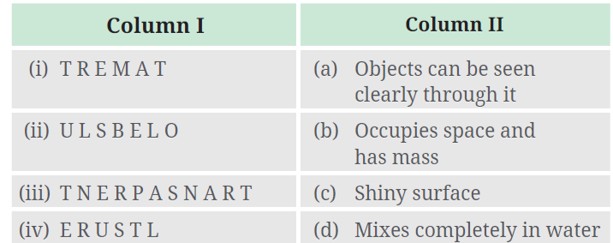
Answer:
| (i) Matter | (b) Occupies space and has mass |
| (ii) Soluble | (d) Mixes completely in water |
| (iii) Transparent | (a) Objects can be seen clearly through it |
| (iv) Lustre | (c) Shiny surface |
3. The containers which are used to store materials in shops and at home are usually transparent. Give your reasons for this.
Answer: Containers used to store materials in shops and at home are often transparent because it helps us to identify the things placed in these containers from outside without opening them
4. State whether the statements given below are True [T] or False [F]. Correct the False statement(s).
(i) Wood is translucent while glass is opaque. [ ]
(ii) Aluminium foil has lustre while an eraser does not. [ ]
(iii) Sugar dissolves in water whereas sawdust does not. [ ]
(iv) An apple is a matter because it occupies no space and has mass. [ ]
Answer:
(i) False [F]
Correct Statement: Wood is opaque while glass is translucent.
(ii) True [T]
(iii) True [T]
(iv) False [F]
Correct Statement: An apple is a matter as it occupies space and has mass.
5. We see chairs made up of various materials, such as wood, iron, plastic, bamboo, cement and stones. Following are some desirable properties of materials which can be used to make chairs. Which materials used to make chairs fulfil these properties the most?
(i) Hardness (does not bend or shake on sitting even after long use).
(ii) Lightweight (easy to lift or to take from one place to another).
(iii) Does not feel very cold when sitting during winters.
(iv) Can be cleaned regularly and made to look new even after long use.
Answer: (i) Hardness: Iron, Cement, Stones.
(ii) Lightweight: Plastic, Bamboo.
(iii) Wood and bamboo chairs do not feel very cold when sitting during winters.
(iv) Plastic and iron chairs can be cleaned regularly and made to look new even after long use.
6. You need to have containers for collection of:
(i) food waste,
(ii) broken glass and
(iii) wastepaper.
Which materials will you choose for containers of these types of waste? What properties of materials do you need to think of?
Answer: (i) Food waste: Plastic or metal containers are ideal for storing food waste because they are durable, resistant to corrosion and easy to clean.
(ii) Broken glass: Metal or hard plastic containers should be used for collecting broken glass due to their durability and toughness.
(iii) Wastepaper: Light weight plastic or cardboard containers work well for collecting wastepaper.
7. Air is all around us but does not hinder us from seeing each other. Whereas, if a wooden door comes in between, we cannot see each other. It is because air is _____ and the wooden door is ______.
Choose the most appropriate option:
(i) transparent, opaque
(ii) translucent, transparent
(iii) opaque, translucent
(iv) transparent, translucent
Answer: (i) transparent, opaque
Reason: Air is all around us but does not hinder us from seeing each other. Whereas, if a wooden door comes in between, we cannot see each other. It is because air is transparent and the wooden door is opaque.
8. Imagine you have two mysterious materials, X and Y. When you try to press material X, it feels rigid and does not change its shape easily. On the other hand, material Y easily changes its shape when you press it. Now, when you mix both materials in water, only material X dissolves completely while material Y remains unchanged. What can materials X and Y be? Can you identify whether material X is hard or soft? What about material Y? Justify your answer.
Answer:
- Material X: Likely a hard soluble solid e.g. salt, sugar.
- Material Y: Likely a soft insoluble material e.g. clay, rubber.
Material X is hard because it retains its shape under pressure and is likely a solid that dissolves in water.
Material Y is soft because it changes shape easily when pressed and it does not dissolve in water.
9. (i) Who am I? Identify me on the basis of the given properties.
(a) I have lustre. ______
(b) I can be easily compressed. ______
(c) I am hard and soluble in water. ______
(d) You cannot see clearly through me. ______
(e) I have mass and volume but you cannot see me. ______
(ii) Make your own ‘Who am I?’ ______
Answer:
(i) Identification on the basis of properties:
(a) I have a lustre – Metal
(b) I can be easily compressed – Gas
(c) I am hard and soluble in water – Salt
(d) You cannot see clearly through me – Translucent objects
(e) I have mass and volume but you cannot see me – Air
(ii) Here’s my own “Who am I?”
(a) I am a solid but changes into a liquid at room temperature.
(b) I am poisonous and can cause health hazards if inhaled.
(c) I have a metallic lustre and am used in thermometers.
Who am I? → Mercury.
10. You are provided with the following materials—vinegar, honey, mustard oil, water, glucose and wheat flour.
Make any two pairs of materials where one material is soluble in the other. Now, make two pairs of materials where one material remains insoluble in the other material.
Answer: Two pairs of materials where one material is soluble in the other.
- Vinegar and water.
- Glucose and water.
Two pairs of materials where one material remains insoluble in the other material.
- Mustard oil and water.
- Wheat flour and water
We hope these NCERT Solutions for Class 6 Science help students understand the textbook activities, revise important concepts and prepare confidently for their examinations.
Materials Around Us Class 6 Science Chapter 6 NCERT Solutions
Class 6 Science Chapter 6, Materials Around Us, introduces students to the different materials found in their surroundings and their properties. It explains how objects are made from different materials and how these materials can be classified based on their characteristics. Students also learn about properties such as appearance, hardness, solubility, transparency and the ability to float or sink in water. The chapter helps learners understand why different materials are used for making different objects in everyday life.
In this article, we provide Class 6 Science Chapter 6 NCERT question answers. All the answers are explained in a clear and student-friendly manner so that learners can understand the concepts without difficulty. Whether you are looking for NCERT textbook solutions or revising the chapter before an examination, these solutions will help you study more effectively.
Class 6 Science Chapter 6 – What Will You Learn?
The chapter Materials Around Us helps students understand the different types of materials used to make everyday objects. It explains how materials can be grouped according to their properties and why choosing the right material is important for different purposes.
The important concepts covered in this chapter are:
- Objects and Materials: Understanding the difference between objects and the materials used to make them.
- Classification of Materials: Learning how materials can be grouped based on their similarities and differences.
- Appearance of Materials: Exploring how materials differ in colour, texture and lustre.
- Hardness and Softness: Understanding the difference between hard and soft materials through everyday examples.
- Solubility in Water: Learning about soluble and insoluble substances and how different materials behave when mixed with water.
- Transparency: Understanding transparent, translucent and opaque materials based on how much light passes through them.
- Floating and Sinking: Exploring why some materials float on water while others sink.
- Uses of Materials: Understanding how the properties of different materials determine their uses in everyday objects.