

Looking for NCERT Solutions for Class 6 Science Curiosity Chapter 2 Diversity in the Living World? Here, you will find easy-to-understand answers to all the important questions and activities from the NCERT Class 6 Science textbook. These solutions are prepared in simple language to help students understand the concepts, complete their homework and prepare for examinations.
Class 6 Science Chapter 2 Diversity in the Living World NCERT Questions and Answers
Let Us Enhance Your Learnings
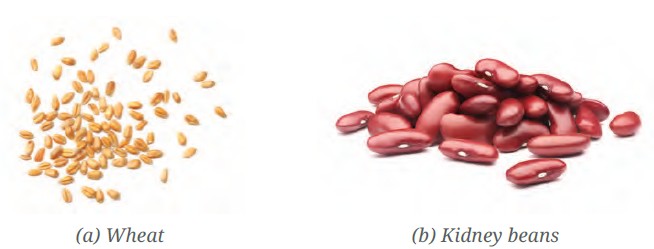
Question 1. Here are two types of seeds. What differences do you find among the roots and leaf venation of their plants?
Answer:
| Wheat | Kidney Beans |
| Wheat are monocots. | Kidney beans are dicots. |
| Wheat leaves exhibit parallel venation. | Kidney beansexhibit reticulate venation. |
| They have fibrous roots. | They have taproot system. |
OR
Wheat: It is a monocot plant. It has parallel leaf venation. Its roots form a fibrous root system, which consists of many roots of similar size.
Kidney beans: They are dicot in nature. They have reticulate venation, where veins form a net-like structure, and a taproot system, which features one main root with smaller lateral branches.
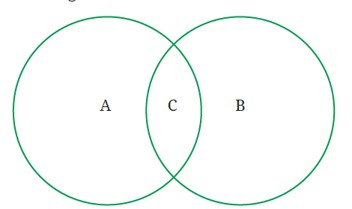
Question 2. Names of some animals are given below. Group them based on their habitats. Write the names of aquatic animals in the area marked ‘A’ and terrestrial animals in the area marked ‘B’. Enter the names of animals living in both habitats in part ‘C’.
Horse, Dolphin, Frog, Sheep, Crocodile, Squirrel, Whale, Earthworm, Pigeon, Tortoise
Answer:
A. Aquatic Animals: Dolphin, Whale
B. Terrestrial Animals: Horse, Sheep, Squirrel, Pigeon, Earthworm
C. Both aquatic and terrestrial Animals: Frog, Crocodile, Tortoise
Question 3. Manu’s mother maintains a kitchen garden. One day, she was digging out radish from the soil. She told Manu that radish is a kind of root. Examine a radish and write what type of root it is. What type of venation would you observe in the leaves of radish plant?
Answer: Radish has a tap root system. The type of venation observed in the leaves of radish plant is reticulate venation.
Root type and leaf venation of radish are
- Type of root: Taproot (thick, fleshy taproot)
- Leaf venation: Reticulate venation (because radish is a dicot plant)
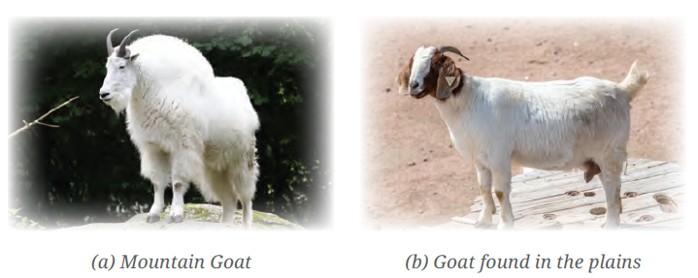
Question 4. Look at the image of a mountain goat and a goat found in the plains. Point out the similarities and differences between them. What are the reasons for these differences?
Answer: Similarities between mountain goat and goats found in plains:
- Both are goats and belong to same family.
- Both have horns and hooves.
- Both are herbivore animals.
Difference between mountain goat and goats found in plains:
| Mountain goat | Goats found in plain |
| Mountain goat has thick and long fur to protect themselves from cold climate. | They have shorter and thin fur. |
| They have shorter legs. | They have longer legs. |
| Muscular body and specialised hooves to climb mountains. | Lean body and flat hooves specialised for plain area. |
Reasons for differences: These differences are adaptations to their habitats. Mountain goats need thick fur for warmth and shorter legs for better balance on steep slopes. Plains goats have longer legs for running in open areas.
Question 5. Group the following animals into two groups based on any feature other than those discussed in the chapter— cow, cockroach, pigeon, bat, tortoise, whale, fish, grasshopper, lizard.
Answer: Group 1: Animals which can fly
- Pigeon
- Bat
- Cockroach
- Grasshopper
Group 2: Animals which cannot fly
- Cow
- Tortoise
- Whale
- Fish
- Lizard
Question 6. As the population grows and people want more comfortable lives, forests are being cut down to meet various needs. How can this affect our surroundings? How do you think we can address this challenge?
Answer: Effects of deforestation:
- Loss of habitats for animals and plants.
- Reduction in biodiversity.
- Climate change due to fewer trees absorbing carbon dioxide.
- Soil erosion
- Disruption in water cycle
Addressing the challenge:
- Planting more trees (afforestation).
- Adopting sustainable practices.
- Creating protected areas for wildlife.
- Using resources wisely and reduce waste.
- Public awareness which means educating people about the importance of forests.
- Implementing strict laws and punishment.
Question 7. Analyse the flowchart. What can be examples of ‘A’ and ‘B’?
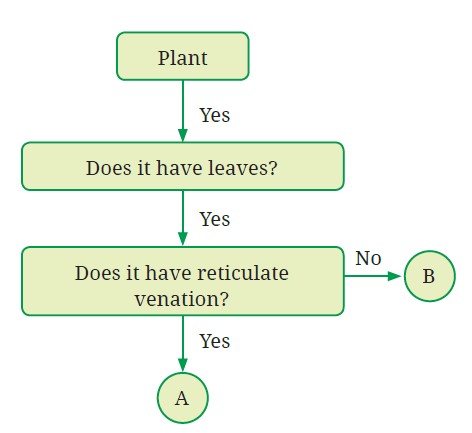
Answer: A. Plants with reticulate venation: Examples include mango, rose, or any other dicot plant
B. Plants with parallel venation: Examples include grass, wheat, or any other monocot plant
Question 8. Raj argues with his friend Sanjay that “Gudhal (hibiscus) plant is a shrub”. What questions can Sanjay ask for clarification?
Answer: Sanjay could ask following questions for clarification:
- How tall is the Gudhal (hibiscus) plant?
- Does it have a single main stem or multiple stems?
- Are the stems of Gudhal plant woody or soft?
- Do the branches start near the ground or higher?
Question 9. Based on the information in the table, find out examples of these plants for each group.
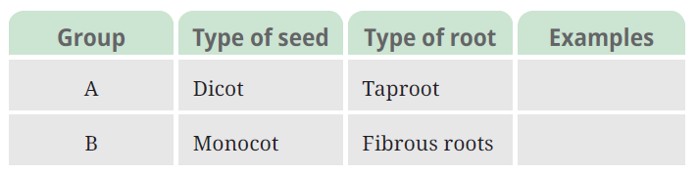
(a) What other similarities do plants of group A have?
(b) What other similarities do plants of group B have?
Answer:

(a) Plants in group A have reticulate venation in their leaves.
(b) Plants in group B have parallel venation in their leaves.
Question 10. Observe the labelled part of a duck in the picture given below. What differences do you observe in the feet of the duck compared to the other birds? Which activity would the duck be able to perform using this part?
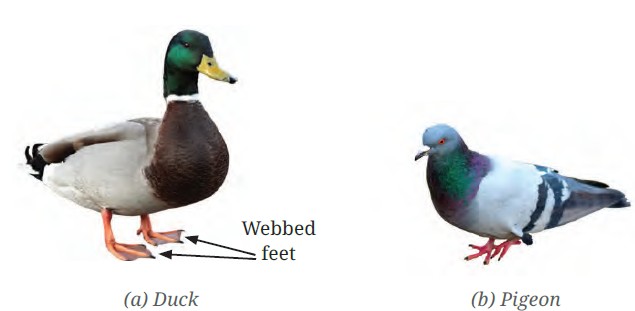
Answer: Difference in the feet: The duck has webbed feet, while the pigeon has separate toes.
Activities duck can perform with webbed feet:
The webbed feet help the duck swim in water. They act like paddles, making it easier for the duck to move through water.
We hope these NCERT Solutions for Class 6 Science help students understand the textbook activities, revise important concepts and prepare confidently for their examinations.
Diversity in the Living World Class 6 Science Chapter 2 NCERT Solutions
Class 6 Science Chapter 2, Diversity in the Living World, introduces students to the wide variety of plants and animals found around us. It explains how living organisms differ in their shapes, sizes, structures and habitats. Students also learn how plants and animals can be grouped based on their common characteristics and how different organisms adapt to their surroundings.
The important concepts covered in this chapter are:
- Diversity in Living Organisms: Understanding the variety of plants and animals found in different regions and the importance of biodiversity.
- Grouping of Plants: Learning how plants are classified into herbs, shrubs, trees, climbers and creepers based on their characteristics.
- Leaf Venation: Understanding the two main types of leaf venation, reticulate and parallel venation.
- Types of Roots: Learning about taproots and fibrous roots and identifying plants based on their root systems.
- Monocot and Dicot Seeds: Understanding the difference between seeds having one cotyledon and those having two cotyledons.
- Grouping of Animals: Exploring the different ways animals move and identifying their common characteristics.
- Habitats and Adaptations: Learning how plants and animals adapt to different surroundings, such as deserts, mountains, forests and water bodies.