

Looking for NCERT Solutions for Class 6 Science Curiosity Chapter 4 Exploring Magnets? Here, you will find easy-to-understand answers to all the important questions and activities from the NCERT Class 6 Science textbook. These solutions are prepared in simple language to help students understand the concepts, complete their homework and prepare for examinations.
Class 6 Science Chapter 4 Exploring Magnets NCERT Questions and Answers
Question: Do magnets stick to objects made of certain materials only? (Page – 62)
Answer: Yes, magnets stick to objects made of magnetic materials only. Magnetic materials, such as iron, nickel and cobalt are attracted to magnets. But materials such as wood, plastic and rubber are non-magnetic and thus do not stick to magnets.
Question: Do all parts of a magnet attract magnetic materials equally? (Page – 64)
Answer: No, all parts of a magnet do not attract magnetic materials equally. The ends of a magnet known as the poles have the strongest magnetic force. These poles attract magnetic materials more strongly than the middle part of the magnet.
Question: Can we find a magnet with a single pole? (Page – 65)
Answer: No, a magnet with a single pole cannot exist. Every magnet has both a north pole and a south pole. When a magnet is cut or broken each piece will have both poles even if it is very small.
Exploring Magnets Class 6 Textbook Questions
Let Us Enhance Your Learning
Question 1. Fill in the blanks
(i) Unlike poles of two magnets ______ each other, whereas like poles _____ each other.
(ii) The materials that are attracted towards a magnet are called _____.
(iii) The needle of a magnetic compass rests along the _____ direction.
(iv) A magnet always has _____ poles.
Answer:
(i) Unlike poles of two magnets attract each other, whereas like poles repel each other.
(ii) The materials that are attracted towards a magnet are called magnetic materials.
(iii) The needle of a magnetic compass rests along the north-south direction.
(iv) A magnet always has two poles.
Question 2. State whether the following statements are True (T) or False (F).
(i) A magnet can be broken into pieces to obtain a single pole. [ ]
(ii) Similar poles of a magnet repel each other. [ ]
(iii) Iron filings mostly stick in the middle of a bar magnet when it is brought near them. [ ]
(iv) A freely suspended bar magnet always aligns with the north-south direction. [ ]
Answer:
(i) False
Explanation: If a magnet is broken into pieces we don’t get a single pole, we get smaller magnets, each with its own north and south poles.
(ii) True
Explanation: Like poles of magnets repel each other, while unlike poles of magnets attract each other. The south pole of a magnet attracts the north pole of another magnet and repels the south pole of that magnet.
(iii) False
Explanation: The amount of iron filings that stick to a bar magnet depends on the strength of the magnet. The magnetism of a bar magnet is maximum at its two poles and minimum in the middle. Hence, maximum iron filings will stick at the two ends of the magnet and minimum in the middle.
(iv) True
Question 3. Column I shows different positions in which one pole of a magnet is placed near that of the other. Column II indicates the resulting interaction between them for different situations. Fill in the blanks.
| Column I | Column II |
| N – N | _______ |
| N – ___ | Attraction |
| S – N | _________ |
| ___ – S | Repulsion |
Answer:
| Column I | Column II |
| N – N | Repulsion |
| N – S | Attraction |
| S – N | Attraction |
| S – S | Repulsion |
Question 4. Atharv performed an experiment in which he took a bar magnet and rolled it over a heap of steel U-clips (Fig. 4.15).
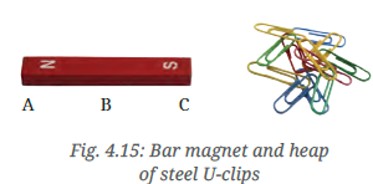
According to you, which of the options given in Table 4.3 is likely to be his observation?
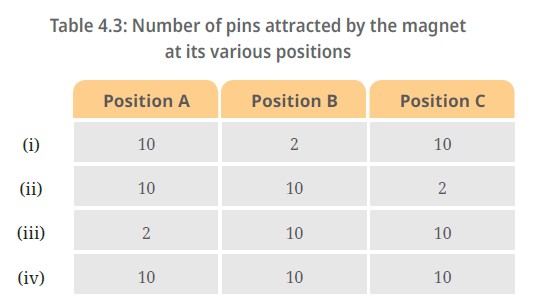
Answer: The strength of a magnet is more at the ends. So, the ends of the magnet have more iron fillings attached to it. Therefore, option (i) 10,2,10 is correct as it has more iron filling attracted to the end of the magnet.
Question 5. Reshma bought three identical metal bars from the market. Out of these bars, two were magnets and one was just a piece of iron. How will she identify which two amongst the three could be magnets (without using any other material).
Answer: Reshma can identify the magnets by using their property of repulsion. Two magnets will repel each other when similar poles are brought near, while an iron bar will be attracted by both poles of a magnet as it is a magnetic substance.
Question 6. You are given a magnet which does not have the poles marked. How can you find its poles with the help of another magnet which has its poles marked?
Answer: I will use another marked magnet to find the poles. The North pole of the marked magnet will attract the South pole and repel the North pole of the unmarked magnet.
Question 7. A bar magnet has no markings to indicate its poles. How would you find out near which end its North pole is located without using another magnet?
Answer: A freely suspended bar magnet will always align with the Earth’s North-South direction. The end pointing North is the North pole.
OR
A freely suspended bar magnet always comes to rest in the North−South direction. The north facing end of the magnet is its north pole, and the south facing end is its south pole. Hence, the unknown poles of a bar magnet can be marked by suspending it freely by a string.
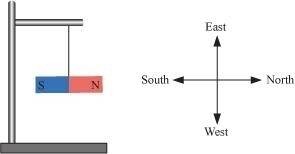
Question 8. If the earth is itself a magnet, can you guess the poles of earth’s magnet by looking at the direction of the magnetic compass?
Answer: Yes, we can guess the poles of Earth’s magnet by looking at the direction of the magnetic compass. The north seeking end of the compass needle points towards the geographic North Pole of the Earth, which is actually the Earth’s magnetic South pole.
Question 9. While a mechanic was repairing a gadget using a screw driver, the steel screws kept falling down. Suggest a way to solve the problem of the mechanic on the basis of what you have learnt in this chapter.
Answer: The mechanic can magnetize the screwdriver by rubbing it with a magnet several times in one direction. The screwdriver would then be able to attract the screws easily.
Question 10. Two ring magnets X and Y are arranged as shown in Fig. 4.16. It is observed that the magnet X does not move down further. What could be the possible reason? Suggest a way to bring the magnet X in contact with magnet Y, without pushing either of the magnets.
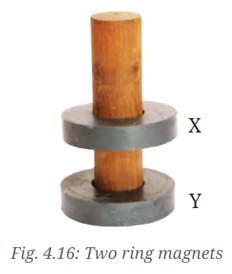
Answer: Magnet X not moving down because the like poles of Magnet X and Y (North-North or South- South) are facing each other causing repulsion. To bring them together, flip one magnet so that unlike poles (North-South) poles of the magnets are facing each other.
Question 11. Three magnets are arranged on a table in the form of the shape shown in Fig. 4.17. What is the polarity, N or S, at the ends 1, 2, 3, 4 and 6 of the magnets? Polarity of one end (5) is given for you.
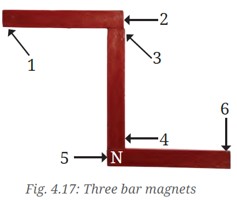
Answer: By observing the interactions and using the known polarity of one end we can determine the remaining ends based on attraction or repulsion.
Given end 5 is North (N), so end 4 and 6 must be south (S).
Similarly, since end 4 is south (S) end 3 must be North.
Now, we have end 3 is North hence end 2 is south. So, end 1 will be North.
So, we have
- 1- N
- 2- S
- 3- N
- 4- S
- 5- N
- 6- S
We hope these NCERT Solutions for Class 6 Science help students understand the textbook activities, revise important concepts and prepare confidently for their examinations.
Exploring Magnets Class 6 Science Chapter 4 NCERT Solutions
Class 6 Science Chapter 4, Exploring Magnets, introduces students to the interesting properties and uses of magnets. It explains how magnets attract certain materials, how their two poles behave and why a freely suspended magnet always points in the north-south direction. Students also learn about magnetic and non-magnetic materials, magnetic attraction and repulsion, and the use of magnets in everyday life.
Class 6 Science Chapter 4 – What Will You Learn?
The chapter Exploring Magnets helps students understand the basic properties of magnets and how they interact with different materials. It introduces the concept of magnetic poles and explains how magnets are useful in navigation and various everyday applications.
The important concepts covered in this chapter are:
- Magnets and Their Properties: Understanding what magnets are and how they attract certain materials such as iron.
- Magnetic and Non-Magnetic Materials: Learning to distinguish between materials that are attracted by magnets and those that are not.
- Types of Magnets: Exploring different shapes of magnets, such as bar magnets, horseshoe magnets, ring magnets and cylindrical magnets.
- Poles of a Magnet: Understanding the north pole and south pole of a magnet and their important properties.
- Magnetic Attraction and Repulsion: Learning that unlike poles attract each other, while like poles repel each other.
- Direction-Finding Property: Understanding why a freely suspended magnet always comes to rest in the north-south direction.
- Compass: Learning how a magnetic compass helps us identify directions.
- Uses of Magnets: Exploring how magnets are used in everyday objects and different devices.