

NCERT Solutions for Class 7 English Poorvi Chapter 12 Conquering the Summit are provided here with simple and easy-to-understand answers. This lesson is a part of Unit 4: Travel and Adventure in the NCERT English textbook Poorvi. It explores Arunima Sinha’s inspiring journey and the determination that helped her overcome immense challenges. These solutions help students understand the text and practise the textbook questions with confidence.
Conquering the Summit Questions and Answers Class 7 English Poorvi Chapter 12
Let us do these activities before we read (Page No. 166)
I. Identify the activities represented by the icons given below. Share your answers with your classmates and the teacher.
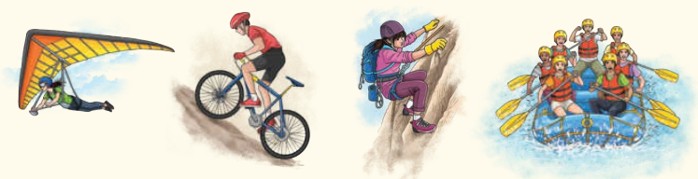
Answer:
1. Paragliding
2. Mountain biking
3. Rock climbing
4. River rafting
II. Work in pairs and discuss the following questions.
1. Why do you think people undertake the activities identified above?
Answer: People undertake these activities for fun, adventure, fitness, and to challenge themselves. They also enjoy exploring nature and trying new experiences.
2. How would they prepare for these activities?
Answer: They prepare by doing physical training, carrying proper equipment, learning safety rules, and taking guidance from experts.
3: Which one of them do you find the most exciting? Why?
Answer: I find mountain climbing the most exciting because it offers thrill, challenge, beautiful views. It also gives a strong feeling of success after reaching the top.
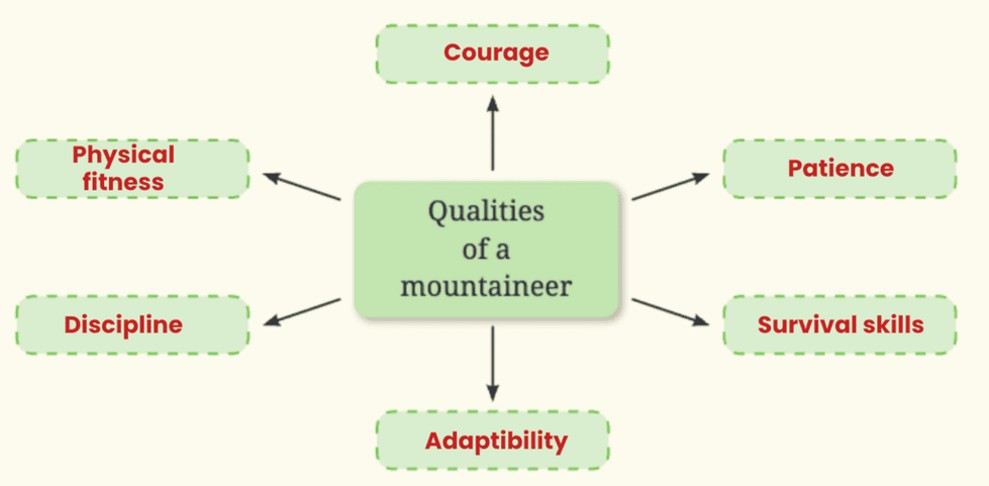
III. Work in pairs to complete the word web given below. Share the answers with the teacher.
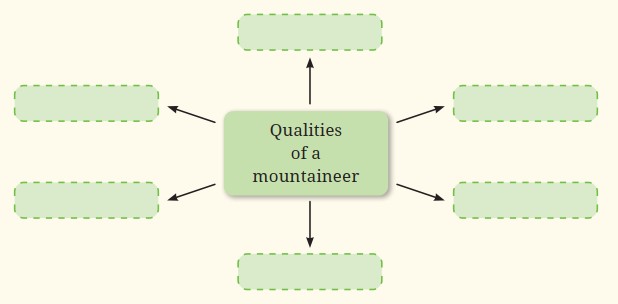
Answer:
Let us discuss (Page No. 169)
Read the statements given below and explain each statement in your own words.
1. Arunima Sinha is considered a beacon of hope and resilience.
Answer: Arunima Sinha is considered a beacon of hope and resilience because even after losing her leg in a train accident, she refused to give up. She trained hard and achieved the impossible by climbing Mount Everest. Her determination to walk again, and climb Everest inspires others to stay strong and motivated.
2. Arunima decided to climb Mount Everest despite losing her leg.
Answer: Arunima decided to climb Mount Everest despite losing her leg because she wanted to prove that her disability could not stop from achieving big dreams. She set a powerful goal that would give new meaning to her life. Inspired by Everest, she chose the challenge to show her courage, strength, and determination.
3. Bachendri Pal’s guidance was crucial in Arunima’s journey to the summit of Mount Everest. (Page 169)
Answer: Bachendri Pal, the first Indian woman to climb Everest encouraged Arunima when she doubted herself. As an experienced mountaineer, she understood the challenges of Everest and prepared Arunima mentally and physically. Her support, confidence, and advice helped Arunima believe in herself and reach the top of Mount Everest.
4. Arunima’s achievements go beyond just physical endurance.
Answer: Arunima’s achievements go beyond physical strength because they show her mental courage, self-belief, and strong willpower. She not only climbed Everest but also completed the Seven Summits.
5. Arunima’s autobiography inspires readers around the world. (Page 169)
Answer: Arunima’s autobiography inspires readers because it tells her real story of pain, struggle, and victory. It shows how she turned a tragic accident into a life of purpose through hard work and courage. Her experiences motivate people to stay strong, set meaningful goals, and believe that anything is possible with determination.
Let us think and reflect (Page No. 170)
Read the extract given below and answer the questions that follow.
1. Bachendri Pal instilled confidence in Arunima and said, “My child, you decided to climb Mount Everest in these situations with a prosthetic leg—you have conquered the Everest within you; the world will realise it later.”
On 21 May 2013, after 52 exhausting days, Arunima Sinha reached the summit of Mount Everest. Standing at the top of the world, she felt a surge of emotions—pride, relief, and an overwhelming sense of achievement.
1. Complete the sentence with a suitable reason.
Bachendri Pal said that Arunima had conquered the Everest within her because ______
Answer: Bachendri Pal said that Arunima had conquered the Everest within her because she had already overcome her fear, pain, and doubts despite losing her leg
2. How might Arunima have felt after what Bachendri Pal told her?
Answer: Arunima might have felt encouraged, confident, and motivated after hearing Bachendri Pal’s supportive words.
3. Choose a phrase from the extract which shows that reaching the summit of Mount Everest was tiring.
Answer: The phrase is: “after 52 exhausting days”.
4. Select the correct option to complete the sentence. After her success when Arunima felt ‘an overwhelming sense of achievement’, she would have most likely said, “_______”
(i) I am confident of my abilities
(ii) I will accomplish this soon
(iii) I am excited to begin this climb
(iv) I finally realised my dream
Answer: (iv) I finally realised my dream
II. Answer the following questions. (Page 170)
1. What did Arunima do in order to fulfil her ambition of conquering Mount Everest?
Answer: Arunima completed a basic mountaineering course, trained hard for eighteen months, and took guidance from Bachendri Pal to prepare herself physically and mentally for the climb.
2. Arunima is a beacon of hope and resilience. Support this statement with evidence from the text.
Answer: Arunima showed great courage after losing her leg in a train accident. Instead of giving up, she learned to walk again, trained for months, and finally climbed Mount Everest. This shows Arunima is a beacon of hope and resilience.
3. Arunima’s autobiography is titled Born Again on the Mountain: A Story of Losing Everything and Finding It Back. Why do you think this title is appropriate?
Answer: The title is appropriate because after Arunima lost her leg in an accident, she felt she had lost everything. Climbing Everest gave her new confidence, purpose, and identity. It was like starting her life again with fresh hope and strong determination.
4. Arunima says, “Failure is when we don’t have goals worthy enough.” What would be the most likely impact of this statement on readers?
Answer: This statement encourages readers to set meaningful goals and work hard for them. It teaches that true failure is not trying, and motivates people to dream big, stay focused, and never give up easily.
Let us learn (Page No. 171)
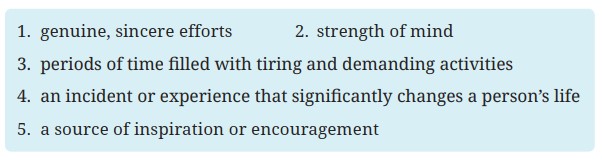
I. Read the underlined phrases in sentences (i)–(v) and match them with their appropriate meanings given in the box below.
(i) Nisha was relieved when the final match was over after several exhausting days of practice.
(ii) Despite several failures, her heartfelt attempts to learn the guitar showed her determination and passion for music.
(iii) Moving to a new city was a life-altering event for Jagan, as it gave him the chance to make new friends and try different activities.
(iv) Competing in the marathon requires not just physical strength but also mental fortitude to stay focused and finish the race.
(v) The lighthouse served as a beacon of hope for the sailors lost at sea.
Answer: (i) exhausting days → 3. periods of time filled with tiring and demanding activities
(ii) heartfelt attempts → 1. genuine, sincere efforts
(iii) life-altering event → 4. an incident that significantly changes a person’s life
(iv) mental fortitude → 2. strength of mind
(v) beacon of hope → 5. a source of inspiration or encouragement
II. Complete the following table by filling in the gaps with correct parts of speech mentioned. An example has been done for you.
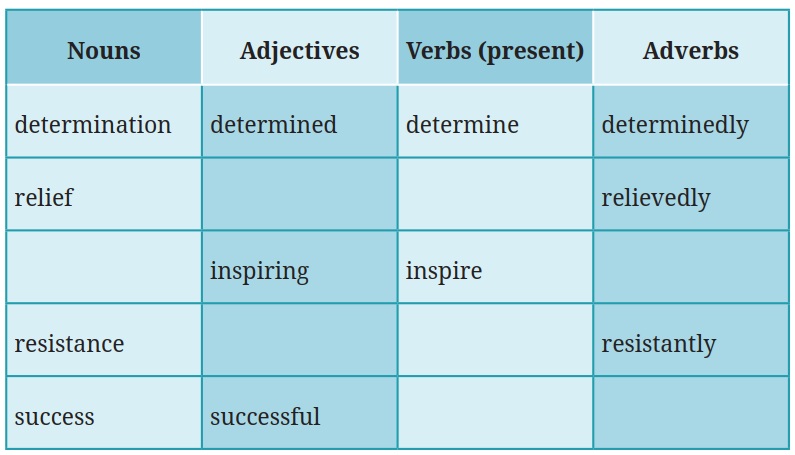
Answer:
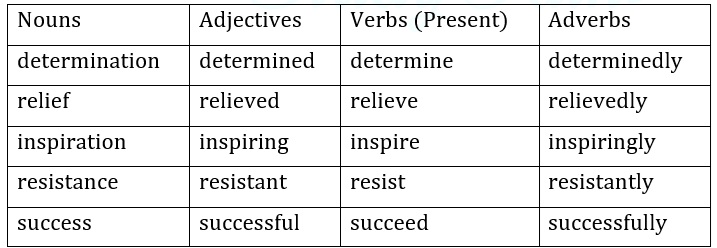
III. Study the highlighted words in the following sentences from the text. (Page 172)
- Arunima made a vow that many would deem impossible.
- Her father was an army engineer.
- Standing at the top of the world, she felt a surge of emotions—pride, relief, and an overwhelming sense of achievement.
- She planted the Indian flag at the summit and left behind a photograph of her idol, Swami Vivekananda.
- Arunima Sinha’s journey from a devastating accident to scaling the highest peak in the world stands as a beacon of hope and resilience.
The highlighted words are articles.
‘A’ and ‘an’ are indefinite articles; ‘the’ is the definite article. The choice between ‘a’ and ‘an’ depends on the sound that follows the article, specifically the initial sound of the word that follows.
1. Fill in the blanks with ‘a’, ‘an’, ‘the’. Put an ‘x’ where no article is required.
We planned (i) _______ adventurous trip to (ii) _______ remote island. (iii) _______ island was known for its beautiful landscapes and (iv) _______ diverse wildlife. On (v) _______ fist day, we set out to explore (vi) _______ island’s dense jungle. (vii) _______ guide led us through (viii) _______ thick foliage and showed us (ix) _______ hidden waterfall. In (x) _______ evening, we gathered around (xi) _______ campfire to share stories and enjoy (xii) _______ meal we cooked. (xiii) _______ experience was truly unforgettable, and we felt (xiv) _______ connection with (xv) _______ nature.
Answer: We planned (i) an adventurous trip to (ii) a remote island. (iii) The island was known for its beautiful landscapes and (iv) x diverse wildlife. On (v) the first day, we set out to explore (vi) the island’s dense jungle. (vii) A guide led us through (viii) the thick foliage and showed us (ix) a hidden waterfall. In (x) the evening, we gathered around (xi) a campfire to share stories and enjoy (xii) a meal we cooked. (xiii) The experience was truly unforgettable, and we felt (xiv) a connection with (xv) x nature.
2. There is an error in each sentence that has been underlined. Correct the error in the following sentences.
(i) We waited for a hour before the bus finally arrived.
Answer: We waited for an hour before the bus finally arrived.
Explanation: “a hour” is incorrect because “hour” starts with a vowel sound (/aʊ/), so “an” is used: “an hour.”
(ii) The guide insisted on an uniform jacket for the group’s safety during the trek.
Answer: The guide insisted on a uniform jacket for the group’s safety during the trek.
Explanation: “an uniform” is incorrect because “uniform” starts with a consonant sound (/juː/), so “a” is used: “a uniform.”
(iii) Mount K2 is a second highest peak in the world.
Answer: Mount K2 is the second highest peak in the world.
Explanation: “a second highest peak” is incorrect; “the” is needed for the superlative form to specify it’s a unique position: “the second highest peak.”
(iv) A Ganga is a sacred river in India, known for its cultural importance.
Answer: The Ganga is a sacred river in India, known for its cultural importance.
Explanation: “A Ganga” is incorrect because “Ganga” is a specific river, so the definite article “The” is used: “The Ganga.”
(v) Challenges are faced with courage and determination by a brave.
Answer: Challenges are faced with courage and determination by the brave.
Explanation: “a brave” is incorrect because “brave” here refers to a general group (brave people), so “the” is used: “the brave.”
(vi) A North Star has guided travellers for centuries.
Answer: The North Star has guided travellers for centuries.
Explanation: “A North Star” is incorrect because “North Star” is a specific star, so the definite article “The” is used: “The North Star.”
Let us write (Page No. 174)
Read the various components of a formal letter from the box given below.

1. Now, read the letter given below and write the matching components.
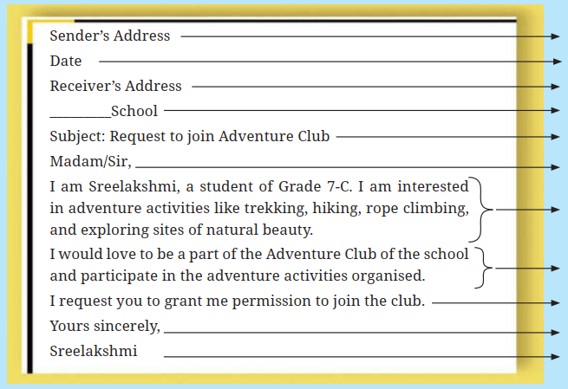
Answer:
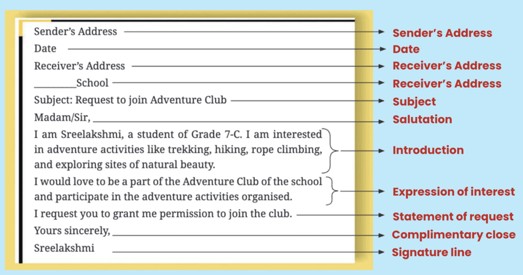
2. Write a letter to the Principal of your school requesting her to organise an excursion to a nearby hill station for Grade 7 students of your school.
Answer:
123, Green Street
Noida
Uttar Pradesh
10 May 2025
To
The Principal
Kendriya Vidyalaya
Subject: Request to Organise an Excursion to a Hill Station
Respected Madam/Sir,
I am a student of Grade 7 and I request you to kindly organise an excursion to a nearby hill station for our class. Such a trip will help us relax, learn about nature, and build team spirit. It will also be an enjoyable and educational experience for all students. We assure you that we will follow all safety measures and guidelines during the trip.
I request you to consider our request and grant your approval.
Thank you.
Yours sincerely,
Arun Krishna
Grade 7
Class 7 English Poorvi Chapter 12 NCERT Solutions
These NCERT Solutions for Class 7 English Poorvi Chapter 12 help students understand the main ideas, complete textbook exercises, improve their language skills, and prepare for school examinations.
The lesson Conquering the Summit presents Arunima Sinha’s journey towards climbing Mount Everest after losing a leg. It highlights the resolve, preparation, and hard work involved in pursuing a demanding goal. Her experience shows how courage and support can help someone move forward after a life-changing setback.
Students also explore resilience, self-belief, and the importance of sustained effort. The chapter encourages them to understand the challenges behind an achievement and express their responses to an inspiring real-life account through comprehension and writing activities.