

NCERT Solutions for Class 7 English Poorvi Chapter 11 Travel are provided here with simple and easy-to-understand answers. This poem is a part of Unit 4: Travel and Adventure in the NCERT English textbook Poorvi. It explores the longing to travel and the excitement inspired by the sound and movement of trains. These NCERT Solutions for Class 7 help students understand the main ideas, complete textbook exercises, improve their language skills, and prepare for school examinations.
Travel Questions and Answers Class 7 English Poorvi Chapter 11
Let us do these activities before we read (Page No. 157)
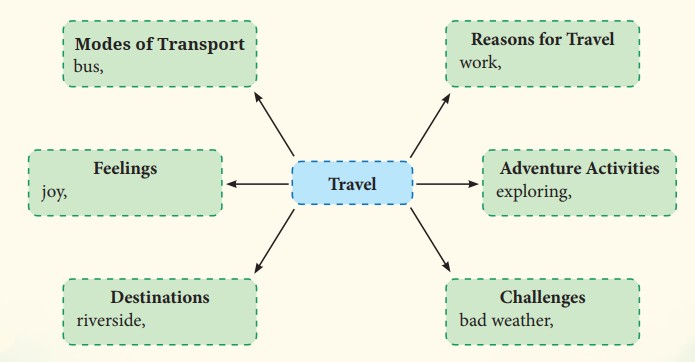
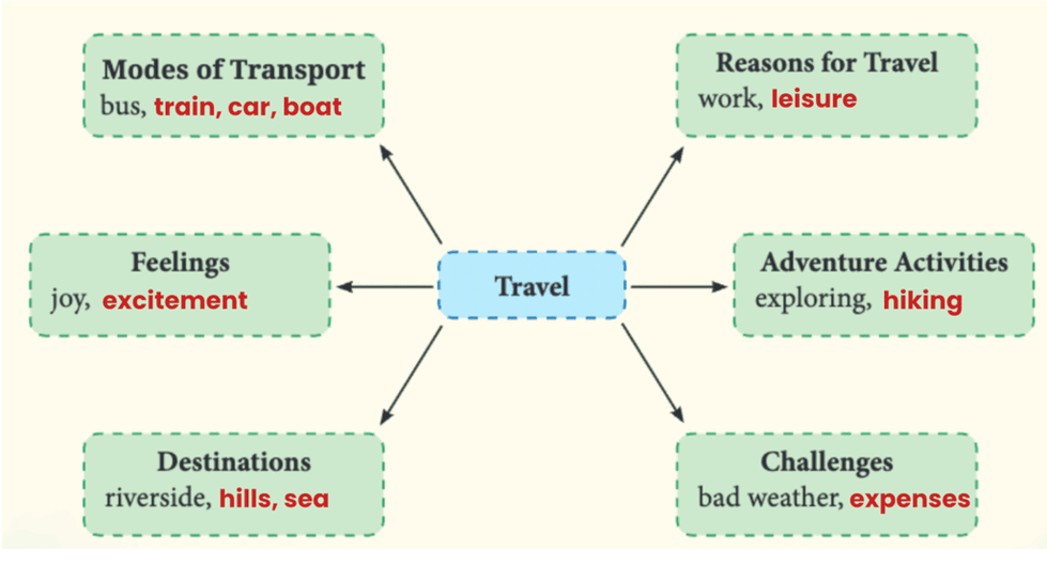
I. Complete the following word web on travel.
Answer:
II. You are going on a trip to an adventure camp with your classmates and teacher.
1. How will you travel to the adventure camp?
Answer: I will travel to the adventure camp by train with my classmates and teacher.
2. What things will you take along?
Answer: I will take a water bottle, snacks, a cap, a torch, comfortable clothes, camera and a small first-aid kit.
3. Why would you like to go there?
Answer: I would like to go there to enjoy nature, try new activities, and have fun with my friends.
4. What are the activities you would like to do with your friends?
Answer: I would like to do trekking, rock climbing, rope activities, and play team games with my friends.
5. How much time will it take to complete your adventure trip?
Answer: It will take about two days to complete the adventure trip.
III. Discuss in pairs. What might be the reasons that people enjoy train journeys?
Answer: People enjoy train journeys because they can relax, enjoy the changing scenery, meet new people, and feel the smooth, rhythmic movement of the train. Train journeys are also comfortable, safe, and give time to talk, read, or enjoy the view outside.
Let us discuss (Page No. 159)
I. The main ideas of each stanza of the poem are given below. Write the number of the
stanza against the matching main idea.
1. At night, the speaker imagines the train and hears its engine in the quiet
Answer: Stanza 2
2. The speaker feels a strong desire to take any train, no matter where it goes
Answer: Stanza 3
3. The speaker hears the train whistle during the day, even though the train is far away
Answer: Stanza 1
II. Read the poem and underline the rhyming words in each stanza. Write the rhyming words from each stanza. An example has been done for you.
1. Stanza (i)
Answer: away-day; speaking-shrieking
2. Stanza (ii)
Answer: by-sky; dreaming-steaming
3. Stanza (iii)
Answer: make-take; knowing-going
III. Identify the rhyme scheme of the poem from the options given below.
1. AABB
2. ABCA
3. ABAB
4. ABBC
Answer: 1. AABB
IV. Identify the word in the poem that personifies the whistle of the train.
Answer: shrieking
V. Tone refers to the attitude the poet has about the poem. Which of these words can be used to describe the poet’s tone in this poem?

Answer: excited; curious; enthusiastic; joyful
VI. Select the words that tell us what the train symbolises for the poet.
1. education
2. adventure
3. Comfort
4. opportunities
Answer: 2. adventure
VII. Complete the following by choosing the correct option from those given in brackets.
The poet repeats the line, ‘…there isn’t a train goes by,’ in all three stanzas to _______. (highlight the speaker’s fascination with the train/suggest that the area has many trains passing through)
Answer: The poet repeats the line, ‘…there isn’t a train goes by,’ in all three stanzas to highlight the speaker’s fascination with the train.
VIII. The poem contrasts the busy day with the stillness of the night. What is the common factor in these? (Page 160)
Answer: The common factor in both the busy day and the still night is the train. The speaker always notices its whistle or sound, whether it is day or night.
IX. Imagery is a literary device that uses descriptive language to create mental pictures and appeal to the reader’s senses (sight, sound, smell, taste and touch). It makes the descriptions more relatable. Select the phrases from the poem that are examples of imagery.
Answer: Phrases showing imagery from the poem are:
- “day is loud”
- “whistle shrieking”
- “cinders red on the sky”
- “engine steaming”
Let us think and reflect (Page No. 160)
Read the extract given below and answer the questions that follow.
1. My heart is warm with the friends I make,
And better friends I’ll not be knowing…
(i) Choose the suitable option to complete the following.
The line ‘My heart is warm’ refers to a heart that is _____
A. filled with worries
B. full of love
C. feeling upset
D. experiencing anger
Answer: B. full of love
(ii) What does the speaker say about her current friends?
Answer: The speaker says that her current friends are very good friends and she will never find better friends than them.
(iii) What does the line ‘better friends I’ll not be knowing’ suggest about the speaker’s feelings toward their current friends?
Answer: It suggests the speaker feels her current friends are the best. She feels deeply satisfied and grateful for them.
(iv) Complete the following suitably.
The tone of the speaker in these lines is ______ (grateful/content)
Answer: The tone of the speaker in these lines is content.
II. Answer the following questions. (Page 160)
1. What does the phrase ‘cinders red on the sky’ tell us about the train at night?
Answer: It tells that the burning sparks from the train fly up and glow like red cinders in the dark sky.
2. What is the significance of the repeated references to the train’s whistle?
Answer: The repeated references to the train’s whistle show the speaker’s strong fascination with trains and how she thinks about them all the time.
3. What does the line ‘no matter where it’s going’ reveal about the speaker’s attitude towards travel?
Answer: The line “no matter where it’s going” shows that the speaker is eager for adventure and is willing to travel anywhere just for the joy of the journey.
4. Do you think the poet actually sees and hears the train? Why or why not?
Answer: No, the poet does not actually see or hear the train. The poet imagines the train because she loves travelling. Even when the train is far away, she feels its presence in her mind and dreams.
Let us learn (Page No. 161)
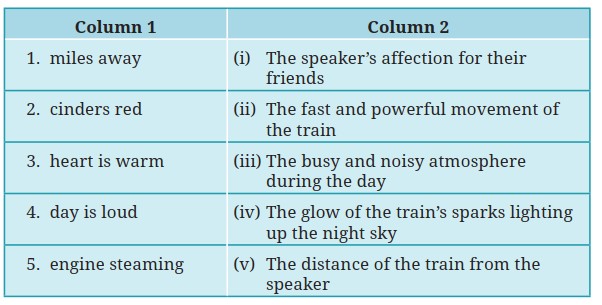
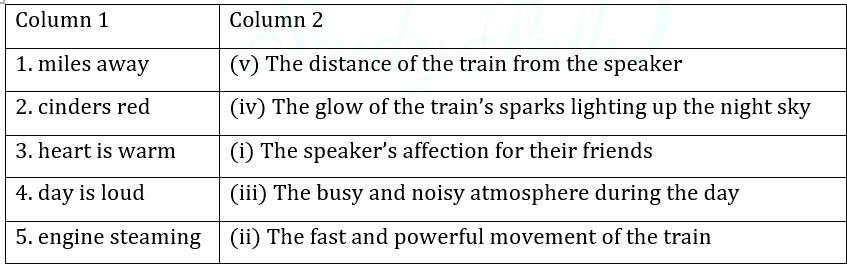
I. Read the expressions from the poem given in Column 1 and match them with what they indicate in Column 2.
Answer:
Now, use the expressions in Column 1 to fill in the following blanks correctly.
1. After meeting her old friend, her ______ with the joy of rekindled memories.
2. As I arrived at the railway station I could hear the ______.
3. The marketplace is bustling, and the ______ with the chatter of shoppers and vendors.
4. The bonfire glowed brightly, throwing ______ into the dark night sky.
5. The sound of a train could still be heard _____ as the evening grew quiet.
Answer: 1. After meeting her old friend, her heart is warm with the joy of rekindled memories.
2. As I arrived at the railway station I could hear the engine steaming.
3. The marketplace is bustling, and the day is loud with the chatter of shoppers and vendors.
4. The bonfire glowed brightly, throwing cinders red into the dark night sky.
5. The sound of a train could still be heard miles away as the evening grew quiet.
II. The poet uses the word ‘shrieking’ to tell us about the sound of the train’s whistle. There are other words that tell us about different types of related sounds.
Read the meanings of such words in Column 1 and match them with the words in Column 2.
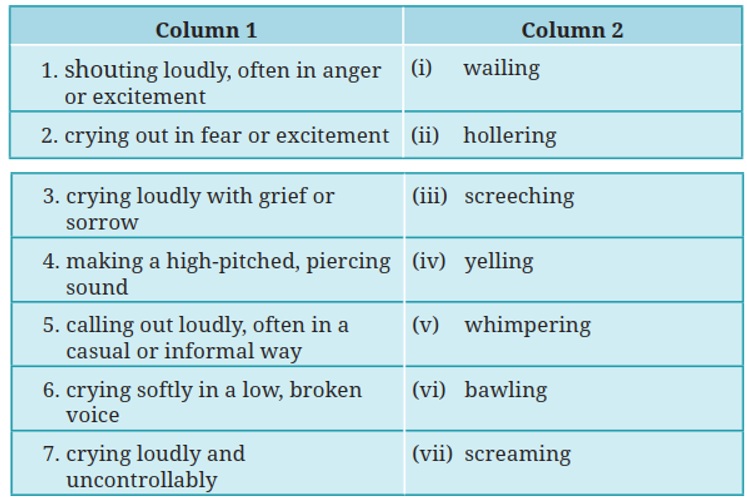
Answer:
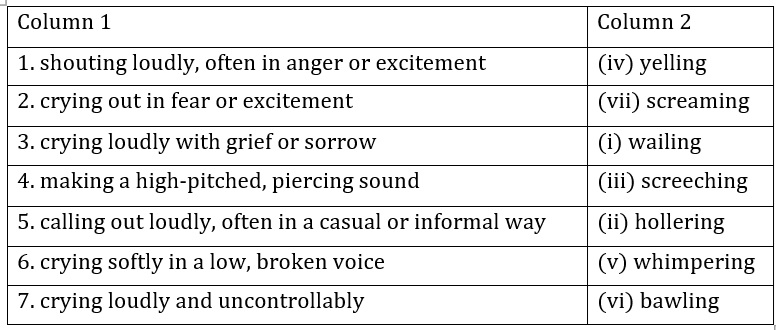
Now, complete the following paragraph by using suitable words from Column 2.
The street was filed with a variety of sounds. A shopkeeper was 1. ______ to attract customers, while a child nearby was 2. _______ at his friend to wait for him. From the other side of the road, a toddler was 3. ________ uncontrollably after dropping his ice cream, and his mother tried to calm him as he began 4. _________ softly. In the background, someone’s loud 5. _________ voice added to the bustling noise of the busy evening
Answer: The street was filled with a variety of sounds. A shopkeeper was yelling to attract customers, while a child nearby was hollering at his friend to wait for him. From the other side of the road, a toddler was bawling uncontrollably after dropping his ice cream, and his mother tried to calm him as he began whimpering softly. In the background, someone’s loud screaming voice added to the bustling noise of the busy evening.
Class 7 English Poorvi Chapter 11 NCERT Solutions
The poem Travel expresses a strong desire to travel beyond familiar surroundings. The presence of a distant railway stirs the speaker’s imagination, even during ordinary moments of daily life. Images of trains capture the attraction of movement, discovery, and journeys into the unknown.
Students also explore the speaker’s feelings, the poem’s imagery, and the way sounds suggest the excitement of travel. The activities help them appreciate poetic expression and explain how a simple sight or sound can awaken a wish for adventure.