

NCERT Solutions for Class 7 English Poorvi Chapter 3 Three Days to See are provided here with simple and easy-to-understand answers. This lesson is a part of Unit 1: Learning Together in the NCERT English textbook Poorvi. It explores Helen Keller’s reflections on sight and the importance of appreciating the world through our senses. These NCERT Solutions for Class 7 help students understand the main ideas, complete textbook exercises, improve their language skills, and prepare for school examinations.
Three Days to See Questions and Answers Class 7 English Poorvi Chapter 3
Let us discuss (Page 31)
I. Work in pairs. Identify the statements that are true from the ones given below. Share your answers with the teacher.
1. The author expresses a deep longing to experience the world through the sense of hearing.
Answer: False.
Reason: The author expresses a deep longing to experience the world through the sense of sight.
2. The author would like exploring the city only to observe how people are suffering.
Answer: False.
Reason: The author wants to observe all aspects of life, not only suffering.
3. The author would spend the first day seeing the people whose kind-heartedness and friendship have enriched her life.
Answer: True.
4. The author acknowledges that even in three days, she would not be able to see everything.
Answer: True.
5. The author feels that everyone can find the greatest joy merely by the sense of touch.
Answer: False.
Reason: The author feels sight is the most delightful of all senses, not touch.
6. The author advises those who can see to appreciate every moment as if they might lose their senses tomorrow.
Answer: True.
7. On the third day, the author would like to observe people in their daily lives and understand their experiences.
Answer: True.
II. Complete the table given below with what Helen Keller wanted to do on the three days if she had sight.
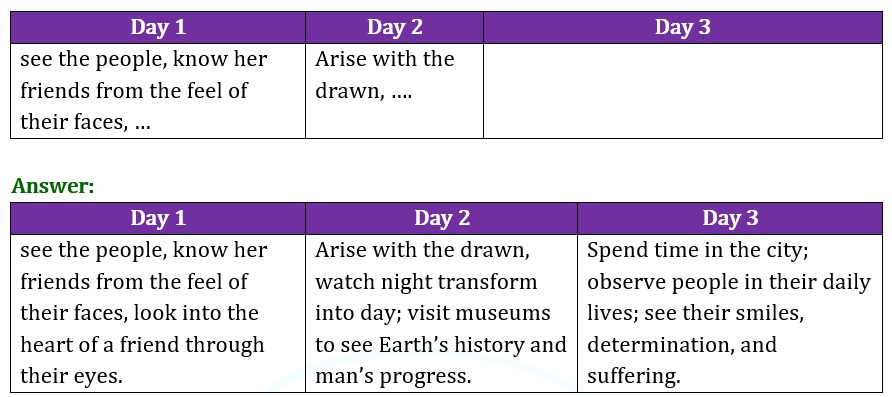
III. The author says that you need eyes to be able to ‘see’ the true self of a person. Therefore, she refers to the eye as ‘window of the soul’. How is the narrator able to understand the feelings of a person?
Answer: Although the narrator cannot see, she understands people’s feelings by gently moving her fingertips over their face. Through her fingertips, she can notice expressions like laughter, sadness, or worry. This helps her recognise emotions and connect with others, even without sight.
Let us think and reflect (Page 32)
I. Read the extracts given below and answer the questions that follow.
1. I feel the delicate symmetry of a leaf. I pass my hands lovingly about the smooth skin of a silver birch, or the rough, shaggy bark of a pine. In spring, I touch the branches of trees hopefully in search of a bud, the first sign of awakening Nature after her winter’s sleep. Occasionally, I am very fortunate; I place my hand gently on a small tree and feel the happy quiver of a bird in full song.
(i) What does the ‘delicate symmetry of a leaf’ symbolise?
Answer: The phrase “delicate symmetry of a leaf” symbolises the beauty, balance, and perfection of nature’s design.
(ii) List two phrases from the extract that describe the texture of objects in nature.
Answer: Two phrases that describe the texture of objects in nature are:
1. The smooth skin of a silver birch.
2. The rough, shaggy bark of a pine.
(iii) Complete the sentence appropriately.
The phrase ‘awakening Nature after her winter’s sleep’ refers to __________________.
Answer: The phrase ‘awakening Nature after her winter’s sleep’ refers to the arrival of spring when new leaves and buds start to grow again.
(iv) What is the tone of the writer in this extract?
A. nostalgic
B. proud
C. admiring
D. celebratory
Answer: C. admiring
2. The next day I should arise with the dawn and see the thrilling miracle by which night is transformed into day. I should behold with awe the magnificent panorama of light with which the sun awakens the sleeping earth. This day I should devote to a hasty glimpse of the world, past and present. I should want to see the pageant of man’s progress, and so I should go to the museums.
(i) The word ‘thrilling’ has been used with ‘miracle’.
Which of the following words does not match with the word ‘thrilling’?
A. experience
B. tale
C. knowledge
D. adventure
Answer: C. knowledge
(ii) Why does the writer refer to the earth as ‘sleeping earth’?
Answer: The writer refers to the earth as the “sleeping earth” to show that the world looks quiet and still before sunrise at night, as if the earth is resting or asleep.
(iii) Complete the sentence with an appropriate reason.
The writer wishes to dedicate the day to a brief look at the present and past world because _______________.
Answer: The writer wishes to dedicate the day to a brief look at the present and past world because she wants to learn about human progress and explore history in a short time.
(iv) Why does the writer use ‘should’ multiple times in the extract?
Answer: The writer uses ‘should’ repeatedly because she is imagining what she would do if she could see for a limited time. It expresses her wishes and plans for those precious days.
II. Answer the following questions. (Page 33)
1. The sense of touch makes up for the loss of sight and hearing. Explain this statement with reference to the text.
Answer: In the text, Helen Keller explains that touch becomes her way of experiencing everything she cannot see or hear. She uses her fingertips to feel the faces of her friends and detect emotions like laughter or sorrow. She also feels the shape of leaves, the budding branches in spring, and the quiver of a bird singing. Thus, touch helps her explore nature and recognise people, making up for the loss of sight and hearing.
2. Why does the author believe that the sense of sight is the most wonderful?
Answer: The author believes the sense of sight is the most wonderful because it reveals the beauty, colours, shapes, and movements of the world instantly. Sight allows a person to enjoy nature, understand people’s expressions, and observe daily life.
3. How might the author’s opinion on making the most of our senses guide us to be kinder towards people with special abilities? (Page 33)
Answer: The author’s view encourages us to value our own senses and understand how difficult life can be without them. It teaches us to understand the challenges faced by people with special abilities and to treat them with respect and empathy.
4. What is the significance of imagining the loss of a sense, according to the author?
Answer: According to the author, imagining the loss of a sense helps us understand how precious each sense is. When we think about life without sight, hearing, smell, taste, or touch, we become more grateful for them and learn to use them more fully.
5. How does the author encourage people to approach their everyday sensory experiences?
Answer: The author encourages people to approach their everyday sensory experiences with awareness and gratitude. She advises them to use each sense as if they might lose it tomorrow. By doing so, people learn to enjoy small details and appreciate the beauty of life more deeply.
6. What do the author’s choices for the three days tell us about her values and priorities? (Page 33)
Answer: The author wants to see the people she loves, enjoy the beauty of the world, and gain knowledge by visiting museums. This reveals that she believes in making the most of life through relationships, appreciation of nature, and the pursuit of knowledge.
Let us learn (Page 34)
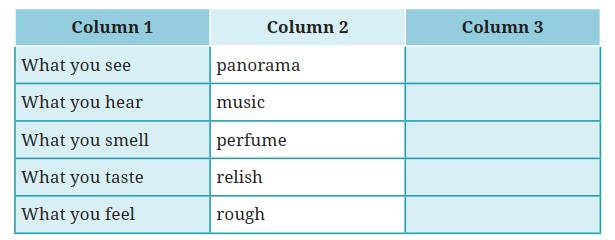
I. Sensory words are descriptive—they describe how we experience the world: how we see, hear, smell, taste or feel something.
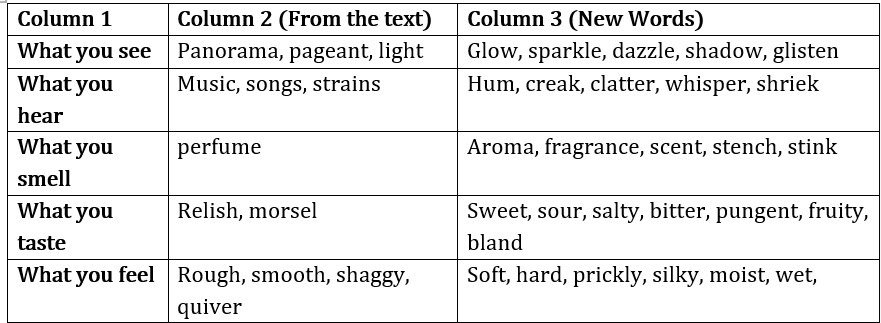
Complete the following table with sensory words from the text in Column 2 for the five senses in Column 1. Add new words in Column 3.
Answer:
II. Read the following sentences from the text and underline the verbs.
- I should divide the period into three parts.
- On the first day, I should want to see…
- The next day I should arise with the dawn…
- I should behold with awe…
Answer:
- I should divide the period into three parts.
- On the first day, I should want to see…
- The next day I should arise with the dawn…
- I should behold with awe…
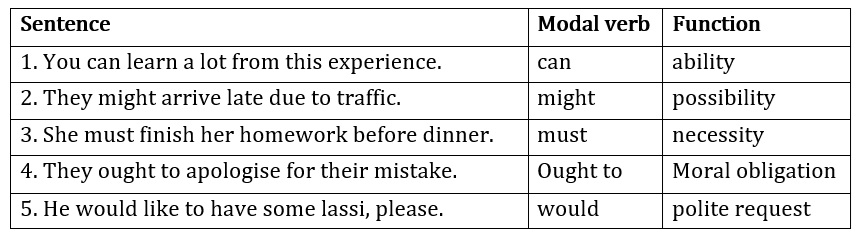
III. Identify the modal verbs in the following sentences. Choose the functions they express from those given in the box below.

1. You can learn a lot from this experience.
2. They might arrive late due to traffic.
3. She must finish her homework before dinner.
4. They ought to apologise for their mistake.
5. He would like to have some lassi, please.
Answer:
IV. Read the situations in Column 1 and functions in Column 2. Fill in the blanks in the sentences in Column 4 with appropriate modal verbs from Column 3. After filling in the blanks, explain the function of each modal verb you used to your classmates and the teacher. (Page 35)
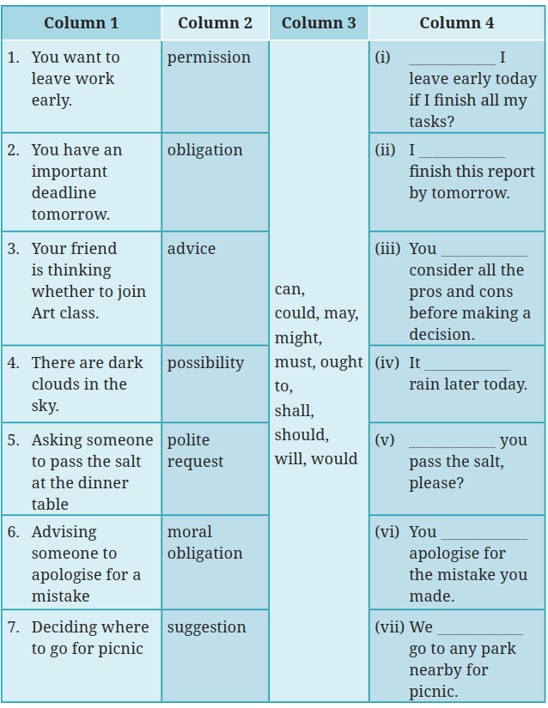
Answer:
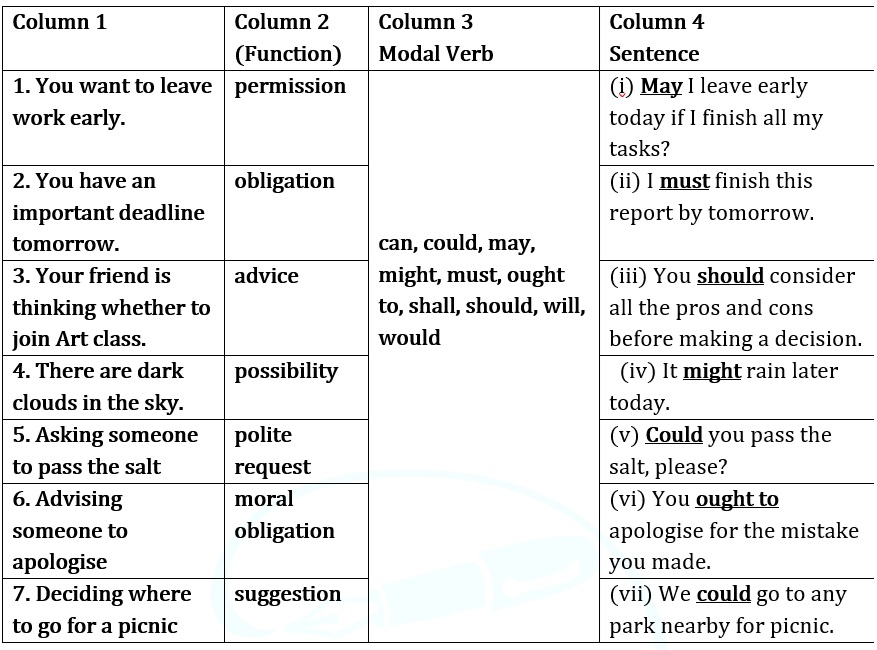
Explanation of Functions:
(i) May – used for asking polite permission.
(ii) Must – shows a strong obligation or necessity.
(iii) Should – used to give advice or a recommendation.
(iv) Might – indicates a possibility.
(v) Could – a polite way to request something.
(vi) Ought to – expresses a moral responsibility or duty.
(vii) Could – used to make a suggestion.
Let us listen (Page 36)
Question: You will listen to a conversation between a mother and son. As you listen, select four true statements from 1–7 given below. (Transcript for the teacher on pg. 41)
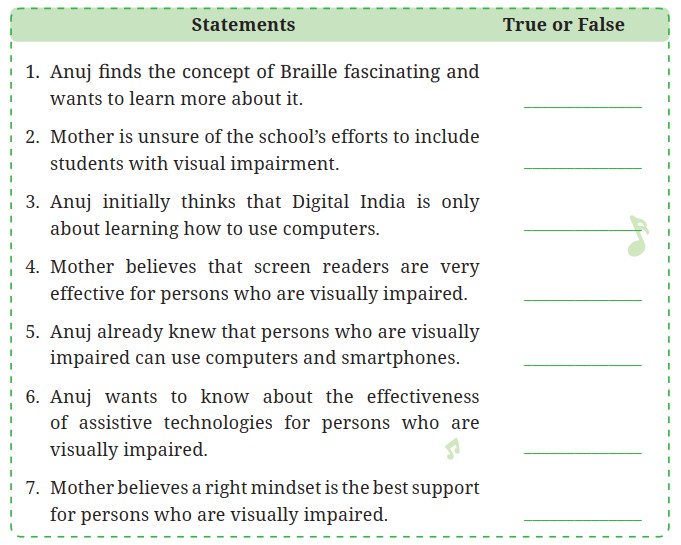
Answer:
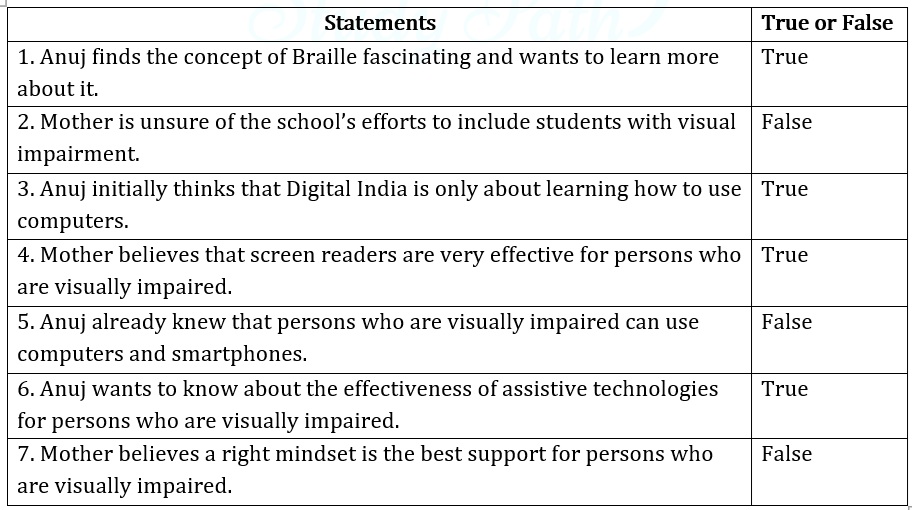
Let us speak (Page 36)
Question: Work in pairs. Take turns to speak for a minute on any one of the senses you value the most. Use the given prompts to frame your response before you speak.
- I value my sense of sight/sound/ touch/smell/taste the most because…
- One of my favourite experiences is…
- This is so because…
- I appreciate being able to see/hear/ touch / smell / taste…
- God forbid, if I were to lose the sense of sight/sound/touch/smell/taste, it would make me feel…
- I would not be able to…
- I thank God that I am able to see/ hear / touch / smell / taste.
Remember to
- speak clearly and confidently
- glance at your notes for reference rather than reading
- make eye contact
- use gestures if you wish to
- pronounce words clearly and avoid mumbling
- speak at a steady, moderate pace
Answer: I value my sense of sight the most because it helps me understand and enjoy the world instantly. One of my favourite experiences is watching the sunrise early in the morning. This is so because the colours of the sky make me feel calm and happy. I appreciate being able to see the faces of my family, the greenery of trees, and the beauty of nature around me. God forbid, if I were to lose my sense of sight, it would make me feel lost and frightened. I would not be able to read books, recognise people easily, or see the beauty of the world. I thank God that I am able to see and experience the world so clearly. Sight is truly a precious gift.
Let us write (Page 37)
Question: A descriptive paragraph describes a person, place, object or event to create a memorable experience for the reader. Write a descriptive paragraph describing a place that you visited recently.
Follow the guidelines given below to draft this paragraph.
1. In the opening line, begin with something interesting to capture the reader’s attention. Introduce the place you visited.
2. In the supporting lines, describe the place using adjectives and specific details that appealed to your five senses—sight, sound, smell, taste, and touch. You may include alliterations, similes, and personifications to hold the reader’s attention.
3. In the concluding lines, summarise the description to provide a final impression. Mention what was the most important thing about that place which others should also experience.
Answer: The moment I stepped near the lakeside, I felt as if the world had suddenly slowed down to welcome me. The calm blue water stretched out like a giant mirror, reflecting the soft golden glow of the early morning sun. I could hear the gentle splash of tiny waves touching the shore and the sweet chirping of birds hidden in the trees. The fresh smell of damp earth and blooming flowers filled the air, making every breath refreshing. When I tasted a cup of warm tea from a nearby stall, it felt even more comforting in that peaceful setting. The lakeside, with its colours, sounds, scents, and soothing beauty, left a lasting impression on me.
Class 7 English Poorvi Chapter 3 NCERT Solutions
The lesson Three Days to See presents Helen Keller’s thoughts on what she would wish to see if she had sight for three days. Her reflections draw attention to people, nature, art, and the ordinary experiences that are often taken for granted. It encourages readers to observe life with greater care and gratitude.
Students also learn about empathy and the value of making thoughtful use of their senses. The chapter helps them interpret the writer’s perspective, discuss meaningful experiences, and develop descriptive language through reading and writing activities.