

NCERT Solutions for Class 7 English Poorvi Chapter 5 A Funny Man are provided here with simple and easy-to-understand answers. This poem is a part of Unit 2: Wit and Humour in the NCERT English textbook Poorvi. It explores an unusual man whose appearance and actions create playful and surprising moments. These NCERT Solutions for Class 7 help students understand the main ideas, complete textbook exercises, improve their language skills, and prepare for school examinations.
A Funny Man Questions and Answers Class 7 English Poorvi Chapter 5
Let us do these activities before we read (Page 59)
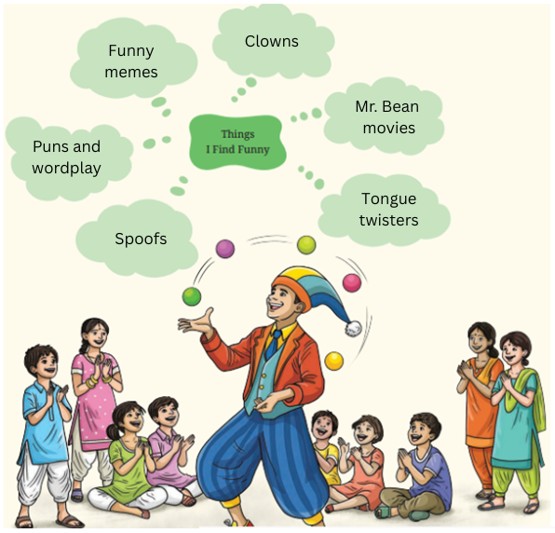
Look around you for things or people that make you laugh. Write them in the bubbles given below. Share the reasons for your answers with your classmates and the teacher.
Answer:
Let us discuss (Page 61)
I. Work in pairs. Identify the true statements. Check your answers with the teacher.
1. The poet says that she had never heard such an amusing song.
2. The funny man was quite ill-mannered.
3. The funny man wore two hats on his feet.
4. The funny man hopped on his head to reach home.
5. The funny man gave a rose to the poet.
6. The funny man smiled at the poet.
Answer:
1. True
2. False – The man “smiled politely” and was well-mannered.
3. True
4. True
5. False – He gave a currant bun, not a rose.
6. True
II. Identify the words from the poem based on the meanings given.
Share your answers with your classmates and the teacher.
1. a small seedless raisin – C __ R __ __ __ T
2. moved unsteadily – S __ __ G G __ __ __ D
Answer:
1. a small seedless raisin – C U R R A N T
2. moved unsteadily – S T A G G E R E D
III. Complete the following sentences with a reason. (Page 61)
1. The tone of the poem is ___________ because ___________.
Answer: The tone of the poem is humorous because the funny man behaves in silly and unusual ways, like wearing shoes on his head
2. The rhyme scheme of the poem is ___________; and it gives a ___________quality to the poem.
Answer: The rhyme scheme of the poem is ABCB; and it gives and it gives a musical and playful quality to the poem.
3. The poet has frequently repeated the word ‘funny’ in order to ___________.
Answer: The poet has frequently repeated the word ‘funny’ in order to highlight the strange and amusing behaviour of the man.
IV. Choose the correct answer from the options given in the brackets.
1. The poem uses vivid imagery to create a _______________(humorous and nonsensical/ confusing but thought-provoking) scene.
2. The structure of the poem is in ___________ (monologue/ dialogue) form.
3. The phrases ‘sounding sight’ and ‘hopped home’ are examples of ___________. (alliteration/simile)
Answer:
1. The poem uses vivid imagery to create a humorous and nonsensical (humorous and nonsensical/ confusing but thought-provoking) scene.
2. The structure of the poem is in dialogue (monologue/ dialogue) form.
3. The phrases ‘sounding sight’ and ‘hopped home’ are examples of alliteration. (alliteration/simile)
V. Rewrite the following line from the poem in the correct order. (Page 61)
1. “But never had I seen before
Such a funny sounding sight.”

Answer: I had never seen such a funny sounding sight before.
2. Why has the poet used phrases like ‘funny sounding sight’ and ‘funny feeling sound’ with reference to the funny man?
Answer: The poet uses phrases like ‘funny sounding sight’ and ‘funny feeling sound’ to show how strange and unusual the funny man’s actions are.
VI. Can you think of any real-world situations where people do similar things for fun, entertainment, or performance? Share with your classmates and the teacher.
Answer: Yes, similar things happen in real life during circus acts, street performances, and comedy shows, where performers wear unusual costumes, do funny actions to entertain people. Clowns, magicians, and mime artists often act just like the funny man in the poem to make the audience laugh.
Let us think and reflect (Page 62)
I. Read the extracts given below and answer the questions that follow.
1. He said, “Allow me to present
Your Highness with a rose.”
And taking out a currant bun
He held it to my nose.
I staggered back against the wall
And then I answered, “Well!”
(i) Why does the funny man address the poet as ‘Your Highness’?
Answer: He addresses her as “Your Highness” to mock formal politeness in a humorous way, making the situation funnier and more playful.
(ii) Choose a phrase from the extract which indicates a polite request.
Answer: The phrase indicating a polite request is “Allow me to present”.
(iii) Choose the option which shows a ‘currant bun’.
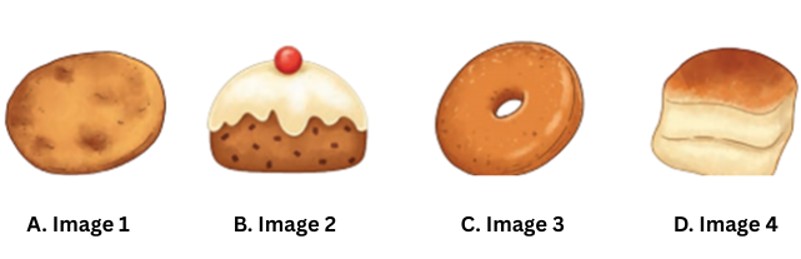
Answer: B. Image 2 shows a currant bun.
(iv) Complete the sentence with an appropriate reason.
When the poet says, ‘Well!’, it expresses surprise. This was so because _________________.
Answer: When the poet says, ‘Well!’, it expresses surprise. This was so because the funny man offered her a currant bun instead of a rose, which was completely unexpected.
2. You never heard in all your life Such a funny feeling sound.
“My friend, why do you wear two hats
Upon your feet?” I said.
He turned the other way about,
And hopped home on his head.
(i) Choose the line from the extract which tells us that the sound was unique.
Answer: The line that shows the sound was unique is:
“You never heard in all your life / Such a funny feeling sound.”
(ii) Complete the sentence with an appropriate reason.
The poet calls the funny man ‘my friend’ because _________________.
Answer: The poet calls the funny man ‘my friend’ because she finds his behaviour amusing and harmless.
(iii) What does the reaction of the funny man to the poet’s question tell us about him?
Answer: The funny man’s reaction shows that he is carefree and whimsical. Instead of answering the question, he does something even stranger, which proves he enjoys being funny and unpredictable.
(iv) Choose the correct option to complete the sentence.
The last line of the extract makes the readers feel _________________.
A. dreamy
B. impatient
C. worried
D. cheerful
Answer: D. cheerful.
II Answer the following questions. (Page 63)
1. Which character trait of the funny man was most appealing to you? Why?
Answer: The most appealing trait of the funny man is his playfulness. This is because his unusual actions and humorous behaviour make the poem lively, entertaining, and enjoyable to read.
2. The funny man does unusual things in the poem. How does it affect the overall mood of the poem?
Answer: The funny man’s unusual actions create a light, humorous, and entertaining mood in the poem. His strange behaviour makes the poem amusing and delightful to read.
3. What alternative title would you suggest for the poem? Give reason(s) for your choice.
Answer: I would suggest “The Man Who Made Me Laugh” as an alternative title for the poem.
This title is suitable because the funny man’s strange clothes, silly actions, and unusual behaviour create humour throughout the poem. It kept the poet as well as the readers amused.
4. Why do you think the poet has included dialogues in the poem?
Answer: The poet includes dialogues to make the poem more lively and engaging. The conversations between the poet and the funny man help to show his strange behaviour clearly and add humour to the poem.
5. What does the poet wish to convey by highlighting the unusual behaviour of the funny man?
Answer: The poet wants to show that humour can be found in simple, silly actions. By highlighting the funny man’s unusual behaviour, the poet reminds us to enjoy imagination, fun, and playfulness.
Let us learn (Page 63)
Read the following phrases from the poem.
• walking down • taking out • sat down
These are phrasal verbs.
| Phrasal verbs are combinations of a verb with a preposition or adverb that together function as a single unit. They often have meanings that are different from the individual words used alone. The same verb followed by different prepositions or adverbs conveys different meanings. |
I. Match the phrasal verbs in Column 1 with their correct meaning in Column 2.
| Column 1 | Column 2 |
| 1. take up | (i) To understand or comprehend something |
| 2. take after | (ii) to assume control or responsibility for something |
| 3. take in | (iii) to begin to study, practice or do something |
| 4. Take over | (iv) to become popular or successful quickly |
| 5. Take off | (v) to resemble or look similar to (Usually a family member) |
Answer:
| Column 1 | Column 2 |
| 1. take up | (iii) to begin to study, practice or do something |
| 2. take after | (v) to resemble or look similar to (Usually a family member) |
| 3. take in | (i) To understand or comprehend something |
| 4. Take over | (ii) to assume control or responsibility for something |
| 5. Take off | (iv) to become popular or successful quickly |
Now, fill in the blanks with suitable phrasal verbs from the table given in I. You may change the tense of the verb, if required.
1. The new technology is set to _________________ traditional methods of communication.
2. I tried hard to _________________ what the writer wanted to say but was unsuccessful.
3. Arjun decided to _________________ painting as a hobby.
4. The smartphone quickly _________________ the sales in the market.
5. Sheela _________________ her father; they have the same smile.
Answer: 1. The new technology is set to take over traditional methods of communication.
2. I tried hard to take in what the writer wanted to say but was unsuccessful.
3. Arjun decided to take up painting as a hobby.
4. The smartphone quickly took off the sales in the market.
5. Sheela takes after her father; they have the same smile.
II. Match the verbs in Column 1 with any suitable adverbs or prepositions in Column 2. Write their meanings in Column 3. An example has been done for you.
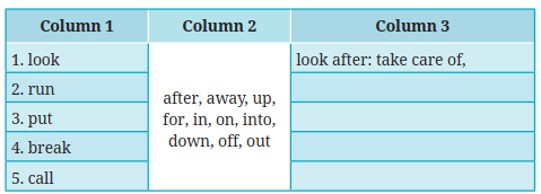
Now, frame sentences of your own using any five phrasal verbs.
Answer:
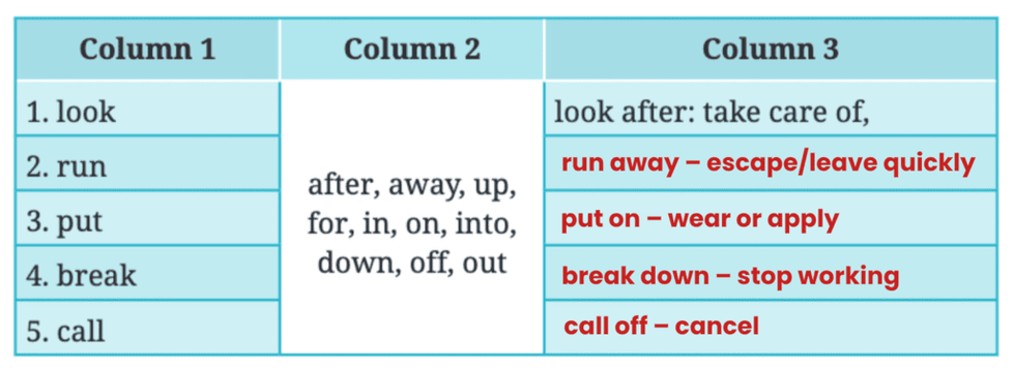
1. Look after:
Parents look after their children with tender loving care.
2. Run away:
The cat ran away when it heard a loud noise.
3. Put on:
Please put on your coat before you go outside.
4. Break down:
The old bridge may break down during heavy rain.
5. Call off:
They had to call off the match because of heavy rain.
III. Read the following words from the poem.
walking, staggered, hopped
The given words denote the different ways of walking. Arrange the words given in the box in increasing order of pace.
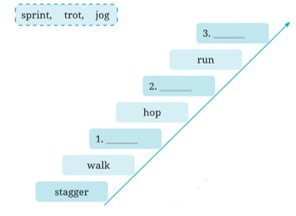
Answer:
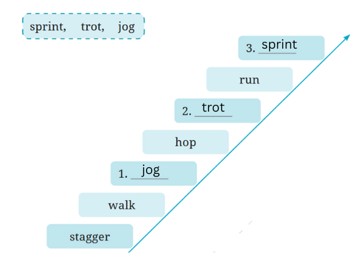
1. jog
2. trot
3. sprint
Let us explore (Page 67)
I. In ancient Indian literature and mythology, there are several humorous or funny characters who play important roles in the stories. These characters often represent wit, humour and mischief while conveying deeper moral lessons. Here are a few well-known funny characters:

Take any story to read and share it with your classmates and the teacher.
Answer: I read a story about Tenali Rama, the witty jester in King Krishnadevaraya’s court. In the story, a rich man claimed that his neighbour had stolen his gold ring. Everyone believed him, but Tenali Rama cleverly observed their actions and discovered that the rich man himself had hidden the ring to trick the neighbour. Tenali exposed the truth with humour and intelligence. This story shows that Tenali Rama used wit, quick thinking, and a playful approach to solve problems. His funny but wise behaviour teaches us that cleverness and honesty are more powerful than lies and false accusations.
Class 7 English Poorvi Chapter 5 NCERT Solutions
The poem A Funny Man describes a strange but polite man who does ordinary things in unexpected ways. His unusual clothing and behaviour create a world of nonsense and surprise. Through these amusing details, students discover how imagination can turn a simple encounter into an entertaining poem.
Students also explore the speaker’s response, the poem’s humorous images, and the contrast between what is expected and what happens. The activities help them understand the poem, build vocabulary, and appreciate the playful use of language.