

NCERT Solutions for Class 7 English Poorvi Chapter 1 The Day the River Spoke are provided here with simple and easy-to-understand answers. This story is a part of Unit 1: Learning Together in the NCERT English textbook Poorvi. It explores a young girl’s desire to attend school and the encouragement that helps her follow her dream. These NCERT Solutions for Class 7 help students understand the main ideas, complete textbook exercises, improve their language skills, and prepare for school examinations.
The Day the River Spoke Questions and Answers Class 7 English Poorvi Chapter 1
Let Us Do These Activities Before We Read (Page no. 1)
I. Close your eyes and quietly listen to the sounds around you for a minute.
1. Are they trying to tell you something?
Answer: Yes, the sounds around us often tell us something. They warn us of danger, show activity around us, or make us feel calm and connected to our surroundings.
2. Do you think the things around you also listen to you all day long?
Answer: Things like trees, rivers, or animals do not listen the way humans do, but when we spend time with them or talk to them, it feels as if they understand us.
II. Jahnavi was a bright young girl who lived with her parents and three brothers in a coastal village in India. Her parents worked on the farm. She had a dream. (Page 1)
1. What could that dream be?
Answer: Jahnavi’s dream could be to study well, become successful, and improve the life of her family.
2. How could she make her dream come true?
Answer: She could make her dream come true by working hard, studying regularly, and using every opportunity to learn and grow.
3. What is your dream? What can you do to make your dream come true?
Answer: My dream is to become a successful and responsible person in the future. I can make my dream come true by studying sincerely, staying disciplined, and always giving my best in whatever I do.
Let Us Discuss (Page no. 3)
1. What was Jahnavi’s dream? Was it important to her? Why?
Answer: Jahnavi’s dream was to go to school and learn to read and write like her brother Ettan and Meena. Yes, it was important to her because she wanted to know about the world, such as why spiders are yellow in yellow flowers, why bamboo trees rustle, why the moon rises from behind the hills, and many more such questions. Education was the only way she could learn these things.
2. Do you think the river can help her in fulfilling her dream? How?
Answer: Yes, the river can help her by giving her courage and confidence. It encourages Jahnavi to go to school, sit quietly, and listen to the lesson.
Let Us Discuss (Page no. 6)
Complete the table given below with Jahnavi’s questions in Column 1 and the River’s answers in Column 2. Check your answers with the teacher.
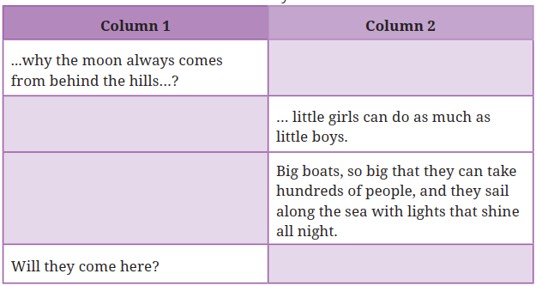
Answer:
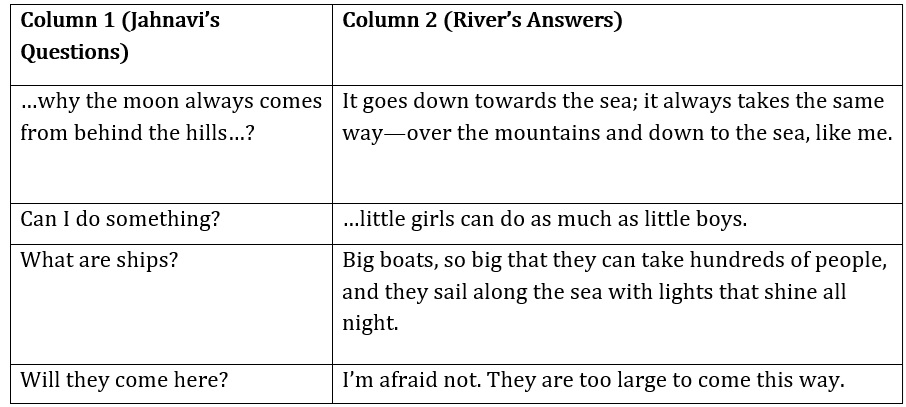
Let Us Think and Reflect (Page no. 7)
I. Read the extracts and answer the questions:
1. “You shouldn’t cry, you know,” the voice went on. “And you really shouldn’t be scared, when you have been coming here to see me every day, well, almost everyday She was puzzled. It was such a voice, like the river. It couldn’t be the river! “Well, tell me all about it,” said the River, for it was the River. “I’ve got to hurry to reach the sea, you know.”
(i) The tone of the River in the given extract is (assuring/sympathising)
Answer: Assuring.
(ii) Select a phrase from the extract which shows that Jahnavi was a frequent visitor to the spot.
Answer: “when you have been coming here to see me every day, well, almost every day.”
(iii): The use of an exclamation mark at the end of the line, ‘It couldn’t be the river!’ expresses ______
A. excitement
B. hesitation
C. irritation
D. disbelief
Answer: D. disbelief
(iv) Choose three qualities of the River highlighted in the extract from the words in the box given below.

Answer: affectionate, thoughtful, kind-hearted
2. “Can I do something?” asked Jahnavi. “Well, it’s up to you,” said the River. “Seems to me little girls can do as much as little boys—they swim as fast as little boys. You just slip along one morning and sit there in the school and listen to what’s going on, and maybe the teacher will let you stay.”
“I couldn’t,” gasped Jahnavi. “I couldn’t! They’d scare me! They’d chase me out.”
(i) Complete the sentence with an appropriate reason.
Answer: According to the River, there was no difference between girls and boys because girls can swim as fast and do things just like boys.
(ii) Identify whether the following statement is true or false.
The River encourages Jahnavi to have faith in herself and fulfill her desire to go to school.
Answer: True.
(iii) Choose the correct option to complete the sentence.
When the River suggests that Jahnavi should ‘slip along’, it means that she should move
A. quickly
B. casually
C. quietly
D. confidently
Answer: C. Quietly.
(iv) What does the repetition of the phrase I couldn’t, tell us?
Answer: The repetition of “I couldn’t” shows: Jahnavi’s nervousness and self-doubt.
II. Answer the following questions (Page 8)
1. Why does the writer describe different aspects of nature in great detail at the beginning of the story?
Answer: The writer describes different aspects of nature in great detail at the beginning to create a peaceful and lively setting. The detailed descriptions of the kingfisher, the lizard, bamboo thicket and river help us imagine the place where Jahnavi sits and show her deep connection with nature.
2. How did the River know so much about Jahnavi?
Answer: The River knew so much about Jahnavi because she visited it almost every day. shared her thoughts there, and spent a lot of time by its side. This made the River familiar with her her thoughts, fears and dreams.
3. Jahnavi says, “And I’m so old now, they’ll never let me go.” What can you infer? (Page 8)
Answer: This line shows that Jahnavi feels she is too old to start school and fears she will not be accepted. Being nearly ten and never allowed to attend, she thinks it may be too late to begin learning. It also reveals that some people in her family or community may not support her going to school.
4. Why did the River laugh when Jahnavi said she would be scared at school?
Answer: The River laughed because Jahnavi was brave. She was not afraid of the green lizard, the snake in the bamboo clump, or even the noisy trains. So, the River found it funny that such a brave girl was scared of going to school.
5. Why should Jahnavi follow the River’s advice?
Answer: Jahnavi should follow the River’s advice because it encourages her to be brave and take the first step toward education. The River knows her potential and wants her to overcome fear. By going to school, she can fulfil her dream of learning and gaining knowledge.
6. How does the conversation between Jahnavi and the River make the story more appealing?
Answer: The conversation between Jahnavi and the River makes the story more exciting. It gives the River a friendly, human-like voice and adds a touch of magic. Their dialogue makes the story lively and emotional. It also helps us understand Jahnavi’s fears, hopes, and dreams in a more engaging and imaginative way.
7. What is the main message that the writer intends to convey? (Page 8)
Answer: The main message of the story is that girls deserve equal opportunities to learn and grow. It encourages courage, self-belief, and the importance of education. The writer shows that with support and determination dreams can come true.
Let us learn (Page no. 8)
I. You have learnt that naming words are called nouns and only proper nouns begin with a capital letter. Why has the author used a capital letter for the ‘River’ even when it is a common noun? (Clue: Has the River been given qualities of a human being?)
Answer: The author uses a capital letter for ‘River’ because it is treated like a real person in the story. It speaks to Jahnavi, listens to her, laughs, and gives her advice. Since it is given human qualities and acts like a character, the writer treats it like a proper noun.
II. There are a few words related to sound in the text. Pick the words from the text and write them next to the correct definition.
1. made a high-pitched piercing sound
2. to cause liquid to strike or fall on something
3. a low continuous background noise
4. cry with loud uncontrollable gasps
5. to make a soft dry sound, like paper or leaves moving
6. took a short quick breath through the mouth due to surprise, pain or shock
7. shaking rapidly to make continuous, short, sharp sounds
8. making a lot of noise
9. made a long, high cry, usually because of pain or sadness
Answer:
1. shrieked
2. splashed
3. murmuring
4. sob
5. rustle
6. gasped
7. rattling
8. noisy
9. wailed
Q. Now, fill in the blanks with suitable sound words from exercise (II).
The classroom grew (i) _______ as the students noticed the teacher carrying the answer papers. As the teacher turned the pages with a (ii) _______, the children (iii) _______, wondering what comments awaited. Someone (iv) _______ in frustration, and the (v) _______of the students steadily increased. Finally, when the teacher praised the students for their excellent performance, the students (vi) _______ with excitement.
Answer: The classroom grew (i) noisy as the students noticed the teacher carrying the answer papers. As the teacher turned the pages with a (ii) rustle, the children (iii) gasped, wondering what comments awaited. Someone (iv) sobbed in frustration, and the (v) murmuring of the students steadily increased. Finally, when the teacher praised the students for their excellent performance, the students (vi) shrieked with excitement.
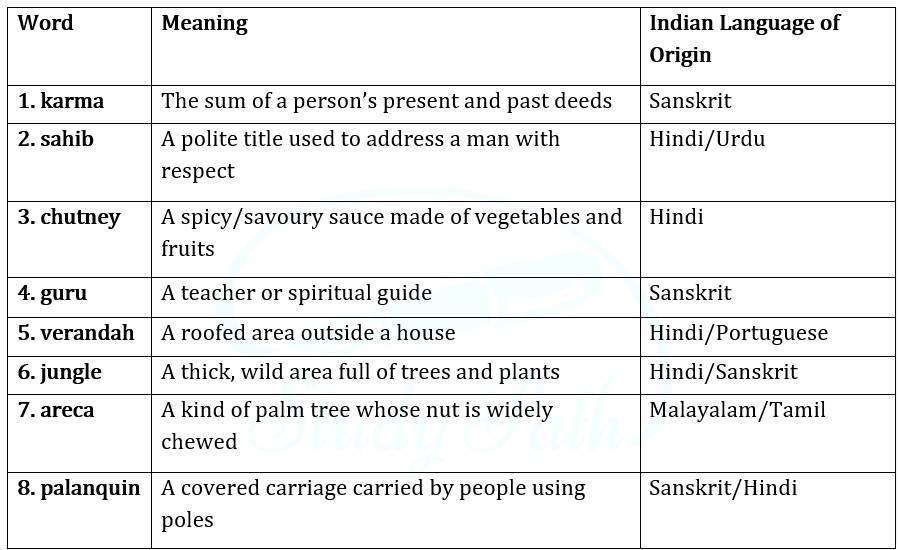
III. The word ‘catamaran’ is used in the text. The word originates from Tamil language ‘kattu maram’ meaning ‘tied wood’. Find out the meanings of these words. From which Indian language these words were borrowed. An example has been given. (Page 9)
1. karma (Sanskrit) 2. sahib 3. chutney 4. guru
5. verandah 6. jungle 7. areca 8. palanquin
Answer:
IV. Chandu, the fisherman, has a catamaran that the River preferred to a ship. Given below are some boats that are used in different parts of our country.
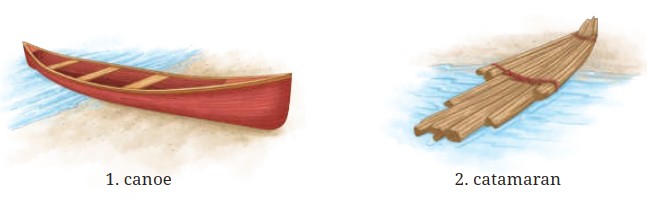
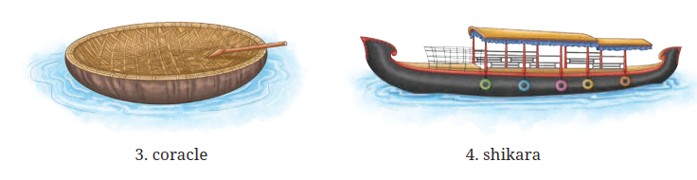
(i) Which one would you like to travel in?
(ii) Make a colourful drawing of a boat that you would like to travel in.
Answer: (i) I would like to travel in a shikara because it is beautifully decorated and glides smoothly over the water.
(ii) Do it yourself.
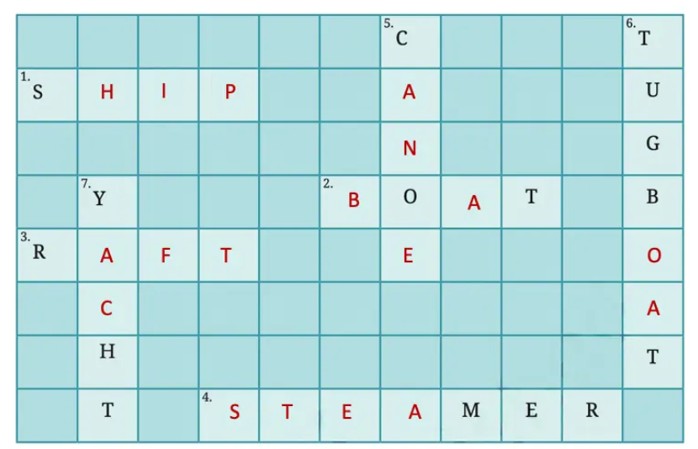
V. Solve the crossword puzzle based on words related to water transport. (Page 10)
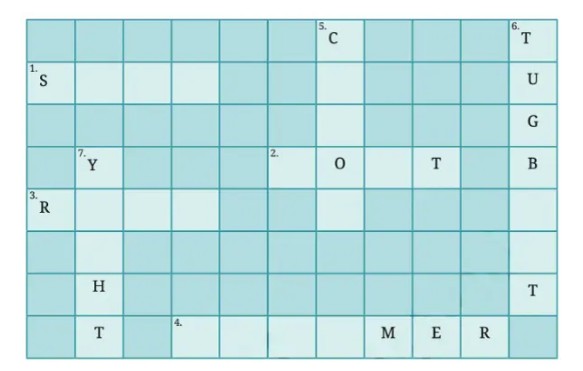
Across:
1. a large vessel used for transporting goods or passengers by sea
2. a small vessel for travelling on water, typically propelled by oars, sails, or an engine
3. a flat floating structure for travelling across water
4. a boat or ship driven by steam
Down:
5. a small, light, narrow boat, pointed at both ends and moved using a paddle
6. a boat with a powerful engine which can change direction easily and is used to pull large ships into and out of port
7. a boat with sails and sometimes an engine, used for either racing or travelling for pleasure, rhymes with ‘cot’
Answer:
VI. Read the highlighted words in the following lines from the text.
“She goes down towards the sea. I’ve seen her; she always takes the same way—over the mountains and down to the sea, like me!”
Prepositions are words that indicate the relationship between nouns or pronouns and other elements in a sentence. They show direction, location, time or logical relationships between ideas.
Now, fill in the blanks with suitable prepositions given within the brackets.
Jahnavi takes the River’s advice and goes to school. On her first day 1. _________ (at/in/on) school, Jahnavi stood nervously 2. _________ (in/ outside/above) the gate, clutching her bag close to her. The bell rang and she hurried 3. _________ (outside/through/inside) the bustling classroom. She found a seat 4. _________ (among/between/from) two friendly classmates. The teacher greeted them warmly and started the lesson 5. _________ (about/in/for) numbers. Jahnavi listened attentively, feeling excited 6. _________ (at/about/for) the new adventure ahead.
Answer: Jahnavi takes the River’s advice and goes to school. On her first day 1. at school, Jahnavi stood nervously 2. outside the gate, clutching her bag close to her. The bell rang and she hurried 3 inside the bustling classroom. She found a seat 4. between two friendly classmates. The teacher greeted them warmly and started the lesson 5. about numbers. Jahnavi listened attentively, feeling excited 6. about the new adventure ahead.
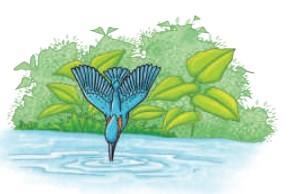
VII. Read the highlighted words in the following sentence from the text. (Page 10)
A kingfisher swept down, its wings an arrow of blue in the sunlight.
Words like on, off, up, down can function both as preposition and as adverb.
For example:
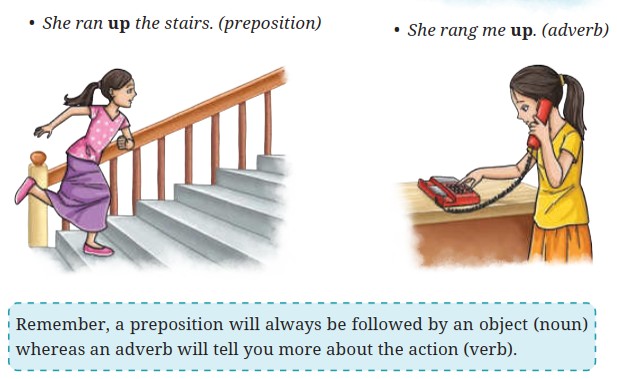
Fill in the blanks with prepositions or adverbs.
1. The cat jumped ___________ the table. (preposition)
2. The children played ___________ until dark. (adverb)
3. She quickly ran ___________ the park. (preposition)
4. The helicopter was hovering ___________. (adverb)
5. We were just walking ___________, chatting. (adverb)
6. After thoroughly wiping his shoes, he stepped ___________. (adverb)
7. She drove slowly ___________ the sharp curve. (preposition)
8. He placed the keys ___________ the mat before leaving. (preposition)
Answer:
1. The cat jumped onto the table.
2. The children played outside until dark.
3. She quickly ran through the park.
4. The helicopter was hovering above.
5. We were just walking along, chatting.
6. After thoroughly wiping his shoes, he stepped inside.
7. She drove slowly around the sharp curve.
8. He placed the keys under the mat before leaving.
Let us speak (Page no. 13)
I. Read the sentence given below.
“Dear, dear! What’s the matter? … You shouldn’t cry, you know. And you really shouldn’t be scared, when you have been coming here to see me every day, well, almost every day.” The River spoke to Jahnavi in a ‘sleepy’ voice. Work in pairs and take turns to speak the same sentence in ‘other’ voices. Some hints are given below.

Answer: Do it yourself.
II. Janhavi asks the River for advice and the River gives advice. Read the given situations and work in pairs to ask for and give advice. Take turns to change your roles. Use the prompts given below.
1. Situation (i) : You wish to play football at school but it has an all-boys’ team only.
2. Situation (ii): You have been unable to score well in Mathematics due to nervousness during exams.
3. Situation (iii): You really enjoy music classes but do not get enough time to practise for it.
4. Situation (iv): You cannot see the blackboard clearly from the last bench.
Answer:
Situation (i): Asking for advice: I want to play football, but my school has an all-boys’ team. What do you think I should do?
Giving advice: I think you should talk to the sports teacher and request a chance. Why don’t you show your skills during practice?
Situation (ii): Asking for advice:
I have a problem. I get nervous during Maths exams and cannot score well. What should I do?
Giving advice: You should practise regularly and solve sample papers. The best thing to do is stay calm and ask your teacher for tips to overcome exam fear.
Situation (iii): Asking for advice: I enjoy music classes a lot but don’t get enough time to practise. What would you do in my position?
Giving advice: Why don’t you set aside a few minutes every day? If I were you, I would make a small practice schedule.
Situation (iv): Asking for advice: I have a problem. I cannot see the blackboard clearly from the last bench. What do you think I should do?
Giving advice: You should tell your teacher and move to the front bench. You may also need to get your eyes checked.
Let us write (Page no. 14)
Observing Nature
Take some time to observe the world around you. Over the next few days, pay attention to the colours, shapes, patterns, and textures found in nature. Look closely at the plants, trees, flowers, birds, and even the sky. Make detailed notes of what you observe, focusing on textures, movements, and how light plays with these elements. Record your observations in detail and the features that draw your attention the most—whether it’s the soft ripple of water, the vibrant flutter of a butterfly or the colour of the birds or flowers.
Now, write a descriptive paragraph based on what you’ve observed. Highlight the colours, shapes, textures, and unique details that made an impression on you.
Give a title to your paragraph.
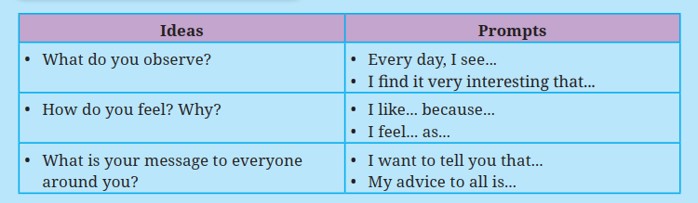
Answer: The Colours of Nature
Every day, I notice the bright colours and gentle movements of nature around me. The leaves glow in different shades of green, some smooth and shiny, others rough with small veins. Flowers bloom in soft pinks, deep reds, and sunny yellows, their petals curved like delicate folds of silk. Birds flutter past with vibrant feathers that sparkle in sunlight. I often watch the water ripple softly, catching light and forming tiny silver patterns. The sky changes from pale blue to golden orange, creating a calm and magical scene. All these colours, textures, and shapes make nature feel alive and beautiful.
Let us explore (Page no. 14)
I. Discuss why rivers in India are considered to be sacred and most of them are referred to as female. Some rivers are referred to as male, for example, the Brahmaputra and the Sone.
Answer: In India, rivers are considered sacred because they give life by providing water for drinking, farming, and daily needs. People believe rivers purify, protect, and bless them. Most rivers are referred to as female because they are seen as nurturing mothers who support and sustain life. However, a few rivers like the Brahmaputra and the Sone are called male due to local legends and cultural beliefs linked to their origin and character.
III. Read the poster given below and answer the questions that follow.
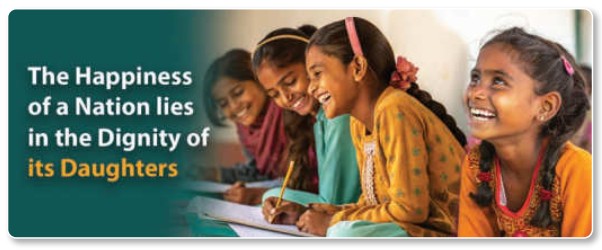
1. What are the things you can observe in the poster?
2. Why do you think the girls look happy?
3. Dignity means ‘self-respect’. What is the relation between ‘dignity’ and ‘happiness’ ?
4. How does a Nation prosper when its daughters are happy?
Answer: 1. In the poster, I can observe 3 to 4 girls sitting together and smiling while studying. They are wearing comfortable home clothes and seem to be enjoying their learning.
2.The girls look happy because they are getting the opportunity to study in a safe and encouraging environment.
3. Dignity and happiness are closely related. When people, especially girls, are treated with respect and given equal opportunities, they feel valued. This self-respect brings confidence, freedom, and joy, which leads to true happiness.
4. A nation prospers when its daughters are educated, confident, and empowered. They contribute to society, strengthen families, support the economy.
4. The Government has launched many schemes for the education of the girl child. Some of them are ‘Beti Bachao Beti Padhao’, ‘Balika Samridhi Yojana’, ‘Samagra Shiksha Scheme–Kasturba Gandhi Balika Vidyalayas’, etc.
Find out more such schemes from the internet or from your teacher and spread awareness in your neighbourhood.
Answer: Here are some additional government schemes for the education and well-being of the girl child in India,
- Sukanya Samriddhi Yojana: A savings scheme aimed at parents of girl children to save for their future education or marriage.
- Ladli Laxmi Yojana (Madhya Pradesh): Provides financial assistance and encourages education of girls from birth through higher secondary.
- Bangaru Thalli Scheme (Andhra Pradesh): Supports girl children from birth to graduation with future-funding and educational support.
- Rajiv Gandhi Scheme for Empowerment of Adolescent Girls (SABLA): Targets adolescent girls (11-18 yrs) for education, health, life-skills, and vocational training.
Class 7 English Poorvi Chapter 1 NCERT Solutions
The story The Day the River Spoke follows Jahnavi, a girl who longs to learn but has not been given the opportunity to attend school. Her conversation with the river gives her confidence to take a step towards education. Through her experience, the lesson highlights curiosity, courage, and equal opportunities for girls.
Students also explore how encouragement and understanding can help someone overcome barriers. The chapter’s questions develop comprehension, vocabulary, and the ability to explain characters’ feelings, while its message encourages respect for every child’s right to learn.