

NCERT Solutions for Class 7 Social Science Part 2 Chapter 2 India and Her Neighbours are provided here with simple and easy-to-understand answers. These NCERT Solutions for Class 7 are based on the new NCERT Social Science textbook Exploring Society: India and Beyond Part 2. In this chapter, students learn about India’s neighbouring countries, their geographical features, and the connections they share with India. The chapter also explains how these ideas help students understand India’s society and the world around them.
India and Her Neighbours Questions and Answers Class 7 Social Science Chapter 2
The Big Questions (NCERT Textbook Page No. 29)
1: What defines a ‘neighbour’? Is it just shared land borders?
Answer: A neighbour is not defined only by sharing a land border. Countries can also be neighbours because they are close to each other by sea. Neighbouring countries can also be connected through shared history, culture, trade, religion and people-to-people relationships. For example, India shares land borders with countries like Pakistan, Nepal, Bhutan, Bangladesh, and Myanmar, while Sri Lanka and the Maldives are India’s maritime neighbours.
2: How do geography and history influence the nature of India’s relationships with her neighbours?
Answer: Geography and history strongly influence India’s relationships with her neighbours.
Geography connects India with neighbouring countries through land borders, rivers, mountains, and seas, which encourages trade, travel, and cooperation. For example, Nepal shares an open border with India, while Sri Lanka and the Maldives are connected to India by sea.
History has created shared culture, religion, language, traditions, and trade links. For example, Buddhism connects India with countries like China, Bhutan, Nepal, and Myanmar, while India and Bangladesh share common historical and cultural ties. Thus, India’s relations with her neighbours are shaped by both physical closeness and shared history.
3: In what ways are India and her neighbours interconnected today?
Answer: Today, India and her neighbours are closely linked through trade, culture, travel and cooperation. People cross borders for work, education and religious visits, while countries share traditions, history and cultural connections. They also cooperate in areas such as security, regional development and other common challenges. Thus, neighbouring countries are connected in many ways beyond just their geographical borders.
Let’s Explore (NCERT Textbook Page No. 30)
Question: Identify the three large water bodies that surround India in the map below.
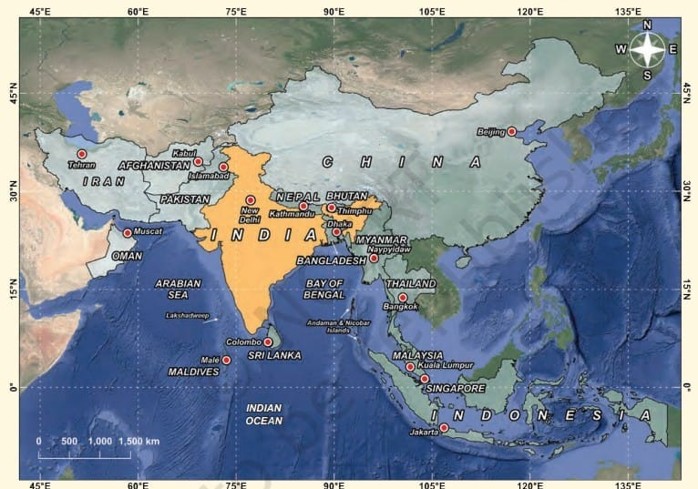
Answer: The three large bodies that surround India are:
- Indian Ocean (to the South)
- Arabian Sea (to the West)
- Bay of Bengal (to the East)
Let’s Explore (NCERT Textbook Page No. 51)
Question: The scene in Fig. 2.21 depicts the well-known Hindu myth of samudra manthana or the churning of the ocean. The devas (gods, on the right here) and the asuras (demons, on the left) decided to join forces to churn the cosmic ocean in search of amrita or the nectar of immortality, with the serpent Vasuki as the churning rope and Vişhnu (above) presiding over the operation – he will eventually deceive the asuras to make sure that the amrita goes to the devas alone. Note also the airport’s official name of ‘Suvarnabhumi Airport’ – does it remind you of something?
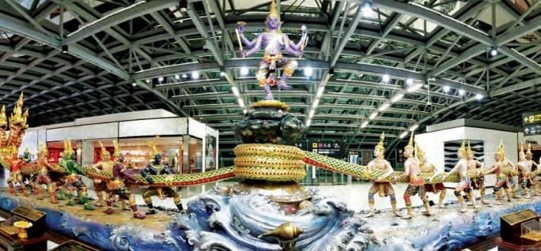
Answer: Yes, the official name of ‘Suvarnabhumi Airport’ reminds us the islands of Java, Sumatra, and Malaya, Indian traders visited these islands in search of gold and other valuable resources that these places to came to be known as “Suvarnabhumi” (the golden land) or “Suvarnadvipa” (the golden island).
Let’s Explore (NCERT Textbook Page No. 53)
Question: Seeing that Tamil is one of Singapore’s official languages, what does this suggest to you about the relationship between south India and Singapore?
Answer: The presence of Tamil as one of Singapore’s official languages suggests that there are strong historical and cultural links between South India and Singapore. Singapore had close cultural and commercial ties with India, with traders and Buddhist monks visiting the region centuries ago. It also shows that about 9% of Singapore’s residents are of Indian origin, many living in an area called Little India.
Questions and activities (NCERT Textbook Page No. 60)
1: Explain who a maritime neighbour is with two examples with respect to India.
Answer: A maritime neighbour is a country that is connected to another country by a shared sea or ocean, even without a direct land border.
Two examples with respect to India are Sri Lanka and Thailand.
- Sri Lanka is maritime neighbour of India. It is situated towards the southeast of India. Sri Lanka is divided by a narrow stretch of sea known as the Palk Strait.
It is only about 32 km away from India making them a close maritime neighbour. - Thailand is located to the east of India across the Bay of Bengal and the Andaman Sea. India and Thailand share a maritime boundary. Thailand is connected with India through Trilateral highway which stretches from Manipur through Myanmar to Thailand.
2: How has Buddhism created links with India’s neighbours? Give examples to explain your answer.
Answer: Buddhism has created strong religious, cultural, and historical links between India and many of her neighbours. Buddhism was introduced in the 3rd century BCE by Mahendra and Sanghamitra, the son and daughter of Emperor Ashoka. It later spread to other countries through monks, pilgrims, and trade routes. For example, Buddhism reached China around the 1st century CE through trade and pilgrimage routes. Chinese monks such as Faxian and Xuanzang later travelled to India. India also shares Buddhist ties with Bhutan and Myanmar. Bhutanese pilgrims visit places such as Bodh Gaya, Rajgir, and Nalanda, while many people from Myanmar visit India on Buddhist pilgrimages.
3: What does ‘open border’ policy mean? How does the India-Nepal ‘open border’ policy affect the lives of people living along the border?
Answer: An ‘open border’ policy means that people of India and Nepal can cross the border relatively freely without needing a visa or passport for ordinary movement.
This policy makes life easier for people living along the border. They can travel across the border for work, education, trade, healthcare and visiting relatives. It also encourages close social, cultural and economic relationships between the people of both countries.
4: The chapter says, “Being neighbours is not just about geography.” Explain this statement with an example.
Answer: Being neighbours is not just about sharing a land border. Countries can also be connected through trade, culture, history, religion and people-to-people relationships. India and her neighbours have shared such connections for centuries.
For example India and China share a long and strategic relationship shaped by history, geography, culture, trade, and politics. Buddhism travelled from India to China many centuries ago. Chinese scholars and monks such as Faxian and Xuanzang visited Indian centres of learning, while Indian monks carried Buddhist teachings to China. India had trade relations with China via ‘Silk route’ during ancient times.
5: What are the different ways in which India has helped smaller countries in her neighbourhood? Explain with examples.
Answer: Different ways in which India has helped smaller countries in her neighbourhood.
(i) In Myanmar, India helped to restore the Ananda temple which was damaged by an earthquake and also gifted a 16 feet replica of the Sarnath statue of the Buddha to the Shwedagon Pagoda.
(ii) In Afghanistan, India supported the development of education healthcare and infrastructure. India is also helping Afghanistan in the construction of the Afghan Parliament building and the Zaranj-Delaram Highway which is a great initiative in this direction by India.
(iii) In Maldives, India’s immediate help during, 2004 Tsunami, 2014 water crisis in Male, Maldives and COVID-19 pandemic has helped both the countries build a strong bond, socially, culturally, economically and politically.
(iv) India supplies important goods to Nepal such as petroleum, medicines, food items, and manufactured products, supporting trade and everyday needs.
6: How do shared challenges become opportunities for cooperation? Were there examples in this chapter to illustrate this?
Answer: Shared challenges can become opportunities for cooperation when neighbouring countries work together to solve problems that affect all of them. This can improve friendship, peace, and development.
For example:
- India and Bangladesh share the Sundarbans, so both countries coordinate its protection and management.
- Kartarpur Corridor in Pakistan is a great opportunity for thousands of Sikh pilgrims to visit the Gurudwara Darbar Sahib in Pakistan.
- India and Indonesia share concerns such as piracy, climate change, protection of sea routes, and disaster relief. They cooperate in maritime security and other regional activities to deal with these common challenges.
7: If borders were drawn only by culture and connections, how would the map look different?
Answer: If borders were drawn only by culture and connections, the map would look very different from today’s political map. People and regions sharing the same languages, religions, festivals, food, trade routes, and traditions might appear connected even if they belong to different countries.
For example, India and Bangladesh share the Bengali language, common history, rivers, and cultural traditions, while India and Nepal share religious traditions, festivals, family ties, and an open border.
Thus, instead of clear political boundaries, the map might show many overlapping “borders of friendship” based on culture, rivers, trade, and people-to-people connections.
8: On blank maps:
(a) Label India’s neighbours.
(b) Draw arrows showing cultural flows (e.g, food, festivals, languages) between India and her neighbours.
(c) Imagine and redraw new “borders of friendship” that connect neighbours through rivers, trade routes, or cultural zones.
(d) Collect pictures of the flags of the countries listed in this chapter and write your observations.
Answer:
(a)
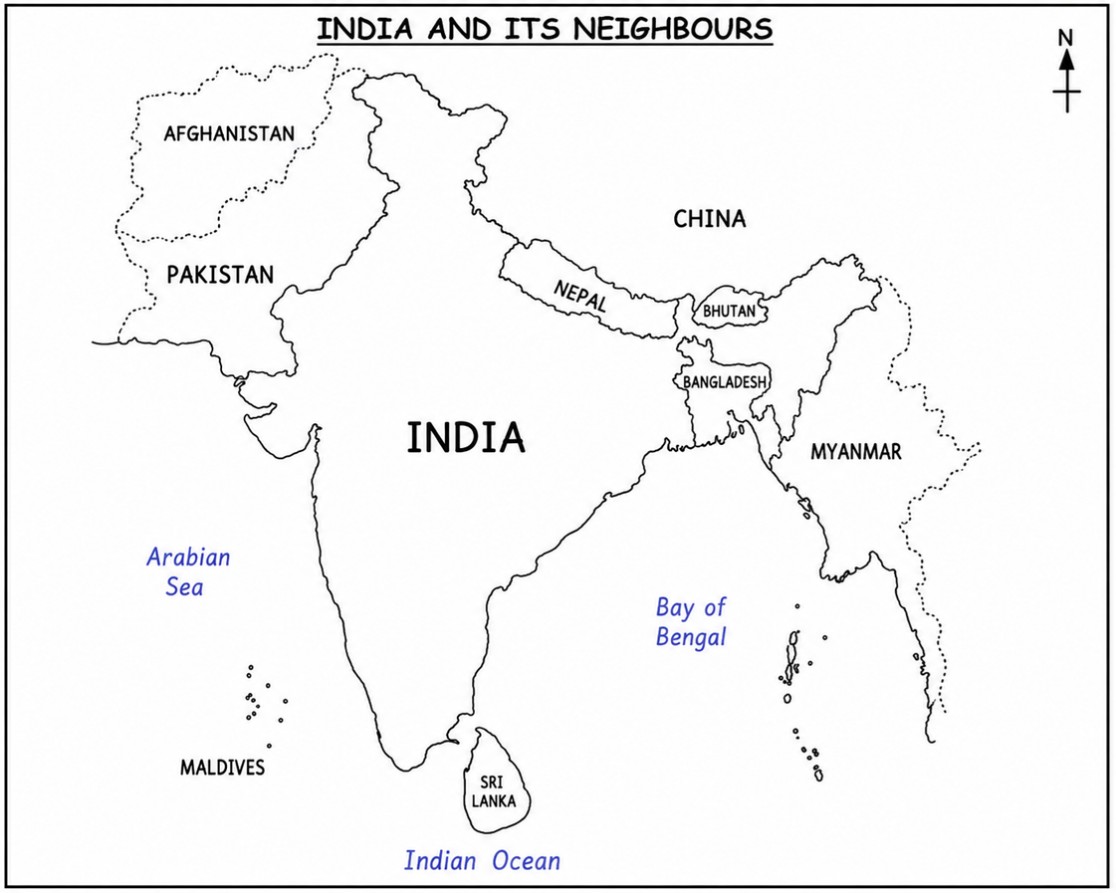
(b) The cultural flow of food, festivals, and languages between India and its neighbours. This exchange is centuries old, shaped by trade, migration, and shared traditions.
Food Exchanges
- India-Nepal: Shared love for dal-bhat (lentils and rice), momos (dumplings), and use of spices like turmeric and cumin.
- India-Bangladesh: Common Bengali cuisine-fish curries, sweets like rasgulla and sandesh, and rice-based dishes.
- India-Pakistan: Mughlai and Punjabi food traditions overlap-biryani, kebabs, parathas, and rich gravies.
- India-Sri Lanka: Exchange of ricebased meals, curries with coconut milk, and snacks like hoppers (appa) and dosas.
- India-Myanmar: Similarities in curries, use of lentils, and Indian-inspired street foods.
- India-Afghanistan: Influence of naan, kebabs, dried fruits, and pulao, which entered North India via trade routes.
Festivals Celebrations
- Diwali: Celebrated in India, Nepal, and among Hindu communities in Sri Lanka and Myanmar.
- Eid: Shared across India, Pakistan, Bangladesh, Afghanistan, and beyond.
- Buddha Purnima: Observed in India, Nepal, Bhutan, Sri Lanka, and Myanmar, reflecting Buddhist heritage.
- Durga Puja: Strongly celebrated in India and Bangladesh, with cultural troupes often crossing borders.
- Holi: Popular in India and Nepal, spreading to communities in Pakistan and Bangladesh.
- Harvest Festivals: Pongal (India-Sri Lanka), Baisakhi (India-Pakistan), and similar agrarian festivals show shared rhythms of rural life.
Language Literature Flow
- Sanskrit Pali: Ancient texts spread to Nepal, Sri Lanka, Myanmar, and Tibet, influencing Buddhist and Hindu traditions.
- Hindi Urdu: Shared across India and Pakistan; Bollywood films and ghazals strengthen linguistic ties.
- Bengali: Common in India (West Bengal, Tripura) and Bangladesh, with shared literary heritage (Tagore, Nazrul).
- Tamil: Spoken in India and Sri Lanka, with deep cultural and literary exchanges.
- Punjabi: Shared between India and Pakistan, especially in poetry and folk songs.
(c) Do it yourself
(d) Do it yourself
Class 7 Social Science: Exploring Society Part 2 Chapter 2 NCERT Solutions
The chapter India and Her Neighbours explores India’s position in its surrounding region and introduces the countries connected to it by land and sea. Students learn about borders, landscapes, and the geographical features that influence contact between neighbouring societies.
Students also learn about shared histories, cultural links, trade, and people-to-people connections. The chapter helps them understand how cooperation and mutual understanding can strengthen relationships between India and its neighbours.