

NCERT Solutions for Class 7 Social Science Part 1 Chapter 6 The Age of Reorganisation are provided here with simple and easy-to-understand answers. These NCERT Solutions for Class 7 are based on the new NCERT Social Science textbook Exploring Society: India and Beyond Part 1. In this chapter, students learn about political changes after the Mauryan Empire, the rise of regional powers, and expanding trade and cultural exchanges. The chapter also explains how these ideas help students understand India’s society and the world around them.
The Age of Reorganisation Questions and Answers Class 7 Social Science Chapter 6
The Big Questions? (page 117)
Question 1. Why is the period that followed the Maurya Empire sometimes called the ‘Age of Reorganisation’?
Answer: After the fall of the Mauryan rule around 185 BCE, the empire broke into many smaller kingdoms and many new dynasties emerged. These included the Shungas in the north, Satavahanas in the Deccan, and Kharaveia’s Chedi dynasty in Kalinga. These new kingdoms reorganised the existing regions, revived local traditions. During this time, there were political changes, growth in trade, and cultural development. Thus, the subcontinent went through a phase of reorganisation in politics and society.
Question 2. What were the values or principles that guided the emperors of that period?
Answer: The emperors of the ‘Age of Reorganisation’ followed values such as religious tolerance, cultural growth, public welfare, and moral conduct. Many rulers, like Kharavela and Kaṇiṣhka, supported different religions including Hinduism, Buddhism, and Jainism. They donated to temples, stupas, and public works for the benefit of the people. Leaders like Ashoka promoted Dhamma, which stood for kindness, righteousness, and good behaviour.
Question 3. How did foreign invaders assimilate into Indian society and contribute to cultural confluence?
Answer: Foreign invaders such as the Indo-Greeks, Śhakas and Kuṣhāṇas entered India after the fall of the Mauryan Empire. Although they came as conquerors, they slowly adopted Indian customs, religions, and art forms. They began to worship Indian deities like Vasudeva (Krishna) and Lakṣhmi. They used Indian languages such as Brahmi script on their coins and inscriptions. Their art blended Greek and Indian styles that can be seen in the Gandhara and Mathura schools of art. This mixing of cultures led to a rich cultural confluence.
Let’s Explore (Page 120)
Question: In the previous chapter, you studied the map of the Maurya empire (see page 100). Below is a map of the post-Maurya period. How many kingdoms can you count in the area that were previously under the control of the Maurya empire? (page 120)
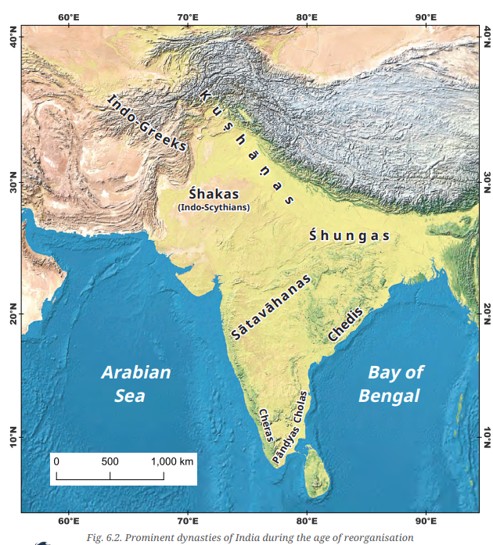
Answer: After the fall of the Maurya Empire, its huge area got divided into many smaller kingdoms. From the map, we can see about seven main kingdoms that came up in its place. These were: the Shungas in the north, the Satavahanas in the Deccan, the Indo-Greeks and Shakas in the northwest the Kushanas in north India and in the far south the Pandyas, Cholas, and Cheres (Chera).
Let’s Explore (Page 124)
Question: Below is a panel from the Bharhut Stupa. Look at the two figures on the right. What are they doing? Can you guess their profession? Notice their attire. What does this tell us about them? List other details that you notice in the panel and discuss your findings in class.
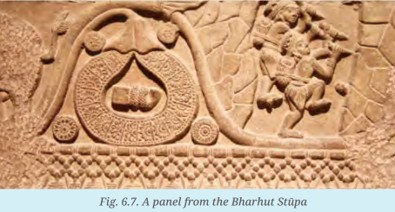
Answer: The two figures on the right seem to be sculptors or artisans. They look like they are carving with tools, which shows their profession. Their simple clothes tell us they were common working people, not rich. From the panel we can also see details like their posture while working and the design of the stupa which shows how carefully such monuments were made by skilled workers.
Think About It (Page 124)
Question: What, according to you, could the tradition of using the mother’s name at the beginning of a king’s name signify?
Answer: The tradition of using the mother’s name at the beginning of a king’s name, as seen in the case of Gautamiputra Satakarṇi, shows the high respect and honour given to women and mothers in society. This tradition reflects the importance of women in royal families and their role in shaping the kingdom’s values.
Think About It (Page 134)
Question: The Panḍyas were known for their pearls. Why do you think pearls were an important article of trade during these times?
Answer: The Paṇḍyas were famous for their pearls, which were considered precious and rare in ancient times. Pearls were used for making jewellery, royal ornaments, and decorations, and were highly valued by foreign traders. Paṇḍyas used to export them to distant lands like Greece and Rome and wealth and fame. Thus, pearls became an important article of trade that strengthened the Paṇḍya kingdom’s economy and international connections.
Let’s Explore (Page 135)
Question: What do you think might have been the meaning of having deities like Vasudeva-Krishna or Lakshmi on some Indo-Greek coins? (page 135)
Answer: Having deities like Vasudeva-Krishna or Lakshmi on Indo-Greek coins shows that the foreign rulers had accepted and respected Indian beliefs and culture. It also means they wanted to connect with the local people and gain their trust by honouring Indian gods. This blending of Greek and Indian traditions reflects cultural harmony and the assimilation of foreign rulers into Indian society.
Let’s Explore (Page 136)
Question 1. Carefully observe this massive statue (1.85 m high) and notice the clothing, weapon, and footwear. What does it tell us about this figure?
Answer: Since the statue is very tall (1.85 m), it likely represents a king, warrior, or divine figure. The detailed clothing suggests royal or elite status, while the weapon symbolises strength, protection, and authority. The footwear indicates high rank and readiness for battle, showing that the figure was a powerful and respected ruler.
Question 2. Observe the coins carefully. Who, besides the emperor, appears on the coin? (page 136)
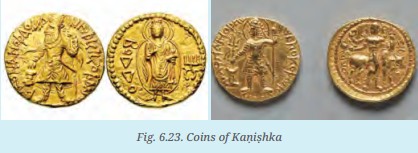
Answer: On the first coin, besides Emperor Kanishka, Buddha is shown on the other side, with Greek inscriptions. On the second coin, the emperor is on one side and Shiva with his bull Nandi appears on the other. These coins show how rulers included important religious figures alongside themselves.
Questions and Activities – Exercise Questions (Page 143)
1. Why was the post-Maurya era also known as the era of reorganisation?
Answer: The post-Maurya era is known as the ‘Era of Reorganisation’ because after the fall of the Mauryan Empire around 185 BCE, the large empire broke into several smaller kingdoms. These new kingdoms reorganised the regions, competing for power and control. This period also saw foreign invasions, political changes, and cultural development through art, trade, and religion. Thus, India was reorganised both politically and culturally during this time.
2. Write a note on the Sangam literature in 150 words.
Answer: The Sangam literature is one of the oldest and most important collections of Tamil writings from South India. It was composed between the 2nd century BCE and 3rd century CE during the rule of the Cholas, Cheras, and Paṇḍyas. The word Sangam comes from the Sanskrit word Sangha, meaning an assembly or gathering. It refers to the assemblies of poets and scholars who created these works. The Sangam texts include poems and songs that describe the social life, love, bravery, trade, and culture of the time. They give valuable information about the political systems, wars, kingdoms, and values of South Indian society. The poems also praise the heroism and generosity of kings and reflect the richness of Tamil language and culture. Sangam literature remains a great source of history for understanding early South Indian civilization.
3. Which rulers mentioned in this chapter included their mother’s name in their title, and why did they do so?
Answer: The rulers of the Satavahana dynasty included their mother’s name in their titles. The best example is Gautamiputra Satakarṇi, whose name means “son of Gautami.” This tradition showed the high respect given to women and mothers in society. By using their mother’s name, rulers honoured their mothers’ virtue, influence, and role in shaping their character and kingdom.
4. Write a note of 250 words about one kingdom from this chapter that you find interesting. Explain why you chose it. After presenting your note in class, find out what kingdoms have been the most selected by your classmates.
Answer: I find the Satavahana Kingdom the most interesting among all the kingdoms mentioned in this chapter. The Satavahanas ruled large parts of the Deccan region, covering present-day Andhra Pradesh, Telangana, and Maharashtra. Their empire was powerful, prosperous, and well-organised.
The Sātavāhanas played an important role in promoting trade and commerce. Their coins, found across India, even show ships, proving that they were engaged in sea trade with distant lands such as Rome. They traded spices, textiles, and pearls, and imported items like glass and perfumes. Agriculture flourished along the Krishna and Godavari rivers, providing economic strength to the kingdom.
They also supported different religions, including Hinduism, Buddhism, and Jainism. Kings like Gautamiputra Satakarṇi respected their mothers and included their names in their royal titles. The Satavahanas contributed to art and architecture, building famous sites like the Karla and Naneghat caves.
I chose this kingdom because it shows how culture, trade, and religion grew together. The Satavahanas maintained peace, encouraged learning, and respected all faiths, making their rule a time of harmony and progress.
5. Imagine you have the chance to create your own kingdom. What royal emblem would you choose, and why? What title would you take as the ruler? Write a note about your kingdom, including its values, rules and regulations, and some unique features.
Answer: If I had the chance to create my own kingdom, I would name it Suryanagar, meaning “The Land of the Sun.” My royal emblem would be a rising sun, symbolising hope, energy, and equality for everyone. My title would be “Maharaja Surya Dev,” which represents a ruler who brings light and goodness to his people.
The kingdom of Suryanagar would follow values of truth, justice, kindness, and hard work. Every citizen would be treated equally, no matter their caste, religion, or wealth. Education would be free for all, and there would be special schools for art, science, and farming.
The kingdom’s rules would focus on protecting nature, helping the poor, and keeping peace. Every family would plant trees and take care of animals. There would be clean cities, green parks, and beautiful temples open to all faiths.
A unique feature of my kingdom would be the Festival of Light, celebrated every year to thank the sun and honour people who helped others. My dream is to make Suryanagar a land of happiness, fairness, and progress for everyone.
6. You have read about the architectural developments of the post-Maurya era. Take an outline of the Indian subcontinent and mark the approximate locations of some of the ancient structures mentioned in this chapter.
Answer: Do it yourself.
Class 7 Social Science: Exploring Society Part 1 Chapter 6 NCERT Solutions
The chapter The Age of Reorganisation explores the changes that took place as new kingdoms and regional powers emerged after Mauryan rule. Students learn about important dynasties, their territories, and the ways they shaped political life in different parts of the Indian subcontinent.
Students also learn about trade routes, contacts with other regions, and developments in art, religion, and culture. The chapter shows how political reorganisation was accompanied by economic activity and cultural exchanges that connected communities within India and beyond.