

NCERT Solutions for Class 7 Social Science Part 1 Chapter 10 The Constitution of India – An Introduction are provided here with simple and easy-to-understand answers. These NCERT Solutions for Class 7 are based on the new NCERT Social Science textbook Exploring Society: India and Beyond Part 1. In this chapter, students learn about the meaning of a constitution, the making of India’s Constitution, and the principles that guide the country. The chapter also explains how these ideas help students understand India’s society and the world around them.
The Constitution of India — An Introduction Questions and Answers Class 7 Social Science Chapter 10
The Big Questions (Page 209)
1: What is a constitution, and why do we need one?
Answer: A constitution is a document that tells the basic rules and principles of a country. It explains:
- How the government is formed.
- The roles of the legislature, executive, and judiciary.
- The rights and duties of citizens.
- Long-term goals and values of the nation.
We need a constitution because
- It works like a rulebook for the country.
- It makes sure the government works fairly.
- It protects the rights of the people.
- It ensures that everyone is treated fairly and equally.
2: How was the Indian Constitution prepared?
Answer: The Indian Constitution was prepared by the Constituent Assembly, which was formed in 1946. It first had 389 members, which later became 299 after Partition. The Assembly worked for almost three years to prepare the Constitution. The Drafting Committee, chaired by Dr. B. R. Ambedkar, prepared the first draft of the Constitution. Dr. Ambedkar is known as the Chief Architect of the Indian Constitution. The Constitution was completed on 26 November 1949. It came into effect on 26 January 1950, which we celebrate every year as Republic Day.
3: How did our freedom struggle and civilisational heritage influence the Constitution?
Answer: Our freedom struggle and civilisational heritage had a big influence on the Indian Constitution. Leaders who fought for independence were members of the Constituent Assembly, so they included the values they believed in. They wanted a country based on equality, justice, freedom, and fraternity, so these ideas were included in the Constitution. India’s ancient culture and traditions also taught values like respect for others’ opinions, peace, learning, and the idea that the whole world is one family (vasudhaiva kutumbakam). These values inspired parts of the Constitution such as Fundamental Duties and the spirit of unity in diversity.
4: What are the key features of the Constitution of India? Why is it still relevant, even though it was written more than seventy years ago?
Answer: Key features of the Constitution of India:
- It clearly explains the roles of the legislature, executive, and judiciary.
- It has Directive Principles which guide the government to work for people’s welfare.
- It gives Fundamental Rights to all citizens.
- It lists Fundamental Duties that citizens should follow.
- It gives every adult citizen the right to vote.
- It describes a three-tier government: central, state, and local.
The Constitution is still relevant even after more than seventy years because it protects our rights, keeps the government responsible. It provides a clear structure for running the country. It can also be changed when needed through amendments.
Let’s Explore (Page 226)
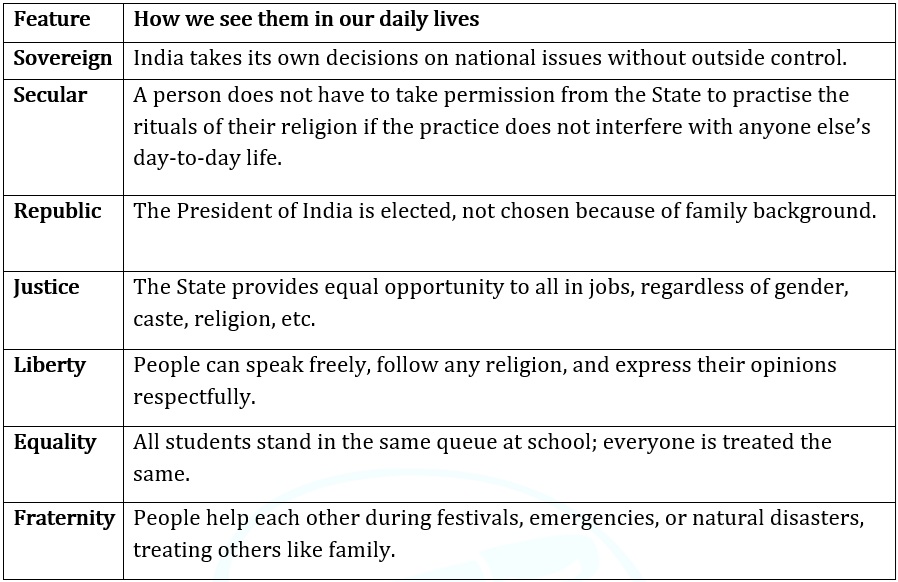
Below is the list of features given in the Preamble. Read them closely from the image above and write down examples of the application of these values in daily life around you. Two have been completed to help you with the exercise.
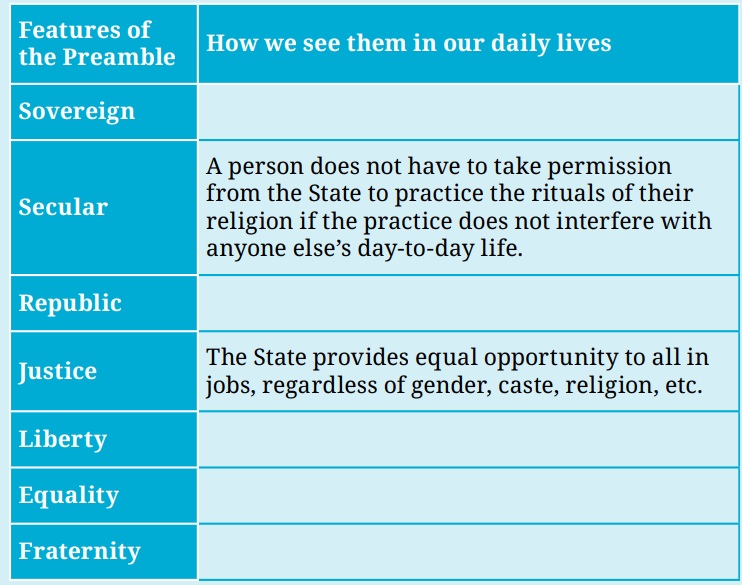
Answer:
Questions and activities (Exercise) (Page 227)
1. “The Constituent Assembly had representatives from diverse backgrounds in India.” Why do you think it was important to have a diverse set of representatives from all over India?
Answer: It was important to have a diverse set of representatives in the Constituent Assembly because India is a large and diverse country with many languages, religions, and cultures. Having members from different backgrounds ensured that everyone’s ideas and needs were included in the Constitution. This diversity helped make the Constitution fair, balanced, and suitable for all Indians, not just for one group of people.
2. Read the statements below carefully and identify which key features values in the Constitution of India arc reflected in each statement.
(a) Sheena, Rajat, and Harsh are standing in a line. They are excited to cast their first vote in the general elections.
(b) Radha, Imon, and Harpreet study in the same class in the same school.
(c) Parents must make arrangements to ensure their children’s education.
(d) People of all castes, genders, and religions can use the village well.
Answer: (a) Right to vote or Universal Adult Franchise
(b) Right to Equality
(c) Fundamental Duty (Duty of parents to provide education to children between 6 and 14 years).
(d) Social Justice and Equality (No discrimination based on caste, religion, or gender).
3. It is said that ‘All citizens in India are equal before the law’. Do you think this is a fact? If yes, why? If not, why not? Formulate your arguments.
Answer: Yes, this is a fact, because the Constitution of India guarantees equality before the law to all citizens. The Constitution gives every person equal protection of the law, no matter what their religion, caste, gender, or background is.
However, in real life, this ideal is not always fully achieved. Some people still face discrimination or do not get equal opportunities because of poverty, caste, or social inequalities. So, while the law promises equality, our society still needs to work harder to make this a reality for all.
4. You have learnt that ‘India is the only country that provided universal adult franchise to its citizens from the beginning.’ Can you explain why India did it?
Answer: India gave universal adult franchise to all its citizens from the very beginning because the leaders believed in equality and democracy. They wanted every adult regardless of gender, caste, religion, or economic background to have the right to vote. This decision was made to ensure that every citizen had a say in the governance of the country.
5. How did the freedom struggle inspire the making of the Constitution of India? How did India’s civilisational heritage inspire some of the key features in the Constitution of India? Explain.
Answer: The freedom struggle inspired the making of the Constitution because the leaders who fought against British rule believed strongly in values like equality, justice, freedom, and fraternity. Many of these leaders were members of the Constituent Assembly, so they included these ideals in the Constitution.
India’s civilisational heritage also influenced the Constitution. Our ancient culture taught ideas like respect for all religions, harmony, peace, and the belief that the world is one family (vasudhaiva kutumbakam). It also valued knowledge, duty, and moral responsibility. These ideas can be seen in features like the Fundamental Duties.
Question 6. Do you think we, as a society, have achieved all the ideals of the Constitution? If not, what can we each do as citizens to move our country closer to these ideals?
Answer: No, we have not yet achieved all the ideals of the Constitution. While India has made progress in democracy and equality, problems like poverty, corruption, and discrimination still exist.
As citizens, we can help by following our Fundamental Duties, respecting others’ rights, obeying the law, and treating everyone equally. We should also protect the environment, value our national symbols, and work honestly for the good of the country.
7. Read the clues carefully to solve the crossword on the next page to uncover important concepts from the Indian Constitution.

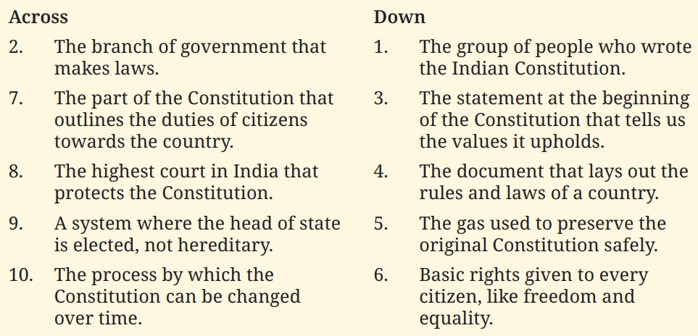
Answer:
Across
2. Legislature
7. Fundamental Duties
8. Supreme Court
9. Republic
10. Amendment
Down
1. Constituent Assembly
3. Preamble
4. Constitution
5. Helium
6. Fundamental Rights
Class 7 Social Science: Exploring Society Part 1 Chapter 10 NCERT Solutions
The chapter The Constitution of India — An Introduction explores the Constitution as the foundation of India’s system of governance. Students learn about the Constituent Assembly, the Preamble, and the ideals of justice, liberty, equality, and fraternity that shape democratic life.
Students also learn about fundamental rights, duties, and the rules that guide public institutions. The chapter explains how the Constitution helps protect people’s freedoms, promote equality, and provide a common framework for a diverse country.