

NCERT Solutions for Class 7 Social Science Part 1 Chapter 9 From the Rulers to the Ruled: Types of Governments are provided here with simple and easy-to-understand answers. These NCERT Solutions for Class 7 are based on the new NCERT Social Science textbook Exploring Society: India and Beyond Part 1. In this chapter, students learn about different forms of government, the distribution of power, and the role of people in governance. The chapter also explains how these ideas help students understand India’s society and the world around them.
From the Rulers to the Ruled: Types of Governments Questions and Answers Class 7 Social Science Chapter 9
The Big Question (Page 185)
1: What are the different types of government?
Answer: There are several types of government in the world. They are:
Democracy – In this form of government, people elect their representatives through elections. The government is chosen by the people and works for the people.
Example: India, USA.
Monarchy – In this form, the ruler is a king or queen. The position of ruler is usually inherited by birth.
Example: Saudi Arabia (Absolute Monarchy), United Kingdom (Constitutional Monarchy).
Theocracy – In this form of government, religious leaders rule the country according to religious laws.
Example: Iran, Vatican City.
Dictatorship – In this government, power is held by one person or a small group. People have no role in decision-making.
Example: North Korea
Oligarchy – In this form, a small group of powerful or wealthy people control the government.
Example: Ancient Greece (some city-states).
2: Where do governments get their power from?
Answer: Governments get their power from different sources, depending on the type of government.
- In a democracy, power comes from the people who elect the leaders.
- In a theocracy, power comes from religious beliefs and leaders.
- In a monarchy, power comes from the royal family.
- In a dictatorship, the power is taken and held by force or military control.
3: How does a country’s government interact with the people?
Answer: A country’s government interacts with the people in many ways. It:
- Makes laws to maintain peace and order in society.
- Implements rules and policies for the welfare of the people.
- Provides services such as education, healthcare, transport, and safety.
- Collects taxes from the people to use for public development.
- Holds elections so that citizens can choose their representatives.
- Listens to people’s needs and problems through representatives, media, and public discussions.
4: Why does democracy matter?
Answer: Democracy matters because it gives people the power to choose their leaders and take part in decision-making. It ensures equality among all citizens and gives everyone the right to express their opinions freely. In a democracy, the government is accountable to the people and works for their welfare. It also protects the rights of citizens and allows peaceful leadership change through elections. Therefore, democracy is important for justice, equality, and the overall well-being of the people.
Think About It (Page 199)
Q. What might happen if the king considered himself to have divine powers? How would he rule over the people?
Answer: If a king believed he had divine powers, he might think he was chosen by God and therefore could do anything he wanted. Such a belief could make the king proud and selfish. He might rule unfairly and ignore the needs of the people. He could make laws that only benefit himself. The people would have no freedom to disagree or express their opinions. His rule could become harsh, unjust, and oppressive.
Let’s Explore (Page 205)
Question: Can a democracy turn into an oligarchy? What can people do to keep democracy strong?
Answer: Yes, a democracy can turn into an oligarchy if a small group of rich or powerful people start controlling the government and making all the decisions. This can happen when citizens stop taking part in elections or when corruption increases.
People can do the following things to keep democracy strong
- Stay aware of what the government is doing
- Vote regularly and thoughtfully
- Speak up if they see something wrong
- Make sure power does not go only to a few
- Support fair laws and equal rights for everyone
Questions and activities (Page 207)
1. Write the names of the various types of government that you have learned in the chapter.
Answer: The various types of government mentioned in the chapter are:
- Democracy
- Monarchy
- Theocracy
- Dictatorship
- Oligarchy
2. Which type of Government does India have? And why is that called that type?
Answer: India has a Democratic government, specifically a Parliamentary Democracy. It is called this because:
- People elect their representatives through elections.
- The Prime Minister and Council of Ministers are part of the Parliament (legislature).
- The government is accountable to the people.
3. You read that an independent judiciary is present in all types of democracies. State any three reasons why you think it is important for the judiciary to be independent.
Answer: An independent judiciary is important because:
- It protects people’s fundamental rights
- It ensures that laws are followed by everyone
- It keeps the executive and legislature in check
4. Do you think democratic government is better than other forms of government? Why?
Answer: Yes, a democratic government is better than other forms of government because
- In a democracy, people elect their representatives.
- People are free to express themselves, follow their beliefs, and make choices.
- If the government does not work well, people can change it through elections.
OR
Yes, a democratic government is better than other forms of government because it gives power to the people. In a democracy, citizens can choose their leaders and take part in decision-making. It ensures equality, freedom, and justice for everyone. The government is answerable to the people and works for their welfare. Unlike monarchy or dictatorship, democracy allows people to express their opinions freely and change their government through elections if it does not perform well.
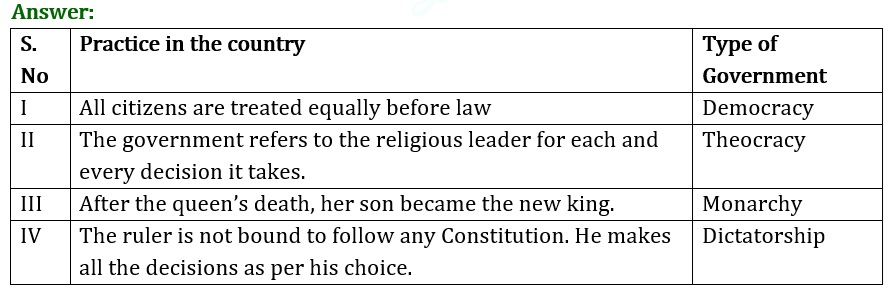
5. These are some practices in a few different countries. Can you match the practice with the type of government?
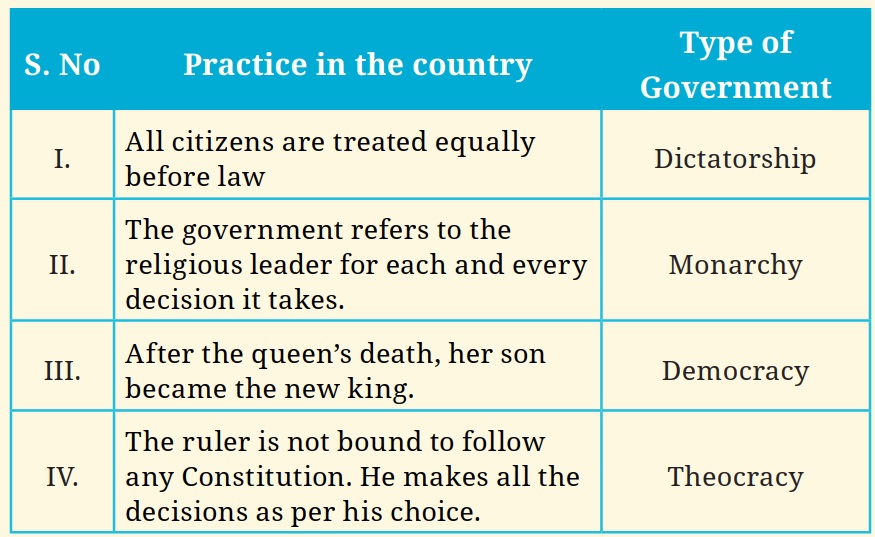
Answer:
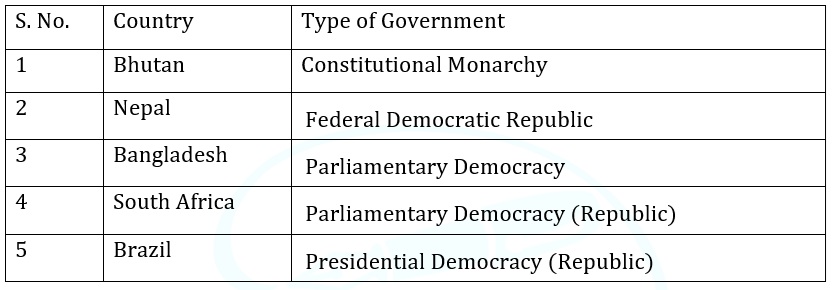
6. Below is a list of countries. Find out the types of government these countries have:
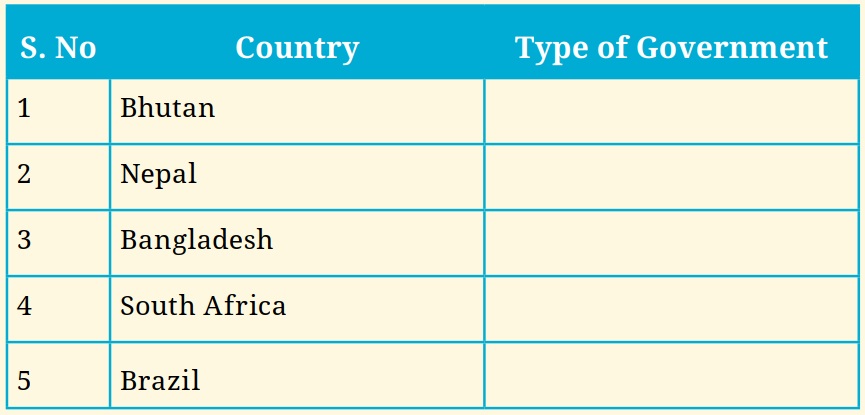
Answer:
7. What are the possible hurdles in a democracy in achieving its values and ideals? How can they be overcome?
Answer: Some possible hurdles in a democracy are corruption, unequal distribution of wealth, lack of education, misuse of power, and influence of a few powerful people over the government. These problems stop democracy from achieving equality, justice, and freedom for all.
To overcome these hurdles, citizens must stay aware and active, vote honestly, and question unfair actions by the government. The media should report truthfully, and the judiciary must remain independent. Good education and strong laws can also help build a fair and responsible democratic society.
8. Democracy is different from monarchy and dictatorship. Explain.
Answer: Democracy is a form of government where the people have the power to elect their representatives and take part in decision-making. The government is accountable to the people and works for their welfare. In a monarchy, the ruler is a king or queen, and power is usually inherited by birth. People do not choose their ruler. In a dictatorship, all power lies with one person or a small group, and citizens have no freedom to express their opinions or change the government. Thus, democracy is different because it gives importance to people’s participation, equality, freedom, and justice, while monarchy and dictatorship do not.
Class 7 Social Science: Exploring Society Part 1 Chapter 9 NCERT Solutions
These Social Science Chapter 9 help students understand important concepts, complete textbook exercises, and prepare for school examinations.
The chapter From the Rulers to the Ruled: Types of Governments introduces the main features of different systems of government. Students learn about monarchy, democracy, and other forms of rule, including how leaders gain power and how decisions are made.
Students also learn about participation, accountability, and the relationship between governments and the people they govern. The chapter helps them compare political systems and understand why citizens’ voices, rights, and responsibilities are important in a democracy.