

NCERT Solutions for Class 7 Social Science Part 1 Chapter 4 New Beginnings: Cities and States are provided here with simple and easy-to-understand answers. These NCERT Solutions for Class 7 are based on the new NCERT Social Science textbook Exploring Society: India and Beyond Part 1. In this chapter, students learn about the growth of early cities, the emergence of janapadas and mahajanapadas, and changes in ancient Indian society. The chapter also explains how these ideas help students understand India’s society and the world around them.
New Beginnings: Cities and States Questions and Answers Class 7 Social Science Chapter 4
The Big Questions (Page 68)
1: What is meant by ‘Second Urbanisation of India’?
Answer: Second urbanisation of India refers to the rise of new cities about 1000 years after the decline of the Harappan Civilization. These new cities developed mainly in the Ganga plains, the Indus basin, and nearby regions during the 1st millennium BCE. It showed a change from rural village life to urban life, with the growth of trade, use of iron tools, and coins. During this period, janapadas and mahajanapadas (small and large states) emerged, marking the beginning of early kingdoms and governance in India.
2: Why were the janapadas and mahajanapadas an important development in India’s early history?
Answer: The rise of janapadas and mahājanapadas was an important step in India’s early history. They improved farming with better tools and methods, which increased food production. Trade also expanded as people began to exchange goods over larger areas. These states developed stronger political systems that brought order and stability. Together, these changes led to economic growth and the rise of new towns and cities.
3: What kind of system of governance did they evolve?
Answer: The mahajanapadas followed two main systems of governance. In most of them, the king ruled with the help of assemblies like the sabha and samiti, where elders discussed important matters and advised him. However, in some states such as Vajji and Malla, there was a more democratic system of rule. In these places decisions were made by an assembly of people instead of a single ruler. The members of the assembly made decisions through discussion and voting, and even chose their ruler. This became one of the earliest examples of a republic or democratic form of government in the world.
Let’s Explore (Page 70)
Question 1. The most powerful of these new states were Maga- dha, Kosala, Vatsa and Avanti. Looking at the map, can you identify their capitals? Also, how many can you match with Indian cities of today? (page 70)
Answer:
- The capital of Magadha was first at Rajagriha (present-day Rajgir) and later shifted to Pataliputra (modern Patna, Bihar).
- The capital of Kosala was Shravasti which is near today’s Bahraich district in Uttar Pradesh and still known by the same name.
- The capital of Vatsa was Kaushambi located close to present-day Prayagraj in Uttar Pradesh.
- The capital of Avanti was Ujjayini which is now Ujjain in Madhya Pradesh, a city still famous for its religious importance.
Question: Compare this map (see Fig. 4.3 in the chapter) with the map of the regions mentioned in the Mahabharata (see Fig. 5.4 in the chapter ’India, That Is Bharat’ in Grade 6) and list the names common to both maps. What do you think this implies? (page 70)
Answer: Some names common to both maps are Magadha, Kosala, Kuru, Panchala, Gandhara, and Avanti. This shows that many regions mentioned in the Mahabharata were not just legendary but were also real historical places. Later, these regions became powerful janapadas and mahājanapadas. It also shows a strong connection between the epic stories and the real political geography of ancient India.
Let’s Explore (Page 74)
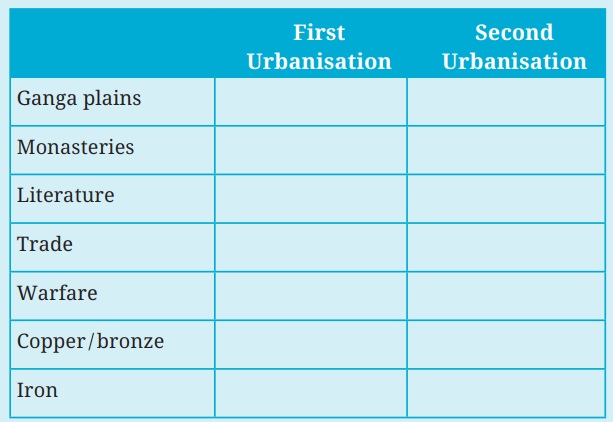
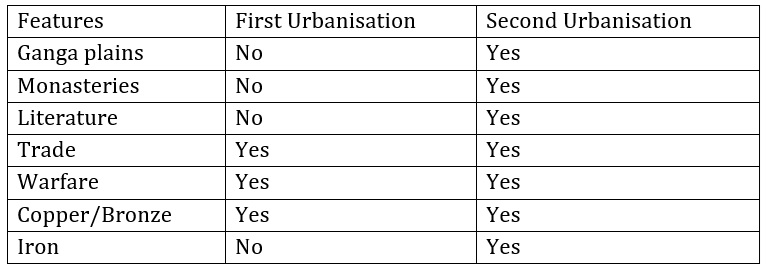
Question: Fill up the following table with a Yes (or tick mark) or No (or cross mark) in each square, which provides an interesting comparison between these two phases of Indian civilisation.
Answer:
Let’s Explore (Page 76)
Question: Why should a complex society divide itself into such groups? Think about several possible factors why this happens. (page 76)
Answer: A complex society divides itself into groups to maintain order and meet the different needs of the community. As people began living in larger settlements, various tasks had to be managed by different groups, such as farmers, traders, craftsmen, rulers, and priests. This division helped to organize resources, share responsibilities, and allowed people to specialize in their work. Over time, these divisions also led to the formation of social classes and professions in society.
Question: List other such professions you expect in a complex society of the 1st millennium BCE. (page 76)
Answer: In a complex society of the 1st millennium BCE, there would be many different professions. Some of them include soldiers, builders, weavers, potters, metal workers, merchants, scribes or teachers, priests, farmers, carpenters, artists, and musicians. Each profession played important role in keeping the society active, organised, and prosperous.
Think About It (page 78)
Question: Inequalities within society can exist in many forms. Have you encountered any incident where you or anyone you know might have been made to feel different from others? Do you think equality is desirable in a society? If so, why? Have you come across people or initiatives that lessened inequalities? (page 78)
Answer: Yes, I have seen situations where some people were treated differently because of their family background or financial status. It made them feel left out or less important. I believe equality is very important in a society because everyone deserves respect and fair opportunities, no matter who they are.
When people are treated equally, there is peace, friendship, and cooperation among them. I have also seen some school programs and community drives where people help the poor, teach underprivileged children, or raise awareness about equal rights. Such efforts help to reduce inequality and make society more kind and balanced.
Questions and Activities (Page 81)
1: Consider the quotation at the start of the chapter and discuss in several groups. Compare your observations and conclusions on what Kauṭilya recommends for a kingdom. Is it very different today?
Answer: Kauṭilya, in the Arthasastra, says that a kingdom should be strong, well-planned, and self-sufficient. He also emphasized that the land should be able to support not just the population but also outsiders in times of crisis, like famine or war. He recommends that the capital and border towns should be well protected with forts, good roads and waterways. Kautilya highlighted the importance of natural resources, such as fertile land, forests, pastures, mines, and water. These ideas are not very different from today. Modern governments also focus on security, good infrastructure, trade, agriculture, and self-reliance.
2: According to the text, how were rulers chosen in early Vedic society?
Answer: In early Vedic society, rulers were chosen by the assemblies called the sabha and samiti. These groups of elders and important people discussed and decided who would become the raja (king). The ruler used to take advice from these assemblies and not rule alone. The position of the king was usually hereditary. But if the king was found to be incompetent the assembly could remove him from power. Thus, early Vedic rulers were chosen through a combination of hereditary succession and democratic consultation with the elders of the tribe.
3: Imagine you are a historian studying ancient India. What types of sources (archaeological, literary, etc.) would you use to learn more about the mahajanapadas? Explain how each source might contribute to your understanding.
Answer: As a historian studying ancient India, I would rely on several types of sources to gather information about the mahajanapadas:
- Archaeological Sources: These include excavations, artifacts, inscriptions, and coins found from ancient sites. These sources give us physical evidence about daily life, trade, art, and the architecture of ancient cities.
- Literary Sources: These include Vedic texts, Buddhist and Jain literature, and other ancient writings. They give information about the names of kingdoms, their rulers, customs, and political systems.
- Numismatic Sources (Coins): The study of coins, particularly punch-marked coins tells us about the rulers, economic activities, trade and how states interacted with each other.
- Epigraphic Sources (Inscriptions): Inscriptions on stones or pillars can provide information about the rulers, laws, donations and events that took place in the Mahajanapadas.
4: Why was the development of iron metallurgy so important for the growth of urbanism in the 1st millennium BCE?
Answer: The development of iron metallurgy was very important for the growth of urbanism in the 1st millennium BCE. The use of iron tools, such as plows, made farming more efficient. This increased food production and supported larger populations.
Iron weapons like swords, spears, and arrows were stronger and sharper than bronze ones. This helped kingdoms defend their territories and expand their power. Iron tools were also used to build cities, roads, and fortifications, that helped to make better infrastructure.
As farming and warfare improved, trade increased, and iron itself became a valuable trade good. All these changes led to the growth of towns and cities, marking India’s Second Urbanisation.
Class 7 Social Science: Exploring Society Part 1 Chapter 4 NCERT Solutions
The chapter New Beginnings: Cities and States explores how settlements developed into larger towns and cities in ancient India. Students learn about changes in agriculture, the use of iron, expanding trade, and the emergence of janapadas and mahajanapadas. It explains how these developments supported new forms of political organisation.
Students also learn about different systems of rule and the factors that helped powerful states grow. The chapter connects economic changes with urban life and political developments, helping students understand an important stage in the formation of early Indian states.