

NCERT Solutions for Class 7 Social Science Part 1 Chapter 2 Understanding the Weather are provided here with simple and easy-to-understand answers. These NCERT Solutions for Class 7 are based on the new NCERT Social Science textbook Exploring Society: India and Beyond Part 1. In this chapter, students learn about the elements of weather, including temperature, rainfall, air pressure, wind, and humidity. The chapter also explains how these ideas help students understand India’s society and the world around them.
Understanding the Weather Questions and Answers Class 7 Social Science Chapter 2
The Big Questions (Page 27)
1. How can we measure and monitor the weather around us?
Answer: We can measure and monitor the weather using special instruments:
- Thermometer: Measures temperature.
- Rain Gauge: Measures the amount of rainfall.
- Barometer: Measures atmospheric pressure.
- Hygrometer: Measures humidity.
- Anemometer: Measures wind speed.
- Wind Vane: Shows wind direction.
All these instruments are kept at weather stations, where scientists called meteorologists record and study the data to predict and monitor the weather.
2. How do weather predictions help us prepare for events like heavy rain, storms, drought and heat waves?
Answer: Weather predictions by meteorologists give early warnings about extreme weather so people can stay safe. For example:
- If a cyclone is coming, fishermen can avoid the sea and people can move to safe areas.
- Before heavy rain, authorities can warn about floods and prepare rescue teams.
- During heat waves or droughts, people and farmers can plan water use and take precautions.
- Weather forecasts also help in air travel and transport by warning about strong winds or storms.
Don’t Miss Out (Page 32)
Question: Can you think of a reason why rain arises from the sun?
Answer: Rain arises from the sun because the heat of the sun makes water from rivers, lakes, and oceans evaporate and turn into water vapour. This vapour rises, cools, and forms clouds. When the clouds become heavy, the water falls back to the Earth as rain.
LET’S EXPLORE (Page 32)
Question: Here’s a chart of the temperatures of a city in Madhya Pradesh. What is the maximum temperature recorded in the week shown here? What is the minimum? Calculate the range.
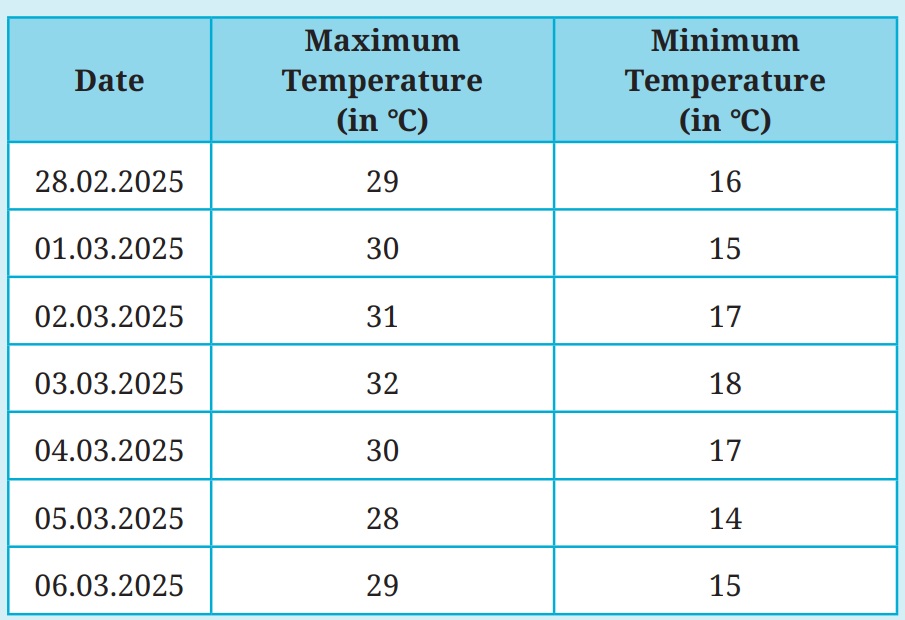
Answer: Maximum temperature: 32°C
Minimum temperature: 14°C
Range of Temperature = Maximum temperature – Minimum temperature
= 32°C – 14°C
= 18°C
THINK ABOUT IT (Page 35)
Why do you think it would be important to measure atmospheric pressure? Who are the people most likely to use such measurements?
Answer: It is important to measure atmospheric pressure because changes in pressure help to predict the weather. A sudden drop in pressure can mean a storm or cyclone is coming, while high pressure often indicates clear skies.
People who use these measurements include meteorologists, pilots, sailors, and mountaineers. It helps them make safe and smart decisions in their work.
LET’S EXPLORE (Page 37)
Question: Where do you think humidity is likely to be more, Kochi or Jaipur? You might guess that Kochi has higher humidity than Jaipur because it is located near the sea. But how will we know for sure? If we had to compare the humidity level between Kochi and Mangaluru, how would we do it? Discuss with your classmates
Answer: Humidity is likely to be higher in Kochi than in Jaipur because Kochi is near the sea and coastal places usually have more water vapour in the air. Jaipur is inland and drier. To make sure, we can use an instrument called a hygrometer to measure the humidity levels. If we had to compare Kochi and Mangaluru, we would still need to use a hygrometer. Both cities are located on the coast of the Arabian Sea, so they both have high humidity.
THINK ABOUT IT (Page 38)
Question: If the humidity in Delhi is at 52% while in Kochi it is 84%, in which of the two places are wet clothes likely to dry faster? And where are you likely to sweat more, assuming the temperature is the same in both places?
Answer: Wet clothes are likely to dry faster in Delhi because the humidity is lower at 52%, which means the air can absorb more moisture. In Kochi, where the humidity is 84%, the air is already full of moisture, so clothes will take longer to dry.
We will sweat more in Kochi because the air is already full of moisture (84%), so sweat does not evaporate easily and our body feels hotter and sticky, even if the temperature is the same as in Delhi.
Questions and activities (Page 42)
1. Match the instrument with the weather element it measures.
| Instrument used | Element of the Weather |
| (1) Hygrometer | (a) Precipitation |
| (2) Anemometer | (b) Atmospheric pressure |
| (3) Barometer | (c) Wind direction and speed |
| (4) Thermometer | (d) Humidity |
| (5) Rain gauge | (e) Temperature |
Answer:
| Instrument used | Element of the Weather |
| (1) Hygrometer | (d) Humidity |
| (2) Anemometer | (c) Wind direction and speed |
| (3) Barometer | (b) Atmospheric pressure |
| (4) Thermometer | (e) Temperature |
| (5) Rain gauge | (a) Precipitation |
2. Jyotsna is deciding what clothes to pack for her school trip to Mumbai in June. She looks at the weather forecast, which predicts 29°C and 84% humidity. What would be your advice to her?
Answer: The weather forecast for Mumbai in June is 29°C with 84% humidity, so it will feel hot and uncomfortably sticky.
I would advise Jyotsna to pack light cotton clothes that keep her cool and comfortable in the hot and humid weather. Since June is the monsoon season in Mumbai, she should also carry a raincoat or umbrella and waterproof footwear to stay dry during sudden rains. It is also important to stay hydrated.
Question 3: Imagine that a small group of students is setting up a rain gauge.
Here are some options for the site.
1. The school vegetable garden.
2. The terrace of the school building.
3. Open ground with elevated platform.
4. Compound wall of school.
5. Verandah of the school laboratory.
Discuss in your group and finalise the site. Write down the reasons for your decision.
Answer: The students should choose option 3 – an open ground with an elevated platform for setting up the rain gauge.
Reasons:
- It is an open area, so rain can fall directly into the gauge without being blocked by trees, walls, or buildings.
- The elevated platform keeps the rain gauge stable and level, preventing it from toppling over in wind or getting flooded.
- It ensures that the measurements are accurate, as no extra water from nearby surfaces will enter the gauge.
- It is easy to observe and empty the rain gauge regularly.
Therefore, an open ground with an elevated platform is the best and most accurate place to measure rainfall.
Class 7 Social Science: Exploring Society Part 1 Chapter 2 NCERT Solutions
The chapter Understanding the Weather introduces weather as the condition of the atmosphere at a particular place and time. Students learn how different weather elements are observed and measured using instruments such as thermometers and rain gauges. It also explains the role of weather stations in recording changes in atmospheric conditions.
Students also learn why weather forecasts are useful for farming, travel, and everyday activities. The chapter helps them connect observations of clouds, wind, and rainfall with changing weather conditions and understand the importance of reliable weather information.