

NCERT Solutions for Class 7 Science Chapter 11 Light: Shadows and Reflections are provided here in simple and easy-to-understand language. These NCERT Solutions for Class 7 are based on the new NCERT Science textbook Curiosity. In this chapter, students learn about light, shadows, and reflections and how they are formed. The chapter explains how light travels in a straight line, how shadows are produced, and how mirrors reflect light. Students also learn about luminous and non-luminous objects, plane mirrors, and the working of simple devices such as pinhole cameras and periscopes.
Light: Shadows and Reflections NCERT Class 7 Science Chapter 11 Questions & Answers
Intext Questions
Question: What happens when an opaque object blocks the path of light? (Page no. 157)
Answer: When an opaque object blocks the path of light, the light cannot pass through it and a dark patch is formed on the surface behind the object where the light does not reach. This dark patch is called a shadow.
Question: When the opaque object was a shiny object like a polished steel plate, I got a shadow on the screen, but I also saw that there was a bright spot of light on the wall on the opposite side. Why was it so? (Page no. 159)
Answer: An opaque object with a polished surface, like a shiny plate, causes a bright spot due to the reflection of light.
Question: In a mirror, I can also see my face. Is that also due to the reflection of light? (Page no. 160)
Answer: Yes, we can see our face in a mirror due to the reflection of light.
Question: Can we see an image of an object only in a mirror or are there some other ways as well? (Page no. 162)
Answer: We can see an image of an object in ways other than a mirror. For example: a pinhole camera can form an image of an object on a screen without using a mirror. Other devices like lenses and water surfaces can also form images.
Let Us Enhance Our Learning (Exercise)
1. Which of the following are luminous objects?
Mars, Moon, Pole Star, Sun, Venus, Mirror
Answer: The luminous objects from the list are: Pole Star and Sun.
Mars, Moon, and Venus shine by reflecting sunlight, so they are non-luminous. A mirror only reflects light and does not produce its own light
2. Match the items in Column A with those in Column B.
| Column A | Column B |
| Pinhole camera | Blocks light completely |
| Opaque object | The dark region formed behind the object |
| Transparent object | Forms an inverted image |
| Shadow | Light passes almost completely through it |
Answer:
| Column A | Column B |
| Pinhole camera | Forms an inverted image |
| Opaque object | Blocks light completely |
| Transparent object | Light passes almost completely through it |
| Shadow | The dark region formed behind the object |
3. Sahil, Rekha, Patrick, and Qasima are trying to observe the candle flame through the pipe as shown in Fig. 11.16. Who can see the flame?
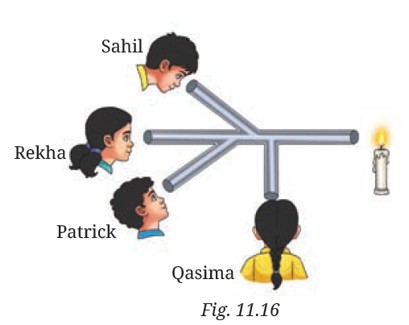
Answer: Rekha can see the candle flame because she is looking through a straight pipe, and light travels in a straight line. Sahil, Patrick, and Qasima cannot see the flame because their pipes are bent.
4. Look at the images shown in Fig. 11.17 and select the correct image showing the shadow formation of the boy.
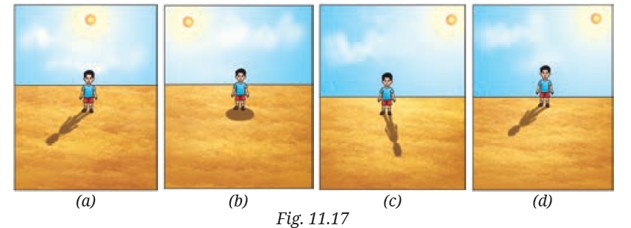
Answer: The correct image is (b). The shadow of the boy should be a dark silhouette with the same shape as the boy, formed on the screen behind him when light is blocked.
5. The shadow of a ball is formed on a wall by placing the ball in front of a fixed torch as shown in Fig. 11.18. In scenario (i) the ball is closer to the torch, while in scenario (ii) the ball is closer to the wall. Choose the most accurate representation of the shadows formed in both scenarios from the options provided (a and b).
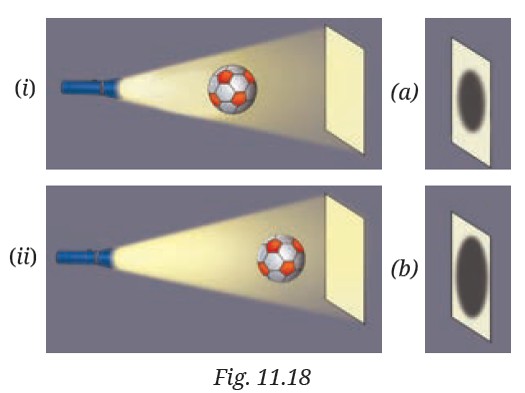
Answer: The correct option is (a).
Scenario (i): when the ball is closer to the torch, the shadow is larger than the ball.
Scenario (ii): When the ball is closer to the wall, the shadow should be smaller. But here the shadow is greater than the ball.
6. Based on Fig. 11.18, match the position of the torch in Column A with the characteristics of the ball’s shadow in Column B.
| Column A | Column B |
| If the torch is close to the ball | The shadow would be smaller |
| If the torch is far away | The shadow would be larger |
| If the ball is removed from the set-up | Two shadows would appear on the screen |
| If two torches are present in the set-up on the left side of the ball | A bright spot would appear on the screen |
Answer:
| Column A | Column B |
| If the torch is close to the ball | The shadow would be larger |
| If the torch is far away | The shadow would be smaller |
| If the ball is removed from the set-up | A bright spot would appear on the screen |
| If two torches are present in the set-up on the left side of the ball | Two shadows would appear on the screen |
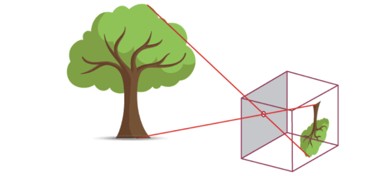
7.Suppose you view the tree shown in Fig. 11.19 through a pinhole camera. Sketch the outline of the image of the tree formed in the pinhole camera.
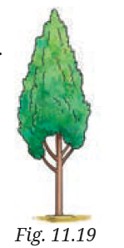
Answer: The image of the tree in a pinhole camera will be upside down (inverted). The outline will show the tree with its top pointing downward and the trunk pointing upward, maintaining the same shape and colours but flipped vertically.
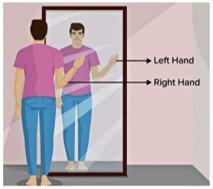
8. Write your name on a piece of paper and hold it in front of a plane mirror such that the paper is parallel to the mirror. Sketch the image. What difference do you notice? Explain the reason for the difference.
Answer: The image of your name in the mirror will appear reversed from left to right (laterally inverted). For example, if your name is “RAJ,” it will look like “JAR” in the mirror. This happens because a plane mirror causes lateral inversion, where the left side of the object appears as the right side in the image.
9. Measure the length of your shadow at 9 AM, 12 PM, and 4 PM with the help of your friend. Write down your observations:
(i) At which of the given times is your shadow the shortest?
(ii) Why do you think this happens?
Answer: (i) The shadow is the shortest at 12 PM.
(ii) This happens because, at 12 PM, the Sun is directly overhead, so the light rays are almost vertical, making the shadow shorter. At 9 AM and 4 PM, the Sun is lower in the sky, so the light rays are slanted, causing longer shadows.
10. On the basis of following statements, choose the correct option.
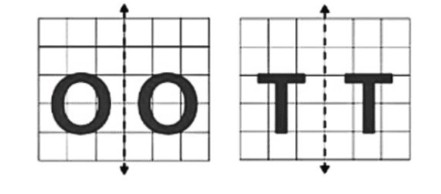
Statement A: Image formed by a plane mirror is laterally inverted.
Statement B: Images of alphabets T and O appear identical to themselves in a plane mirror.
(i) Both statements are true
(ii) Both statements are false
(iii) Statement A is true, but statement B is false
(iv) Statement A is false, but statement B is true
Answer: (i) Both statements are true.
Reason: Statement A: True – A plane mirror produces a laterally inverted image.
Statement B: True – Letters like T and O look the same even after lateral inversion
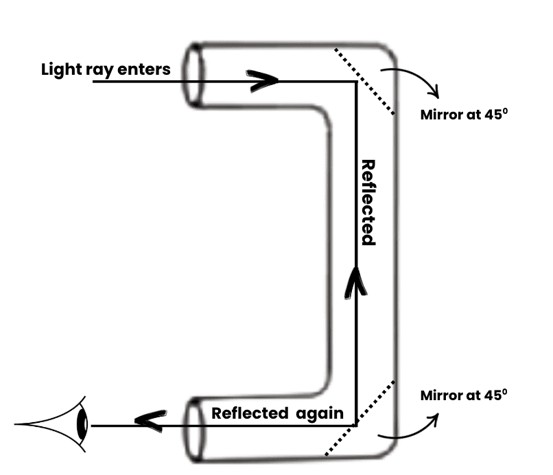
11. Suppose you are given a tube of the shape shown in the Fig. 11.20 and two plane mirrors smaller than the diameter of the tube. Can this tube be used to make a periscope? If yes, mark where you will fix the plane mirrors.
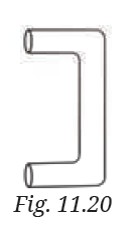
Answer: Yes, the tube can be used to make a periscope. Fix one plane mirror at the top opening of the tube, tilted at a 45° angle to reflect incoming light downward. Fix the second plane mirror at the bottom opening, also tilted at a 45° angle, to reflect the light toward the viewer’s eye.
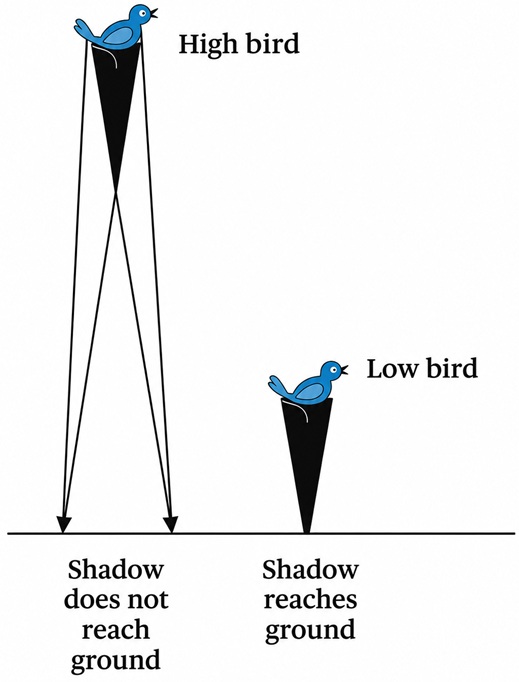
12. We do not see the shadow on the ground of a bird flying high in the sky. However, the shadow is seen on the ground when the bird swoops near the ground. Think and explain why it is so.
Answer: When a bird flies high in the sky, its shadow is spread over a large area and becomes faint, making it hard to see. When the bird swoops near the ground, it is closer to the surface, so the shadow is smaller, sharper and more visible because the light is blocked more effectively.
Class 7 Science Curiosity Chapter 11 NCERT Solutions
The chapter Light: Shadows and Reflections introduces students to the basic properties of light and its behaviour. It explains how light travels in straight lines and how shadows are formed when an opaque object blocks the path of light.
Students learn about the reflection of light from plane mirrors and the characteristics of images formed by them. The chapter also explains how pinhole cameras, periscopes, and kaleidoscopes work using the principles of light and reflection.