

NCERT Solutions for Class 7 Science Chapter 9 Life Processes in Animals are provided here in simple and easy-to-understand language. NCERT Solutions for Class 7 are based on the new NCERT Science textbook Curiosity. In this chapter, students learn about the different life processes that help animals survive and grow. The chapter explains how animals obtain and digest food, breathe, and release energy from food. Students also learn about the human digestive system, respiratory system, and the importance of nutrition and respiration in living organisms.
Life Processes in Animals NCERT Class 7 Science Chapter 9 Questions and Answers
Intext Question
Question: Cows keep chewing the food even when they are not actively grazing or eating anything. Why? (Page no. 127)
Answer: Cows keep chewing even when they are not actively grazing because they are ruminants. They first chew grass partially and swallow it into their stomach, where partial digestion occurs. Later, this partially digested food, called cud, is brought back to the mouth for thorough chewing in a process called rumination. This helps break the food down more completely, making digestion easier and more efficient.
Question: Is the process of respiration the same in all animals? (Page no. 128)
Answer: No, respiration varies among animals. Humans, birds, and other mammals breathe through lungs, while fish use gills. Frogs use gills during the tadpole stage and lungs and moist skin as adults. Earthworms respire through their moist skin.
Let Us Enhance Our Learning (Exercise)
1. Complete the journey of food through the alimentary canal by filling up the boxes with appropriate parts-
Food → Mouth → ______ → Stomach → ______ → ______ → Anus
Answer: Food → Mouth → Oesophagus (Food pipe) → Stomach → Small Intestine → Large Intestine → Anus
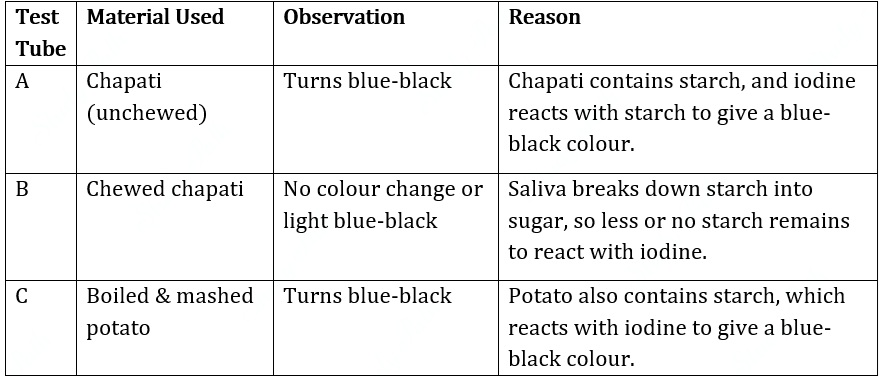
2. Sahil placed some pieces of chapati in test tube A. Neha placed chewed chapati in test tube B, and Santushti took boiled and mashed potato in test tube C. All of them added a few drops of iodine solution to their test tubes-A, B, and C, respectively. What would be their observations? Give reasons.
Answer: Observations and Reasons:
3. What is the role of the diaphragm in breathing?
(i) To filter the air
(ii) To produce sound
(iii) To help in inhalation and exhalation
(iv) To absorb oxygen
Answer: (iii) To help in inhalation and exhalation
Explanation: The diaphragm moves downward during inhalation, expanding the chest cavity, and moves upward during exhalation, pushing air out of the lungs.
4. Match the following.
| Name of the part | Functions |
| (i) Nostrils | (a) fresh air from outside enters |
| (ii) Nasal passages | (b) exchange of gases occurs |
| (iii) Windpipe | (c) protects lungs |
| (iv) Alveoli | (d) tiny hair and mucus help to trap dust and dirt from the air we breathe |
| (v) Ribcage | (e) air reaches our lungs through this part |
Answer:
| Name of the part | Functions |
| (i) Nostrils | (d) tiny hair and mucus help to trap dust and dirt from the air we breathe |
| (ii) Nasal passages | (a) fresh air from outside enters |
| (iii) Windpipe | (e) air reaches our lungs through this part |
| (iv) Alveoli | (b) exchange of gases occurs |
| (v) Ribcage | (c) protects lungs |
5. Anil claims to his friend Sanvi that respiration and breathing are the same process. What question(s) can Sanvi ask him to make him understand that he is not correct?
Answer: Sanvi can ask the following questions to Anil to make him understand that breathing and respiration are not the same process:
- Do plants breathe? How do they get oxygen?
- Does the carbon dioxide we exhale come from respiration or breathing?
- Does respiration happen even when we are not breathing?”
6. Which of the following statements is correct and why?
Anu: We inhale air.
Shanu: We inhale oxygen.
Tanu: We inhale air rich in oxygen.
Answer: Tanu’s statement is correct because the air we inhale is a mixture of gases about 21% oxygen, 78% nitrogen and small amounts of other gases. It is not pure oxygen but air rich in oxygen.
7. We often sneeze when we inhale a lot of dust-laden air. What can be possible explanations for this?
Answer: When we inhale a lot of dust-laden air, the dust particles get trapped in the hair of our nasal cavity. These particles irritate the lining of the cavity. Sneezing expels these dust particles from the inhaled air and preventing them from entering the lungs.
8. Paridhi and Anusha of Grade 7 started running for their morning workout. After they completed their running, they counted their breaths per minute. Anusha was breathing faster than Paridhi. Provide at least two possible explanations for why Anusha was breathing faster than Paridhi.
Answer: Here are two simple reasons why Anusha was breathing faster than Paridhi after their run:
- Anusha may have run faster or covered a longer distance than Paridhi, making her body need more oxygen and causing her to breathe faster.
- Anusha might not be as fit as Paridhi, so her body had to work harder during the run, making her breathe faster to get enough oxygen.
9. Yadu conducted an experiment to test his idea. He took two test tubes, A and B, and added a pinch of rice flour to the test tubes, half filled with water and stirred them properly. To test tube B, he added a few drops of saliva. He left the two test tubes for 35-45 min. After that, he added iodine solution into both the test tubes. Experimental results are as shown in Fig. 9.15. What do you think he wants to test?
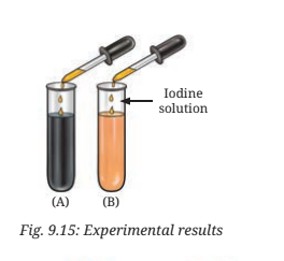
Answer: Yadu wanted to test whether saliva breaks down starch into sugar.
Explanation:
- Test Tube A (without saliva) turned blue-black after adding iodine, indicating the presence of starch.
- Test Tube B (with saliva) showed no colour change or a lighter colour, meaning the starch was broken down by the saliva.
This proves that saliva contains enzymes (like salivary amylase) that help digest starch into sugar.
10. Rakshita designed an experiment taking two clean test tubes, A and B and filled them with lime water as shown in the figure. In test tube A, the surrounding air that we inhale was passed on by sucking air from the pipe, and in test tube B, the exhaled air was blown through the pipe (Fig. 9.16). What do you think she is trying to investigate? How can she confirm her findings?
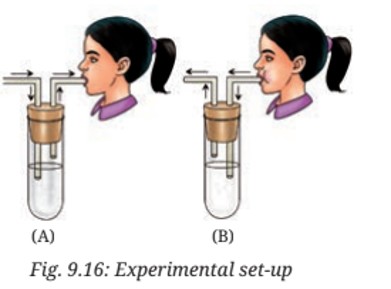
Answer: Rakshita is trying to investigate the gas we inhale and exhale while breathing. The lime water in test tube B turned milky (or cloudy), but the lime water in test tube A did not. Lime water turns milky when it reacts with carbon dioxide. Therefore, this indicates that the exhaled air contains more carbon dioxide than the air we inhaled.
OR
Rakshita is trying to investigate the gas we inhale and exhale while breathing. She can confirm her findings by inhaling and exhaling from tubes:
Test Tube A (Inhaled air): When the air we breathe in passes through lime water, there will likely be no colour change because the air we inhale has very little carbon dioxide.
Test Tube B (Exhaled air): When exhaled air passes through lime water, the lime water will turn milky due to the presence of higher carbon dioxide in the exhaled air. Carbon dioxide reacts with lime water to form calcium carbonate, which causes the milkiness.
Conclusion: By observing whether the lime water in test tube B turns milky, Rakshita can confirm that exhaled air contains more carbon dioxide than inhaled air.
Class 7 Science Curiosity Chapter 9 NCERT Solutions
The chapter Life Processes in Animals introduces students to the essential processes carried out by animals to stay alive. It explains how different organs of the digestive system work together to break down food, absorb nutrients, and remove undigested waste from the body.
Students learn about the process of respiration and how animals exchange gases with their surroundings. The chapter also explains the functions of different respiratory organs and how breathing and digestion help animals obtain the energy needed for various activities.