

NCERT Solutions for Class 7 Science Chapter 5 Changes Around Us: Physical and Chemical are provided here in simple and easy-to-understand language. These NCERT Solutions for Class 7 are based on the new NCERT Science textbook Curiosity. In this chapter, students learn about physical and chemical changes that occur in everyday life. The chapter explains the differences between physical and chemical changes with examples such as melting of ice, burning of paper, and rusting of iron. Students also learn about reversible and irreversible changes and their importance in nature.
Changes Around Us – Physical and Chemical NCERT Class 7 Science Chapter 5 Questions and Answers
Let Us Enhance Our Learning (Page 69)
1. Which of the following statements are the characteristics of a physical change?
(i) The state of the substance may or may not change.
(ii) A substance with different properties is formed.
(iii) No new substance is formed.
(iv) The substance undergoes a chemical reaction.
(a) (i) and (ii)
(b) (ii) and (iii)
(c) (i) and (iii)
(d) (iii) and (iv)
Answer: (c) (i) and (iii)
Explanation: In a physical change, only the physical properties of a substance change such as shape, size, state (solid, liquid, gas) or appearance. However, the chemical composition of the substance remains the same and no new substance is formed.
2. Predict which of the following changes can be reversed and which cannot be reversed. If you are not sure, you may write that down. Why are you not sure about these?
(i) Stitching cloth to a shirt
(ii) Twisting of straight string
(iii) Making idlis from a batter
(iv) Dissolving sugar in water
(v) Drawing water from a well
(vi) Ripening of fruits
(vii) Boiling water in an open pan
(viii) Rolling up a mat
(ix) Grinding wheat grains to flour
(x) Forming of soil from rocks
Answer:
(i) Stitching cloth to a shirt: Irreversible change.
Reason: Once cloth is cut and stitched into a shirt, we cannot bring it back to the original pieces of cloth in the same condition.
(ii) Twisting of straight string – Reversible change.
Reason: The straight string can be twisted and straightened again.
(iii) Making idlis from a batter: Irreversible change.
Reason: Once the batter is cooked, a new substance idli is formed due to a chemical change. We can’t turn the idli back into batter.
(iv) Dissolving sugar in water – Reversible change.
Reason: By evaporating the water, sugar can be recovered, so this is a physical change.
(v) Drawing water from a well – Reversible change.
Reason: Water drawn from a well can be poured back into it, so this action is reversible.
(vi) Ripening of fruits – Irreversible change.
Reason: Ripening is a natural and chemical change. Once ripe, a fruit cannot become unripe.
(vii) Boiling water in an open pan – Reversible change.
Reason: The evaporated water can be recovered by condensation.
(viii) Rolling up a mat – Reversible change.
Reason: The mat can be unrolled back to its original form.
(ix) Grinding wheat grains to flour – Irreversible change.
Reason: Once grains are ground into flour, they cannot be changed back into whole grains.
(x) Forming of soil from rocks – Irreversible change.
Reason: Rocks undergo physical and chemical changes due to weathering to form soil.
3. State whether the following statements are True or False. In case a statement is False, write the correct statement.
(i) Melting of wax is necessary for burning a candle.
(ii) Collecting water vapour by condensing involves a chemical change.
(iii) The process of converting leaves into compost is a chemical change.
(iv) Mixing baking soda with lemon juice is a chemical change.
Answer:
(i) True.
Reason: The wax of the candle melts, is carried up the wick, and evaporates due to the heat of the flame.
(ii) False.
Reason: Condensation of water vapour is a physical change, not a chemical change.
(iii) True.
Reason: The process of decomposing leaves into compost involves chemical reactions, which is irreversible.
(iv) True.
Reason: When baking soda is mixed with lemon juice, new substances such as carbon dioxide is produced. Thus, it is a chemical change.
4. Fill in the blanks in the following statements:
(i) Nalini observed that the handle of her cycle has got brown deposits. The brown deposits are due to ________, and this is a________ change.
(ii) Folding a handkerchief is a _________________ change and can be________.
(iii) A chemical process in which a substance reacts with oxygen with evolution of heat is called _________, and this is a __________ change.
(iv) Magnesium, when burnt in air, produces a substance called __________. The substance formed is _________ in nature. Burning of magnesium is a _________ change.
Answer:
(i) Nalini observed that the handle of her cycle has got brown deposits. The brown deposits are due to rust, and this is a chemical change.
(ii) Folding a handkerchief is a physical change and can be reversed.
(iii) A chemical process in which a substance reacts with oxygen with evolution of heat is called combustion, and this is a chemical change.
(iv) Magnesium, when burnt in air, produces a substance called magnesium oxide. The substance formed is basic in nature. Burning of magnesium is a chemical change.
5. Are the changes of water to ice and water to steam, physical or chemical? Explain.
Answer: The changes of water into ice and steam are physical changes. This is because only the state of the substance (water) changes during freezing and boiling, while its chemical composition remains the same. No new substance is formed in either process, and both changes are easily reversible.
6. Is curdling of milk a physical or chemical change? Justify your statement.
Answer: Curdling of milk is a chemical change because when milk curdles, a new substance curd is formed. In this process the taste, texture and protein structure of the milk changes. These changes cannot be reversed. Hence, curdling of milk is a chemical change.
7. Natural factors, such as wind, rain, etc., help in the formation of soil from rocks. Is this change physical or chemical and why?
Answer: The breaking down of rocks into smaller particles due to weathering by wind, rain, and temperature is a physical change. his breaking is a physical change because only the size and shape of the rocks change but no new substance is formed. At the same time, water, air, and other substances can react with the minerals in the rocks, leading to the chemical chemicals changes in the rock. For example, a black rock like basalt can turn red due to the formation of iron oxide. So, the formation of soil from rocks involves both physical and chemical changes.
8. Read the following story titled ‘Eco-friendly Prithvi’, and tick the most appropriate option(s) given in the brackets. Provide a suitable title of your choice for the story.
Prithvi is preparing a meal in the kitchen. He chops vegetables, peels potatoes, and cuts fruits (physical changes/chemical changes). He collects the seeds, fruits, and vegetable peels into a clay pot (physical change/chemical change). The fruits, vegetable peels, and other materials begin to decompose due to the action of bacteria and fungi, forming compost (physical change/chemical change). He decides to plant seeds in the compost and water them regularly. After a few days, he notices that the seeds begin to germinate and small plants start to grow, eventually blooming into colourful flowers (physical change/chemical change). His efforts are appreciated by all his family members.
Answer: Prithvi is preparing a meal in the kitchen. He chops vegetables, peels potatoes, and cuts fruits (physical changes). He collects the seeds, fruits, and vegetable peels into a clay pot (physical change). The fruits, vegetable peels, and other materials begin to decompose due to the action of bacteria and fungi, forming compost (chemical change). He decides to plant seeds in the compost and water them regularly. After a few days, he notices that the seeds begin to germinate and small plants start to grow, eventually blooming into colourful flowers (chemical change). His efforts are appreciated by all his family members.
A suitable title for the story would be, “Prithvi’s Green Kitchen.”
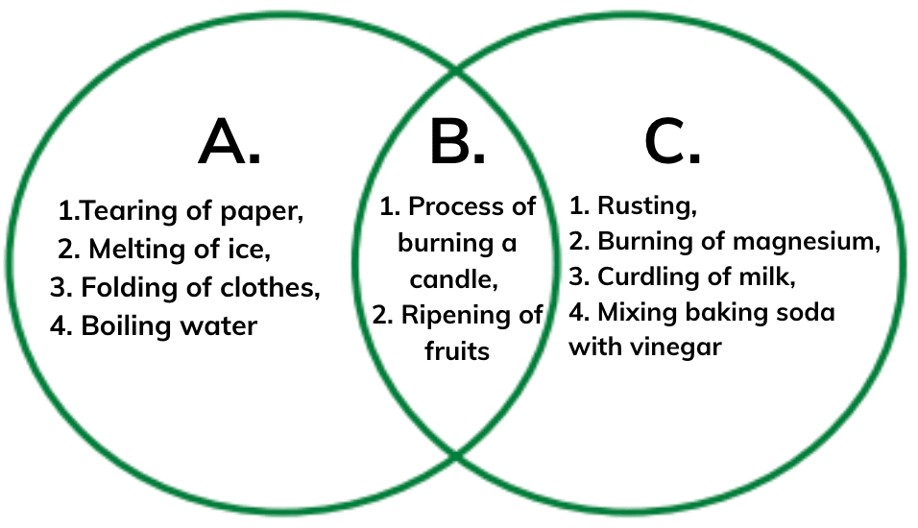
9. Some changes are given here. Write physical changes in the area marked ‘A’ and chemical changes in the area marked ‘B’. Enter the changes which are both physical and chemical in the area marked ‘C’.
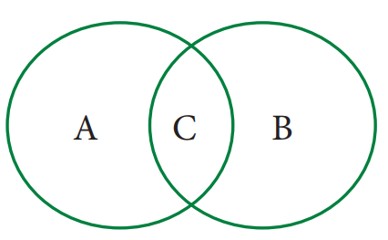
Process of burning a candle; Tearing of paper; Rusting; Curdling of milk; Ripening of fruits; Melting of ice; Folding of clothes; Burning of magnesium and Mixing baking soda with vinegar.
Answer:
10. The experiments shown in Fig. 5.11a, b, c, and d were performed. Find out in which case(s) did lime water turn milky and why?
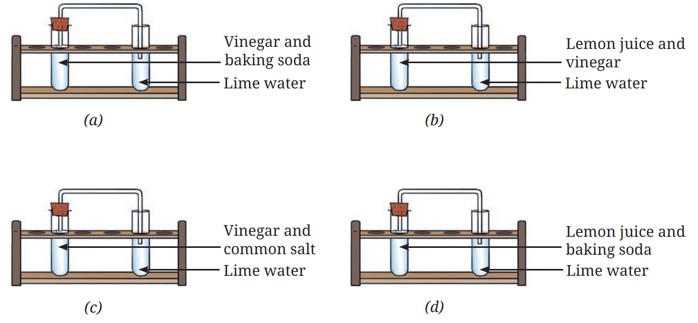
Answer: (a) and (d)
In (a) acidic vinegar and basic baking soda react to form carbon dioxide gas which turns lime water milky.
In (d) acidic lemon juice and basic baking soda react to form carbon dioxide gas which turns lime water milky as well.
In (b) lemon juice and vinegar are both acidic, hence they do not react to form CO2.
In (c) acidic vinegar will not react with common salt to produce CO2.
Class 7 Science Curiosity Chapter 5 NCERT Solutions
The chapter Changes Around Us: Physical and Chemical introduces students to different types of changes that take place in their surroundings. It explains how physical changes affect the shape, size, or state of a substance without forming a new substance, while chemical changes result in the formation of new substances.
Students learn about examples of physical and chemical changes, including melting, burning, rusting, and cooking. The chapter also explains reversible and irreversible changes, along with natural processes such as weathering and erosion.